The main difference between the .45-70 Government and the .44 Magnum is that the .45-70 is a massive, dedicated rifle cartridge designed to deliver devastating kinetic energy and deep penetration on the largest big game in North America, while the .44 Magnum is a premier handgun cartridge that performs exceptionally well in lightweight lever action carbines, offering higher magazine capacity and milder recoil for hunting medium game at closer ranges.
.45-70 vs .44 Magnum Comparison Table
To accurately compare these legendary brush gun cartridges, we must examine their physical dimensions and baseline ballistic performance. The data below represents standard premium factory loads designed for hunting. Because the .44 Magnum is frequently fired from both handguns and rifles, the ballistic data provided below for the .44 Magnum specifically reflects its performance from a 16 to 20 inch rifle barrel to ensure a fair “rifle to rifle” comparison against the .45-70.
| Specification | .45-70 Government | .44 Remington Magnum (Rifle Data) |
| Cartridge Type | Centerfire Rifle | Centerfire Handgun / Rifle |
| Parent Case | None (Original Design, 1873) | .44 Special (1955) |
| Bullet Diameter | .458 in (11.6 mm) | .429 in (10.9 mm) |
| Case Length | 2.105 in | 1.285 in |
| Overall Length | 2.550 in | 1.610 in |
| Typical Bullet Weights | 300 gr to 430 gr | 200 gr to 300 gr |
| Muzzle Velocity (Rifle bbl) | 2,050 fps (325gr LEVERevolution) | 1,760 fps (240gr JSP) |
| Muzzle Energy (Rifle bbl) | 3,032 foot pounds | 1,650 foot pounds |
| Maximum Pressure | 28,000 CUP (Trapdoor) / 40,000 CUP (Modern) | 36,000 psi (SAAMI) |
| Effective Range | 200 to 250 yds | 100 to 125 yds |
| Trajectory | Arced (Rainbow trajectory) | Highly Arced |
| Bullet Drop (200 yds) | Approx. 10.5 inches | Approx. 16.0 inches |
| Wind Drift | Moderate | High (Blunt bullet profile) |
| Recoil | Severe (Approx. 35 foot pounds) | Mild (Approx. 11 foot pounds) |
| Barrel Length Performance | Excels in 18 to 22 inch barrels | Maximizes velocity in 16 to 20 inch barrels |
| Suppressor Performance | Good (Subsonic loads available) | Good (Can shoot subsonic .44 Special) |
| Short Barrel Performance | Massive muzzle blast in Guide Guns | Excellent in handguns and carbines |
| Accuracy | High | High |
| Penetration | Extreme (Can shoot through a bison) | Deep (Excellent on deer and hogs) |
| Expansion | Devastating | Excellent |
| Hunting Performance | Elite (Grizzly, Moose, Elk, Bison) | Excellent (Deer, Hogs, Black Bear) |
| Home Defense | Not Recommended (Extreme over penetration) | Good (In a carbine platform) |
| Tactical Use | Historical Military Standard (1873) | None |
| AR-15 Compatibility | No | No |
| Magazine Compatibility | Tubular Magazines (Requires flat nose) | Tubular Magazines (Requires flat nose) |
| Ammunition Cost | Very High | Moderate |
| Ammo Availability | Good | Excellent |
| Best Uses | Dangerous game defense, heavy timber hunting | Brush hunting, companion pistol/carbine setups |
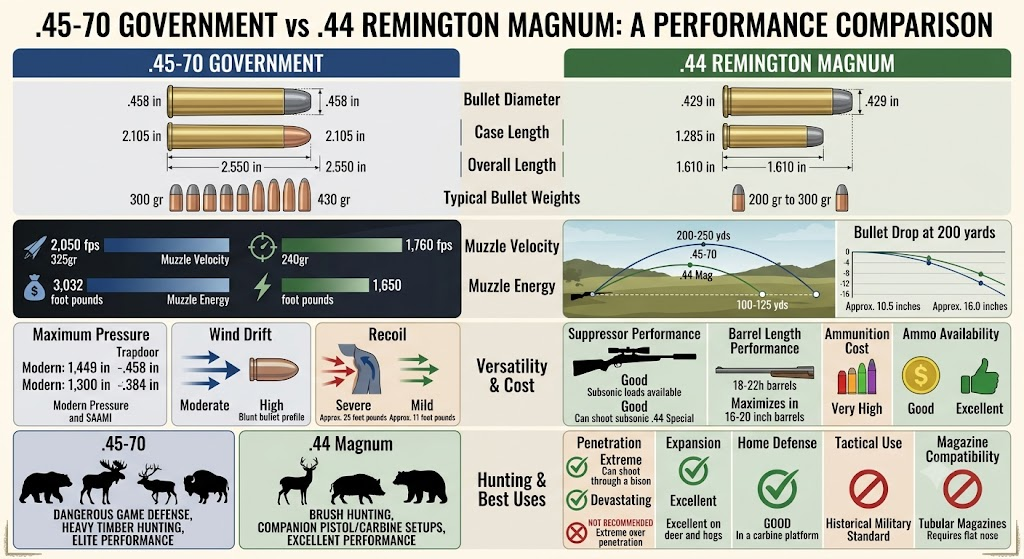
Understanding the Numbers
The technical differences between these cartridges span over 80 years of firearms development. The .45-70 Government was adopted by the United States military in 1873. Originally loaded with 70 grains of black powder pushing a massive 405 grain lead bullet, it requires a large, elongated case. Today, SAAMI limits standard .45-70 ammunition to 28,000 CUP to protect antique “Trapdoor” Springfield rifles. However, ammunition manufacturers like Hornady and Buffalo Bore produce high pressure loads specifically tailored for strong modern lever action rifles (like the Marlin 1895), pushing the ballistic capabilities of the .45-70 to extraordinary levels.
The .44 Remington Magnum was introduced in 1955. It is essentially a lengthened .44 Special case designed to hold more smokeless powder and operate at a robust 36,000 psi. While it was engineered specifically for large frame revolvers, hunters quickly realized that chambering lightweight lever action carbines in .44 Magnum created the ultimate close range brush gun.
Velocity Comparison
Velocity is the driving force behind a bullet’s trajectory and kinetic energy.
If we compare modern, polymer tipped hunting ammunition designed for tubular magazines (Hornady LEVERevolution) fired from 18 to 20 inch rifle barrels:
- .45-70 Government (Hornady 325gr): 2,050 fps
- .44 Magnum (Hornady 225gr): 1,870 fps
- .44 Magnum (Standard 240gr Soft Point): 1,760 fps
Despite pushing a significantly heavier bullet, the massive powder capacity of the .45-70 allows it to easily outpace the .44 Magnum in raw velocity when fired from a rifle. If the .44 Magnum is fired from a standard 6 inch revolver, its velocity drops to roughly 1,350 fps.
Muzzle Energy Comparison
Muzzle energy dictates how much kinetic force the bullet strikes with upon impact.
Using the same modern rifle loads:
- .45-70 Government (325gr): 3,032 foot pounds
- .44 Magnum (225gr): 1,747 foot pounds
- .45-70 Government (Buffalo Bore 430gr Hard Cast): 3,537 foot pounds
The .45-70 Government completely eclipses the .44 Magnum in raw power. By generating over 3,000 foot pounds of energy, the .45-70 belongs in the same kinetic category as the .30-06 Springfield and .300 Winchester Magnum, albeit relying on massive weight rather than blazing speed. The .44 Magnum generates highly respectable energy for a short range carbine, but it simply cannot match a true dedicated rifle cartridge.
Trajectory Comparison
A flat trajectory makes hitting targets at unknown distances much easier.
Both of these cartridges suffer from steep, arced trajectories when compared to modern bottleneck rifle cartridges. Because they utilize flat nosed or round nosed bullets designed to sit safely end to end in tubular magazines, they shed velocity rapidly.
However, because the .45-70 starts at a higher velocity, it shoots noticeably flatter than the .44 Magnum. The .44 Magnum sheds its velocity incredibly fast, causing it to drop like a mortar past 100 yards.
Bullet Drop Comparison
Let us look at the mathematical bullet drop using Hornady LEVERevolution ammunition, assuming a 100 yard zero out of standard rifle barrels.
| Distance | .44 Magnum (225gr FTX) | .45-70 Government (325gr FTX) |
| 100 Yards | 0 inches | 0 inches |
| 150 Yards | -4.5 inches | -3.0 inches |
| 200 Yards | -16.0 inches | -10.5 inches |
| 250 Yards | -36.5 inches | -24.0 inches |
At 200 yards, the .44 Magnum drops significantly more than the .45-70. Trying to ethically harvest a deer at 200 yards with a .44 Magnum requires exact range estimation and significant holdover. The .45-70 provides a much larger margin of error.
Wind Drift Comparison
Wind deflection is mitigated by a bullet’s velocity and its aerodynamic profile.
Neither cartridge performs well in crosswinds. Their blunt noses and low Ballistic Coefficients mean that wind easily pushes them off course. However, because the .45-70 reaches the target faster, it spends less time exposed to the wind. At 150 yards, the .45-70 will drift noticeably less than the slower .44 Magnum.
Recoil Comparison
Recoil dictates a shooter’s ability to fire rapid and accurate follow up shots.
The .44 Magnum, when fired from a 7 pound lever action carbine, is incredibly pleasant to shoot. It generates roughly 11 foot pounds of free recoil. It is mild enough for teenagers and smaller framed shooters to practice with all day without fatigue.
The .45-70 Government, when fired from a similar 7 pound lever action (like a Marlin 1895 Guide Gun), is brutally punishing. Pushing a 325 grain bullet to 2,050 fps generates approximately 35 foot pounds of free recoil. It hits the shoulder with violent, bone jarring force. Many hunters develop a flinch when training with full power .45-70 loads.
Stopping Power Comparison
Stopping power on big game requires massive energy transfer and deep penetration.
The .44 Magnum delivers excellent stopping power on medium game like whitetail deer, feral hogs, and black bear inside 100 yards. The wide .429 inch bullet creates a devastating wound channel.
The .45-70 Government offers elite stopping power on the largest, most dangerous game on the planet. It is widely considered the ultimate defense cartridge against charging grizzly bears in Alaska. The massive kinetic energy and .458 inch diameter literally crush heavy bone and anchor massive predators with unmatched authority.
Penetration Comparison
Penetration is critical for ensuring the bullet reaches the vital organs of heavily armored animals.
If both cartridges are loaded with hard cast lead bullets (designed for maximum penetration without expansion), the .45-70 is the undisputed champion. A 430 grain .45-70 hard cast bullet possesses so much momentum that it will easily punch straight through both shoulders of a grizzly bear or bison and exit the other side.
A 300 grain hard cast .44 Magnum penetrates exceptionally well and is trusted by many backcountry hikers in a revolver, but it cannot match the sheer plowing force of a true big bore rifle bullet.
Expansion Comparison
To test expansion, the industry relies on calibrated ordinance gel.
Both cartridges expand reliably when loaded with soft point or jacketed hollow point ammunition. A .45-70 soft point starts at .458 inches and will often mushroom to over .75 inches in diameter, creating a wound channel you can practically fit your fist through. A .44 Magnum hollow point starts at .429 inches and will easily expand past .65 inches, providing massive tissue disruption on deer sized game.
Accuracy Comparison
Both cartridges are capable of elite mechanical accuracy at close ranges.
When fired from a high quality lever action rifle, both can produce groups under two inches at 100 yards. However, practical accuracy is dictated by the shooter’s ability to manage recoil. The mild recoil of the .44 Magnum lever action allows the average shooter to place their shots with much more precision under pressure compared to the bruising recoil of the .45-70.
Effective Range Comparison
The effective range of a brush gun is limited by bullet drop and retained energy.
The .44 Magnum, fired from a rifle, is a dedicated 100 yard to 125 yard hunting cartridge. Beyond that distance, it sheds energy rapidly and drops too steeply for ethical shots on game.
The .45-70 Government holds its energy and trajectory much better. In the hands of a skilled marksman who understands their bullet drop, the .45-70 is a highly ethical 200 yard to 250 yard elk and moose cartridge.
Suppressor Performance Comparison
Suppressing a lever action rifle is incredibly effective because the manually operated action keeps all the gases trapped inside the barrel, unlike an AR-15.
Both the .45-70 and the .44 Magnum serve as fantastic suppressor hosts. You can easily purchase heavy, subsonic .45-70 ammunition that sounds remarkably quiet through a large volume silencer. The .44 Magnum has a unique advantage because every .44 Magnum rifle can safely shoot .44 Special ammunition. Standard .44 Special is naturally subsonic, making it one of the quietest and most enjoyable suppressed combinations available today.
Short Barrel Performance Comparison
Many lever action rifles are offered in compact “Trapper” configurations with short barrels to maximize maneuverability in dense timber.
The .44 Magnum utilizes fast burning pistol powders. It achieves maximum powder burn very quickly, meaning you can chop the barrel down to 16 inches and lose almost zero velocity.
The .45-70 Government utilizes slower burning rifle powders. When you fire a full power .45-70 load out of an 18.5 inch Guide Gun barrel, a significant amount of unburnt powder erupts outside the muzzle, resulting in a blinding fireball and a deafening concussive blast.
16 inch Carbine vs Handgun Performance
This category specifically highlights the versatility of the .44 Magnum.
The .44 Magnum allows a hunter to carry a revolver on their hip and a carbine slung over their shoulder, utilizing the exact same box of ammunition for both firearms. When fired from a 16 inch carbine, the .44 Magnum gains roughly 300 to 400 feet per second over a 6 inch revolver. This massive velocity boost transforms it from a close range defensive handgun into a highly capable 100 yard deer rifle.
The .45-70 Government is strictly a rifle cartridge. While novelty revolvers (like the Magnum Research BFR) exist in .45-70, they are incredibly heavy, entirely impractical, and produce painful recoil.
Home Defense Comparison
Inside the home, you must balance stopping power against over penetration and auditory safety.
Neither of these cartridges is ideal for suburban home defense if you live in an apartment or a crowded neighborhood. Firing a .45-70 indoors will blow clean through an intruder, through multiple interior walls, and easily penetrate the exterior of a neighboring house.
A lever action .44 Magnum loaded with rapidly expanding hollow points is a viable home defense weapon for rural homeowners, offering high magazine capacity and devastating stopping power, but over penetration remains a serious concern compared to a standard 9mm pistol or a 5.56 NATO rifle.
Hunting Comparison
Both cartridges are absolute hammers in the hunting woods.
- Whitetail Deer: Both are exceptional brush guns for deer. The .44 Magnum is often preferred because it destroys less meat, recoils less, and allows for faster follow up shots.
- Feral Hogs: The .44 Magnum lever action is arguably the ultimate short range hog gun, allowing a hunter to quickly cycle the lever and drop multiple hogs in a sounder.
- Elk, Moose, and Grizzly: The .45-70 Government is vastly superior. The heavy bone structures of these massive animals demand the extreme kinetic energy and deep penetration that only a true big bore rifle cartridge can provide.
Tactical and Duty Use Comparison
The .45-70 Government was the primary duty cartridge of the U.S. Military during the Indian Wars of the late 19th century.
Today, neither cartridge has any application in modern law enforcement or military roles. They are fired from manually operated, slow to reload lever action rifles or heavy revolvers, making them tactically obsolete compared to modern intermediate semi automatic rifles.
AR-15 Compatibility
Neither cartridge is compatible with the standard AR-15 platform. The AR-15 can only accommodate cartridges with a maximum overall length of 2.260 inches, and both of these cartridges utilize rimmed cases that do not stack or feed reliably from standard box magazines.
Magazine Compatibility
Both cartridges are perfectly designed for tubular magazines located beneath the barrel of lever action rifles. Because they utilize flat nosed bullets, they stack safely end to end without the risk of a pointed bullet detonating the primer of the cartridge in front of it during recoil.
Because the .44 Magnum cartridge is significantly shorter (1.610 inches) than the .45-70 (2.550 inches), a lever action rifle chambered in .44 Magnum will hold significantly more ammunition in its tubular magazine. A standard 20 inch barrel lever action holds 10 rounds of .44 Magnum, but only 6 rounds of .45-70.
Ammo Cost Comparison
To become proficient with a rifle, you must practice frequently.
The .44 Magnum is moderately priced. Because it is a global standard for revolver shooters, ammunition is mass produced in large quantities. Furthermore, you can practice with cheaper .44 Special ammunition to save money.
The .45-70 Government is an expensive, boutique rifle cartridge. A box of 20 premium hunting rounds for the .45-70 typically costs double or triple the price of a comparable box of .44 Magnum ammunition.
Ammo Availability Comparison
Walk into any gun store in the world, and you will find .44 Magnum ammunition sitting on the shelf.
The .45-70 Government is also highly popular, but during times of national ammunition shortages, manufacturers prioritize pistol ammunition and military calibers. .45-70 is often produced in seasonal batches, leading to temporary shortages on local store shelves.
Reloading Comparison
Both cartridges are absolute favorites in the reloading community.
They are both straight walled cartridges, meaning they are incredibly easy and fast to reload. There are no microscopic shoulder angles to bump back like you find on bottleneck rifle cartridges.
The .44 Magnum is a handloader’s dream because it uses carbide sizing dies, eliminating the need to lubricate the brass cases before resizing. The .45-70 offers extreme versatility, allowing handloaders to craft mild, low recoil cast lead target loads, or absolute maximum pressure bear defense loads.
Pros and Cons
.45-70 Government
Pros
- Generates over 3,000 foot pounds of kinetic energy.
- Elite stopping power on the largest, most dangerous game.
- Highly ethical 200 yard to 250 yard effective range.
- Massive .458 caliber bullets create devastating wound channels.
- Deeply steeped in American history and tradition.
Cons
- Generates severe, bruising recoil in lightweight rifles.
- Ammunition is incredibly expensive.
- Lower magazine capacity due to the long cartridge case.
- Massive concussive muzzle blast in short barrel Guide Guns.
.44 Magnum
Pros
- Very mild recoil allows for fast, accurate follow up shots.
- Higher magazine capacity in lever action rifles.
- Ammunition is widely available and more affordable.
- Allows you to carry a companion revolver in the exact same caliber.
- Can safely fire quiet, low recoil .44 Special ammunition.
Cons
- Lacks the kinetic energy required for large game like moose or grizzly.
- Steep trajectory limits the ethical hunting range to 100 or 125 yards.
- Poor wind deflection at extended distances.
Final Verdict
Choosing between the .45-70 Government and the .44 Magnum comes down to balancing raw stopping power against practicality and recoil management.
- For Elk, Moose, and Bear Defense: Choose the .45-70 Government. There is no substitute for displacement. The massive .45-70 delivers the bone crushing kinetic energy and deep penetration required to stop a charging apex predator instantly.
- For Whitetail Deer and Feral Hogs: Choose the .44 Magnum. A lever action .44 Magnum is lighter, recoils significantly less, holds more ammunition, and is completely devastating on medium game inside 100 yards.
- For Budget Conscious Shooters: Choose the .44 Magnum. You will save massive amounts of money on factory ammunition, allowing you to train much more frequently.
- For Companion Carry Setups: Choose the .44 Magnum. The logistical advantage of carrying a lever action carbine and a revolver on your hip that both feed from the exact same box of ammunition is unparalleled in the backcountry.
- For Recoil Sensitive Shooters: Choose the .44 Magnum. The severe recoil of a lightweight .45-70 lever action is genuinely painful for many shooters, whereas the .44 Magnum carbine is an absolute joy to shoot all day long.
FAQ
Is the .45-70 more powerful than the .44 Magnum?
Yes, significantly. When fired from a rifle, the .45-70 Government generates over 3,000 foot pounds of kinetic energy, whereas the .44 Magnum generates roughly 1,600 foot pounds. The .45-70 is nearly twice as powerful.
Can I shoot a bear with a .44 Magnum?
Yes, the .44 Magnum is highly effective on black bears at close range, especially when using heavy hard cast bullets. However, if you are hunting or defending against massive coastal brown bears or grizzlies, the .45-70 Government is universally recommended over the .44 Magnum.
Does a .45-70 kick hard?
Yes. Firing full power, modern hunting ammunition out of a lightweight lever action rifle generates a severe, heavy recoil impulse that is often compared to a 12 gauge shotgun firing 3 inch magnum slugs.
Can I use pointed bullets in a lever action rifle?
Generally, no. Both of these cartridges are fired from lever action rifles with tubular magazines located beneath the barrel. Loading traditional pointed bullets can cause a chain fire explosion in the magazine under recoil. You must use flat nose, round nose, or specialized polymer tipped bullets (like Hornady FTX).
Is the .44 Magnum a rifle or pistol bullet?
The .44 Magnum was originally designed in 1955 as a premier large frame revolver cartridge. However, because it performs so exceptionally well in 16 to 20 inch barrels, it has become one of the most popular lever action rifle cartridges in the world.
Why is the .45-70 called Government?
The U.S. Military adopted the cartridge in 1873 for the Springfield Trapdoor rifle. The original designation was .45-70-405, which stood for a .45 caliber bullet, pushed by 70 grains of black powder, weighing 405 grains. It was given the “Government” moniker because it was the official military issue cartridge.