The main difference between the .38 Special and the 9mm is that the 9mm operates at high pressure to deliver superior velocity, kinetic energy, and ammunition capacity in semi automatic pistols, while the .38 Special is a lower pressure rimmed cartridge designed for revolvers that offers extreme reliability, a mild recoil impulse, and the ability to fire heavy cast bullets without feeding issues. When choosing between these two legendary personal defense calibers, you must compare velocity, muzzle energy, trajectory, bullet drop, recoil, penetration, expansion, effective range, suppressor performance, short barrel performance, and ammunition cost. In this comprehensive guide, we analyze all of these metrics to help you confidently decide which cartridge belongs in your everyday carry setup.
.38 Special vs 9mm Comparison Table
To understand how these cartridges perform, we must look at their physical dimensions and baseline ballistic performance. The data below represents standard premium factory loads, comparing a standard pressure 130 grain .38 Special against a standard pressure 115 grain 9mm load.
| Specification | .38 Special | 9mm (9x19mm Parabellum) |
|---|---|---|
| Cartridge Type | Centerfire Revolver | Semi Automatic Handgun |
| Parent Case | .38 Long Colt (1898) | None (Original Design, 1901) |
| Bullet Diameter | .357 in (9.07 mm) | .355 in (9.01 mm) |
| Case Length | 1.155 in | 0.754 in |
| Overall Length | 1.550 in | 1.169 in |
| Typical Bullet Weights | 110 gr to 158 gr | 115 gr to 147 gr |
| Muzzle Velocity (4 inch bbl) | 800 fps (130gr Standard) | 1,150 fps (115gr Standard) |
| Muzzle Energy (4 inch bbl) | 185 foot pounds | 338 foot pounds |
| Maximum Pressure | 17,000 psi (20,000 psi Plus P) | 35,000 psi (SAAMI) |
| Effective Range | 25 to 50 yds (Handgun) | 50 yds (Handgun) |
| Trajectory | Arced (Rainbow trajectory) | Flat |
| Bullet Drop (50 yds) | Approx. 4.0 inches | Approx. 2.0 inches |
| Wind Drift | High (Slow moving bullet) | Moderate |
| Recoil | Very Mild (Rolling push) | Mild (Slightly snappier) |
| Barrel Length Performance | Excels in 4 to 6 inch barrels | Excels in 3 to 5 inch barrels |
| Suppressor Performance | Poor (Revolver cylinder gap) | Elite (When using 147gr subsonic loads) |
| Short Barrel Performance | Massive velocity loss in snub noses | Excellent powder burn in micro pistols |
| 16 inch vs 10.5 inch (Carbine) | Excellent velocity gains in lever actions | Good velocity gains in carbines |
| Accuracy | Extremely High | High |
| Penetration | Moderate (Relies on mass) | Deep (Speed and bullet design) |
| Expansion | Marginal (Due to low velocity) | Devastating (Violent expansion) |
| Hunting Performance | Marginal (Small game only) | Marginal (Small game only) |
| Home Defense | Good (Simple manual of arms) | Elite (High capacity, proven stopping power) |
| Tactical / Duty Use | Historical Police Standard | Global Military and Police Standard |
| Magazine Compatibility | None (Uses 5 or 6 round cylinders) | Fits all 9mm double stack magazines |
| Ammunition Cost | Moderate | Very Low |
| Ammo Availability | Good | Ubiquitous |
| Best Uses | Backup guns, woods carry, beginners | Concealed carry, home defense, duty use |
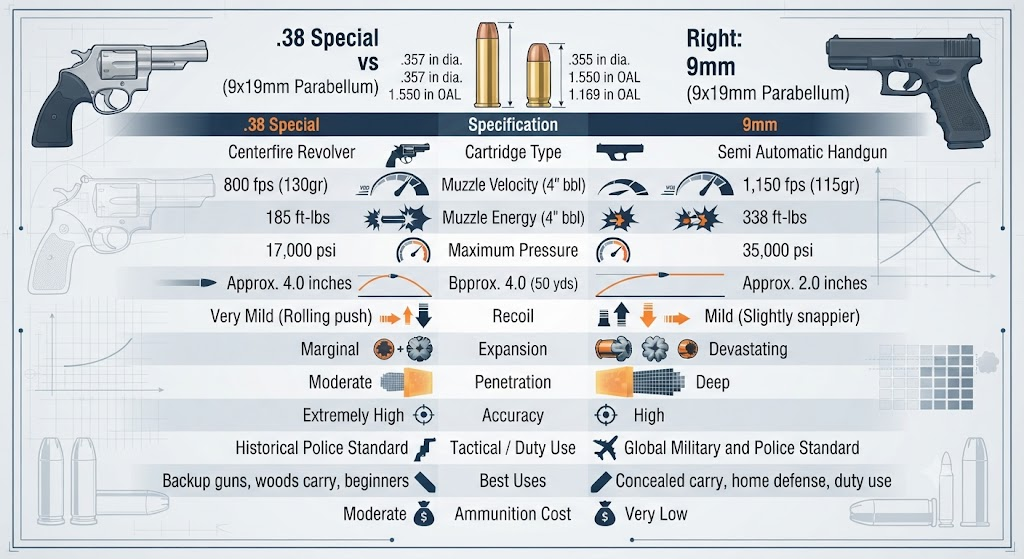
Velocity Comparison
Velocity is the primary mechanism the 9mm uses to achieve reliable hollow point expansion.
Muzzle Velocity Data (4 inch barrel):
- 9mm (Federal 115gr FMJ): 1,150 fps
- 9mm (Speer Gold Dot 124gr JHP): 1,150 fps
- .38 Special (Federal 130gr FMJ): 800 fps
- .38 Special (Speer Gold Dot 125gr Plus P JHP): 945 fps
The 9mm is a significantly faster cartridge. By operating at a robust 35,000 psi, the 9mm effortlessly pushes a 115 grain bullet past 1,100 feet per second. The .38 Special is handicapped by its late 19th century design. Because it was originally a black powder cartridge, SAAMI restricts standard pressure .38 Special to a mere 17,000 psi to protect antique revolvers. Even when utilizing modern Plus P overpressure ammunition, the .38 Special struggles to break 1,000 feet per second.
Winner: 9mm
Muzzle Energy Comparison
Muzzle energy dictates the kinetic force the bullet strikes with upon impact.
Muzzle Energy Data (4 inch barrel):
- 9mm (115gr Standard FMJ): 338 foot pounds
- 9mm (124gr Plus P JHP): 410 foot pounds
- .38 Special (130gr Standard FMJ): 185 foot pounds
- .38 Special (125gr Plus P JHP): 248 foot pounds
The mathematical formula for kinetic energy heavily favors velocity over mass. Because the 9mm is traveling roughly 350 feet per second faster than the .38 Special, it generates nearly double the kinetic energy of standard pressure .38 Special loads. Even the hottest .38 Special Plus P ammunition falls roughly 100 foot pounds short of standard 9mm defensive loads.
Winner: 9mm
Trajectory Comparison
A flat trajectory makes hitting targets at extended distances much easier.
Because the 9mm drives its bullets at high velocities, it shoots exceptionally flat for a handgun cartridge. You can aim directly at the center of a target at 50 yards and expect a perfect hit. The standard .38 Special travels at only 800 feet per second, meaning gravity begins pulling the bullet down almost immediately after it leaves the muzzle.
Winner: 9mm
Bullet Drop Comparison
Let us look at the mathematical bullet drop using standard factory loads assuming a 25 yard zero.
| Distance | 9mm (115gr Standard) | .38 Special (130gr Standard) |
|---|---|---|
| 25 Yards | 0 inches | 0 inches |
| 50 Yards | -2.0 inches | -4.0 inches |
| 75 Yards | -6.8 inches | -11.5 inches |
| 100 Yards | -14.5 inches | -24.0 inches |
At 100 yards, the slow moving .38 Special drops a full two feet, making it very difficult to place accurate shots on small targets. The 9mm drops significantly less, making it a much more viable cartridge for taking longer shots if forced to do so.
Winner: 9mm
Wind Drift Comparison
Wind deflection is mitigated by a bullet’s velocity and its aerodynamic profile.
Because the 9mm reaches the target much faster than the .38 Special, the wind has significantly less time to push the bullet off course. At 50 yards in a crosswind, the 9mm will drift noticeably less than the slow moving revolver round.
Winner: 9mm
Recoil Comparison
Recoil dictates a shooter’s ability to fire rapid and accurate follow up shots.
The 9mm generates a mild, slightly snappy recoil impulse. In a modern full size polymer pistol, the recoil spring and slide mechanism absorb much of this rearward force, making it incredibly easy to shoot fast.
The .38 Special generates a gentle, rolling push. When fired from a heavy, all steel 4 inch revolver, the .38 Special produces almost zero felt recoil. It is arguably the most pleasant centerfire handgun cartridge in the world to shoot. However, when fired from a 15 ounce aluminum snub nose revolver, the .38 Special becomes surprisingly snappy and uncomfortable.
Winner: Tie (Platform Dependent)
Stopping Power Comparison
Stopping power against unarmored targets requires rapid energy transfer and wide bullet expansion.
The 9mm is the undisputed king of modern defensive stopping power. Decades of projectile engineering have resulted in 9mm hollow points that expand violently and dump all their energy instantly upon impact.
The .38 Special struggles in this department. Because it travels so slowly, many hollow points fail to open when they hit heavy clothing or dense tissue. When a .38 Special hollow point fails to expand, it acts like a full metal jacket, passing straight through the target and causing minimal tissue damage.
Winner: 9mm
Penetration Comparison
Penetration is critical for ensuring the bullet reaches vital organs.
Both cartridges easily meet the strict FBI protocol of 12 to 18 inches of penetration in calibrated ballistic gelatin. The 9mm relies on modern bonded jackets to retain its weight as it punches through tissue. The .38 Special relies on the heavy mass of its 158 grain cast lead bullets to maintain momentum and push deeply into the target.
Winner: Tie
Expansion Comparison
To test expansion, the industry relies on calibrated ordinance gel covered in heavy clothing.
A premium 9mm hollow point starts at .355 inches in diameter. When it hits tissue at 1,150 feet per second, it violently mushrooms to over .60 inches.
A .38 Special hollow point starts at .357 inches in diameter. Because it is traveling slowly, it often fails to open completely. To get reliable expansion from a .38 Special, shooters must buy expensive, specialized short barrel ammunition (like the Speer Gold Dot Short Barrel load) designed with massive hollow cavities.
Winner: 9mm
Accuracy Comparison
Both cartridges are capable of elite mechanical accuracy.
Many competitive shooters actually prefer the .38 Special for bullseye shooting. When fired from a high quality revolver in single action mode, the fixed barrel of the revolver and the crisp trigger pull often result in slightly tighter groups on paper than a semi automatic 9mm pistol with a tilting barrel mechanism.
Winner: .38 Special
Effective Range Comparison
The effective range of a handgun is limited by bullet drop and retained energy.
Because the standard .38 Special drops like a rock past 50 yards and bleeds velocity quickly, its practical effective defensive range is generally limited to 25 to 50 yards. The 9mm shoots flat enough and retains enough kinetic energy to be effective out to 50 or 75 yards in the hands of a skilled marksman.
Winner: 9mm
Suppressor Performance Comparison
Suppressing a revolver is almost entirely ineffective due to the cylinder gap, which is the small space between the cylinder and the barrel where high pressure gases and noise escape before reaching the silencer.
The 9mm is one of the best suppressor hosts in the world. When loaded with heavy 147 grain bullets, the 9mm travels at roughly 990 feet per second, keeping it naturally subsonic. A suppressed 9mm pistol eliminates the muzzle blast and the sonic crack entirely.
Winner: 9mm
Short Barrel Performance Comparison
When you cut a revolver barrel down to 1.8 inches for a snub nose configuration, internal ballistics change drastically.
The .38 Special suffers terribly in snub nose revolvers. The powder does not have enough time to burn completely before the bullet exits the muzzle. A 130 grain bullet that achieves 800 feet per second in a 4 inch barrel will often plummet to 650 feet per second in a snub nose, resulting in terrible terminal ballistics.
The 9mm uses extremely fast burning powder. Modern micro compact 9mm pistols with 3 inch barrels still routinely push 115 grain bullets past 1,050 feet per second. The 9mm retains its lethal velocity much better in small, concealable packages.
Winner: 9mm
16 inch vs 10.5 inch Barrel Performance
Both cartridges are occasionally chambered in rifles.
When fired from a 16 inch pistol caliber carbine, the 9mm gains roughly 150 to 200 feet per second, maximizing its velocity and energy.
When fired from a 16 inch lever action rifle, the .38 Special gains a massive amount of velocity due to the sealed breech and long barrel. A standard 158 grain .38 Special can exceed 1,100 feet per second in a lever action rifle, transforming it into a fantastic small game hunting tool.
Winner: Tie
Home Defense Comparison
Inside the home, you must balance stopping power against ammunition capacity and weapon simplicity.
A 9mm pistol is the gold standard for home defense. A full size pistol holds 17 rounds, accommodates a weapon mounted light effortlessly, and provides devastating terminal ballistics.
The .38 Special revolver holds only 5 or 6 rounds and is very slow to reload under stress. However, revolvers offer supreme simplicity. There are no safety levers, no slide to rack, and no magazines to fail. You simply pick it up and pull the trigger.
Winner: 9mm
The massive advantage in ammunition capacity and stopping power makes the 9mm the clear winner for defending a home.
Hunting Comparison
Neither cartridge is recommended for hunting medium game like deer. They simply lack the kinetic energy and flat trajectory required for ethical harvests. Both can be used for pest control or dispatching small game at close ranges, but true hunting requires magnum revolvers or rifle cartridges.
Winner: Tie
Tactical and Duty Use Comparison
The .38 Special was the undisputed king of American law enforcement from the 1920s through the late 1980s. Every major police department issued 4 inch .38 Special revolvers to their patrol officers.
Today, the .38 Special is tactically obsolete for primary duty use. The 9mm has completely replaced it in military and police holsters globally. The 9mm offers triple the ammunition capacity, faster reload times, and superior terminal ballistics.
Winner: 9mm
Capacity and Platform Comparison
Revolver cylinders are limited by the physical diameter of the cartridges they hold. A standard small frame carry revolver only holds 5 rounds of .38 Special.
A modern micro compact 9mm pistol of the exact same physical size and weight holds 10 to 12 rounds of ammunition in the magazine. Gaining double the ammunition capacity in a concealable firearm is a massive tactical advantage that cannot be ignored.
Winner: 9mm
Ammo Cost Comparison
To become proficient with a handgun, you must practice frequently.
The 9mm is the cheapest centerfire pistol ammunition available today. Commercial 115 grain practice ammunition is mass produced by the billions, making it incredibly affordable for high volume training.
The .38 Special is significantly more expensive. Standard practice ammunition is typically priced at a premium, often costing 50 percent more than a comparable box of 9mm target loads.
Winner: 9mm
Ammo Availability Comparison
Walk into any sporting goods store, rural hardware store, or indoor shooting range in the world, and you will find both 9mm and .38 Special ammunition sitting on the shelf. They are two of the most universally available pistol cartridges in existence.
Winner: Tie
Reloading Comparison
Both cartridges are absolute favorites in the reloading community.
The 9mm is cheap to reload, but the tiny case capacity and high operating pressure mean reloaders must be extremely careful not to overcharge the case.
The .38 Special is a reloader’s absolute dream cartridge. It is a straight walled cartridge that operates at very low pressures. The large case capacity allows for massive variations in powder charges, and the rimmed case extracts perfectly every time.
Winner: .38 Special
Pros and Cons
.38 Special
Pros
- Incredibly mild recoil in medium and full size revolvers.
- Supreme mechanical reliability with zero feeding issues.
- Can fire specialized heavy cast lead bullets safely.
- Simple manual of arms makes it perfect for absolute beginners.
- One of the easiest and safest cartridges to reload at home.
Cons
- Terrible velocity loss when fired from short snub nose barrels.
- Low kinetic energy results in poor hollow point expansion.
- Limited to 5 or 6 rounds in standard cylinders.
- Ammunition is significantly more expensive than 9mm.
9mm
Pros
- Unmatched combination of high capacity and stopping power.
- Elite terminal ballistics with modern hollow point ammunition.
- Ammunition is universally available and incredibly cheap.
- Fast powder burn makes it highly efficient in micro compact pistols.
- Excellent suppressor host when using heavy subsonic ammunition.
Cons
- Requires magazines, which can fail or cause feeding malfunctions.
- Rackable slide can be difficult for shooters with weak grip strength.
- High operating pressure causes snappier recoil in tiny pocket pistols.
Final Verdict
Choosing between the .38 Special and the 9mm comes down to balancing modern ballistic engineering against mechanical simplicity.
- For Concealed Carry and Home Defense: Choose the 9mm. It offers double the ammunition capacity, superior velocity, and highly reliable hollow point expansion in firearms that are the exact same size as 5 shot revolvers.
- For Absolute Beginners: Choose the .38 Special. A medium frame revolver loaded with standard pressure .38 Special offers practically zero recoil and requires no training on how to clear malfunctions or rack a heavy slide.
- For High Volume Training: Choose the 9mm. The incredibly low cost of factory 9mm ammunition will save you hundreds of dollars in training costs over the lifespan of the firearm.
- For Woods Carry and Reliability: Choose the .38 Special. A revolver can be fired from inside a coat pocket without jamming, and it can safely fire heavy hard cast lead bullets that would cause feeding issues in a semi automatic pistol.
- For Suppressed Shooting: Choose the 9mm. A semi automatic 9mm loaded with 147 grain subsonic ammunition is infinitely quieter than a revolver leaking high pressure gas from its cylinder gap.
FAQ
Is the 9mm more powerful than the .38 Special?
Yes. The 9mm operates at 35,000 psi, while the standard .38 Special operates at only 17,000 psi. This allows the 9mm to drive bullets at much higher velocities, generating nearly double the kinetic energy of a standard pressure .38 Special load.
Can a .357 Magnum shoot .38 Special?
Yes. The .357 Magnum cartridge case is simply a .38 Special case that was lengthened slightly to hold more powder. Therefore, every .357 Magnum revolver can safely chamber and fire shorter, lower pressure .38 Special ammunition.
Why do people still carry .38 Special revolvers?
People carry .38 Special revolvers primarily for their supreme mechanical reliability and simplicity. Revolvers do not suffer from failure to feed malfunctions, they can be pressed directly against an attacker without being pushed out of battery, and they are very easy to operate under extreme panic.
Does the 9mm kick harder than the .38 Special?
In firearms of similar size and weight, the 9mm generally produces a snappier recoil impulse because it operates at a much higher pressure. However, the recoil springs in a 9mm pistol absorb much of this force, making both cartridges very manageable for the average shooter.
Are 9mm revolvers a good idea?
Yes, many companies manufacture revolvers chambered in 9mm. Because the 9mm is a rimless cartridge, these revolvers require “moon clips” to hold the ammunition in the cylinder. They offer the reliability of a revolver combined with the cheap ammunition cost and high velocity of the 9mm cartridge.
Which is better for a pocket gun?
The 9mm is ballistically superior in a pocket gun because it uses fast burning powder that retains velocity in short barrels. A 1.8 inch .38 Special snub nose loses so much velocity that hollow points frequently fail to expand, whereas a 3 inch micro 9mm still provides excellent terminal performance.