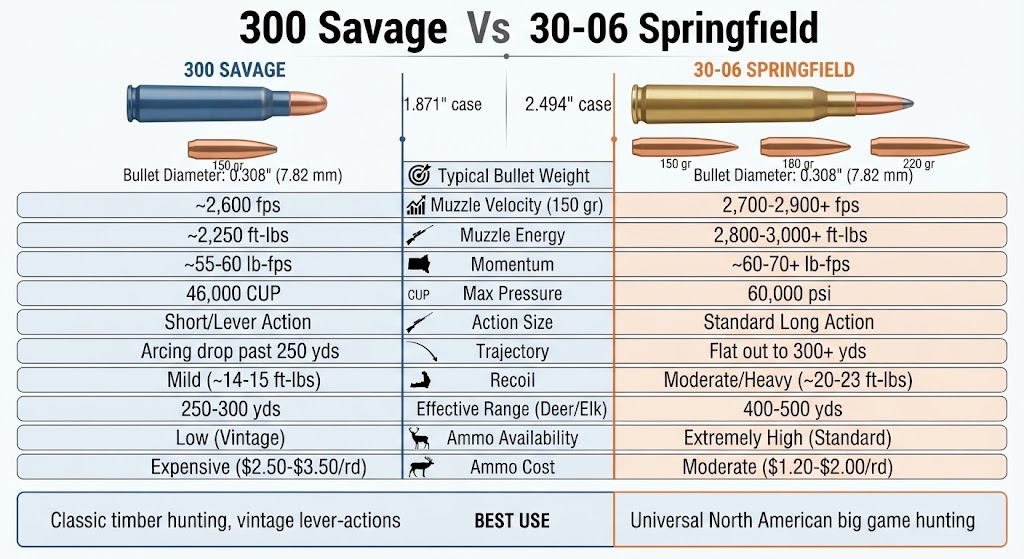
The main difference in the 300 Savage Vs 30-06 comparison is that the 300 Savage was designed as a compact, short-action cartridge for lever-action rifles, whereas the 30-06 is a massive, long-action military powerhouse. While the 300 Savage delivers highly efficient, mild-recoiling performance perfect for medium-range deer hunting, the 30-06 offers drastically larger powder capacity, allowing it to push heavier bullets much faster for large game at extended distances.
300 Savage Vs 30-06 Comparison
| Feature | 300 Savage | 30-06 Springfield |
| Bullet Diameter | 0.308 inches (7.82 mm) | 0.308 inches (7.82 mm) |
| Typical Bullet Weight | 150 gr to 180 gr (typically 150 gr) | 150 gr to 220 gr (typically 150, 165, or 180 gr) |
| Muzzle Velocity | ~2,600 fps (150 gr) | 2,700 to 2,900+ fps (150 gr) |
| Muzzle Energy | ~2,250 ft-lbs | ~2,800 to 3,000+ ft-lbs |
| Momentum | ~55 to ~60 lb-fps | ~60 to ~70+ lb-fps |
| Maximum Pressure | 46,000 CUP (~47,000 psi) | 60,000 psi (SAAMI) |
| Case Length | 1.871 inches (47.5 mm) | 2.494 inches (63.3 mm) |
| Action Size Required | Short Action / Lever Action | Standard Long Action |
| Trajectory | Arcing drop past 250 yards | Flat out to 300+ yards |
| Recoil | Mild (~14 to 15 ft-lbs) | Moderate to Heavy (~20 to 23 ft-lbs) |
| Effective Range | 250 to 300 yards (Deer) | 400 to 500 yards (Deer/Elk) |
| Ammo Availability | Low (Seasonal vintage runs) | Extremely High (Global commercial standard) |
| Ammo Cost | Expensive ($2.50 to $3.50/rd) | Moderate ($1.20 to $2.00/rd) |
| Best Use | Classic timber hunting, vintage lever-actions | Universal North American big game hunting |
The table above illustrates the generational evolution of .30-caliber hunting cartridges. Introduced in 1906, the 30-06 Springfield uses a massive, long brass case capable of holding up to 68 grains of water capacity, generating immense pressure to drive bullets at long ranges.
In 1920, Savage Arms wanted to match the ballistics of the original 30-06 military load (a 150-grain bullet at 2,700 fps) but fit it inside their compact, short-action Savage Model 99 lever-action rifle. They developed the 300 Savage with a severely shortened case and a sharp shoulder. While it fell just short of the 30-06’s velocity, it became a massive success. The highly efficient 300 Savage case design was later used by the U.S. military in the 1950s as the direct parent case for developing the legendary .308 Winchester.
300 Savage Vs 30-06 Ballistics
To objectively evaluate the ballistic capabilities, we must examine standard factory hunting loads fired from standard 22-to-24-inch hunting barrels.
- Load A (300 Savage Standard Deer): Remington Core-Lokt 150-grain Soft Point. Muzzle velocity is 2,630 feet per second. Muzzle energy is 2,303 foot-pounds.
- Load B (300 Savage Heavy Timber): Federal Power-Shok 180-grain Soft Point. Muzzle velocity is 2,350 feet per second. Muzzle energy is 2,207 foot-pounds.
- Load C (30-06 Standard Deer): Remington Core-Lokt 150-grain Soft Point. Muzzle velocity is 2,910 feet per second. Muzzle energy is 2,820 foot-pounds.
- Load D (30-06 Heavy Elk): Federal Premium 180-grain Nosler Partition. Muzzle velocity is 2,700 feet per second. Muzzle energy is 2,913 foot-pounds.
300 Savage Vs 30-06 Velocity
Because the 30-06 holds roughly 20 grains more powder capacity than the compact 300 Savage, it completely dominates the velocity comparison.
When firing identical 150-grain bullets, the 30-06 pushes the projectile nearly 300 feet per second faster than the 300 Savage. When firing heavy 180-grain bullets, the gap widens, as the smaller 300 Savage case runs out of internal room for both the long bullet and the necessary powder, causing velocities to drop to roughly 2,350 fps compared to the 30-06’s robust 2,700 fps.
300 Savage Vs 30-06 Muzzle Energy
Muzzle energy represents the raw kinetic work capacity of a projectile.
The 300 Savage generates roughly 2,200 to 2,300 foot-pounds of energy at the muzzle. This is excellent for whitetail deer, black bear, and hogs at typical woodland distances (under 250 yards), delivering more than enough terminal shock for ethical harvests.
The 30-06 Springfield generates roughly 2,800 to 3,000 foot-pounds of energy at the muzzle. This massive 600 to 700 foot-pound advantage elevates the 30-06 from a deer cartridge into a universal big game cartridge capable of anchoring massive bull elk and moose at extended ranges where the 300 Savage would run out of steam.
300 Savage Vs 30-06 Momentum
Momentum calculates mass in motion, which dictates a bullet’s ability to crush through dense bone and heavy shoulder muscles without deflecting.
Because both cartridges can fire the same .308-caliber 150-grain and 180-grain bullets, the momentum advantage belongs entirely to the faster 30-06. A 180-grain 30-06 bullet traveling at 2,700 fps yields roughly 69.4 pound-feet per second of linear momentum, pushing it much deeper through heavy bone than the slower 300 Savage.
300 Savage Vs 30-06 Trajectory
Understanding external ballistics highlights the strict range limitations of the vintage Savage cartridge. The calculations below assume a standard rifle sight height of 1.5 inches above the bore and a 200-yard zero.
| Distance | 300 Savage (150 gr at 2,630 fps) Drop | 30-06 Win (150 gr at 2,910 fps) Drop |
| Muzzle | -1.5 inches | -1.5 inches |
| 200 Yards | 0.0 inches (Zero) | 0.0 inches (Zero) |
| 300 Yards | -9.5 inches | -6.8 inches |
| 400 Yards | -27.5 inches | -19.5 inches |
| 500 Yards | -56.2 inches | -40.5 inches |
The trajectory data confirms that the 30-06 shoots significantly flatter. At 400 yards, the 300 Savage has plummeted nearly 28 inches, making ethical holdovers very difficult on game animals without a dialed scope. The 30-06 drops 8 inches less at the same distance, extending the ethical “point blank” hunting range of the rifle.
300 Savage Vs 30-06 Recoil
Recoil management highlights the primary benefit of the 300 Savage.
Fired from identical 8-pound rifles, the massive powder charge of the 30-06 generates roughly 20 to 23 foot-pounds of free recoil energy. This is a very stout kick that will eventually fatigue the shooter during long range sessions.
The 300 Savage generates a very mild 14 to 15 foot-pounds of free recoil energy. It is incredibly comfortable to shoot, allowing for faster follow-up shots in lever-action rifles, and making it an excellent cartridge for youth or recoil-sensitive hunters.
300 Savage Vs 30-06 Penetration & Expansion
Both cartridges utilize identical .308-inch diameter bullets, meaning terminal performance relies entirely on impact velocity.
Inside 200 yards, both cartridges will drive soft-point bullets completely through a whitetail deer, creating massive internal trauma.
However, on heavier game (like elk) or at longer ranges (past 300 yards), the 30-06 is vastly superior. The extra velocity ensures that premium hunting bullets hit the animal fast enough to reliably mushroom, whereas the 300 Savage might drop below the minimum velocity threshold required for proper expansion, leading to deep but narrow wound channels.
Which Has More Stopping Power: 300 Savage Vs 30-06?
The 30-06 Springfield possesses significantly more stopping power. It delivers higher kinetic energy, superior hydrostatic shock due to faster impact velocities, and deeper penetration on heavy game.
Which Is More Powerful: 300 Savage Vs 30-06?
Based on raw kinetic energy and velocity, the 30-06 Springfield is substantially more powerful, generating roughly 600 to 700 more foot-pounds of energy at the muzzle.
300 Savage Pros And Cons
Pros
- Exceptional historical pedigree; the father of modern short-action .30-caliber ballistics
- Extremely mild, comfortable recoil impulse compared to modern magnums and the 30-06
- Functions flawlessly in fast-handling, vintage short-throw lever-action rifles
- Highly efficient powder burn yields excellent barrel life and accuracy
Cons
- Commercially obsolete; ammunition is only produced in seasonal batches and is very expensive
- Lacks the kinetic energy and trajectory required for ethical shots past 300 yards on heavy game
- Cannot effectively utilize modern ultra-heavy (200+ grain) .30-caliber bullets due to case capacity limits
30-06 Pros And Cons
Pros
- The undisputed gold standard for North American big game hunting
- Massive powder capacity provides ethical killing power on elk and moose past 400 yards
- Ubiquitous ammunition availability in every sporting goods store worldwide at affordable prices
- Can be loaded with a massive spectrum of bullet weights from 110 grains to 220 grains
Cons
- Requires a heavier, longer bolt-action receiver to accommodate the 2.5-inch case length
- Generates a stout recoil impulse that can induce flinching in inexperienced shooters
Final Comparison
| Category | Winner | Reason |
| Velocity | 30-06 Springfield | Massive powder capacity drives bullets nearly 300 fps faster |
| Muzzle Energy | 30-06 Springfield | Higher velocities yield roughly 700 more ft-lbs of kinetic energy |
| Momentum | 30-06 Springfield | Faster speeds applied to identical bullet mass yield superior momentum |
| Penetration | 30-06 Springfield | Higher impact velocities push heavy hunting projectiles deeper |
| Expansion | 30-06 Springfield | Maintains expanding velocity thresholds further downrange |
| Trajectory | 30-06 Springfield | Faster transit time results in noticeably less bullet drop past 250 yds |
| Recoil Control | 300 Savage | Smaller powder charge generates a remarkably soft, pleasant recoil impulse |
| Action Size | 300 Savage | Fits into compact, fast-handling short-action and lever-action rifles |
| Effective Range | 30-06 Springfield | Retains lethal hunting energy hundreds of yards further than the Savage |
| Ammo Cost | 30-06 Springfield | Massive commercial production offers vastly cheaper retail pricing |
| Ammo Availability | 30-06 Springfield | Found everywhere; 300 Savage is extremely rare and seasonal |
| Overall Performance | 30-06 Springfield | The absolute benchmark of versatility and modern hunting capability |
300 Savage Vs 30-06: Which Should You Choose?
Selecting the winner in the 300 Savage Vs 30-06 matchup is simply a matter of choosing between vintage, fast-handling timber hunting and universal, modern big-game utility.
Choose the 300 Savage if you hunt deer or black bear in thick woods (inside 200 yards) and value the nostalgia of carrying a classic lever-action rifle like the Savage Model 99. It is a wonderfully efficient, low-recoil cartridge that kills deer just as dead today as it did a century ago, provided you are willing to hunt down the rare boxes of ammunition or handload your own.
Choose the 30-06 Springfield for absolutely every other practical hunting application. It is one of the most versatile and powerful non-magnum cartridges on the planet. It shoots flatter, hits vastly harder, and allows you to hunt any animal in North America with the convenience of buying affordable ammunition in any town in the country.
FAQs
Is 300 Savage more powerful than 30-06?
No, the 30-06 is significantly more powerful. The 30-06 generates roughly 2,800 to 3,000 foot-pounds of muzzle energy, completely outclassing the 300 Savage’s 2,200 to 2,300 foot-pounds.
Can a 30-06 shoot 300 Savage ammunition?
No. They are entirely different case lengths and shapes. The 300 Savage case is far too short to safely chamber in a 30-06 rifle, and attempting to fire it will cause a catastrophic headspace failure, potentially injuring the shooter.
Why did the .308 Winchester replace the 300 Savage?
In the 1950s, the U.S. military wanted a cartridge that matched the 30-06’s performance but fit into a shorter action for the new M14 rifle. They used the highly efficient 300 Savage case design, lengthened the neck slightly, and loaded it with modern ball powders. The resulting T65 cartridge (commercialized as the .308 Winchester) safely generated higher pressures, completely rendering the 300 Savage obsolete.
Which has more recoil?
The 30-06 generates significantly more recoil (roughly 20+ foot-pounds compared to the 300 Savage’s 15 foot-pounds). The 300 Savage is much easier on the shoulder.
Is 300 Savage good for elk?
While it can harvest an elk with perfect shot placement at close range (under 150 yards), the 300 Savage is generally considered underpowered for modern elk hunting. The 30-06 is vastly superior for elk.