The main difference between the .45 Long Colt and the .357 Magnum is that the .45 Long Colt fires a massive, heavy bullet at relatively low velocities to create wide wound channels with a mild recoil impulse, while the .357 Magnum operates at high pressure to drive a lighter, narrower bullet at extreme velocities for deeper penetration and flatter trajectories. When choosing between these legendary revolver cartridges, you must weigh history against modern ballistic engineering, comparing velocity, muzzle energy, trajectory, recoil, penetration, hunting capability, and defensive performance to determine which caliber deserves a place in your gun safe.
.45 Long Colt vs .357 Magnum Comparison Table
To accurately compare these cartridges, we must look at standard factory ammunition. The data below represents standard pressure .45 Long Colt loads (safe for all antique and modern revolvers) compared to full power .357 Magnum defensive and hunting loads. We will also reference “Ruger Only” +P loads in the text, which drastically change the .45 Long Colt’s capabilities.
| Specification | .45 Long Colt (.45 Colt) | .357 Magnum |
| Cartridge Type | Centerfire Revolver / Carbine | Centerfire Revolver / Carbine |
| Parent Case | None (Original Design, 1873) | .38 Special (1934) |
| Bullet Diameter | .452 in (11.48 mm) | .357 in (9.07 mm) |
| Case Length | 1.285 in | 1.290 in |
| Overall Length | 1.600 in | 1.590 in |
| Typical Bullet Weights | 225 gr to 255 gr (up to 300gr +P) | 110 gr to 180 gr |
| Muzzle Velocity (4″ to 5″ bbl) | 850 fps (250gr Standard) | 1,450 fps (125gr Magnum) |
| Muzzle Energy (4″ to 5″ bbl) | 400 ft-lbs (Standard Pressure) | 580 ft-lbs (Standard Magnum) |
| Maximum Pressure | 14,000 psi (SAAMI Standard) | 35,000 psi (SAAMI Standard) |
| Effective Range | 50 yds (Handgun) | 75 to 100 yds (Handgun) |
| Trajectory | Arced (Rainbow trajectory) | Flat |
| Bullet Drop (50 yds) | Approx. 3.5 inches | Approx. 2.0 inches |
| Wind Drift | Moderate (Slow moving bullet) | Low at handgun distances |
| Recoil | Mild (Rolling push) | Sharp (Snappy and concussive) |
| Barrel Length Performance | Excels in 4 to 7 inch barrels | Excels in 4 to 6 inch barrels |
| Suppressor Performance | Poor (Revolver cylinder gap) | Poor (Revolver cylinder gap) |
| Short Barrel Performance | Good (Maintains mass) | Poor (Massive velocity loss) |
| Long Range Performance | Poor (Due to low velocity) | Good (Flat shooting) |
| Accuracy | High | Extremely High |
| Penetration | Moderate (Standard) to Deep (+P) | Deep (High velocity) |
| Expansion | Moderate (Relies on original diameter) | Devastating (Violent expansion) |
| Hunting Performance | Excellent (Deer and hogs at close range) | Excellent (Deer out to 75 yards) |
| Home Defense | Good (Mild recoil, wide bullet) | Elite (Proven stopping power) |
| Tactical Use | Historical Military Standard (1873) | Historical Police Standard (1935 to 1990) |
| AR-15 Compatibility | No (Rimmed case) | No (Rimmed case) |
| Cylinder Capacity | 5 to 6 rounds | 6 to 8 rounds (Depending on frame) |
| Ammunition Cost | High | Moderate |
| Ammo Availability | Moderate (Specialty or Online) | Ubiquitous |
| Best Uses | Cowboy Action Shooting, woods carry | Defensive carry, general woods defense |
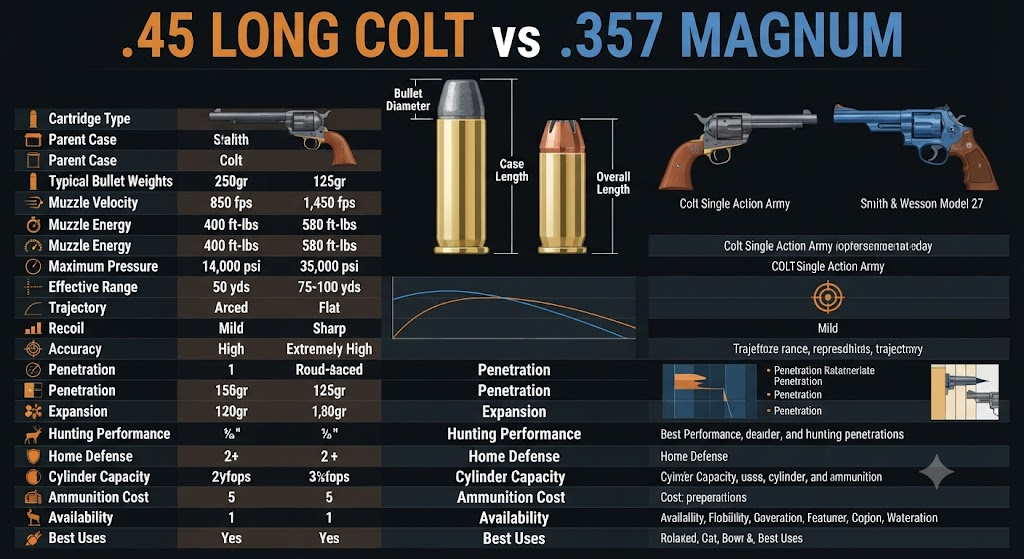
Understanding the Numbers
The technical differences between these cartridges span over sixty years of firearms development. The .45 Long Colt was introduced in 1873 for the legendary Colt Single Action Army revolver. Because it was originally loaded with black powder, the case is massive. Today, SAAMI strictly limits standard .45 Long Colt ammunition to a very low 14,000 psi to ensure old, antique revolvers do not blow up when fired.
The .357 Magnum was born in 1934 during the era of modern smokeless powder and strong steel. It operates at a blistering 35,000 psi. This immense pressure allows the narrower .357 bullet to achieve velocities that the standard .45 Long Colt simply cannot match. However, modern firearms manufacturers like Ruger build .45 Long Colt revolvers (like the Blackhawk or Redhawk) so strongly that boutique ammunition companies produce “Ruger Only” +P loads for the .45 Colt. These loads operate at over 30,000 psi, turning the ancient .45 Long Colt into a magnum powerhouse capable of taking down grizzly bears.
Velocity Comparison
Velocity is the primary mechanism the .357 Magnum uses to achieve its legendary stopping power.
Muzzle Velocity Data (4 inch barrel):
- .357 Magnum (Federal 125gr JHP): 1,450 fps
- .357 Magnum (Federal 158gr JSP): 1,240 fps
- .45 Long Colt (Winchester 250gr Lead Round Nose): 850 fps
- .45 Long Colt +P (Buffalo Bore 300gr Hard Cast): 1,200 fps (Only for modern, heavy frame revolvers)
The .357 Magnum is a speed demon. Driving a 125 grain bullet at 1,450 fps causes rapid, explosive expansion in soft tissue. The standard .45 Long Colt takes a completely different approach. It slowly lobs a massive 250 grain bullet at 850 fps, relying entirely on the bullet’s heavy weight and wide starting diameter to cause tissue damage.
Winner: .357 Magnum
For standard factory ammunition available to all shooters, the .357 Magnum provides vastly superior velocity.
Muzzle Energy Comparison
Muzzle energy dictates the kinetic force the bullet strikes with.
Muzzle Energy Data (4 inch barrel):
- .357 Magnum (125gr JHP): 580 ft-lbs
- .45 Long Colt (250gr Standard): 400 ft-lbs
- .45 Long Colt +P (300gr Hard Cast): 960 ft-lbs (Specialty load)
When comparing standard ammunition safe for all firearms, the .357 Magnum generates roughly 180 foot pounds more energy than the .45 Long Colt. The .357 Magnum hits with devastating shock value. However, if you own a strong modern revolver (like a Ruger Super Redhawk) and load it with Buffalo Bore +P ammunition, the .45 Long Colt suddenly generates nearly 1,000 foot pounds of energy, completely dwarfing the .357 Magnum.
Winner: .357 Magnum (Standard Ammo) / .45 Long Colt (With +P Ammo)
Trajectory Comparison
A flat trajectory makes hitting targets at unknown distances much easier.
Because the .357 Magnum drives its bullets at high velocities, it shoots exceptionally flat. You can aim directly at the center of a target at 50 yards and expect a perfect hit. The standard .45 Long Colt acts like a mortar. Because it travels at only 850 fps, gravity begins pulling the heavy 250 grain bullet down almost immediately after it leaves the muzzle.
Winner: .357 Magnum
The high velocity of the magnum yields a much flatter trajectory.
Bullet Drop Comparison
Let us look at the mathematical bullet drop using standard factory loads, assuming a 25 yard zero.
| Distance | .357 Magnum (158gr JSP) | .45 Long Colt (250gr Standard) |
| 25 Yards | 0 inches | 0 inches |
| 50 Yards | -2.0 inches | -3.5 inches |
| 75 Yards | -6.5 inches | -10.5 inches |
| 100 Yards | -13.5 inches | -22.0 inches |
At 100 yards, the heavy, slow moving .45 Long Colt drops nearly two feet. Hitting a target requires significant holdover estimation. The .357 Magnum drops only 13.5 inches, making it a much more viable cartridge for taking longer shots on game.
Winner: .357 Magnum
Wind Drift Comparison
Wind deflection is mitigated by a bullet’s velocity and its aerodynamic profile.
Handgun bullets generally have terrible aerodynamics. Therefore, velocity is the primary defense against wind drift. Because the .357 Magnum reaches the target much faster than the standard .45 Long Colt, the wind has significantly less time to push the bullet off course. At 50 yards in a crosswind, the .357 Magnum will drift noticeably less.
Winner: .357 Magnum
Recoil Comparison
Recoil dictates a shooter’s ability to fire rapid, accurate follow up shots.
The .357 Magnum operates at 35,000 psi. When fired from a standard revolver, it generates a sharp, stinging recoil impulse directly into the palm of the hand, accompanied by a massive concussive blast and fireball.
The standard pressure .45 Long Colt is a joy to shoot. Operating at only 14,000 psi, it generates a slow, rolling push against the hand rather than a sharp sting. It is incredibly manageable, making it a favorite for Cowboy Action Shooting competitors who need to fire quickly. (Note: +P heavy loads in the .45 Colt generate brutal, wrist twisting recoil).
Winner: .45 Long Colt
With standard ammunition, the .45 Long Colt is much more pleasant to shoot.
Stopping Power Comparison
Stopping power against unarmored targets requires rapid energy transfer and wide bullet expansion.
The .357 Magnum is historically recognized as the greatest man stopping handgun cartridge of the 20th century. During the decades it was carried by law enforcement, the 125 grain jacketed hollow point developed a legendary reputation for ending gunfights with a single shot. The high velocity causes the hollow point to open violently and dump all 580 foot pounds of energy instantly.
The standard .45 Long Colt relies purely on the fact that it starts out very wide (nearly half an inch in diameter). While it punches a large hole and causes rapid blood loss, it lacks the hydrostatic shock generated by the extreme velocity of the magnum.
Winner: .357 Magnum
The combination of velocity and violent hollow point expansion gives the .357 Magnum the edge in defensive stopping power.
Penetration Comparison
Penetration is critical when hunting medium game or defending against large predators.
Standard .357 Magnum hollow points penetrate 12 to 16 inches in ballistic gel, which is perfect for human defense. When loaded with 158 grain solid cast bullets, the .357 Magnum will penetrate deeply enough to break the shoulder of a whitetail deer.
The standard .45 Long Colt, despite its slow speed, penetrates very well due to its heavy 250 grain mass. It easily achieves 16 to 20 inches of penetration. When you utilize +P hard cast ammunition, the .45 Long Colt can penetrate over 30 inches, making it a preferred cartridge for defense against grizzly bears in heavy brush.
Winner: .45 Long Colt
The heavy mass of the .45 caliber bullet ensures deep penetration, especially when loaded to modern pressures.
Expansion Comparison
To test expansion, the industry relies on calibrated ordinance gel.
A .357 Magnum hollow point starts at .357 inches in diameter. When it hits tissue at 1,450 fps, it violently mushrooms to over .60 inches.
A .45 Long Colt hollow point starts at .452 inches in diameter. Because it is traveling slowly (around 850 fps), many modern hollow points fail to open completely. However, even if it fails to expand at all, it is still crushing a half inch hole through the target.
Winner: .357 Magnum
High velocity guarantees reliable and massive hollow point expansion.
Accuracy Comparison
Both cartridges are capable of elite mechanical accuracy.
However, practical accuracy is dictated by the shooter’s ability to manage recoil. Many shooters develop an involuntary flinch when firing the loud, snappy .357 Magnum. The mild, rolling recoil of the standard .45 Long Colt allows shooters to focus on trigger control and sight alignment without anticipating a painful recoil impulse.
Winner: .45 Long Colt
The milder recoil makes it practically more accurate for the average shooter.
Effective Range Comparison
The effective range of a revolver is limited by bullet drop and retained energy.
Because the standard .45 Long Colt drops like a rock past 50 yards and bleeds velocity quickly, its practical effective hunting range is generally limited to 50 yards.
The .357 Magnum shoots flat enough and retains enough kinetic energy to take deer sized game cleanly out to 75 or even 100 yards when fired by a highly skilled handgun hunter.
Winner: .357 Magnum
It extends the practical range of the handgun significantly.
Suppressor Performance Comparison
Suppressing a revolver is largely ineffective due to the cylinder gap (the small space between the cylinder and the barrel where high pressure gases escape). However, both cartridges are heavily utilized in lever action carbines.
When chambered in a lever action rifle with a threaded barrel, the .45 Long Colt is one of the best suppressor hosts in the world. Because standard 250 grain loads travel at 850 fps, they are naturally subsonic. A suppressed .45 Colt lever action rifle sounds incredibly quiet. The .357 Magnum is inherently supersonic, meaning you will always hear the loud crack of the bullet breaking the sound barrier unless you load it with specialty subsonic .38 Special ammunition.
Winner: .45 Long Colt
Native subsonic velocities make it an elite suppressor host in closed action rifles.
Short Barrel Performance Comparison
When you cut a revolver barrel down to 2 inches (a snub nose configuration), internal ballistics change drastically.
The .357 Magnum suffers terribly in short barrels. The large powder charge does not have enough time to burn completely before the bullet exits the muzzle. This results in extreme velocity loss, a blinding muzzle flash, and a deafening concussive roar.
The .45 Long Colt uses fast burning powder and relies on heavy mass rather than speed. While it still loses velocity in a short barrel, a 250 grain bullet moving at 750 fps is still a massive, lethal projectile, and it produces significantly less flash and blast than the magnum.
Winner: .45 Long Colt
Heavy bullets suffer less practical performance degradation from short barrels.
16 inch vs 10.5 inch Barrel Performance
Lever action rifles chambered in these revolver cartridges are legendary brush guns.
- .357 Magnum: When fired from a 16 inch lever action carbine, the .357 Magnum gains a massive amount of velocity. A 158 grain bullet can easily exceed 1,800 fps out of a rifle barrel, transforming it into a highly capable 100 yard deer rifle.
- .45 Long Colt: A standard pressure .45 Long Colt gains modest velocity in a 16 inch barrel, usually topping out around 1,100 fps. It remains a close range brush gun. However, if you feed a strong modern lever action (like a Winchester 1892 or Marlin 1894) with +P ammunition, the .45 Long Colt becomes an absolute sledgehammer capable of taking elk and moose.
Winner: .357 Magnum
For factory standard ammunition, the .357 Magnum scales beautifully with longer barrel lengths.
Home Defense Comparison
Inside the home, you must balance stopping power against over penetration and auditory safety.
Firing a .357 Magnum indoors without ear protection will cause permanent hearing damage and intense physical disorientation due to the 35,000 psi blast. Furthermore, heavy magnum rounds can easily over penetrate drywall and endanger family members.
The standard .45 Long Colt is much safer for home defense. The 14,000 psi operating pressure produces a much lower decibel report. The heavy, wide bullet crushes tissue efficiently but is less likely to zip through multiple exterior walls compared to a high velocity magnum projectile.
Winner: .45 Long Colt
It provides massive stopping power with significantly less indoor concussive blast. (Note: Most .357 Magnum owners load .38 Special +P for home defense to solve this exact issue).
Hunting Comparison
Handgun hunting requires deep penetration and massive energy transfer.
- Deer: The .357 Magnum is a proven deer cartridge. A 158 grain hollow point placed in the vitals will easily harvest a whitetail deer at 50 yards. The standard .45 Long Colt is also highly effective on deer inside 50 yards due to the massive wound channel created by the half inch bullet.
- Bear and Elk: The .357 Magnum is generally considered too light for large, heavy boned game. The .45 Long Colt, when loaded to +P pressures with 300 grain hard cast bullets, will cleanly penetrate the shoulder of a grizzly bear or an elk.
Winner: .45 Long Colt (With +P Ammunition)
If your firearm can safely handle the high pressure loads, the .45 Colt is a vastly superior big game cartridge.
Tactical and Duty Use Comparison
Both cartridges have historical pedigrees in military and police service.
The .45 Long Colt was the official sidearm cartridge of the United States Cavalry starting in 1873. It was designed to drop a horse at close range and served with distinction through the Indian Wars and the Philippine American War.
The .357 Magnum was the gold standard for American law enforcement from the 1950s through the 1980s. Highway patrolmen favored it because the high velocity 125 grain bullets could easily penetrate the heavy steel car doors of the era.
Today, neither cartridge is used by modern military or police units, who have universally transitioned to high capacity 9mm semi automatic pistols.
Winner: Tie
Both are historically legendary but tactically obsolete for modern duty use.
Cylinder Capacity
Revolver cylinders are limited by the physical diameter of the cartridges they hold.
Because the .45 Long Colt is a massive, wide cartridge, a standard full size revolver (like the Colt Single Action Army) can only safely hold six rounds.
The .357 Magnum is significantly narrower. While traditional medium frame revolvers hold six rounds, modern large frame revolvers (like the Smith & Wesson Model 627) can easily hold eight rounds of .357 Magnum. Gaining two extra rounds in a defensive revolver is a massive tactical advantage.
Winner: .357 Magnum
The narrower case allows for higher cylinder capacity.
Ammo Cost Comparison
To become proficient with a handgun, you must practice frequently.
The .357 Magnum is a global standard. You can find practice ammunition in every sporting goods store in America for moderate prices. Furthermore, every .357 Magnum revolver can safely fire .38 Special ammunition, which is incredibly cheap and abundant.
The .45 Long Colt is an expensive, boutique cartridge. Standard practice ammunition is typically priced at a premium, often costing double the price of standard .38 Special target loads.
Winner: .357 Magnum
The ability to shoot cheap .38 Special practice ammunition saves shooters a massive amount of money.
Ammo Availability Comparison
Walk into any gun store in the world, and you will find .357 Magnum and .38 Special ammunition sitting on the shelf.
The .45 Long Colt is significantly harder to find. While most large sporting goods retailers carry a few boxes for the Cowboy Action Shooting crowd, it is frequently absent from the shelves of small, rural hardware stores.
Winner: .357 Magnum
Ubiquitous availability ensures you can always feed your revolver.
Reloading Comparison
Both cartridges are absolute favorites in the reloading community.
The .357 Magnum is a straight walled cartridge that is incredibly easy to reload using carbide dies. There is infinite load data available for every bullet weight imaginable.
The .45 Long Colt is arguably the most versatile reloading cartridge in existence. Because modern firearms (like Ruger Blackhawks) are built so strongly, handloaders can tune the .45 Long Colt from whisper quiet 700 fps target loads all the way up to bone crushing 1,300 fps bear defense loads.
Winner: .45 Long Colt
The extreme versatility of the large case capacity makes it a handloader’s dream.
Pros and Cons
.45 Long Colt
Pros
- Standard pressure loads offer incredibly mild, pleasant recoil.
- Wide .45 caliber bullet punches massive holes in targets.
- Excellent suppressor host when fired from a lever action rifle.
- +P “Ruger Only” loads generate enough power to hunt grizzly bears.
- Deeply steeped in American Wild West history.
Cons
- Standard pressure loads have an arced, rainbow trajectory.
- Ammunition is expensive and sometimes difficult to find locally.
- +P heavy loads generate brutal, painful recoil.
- Limited to 5 or 6 rounds in standard revolver cylinders.
.357 Magnum
Pros
- Unmatched velocity and stopping power for personal defense.
- Shoots incredibly flat out to 100 yards.
- Allows you to shoot cheap, abundant .38 Special ammunition for practice.
- Ammunition is affordable and available universally.
- Modern revolvers can hold 7 or 8 rounds in the cylinder.
Cons
- Generates a sharp, painful recoil impulse and massive concussive blast.
- Blinding muzzle flash when fired from short barrel snub nose revolvers.
- Heavy bullet drop when compared to modern rifle cartridges.
- Highly likely to over penetrate in indoor home defense scenarios.
Final Verdict
Choosing between the .45 Long Colt and the .357 Magnum comes down to your primary use case and whether you purchase factory ammunition or load your own.
- For Home Defense and Concealed Carry: Choose the .357 Magnum. It offers superior terminal stopping power on human threats, higher cylinder capacity, and the option to use mild .38 Special loads to reduce indoor blast.
- For Big Game and Bear Defense: Choose the .45 Long Colt. When loaded with +P ammunition in a strong modern revolver, the heavy 300 grain bullet will penetrate deeply through thick bone and muscle that the .357 Magnum simply cannot breach.
- For Budget Conscious Shooters: Choose the .357 Magnum. The ability to practice with cheap .38 Special ammunition will save you a fortune over the lifespan of the firearm.
- For Suppressed Lever Action Rifles: Choose the .45 Long Colt. The heavy, slow moving bullets are naturally subsonic and perform brilliantly with a silencer attached.
- For Recoil Sensitive Shooters: Choose the .45 Long Colt (using standard pressure ammunition) or the .357 Magnum (loaded with .38 Special). Both provide a gentle, enjoyable shooting experience.
FAQ
Is the .45 Long Colt more powerful than the .357 Magnum?
If you are using standard pressure factory ammunition, no. The .357 Magnum generates higher velocity and more kinetic energy than standard 14,000 psi .45 Long Colt loads. However, if you are using specialized +P ammunition in a strong modern revolver, the .45 Long Colt is significantly more powerful than the .357 Magnum.
Can I shoot .45 ACP in a .45 Long Colt revolver?
Generally, no. The .45 Long Colt is a rimmed cartridge designed for revolvers, while the .45 ACP is a rimless cartridge designed for semi automatic pistols. They will not headspace correctly. However, some manufacturers offer convertible revolvers with two different cylinders, allowing you to swap between the two calibers.
Why is it called .45 Long Colt?
The original designation was simply “.45 Colt.” However, in the late 19th century, the U.S. military also issued a shorter cartridge called the .45 Schofield. Quartermasters began calling the original cartridge the .45 “Long” Colt to differentiate it from the shorter Schofield round, and the nickname became permanently ingrained in shooting culture.
Can a .357 Magnum shoot .38 Special?
Yes. The .357 Magnum cartridge case is simply a .38 Special case that was lengthened by one tenth of an inch to hold more powder. Therefore, every .357 Magnum revolver can safely chamber and fire shorter, lower pressure .38 Special ammunition. You cannot, however, fire a .357 Magnum in a .38 Special revolver.
Is .45 Long Colt good for deer hunting?
Yes. The standard pressure 250 grain bullet will easily harvest a whitetail deer at close range (inside 50 yards). If you use a modern lever action rifle or a strong revolver loaded with modern ammunition, it becomes a devastating 100 yard deer cartridge.
Does the .357 Magnum have too much recoil for beginners?
Yes, full power .357 Magnum ammunition produces a sharp, concussive recoil impulse that often causes beginners to develop a flinch. Beginners should always start by shooting mild .38 Special ammunition in their .357 Magnum revolvers until they master the fundamentals of marksmanship.