The main difference between the .50 AE (Action Express) and the .45 ACP is their design purpose and the platform scale required to fire them. The .50 AE is an ultra-powerful, high-pressure magnum cartridge engineered strictly for massive, heavy-framed semi-automatic pistols like the Desert Eagle to deliver devastating big-bore stopping power, while the .45 ACP is a historic, moderate-pressure combat cartridge designed for standard-sized sidearms like the 1911 to provide controllable, high-capacity defense and military service.
.50 AE vs .45 ACP Comparison Table
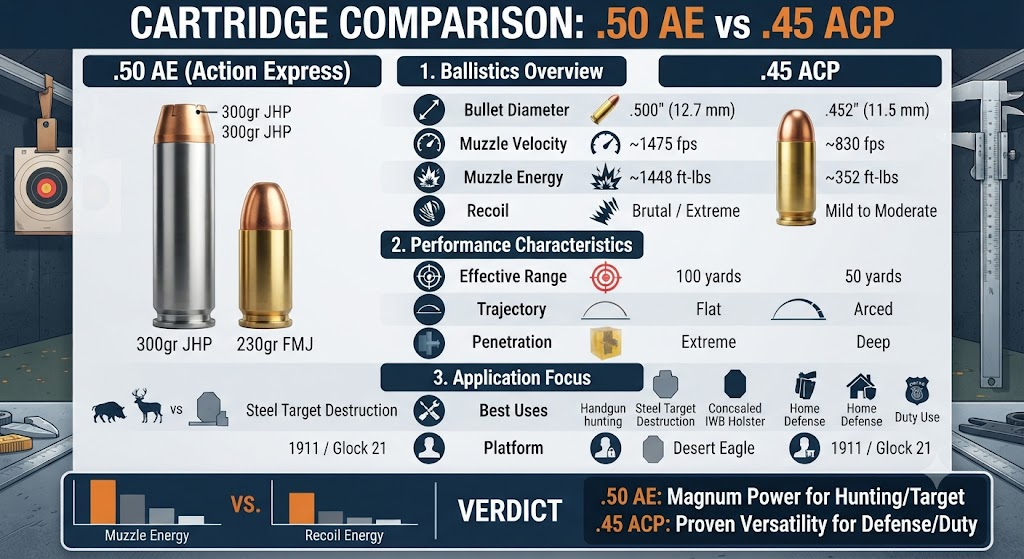
To accurately compare these two iconic large-bore pistol cartridges, we must examine their physical dimensions, pressure limits, and baseline ballistic performance. The data below represents standard premium factory loads, comparing a 300-grain jacketed hollow point load for the .50 AE against a standard 230-grain full metal jacket load for the .45 ACP.
| Specification | .50 AE (Action Express) | .45 ACP |
| Cartridge Type | Semi-Automatic Handgun Magnum | Semi-Automatic Handgun |
| Parent Case | .41 Remington Magnum (Re-engineered) | None (Original Design, 1904) |
| Bullet Diameter | .500 inches (12.7 mm) | .452 inches (11.5 mm) |
| Case Length | 1.285 inches | 0.898 inches |
| Overall Length | 1.610 inches | 1.275 inches |
| Typical Bullet Weights | 300 grains to 325 grains | 185 grains to 230 grains |
| Muzzle Velocity (Handgun bbl) | 1,475 fps (300gr JHP) | 830 fps (230gr FMJ) |
| Muzzle Energy (Handgun bbl) | 1,448 foot-pounds | 352 foot-pounds |
| Maximum Pressure | 36,000 psi (SAAMI) | 21,000 psi (SAAMI) |
| Effective Range | 100 yards | 50 yards |
| Trajectory | Flat (For a pistol) | Arced |
| Bullet Drop (50 yds) | Approximately 1.5 inches | Approximately 3.0 inches |
| Wind Drift | Moderate | Moderate |
| Recoil | Brutal / Extreme (Approx. 20+ ft-lbs) | Mild to Moderate (Approx. 5 ft-lbs) |
| Barrel Length Performance | Excels in 6 to 10 inch barrels | Excels in 4 to 5 inch barrels |
| Suppressor Performance | Poor (Rarely suppressed) | Elite (Naturally subsonic) |
| Short Barrel Performance | Massive muzzle blast | Excellent powder burn |
| Accuracy | High | High |
| Penetration | Extreme | Deep (Full metal jacket) |
| Expansion | Devastating | Reliable with modern hollow points |
| Hunting Performance | Elite (Wild boar, deer, bear defense) | Marginal (Small game / emergency only) |
| Home Defense | Not Recommended (Massive over-penetration) | Elite (Standard military/police adoption) |
| Tactical Use | None | Global Military and Police Standard |
| Platform Compatibility | Desert Eagle (Gas-operated) | 1911, Glock 21, PCCs (Recoil-operated) |
| Magazine Compatibility | Single-stack proprietary box magazines | Single and double-stack box magazines |
| Ammunition Cost | Extremely High | Very Low to Moderate |
| Ammo Availability | Specialty / Online | Ubiquitous |
| Best Uses | Handgun hunting, steel target destruction | Concealed carry, home defense, duty use |
Understanding the Engineering
The technical differences between these cartridges represent two entirely opposite approaches to hand-held ballistics.
The .45 ACP was developed by John Moses Browning in 1904 alongside the legendary 1911 pistol. The United States military wanted a sidearm that could stop an enemy combatant instantly with a single heavy bullet. Browning designed a rimless, moderate-pressure cartridge operating at 21,000 psi. Because it operates at standard pressures and pushes a heavy bullet at subsonic speeds, it can cycle reliably in lightweight, recoil-operated pistols without requiring a massive, heavy locking mechanism.
The .50 AE was introduced in 1988 by Action Arms and Magnum Research. It was engineered with one goal: to create the most powerful semi-automatic handgun cartridge in the world. Because a traditional Browning-style tilting-barrel recoil system cannot safely handle the massive thrust of a .50-caliber round, the Desert Eagle utilizes a rotating-bolt, gas-operated system borrowed from rifle design. Operating at a staggering 36,000 psi, the .50 AE requires a massive, heavy-framed pistol to absorb the force.
Velocity Comparison
Velocity dictates the energy transfer and trajectory flatness of a handgun projectile.
The .50 AE is an absolute speed demon for a heavy-caliber handgun. When firing a standard 300-grain jacketed hollow point, it leaves the muzzle at a blistering 1,475 feet per second.
The .45 ACP operates in an entirely different speed bracket. A standard 230-grain .45 ACP bullet crawls out of a 5-inch barrel at roughly 830 feet per second. The .50 AE travels nearly 650 feet per second faster while carrying a heavier bullet.
Muzzle Energy Comparison
Muzzle energy measures the absolute kinetic force transferred to a target upon impact.
This is the category where the .50 AE completely obliterates almost all handgun competition. A standard .50 AE load generates a staggering 1,448 foot-pounds of energy at the muzzle. That is equivalent to the power of an intermediate rifle cartridge like the 5.56 NATO, coming out of a handgun barrel.
The .45 ACP generates roughly 352 foot-pounds of energy. While entirely adequate for neutralizing human threats, it possesses roughly one-fourth of the raw kinetic power generated by the .50 AE.
Trajectory Comparison
A flat trajectory makes hitting targets at extended distances much easier.
Because the .50 AE drives a massive bullet at near-rifle velocities, it shoots exceptionally flat for a handgun. A shooter can easily engage steel targets at 100 yards with a Desert Eagle without holding dangerously high over the target.
The .45 ACP lobs its heavy projectile in a steep, arcing trajectory. It is strictly optimized for close-quarters engagements inside 25 to 50 yards.
Bullet Drop Comparison
Assuming a standard 25-yard zero for both handguns, the bullet drop at 50 yards illustrates the trajectory difference clearly.
The .50 AE will drop roughly 1.5 inches at 50 yards due to its high velocity. The slow-moving .45 ACP will drop approximately 3.0 inches at the same distance, requiring a much more pronounced holdover for longer shots.
Wind Drift Comparison
Wind deflection is mitigated by a bullet’s velocity and its aerodynamic profile.
Handgun bullets generally possess terrible aerodynamics. However, because the .50 AE travels at nearly 1,500 feet per second, it crosses the distance to the target so fast that crosswinds have very little time to push it off course. The slow-moving .45 ACP is much more susceptible to drifting off target in a strong crosswind at 50 yards.
Recoil Comparison
Recoil directly dictates a shooter’s ability to fire rapid, accurate follow-up shots.
The .50 AE is notoriously brutal. Firing a full-power .50 AE load generates massive rearward force (roughly 20 to 25 foot-pounds of free recoil, depending on the pistol weight). It produces an aggressive, violent muzzle flip that will violently throw the gun upward if the shooter does not lock their wrists rigidly.
The .45 ACP generates a mild, manageable push. While it produces more recoil than a 9mm, the reciprocating slide of a 1911 or Glock absorbs a significant portion of the energy, allowing for fast, controlled strings of fire.
Stopping Power Comparison
Stopping power requires a combination of adequate penetration, rapid energy transfer, and wide tissue disruption.
The .50 AE offers absolute, catastrophic stopping power. Even without expanding, a .500-inch diameter solid lead or jacketed bullet crushes an enormous permanent wound channel. When a hollow-point .50 AE impacts tissue at high velocity, the hydrodynamic shock and massive energy dump cause instantaneous incapacitation.
The .45 ACP relies on a proven combat record. While it generates lower energy, its heavy 230-grain bullet starts out wide (.452 inches) and can expand reliably with modern hollow-point designs, providing dependable defense against human threats.
Penetration Comparison
Penetration is critical for ensuring the bullet reaches vital organs, especially on heavy-boned game or through barriers.
The .50 AE offers extreme penetration. A 300-grain or 325-grain projectile backed by 1,448 foot-pounds of energy will easily punch straight through engine blocks, heavy timber, and thick bone, making it a legitimate handgun hunting cartridge for large North American game.
The .45 ACP penetrates adequately to meet FBI standards (12 to 18 inches in gel) with full metal jacket ammunition, but it completely lacks the brute-force momentum required to punch through thick animal bone or heavy barriers compared to the .50 AE.
Expansion Comparison
To test expansion, the ballistics industry relies on calibrated ordinance gel.
A .50 AE hollow-point bullet hits tissue with so much hydraulic pressure that it frequently causes explosive, catastrophic expansion, occasionally fragmenting into multiple pieces inside the target. A .45 ACP expands in a controlled, predictable manner, mushrooms uniformly, and retains its weight to ensure proper depth.
Accuracy Comparison
Both cartridges are capable of elite mechanical accuracy.
The Desert Eagle platform features a fixed barrel design (because it is gas-operated rather than a tilting barrel), which inherently contributes to exceptional mechanical accuracy at long ranges. The .45 ACP is also legendary for its precision, particularly when fired from custom-tuned 1911 match pistols.
Effective Range Comparison
The effective range of the .45 ACP is strictly limited to 50 yards due to its rapid velocity decay and steep drop.
The .50 AE stretches the effective range of a handgun out to 100 yards and beyond. Experienced shooters frequently use the Desert Eagle in .50 AE to reliably ring steel targets at 100 to 150 yards.
Suppressor Performance Comparison
Suppressors are highly effective on native subsonic cartridges, but the firearm platform matters entirely.
The .45 ACP is the absolute gold standard for suppressed handguns. Because standard 230-grain loads are naturally subsonic (traveling under 1,125 fps), attaching a silencer completely eliminates the supersonic crack and massively tames the muzzle blast.
Suppressing a .50 AE is virtually unheard of. The immense pressures, massive gas volumes, and the unique gas-port operation of the Desert Eagle make suppressing a .50 AE an extremely impractical and mechanically difficult engineering challenge.
Short Barrel Performance Comparison
When you cut a barrel down, internal ballistics change drastically.
The .50 AE requires a barrel of at least 6 inches to allow its massive volume of slow-burning powder to combust completely. Firing a .50 AE out of a shorter barrel results in a massive, blinding fireball and a deafening concussive blast that can shock anyone standing nearby.
The .45 ACP uses fast-burning powders designed specifically for short 4- to 5-inch handgun barrels, burning efficiently with minimal velocity loss.
Home Defense Comparison
Inside the home, you must balance stopping power against over-penetration and weapon control.
A .45 ACP pistol is a classic, highly viable home defense choice. It delivers effective terminal ballistics without excessive recoil, and standard loads are easily managed indoors.
The .50 AE is an absolutely terrible choice for home defense. Firing a .50 AE indoors will cause permanent hearing damage even through electronic ear protection, the blinding muzzle flash will destroy your night vision, and the massive bullet will easily blast through an intruder, through multiple interior walls, and exit your neighbor’s house.
Hunting Comparison
These cartridges serve completely different roles in the field.
The .45 ACP is completely unsuited for hunting. It lacks the velocity, energy, and penetration required to ethically harvest medium or large game.
The .50 AE is a formidable handgun hunting cartridge. When fired from a Desert Eagle, it delivers enough kinetic energy to ethically harvest deer, wild hogs, and black bears at close to medium ranges, provided the shooter can manage the substantial weight and recoil of the firearm.
Platform Compatibility
The .45 ACP is compatible with hundreds of firearm platforms, including 1911s, modern polymer pistols (like the Glock 21), and countless pistol-caliber carbines (PCCs).
The .50 AE is almost exclusively tied to one iconic platform: the Magnum Research Desert Eagle. While a few specialty revolvers have been chambered in .50 AE over the decades, the cartridge’s massive dimensions and rimless design make it exceptionally difficult to adapt to standard handgun mechanisms.
Ammo Cost and Availability Comparison
To become proficient with a handgun, you must practice frequently.
The .45 ACP is one of the most popular centerfire pistol cartridges in the world. Ammunition is universally available on store shelves and is relatively inexpensive.
The .50 AE is an ultra-niche, highly specialized luxury cartridge. Factory ammunition is exceptionally expensive, often costing several dollars per round. You will rarely find boxes of .50 AE on the shelves of local rural gun stores; it almost always requires specialized online ordering.
Reloading Comparison
Both cartridges are popular among handloaders, but for different reasons.
The .45 ACP is cheap and easy to reload using standard carbide dies. The .50 AE is frequently reloaded by Desert Eagle owners specifically to offset the exorbitant cost of factory ammunition, though handloaders must exercise extreme caution to stay strictly within pressure limits to avoid damaging the pistol’s rotating bolt mechanism.
Pros and Cons
.50 AE
Pros
- Unmatched kinetic energy and raw power in a semi-automatic handgun.
- Exceptional terminal ballistics and deep penetration for big-game hunting.
- Flat trajectory enables accurate shooting out to 100+ yards.
- Supreme fun factor and iconic status in popular culture.
Cons
- Brutal, heavy recoil that requires advanced shooting fundamentals.
- Ammunition is extraordinarily expensive and difficult to source locally.
- Pistol platform (Desert Eagle) is massive, heavy, and physically demanding to carry.
- Terrible choice for home defense due to extreme over-penetration and muzzle blast.
.45 ACP
Pros
- Proven, legendary combat record spanning over a century.
- Naturally subsonic, making it an elite suppressor host.
- Comfortable, manageable recoil impulse for rapid follow-up shots.
- Universally available ammunition at affordable prices.
- Chambered in a massive variety of reliable, concealable handguns.
Cons
- Lacks the kinetic energy and velocity required for handgun hunting.
- Lower magazine capacity in traditional single-stack platforms like the 1911.
- Steeper bullet drop limits effective range past 50 yards.
Final Verdict
Choosing between the .50 AE and the .45 ACP is a decision between extreme recreational power and practical tactical utility.
- For Concealed Carry and Home Defense: Choose the .45 ACP. It offers manageable recoil, affordable ammunition for high-volume training, suppressibility, and proven terminal ballistics without the dangerous over-penetration risks of a magnum caliber.
- For Handgun Hunting and Heavy Steel Target Shooting: Choose the .50 AE. If you want rifle-like power packed into a semi-automatic handgun to hunt big game or obliterate steel targets, nothing compares to the sheer authority of the Desert Eagle.
- For Budget-Conscious Shooters: Choose the .45 ACP. The widespread availability of cheap target ammunition allows you to train extensively and build genuine shooting proficiency.
FAQ
Is the .50 AE more powerful than the .45 ACP?
Yes, overwhelmingly so. The .50 AE generates roughly 1,450 foot-pounds of muzzle energy, whereas the .45 ACP generates about 350 foot-pounds. The .50 AE delivers more than four times the kinetic energy of the .45 ACP.
Can I shoot .50 AE in a standard .45 ACP pistol?
Absolutely not. The physical dimensions are entirely incompatible. Furthermore, the .50 AE operates at 36,000 psi, which would instantly destroy a standard .45 ACP pistol and likely cause catastrophic injury to the shooter.
Why is the Desert Eagle so heavy?
The Desert Eagle is heavy (weighing over 4.5 pounds unloaded) because it has to be. Unlike traditional pistols that use a simple blowback or recoil-operated slide, the Desert Eagle uses a gas-operated rotating bolt mechanism similar to an assault rifle to safely handle the extreme pressures of the .50 AE cartridge.
Can the .45 ACP be used for bear defense?
While people have carried .45 ACP pistols in the woods, it is widely considered inadequate for protection against large, aggressive bears. Its low energy and limited penetration pale in comparison to dedicated magnum cartridges like the .50 AE, .44 Magnum, or 10mm Auto.