The main difference between 9mm Luger and 9mm Parabellum is that they are two different names for the exact same physical cartridge, though the American commercial ammunition industry uses the term “9mm Luger” to denote standard pressure loads governed by SAAMI specifications (35,000 psi), while European and military manufacturers use the term “9mm Parabellum” or “9mm NATO” to describe slightly hotter, higher pressure loads (36,500 psi) designed for military submachine guns and service pistols.
9mm Luger vs 9mm Parabellum Comparison Table
To understand how these naming conventions affect ballistic performance, we must compare the standard American civilian loading (9mm Luger) against the standard European military loading (9mm Parabellum / NATO). The data below represents standard 115 grain commercial ammunition compared to 124 grain military specification ammunition.
| Specification | 9mm Luger (Commercial SAAMI Spec) | 9mm Parabellum (Military NATO Spec) |
| Cartridge Type | Semi-Automatic Handgun | Semi-Automatic Handgun / Submachine Gun |
| Designer | Georg Luger (1901) | Georg Luger (1901) |
| Bullet Diameter | .355 in (9.01 mm) | .355 in (9.01 mm) |
| Case Length | 0.754 in (19.15 mm) | 0.754 in (19.15 mm) |
| Overall Length | 1.169 in (29.69 mm) | 1.169 in (29.69 mm) |
| Typical Bullet Weights | 115 gr to 147 gr | 115 gr to 124 gr |
| Muzzle Velocity (4″ bbl) | 1,140 fps (115gr standard) | 1,200 fps (124gr NATO) |
| Muzzle Energy (4″ bbl) | 332 ft-lbs (115gr standard) | 396 ft-lbs (124gr NATO) |
| Maximum Pressure | 35,000 psi (SAAMI) | 36,500 psi (NATO Specification) |
| Effective Range | 50 yds (Handgun) | 50 yds (Handgun) / 100 yds (Submachine Gun) |
| Trajectory | Flat | Flat |
| Bullet Drop (50 yds) | Approx. 2.0 inches | Approx. 1.8 inches |
| Wind Drift | Moderate | Moderate |
| Recoil | Mild and highly manageable | Mild, slightly snappier than standard |
| Barrel Length Performance | Excels in 3 to 5 inch barrels | Excels in 4 to 8 inch barrels |
| Suppressor Performance | Elite (When using 147gr subsonic loads) | Moderate (Usually loaded supersonic) |
| Short Barrel Performance | Excellent (Fast burning powder) | Excellent |
| 16 inch vs 10.5 inch (PCC) | Good velocity gains in carbines | Excellent velocity gains in carbines |
| Accuracy | High | High |
| Penetration | Moderate (12 to 18 inches in gel) | Deep (Often uses full metal jacket) |
| Expansion | Devastating (With premium hollow points) | Zero (Military utilizes ball ammunition) |
| Hunting Performance | Marginal (Small game only) | Marginal (Small game only) |
| Home Defense | Elite (With expanding hollow points) | Good (Risk of over penetration with FMJ) |
| Tactical / Duty Use | Global Police Standard | Global Military Standard |
| AR-15 Compatibility | Yes (AR-9 Pistol Caliber Carbines) | Yes (AR-9 Pistol Caliber Carbines) |
| Magazine Compatibility | Fits all 9x19mm magazines | Fits all 9x19mm magazines |
| Ammunition Cost | Very Low | Low |
| Ammo Availability | Ubiquitous | Excellent |
| Best Uses | Concealed carry, target shooting | High volume training, military surplus |
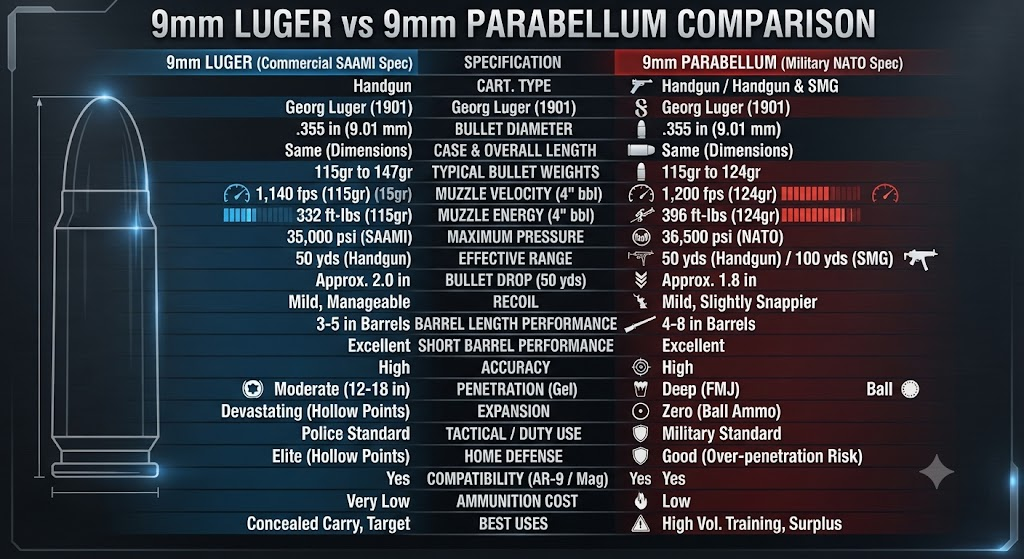
Understanding the Naming Convention
The most important fact to establish is that 9mm Luger, 9mm Parabellum, and 9x19mm are the exact same physical cartridge.
Austrian designer Georg Luger created the cartridge in 1901 for the German weapons manufacturer DWM (Deutsche Waffen und Munitionsfabriken). DWM used the Latin motto “Si vis pacem, para bellum”, which translates to “If you want peace, prepare for war.” The company named their new 9mm cartridge the “9mm Parabellum” after this motto.
When the cartridge was introduced to the United States market, American manufacturers did not want to use a European trademarked name. Therefore, the Sporting Arms and Ammunition Manufacturers Institute (SAAMI) standardized the cartridge in America under the name “9mm Luger” to honor its inventor. Today, civilian boxes in America say 9mm Luger, while European and military boxes say 9mm Parabellum.
Velocity Comparison
Velocity dictates how well a bullet performs at distance and how reliably a hollow point expands.
Muzzle Velocity Data (4 inch barrel):
- 9mm Luger (Winchester White Box 115gr FMJ): 1,140 fps
- 9mm Luger (Federal HST 124gr JHP): 1,150 fps
- 9mm Parabellum (Winchester 124gr NATO FMJ): 1,200 fps
Because military specification 9mm Parabellum is loaded to 36,500 psi (compared to the civilian SAAMI maximum of 35,000 psi), it consistently yields higher muzzle velocities. The military NATO round pushes a heavier 124 grain bullet 50 to 60 feet per second faster than a standard civilian 124 grain load. This extra velocity is designed to ensure reliable cycling in heavy military submachine guns like the MP5 or Uzi, even in freezing temperatures or fouled chambers.
Muzzle Energy Comparison
Muzzle energy measures the kinetic force transferred to the target upon impact.
Muzzle Energy Data (4 inch barrel):
- 9mm Luger (115gr Standard FMJ): 332 ft-lbs
- 9mm Luger (124gr Standard JHP): 364 ft-lbs
- 9mm Parabellum (124gr NATO FMJ): 396 ft-lbs
The 9mm Parabellum NATO spec load delivers nearly 400 foot pounds of energy. This places it directly on par with many commercial .40 S&W loads. The civilian 9mm Luger standard pressure loads are slightly softer, prioritizing shooter comfort and weapon longevity over raw kinetic force.
Trajectory Comparison
For practical handgun distances, the trajectory of both variations is practically identical.
Because the NATO spec 9mm Parabellum travels slightly faster, it technically shoots a flatter arc. However, inside 25 yards, the difference is mathematically imperceptible to the human eye. Both loads will hit exactly where the sights are aligned.
Bullet Drop Comparison
Assuming a standard 25 yard zero, the bullet drop out to 100 yards shows a marginal advantage for the hotter Parabellum load.
| Distance | 9mm Luger (115gr Standard) | 9mm Parabellum (124gr NATO) |
| 25 Yards | 0 inches | 0 inches |
| 50 Yards | -2.1 inches | -1.8 inches |
| 75 Yards | -6.8 inches | -5.9 inches |
| 100 Yards | -14.5 inches | -12.4 inches |
If you are using a pistol caliber carbine at 100 yards, the 9mm Parabellum NATO load drops roughly two inches less than standard civilian practice ammunition.
Wind Drift Comparison
Wind deflection is mitigated by a bullet’s velocity and its ballistic coefficient.
Because both names refer to the exact same physical bullet diameters and profiles, the only variable is velocity. The 9mm Parabellum NATO load reaches the target faster, giving crosswinds less time to push the projectile off course. However, handgun bullets are aerodynamically inefficient, and both will suffer significant drift in heavy winds past 50 yards.
Recoil Comparison
Recoil management is critical for fast, accurate follow up shots in a defensive scenario.
The 9mm Luger standard pressure load (115gr at 1,140 fps) is famous for its mild, pleasant recoil impulse. It allows beginner shooters to quickly master pistol fundamentals without developing a flinch.
The 9mm Parabellum NATO load is noticeably snappier. Because it operates at 36,500 psi, the slide cycles much faster and more violently. While it is still entirely manageable for an experienced shooter, it produces more muzzle flip than a standard civilian target load.
Stopping Power Comparison
Stopping power against a human threat relies on a bullet expanding reliably and transferring its energy without over penetrating.
By international law (the Hague Convention), militaries are strictly forbidden from using expanding hollow point ammunition in combat. Therefore, true military 9mm Parabellum is loaded with Full Metal Jacket (FMJ) ball ammunition. While it travels faster and carries more energy, it simply punches a clean .355 inch hole through the target, resulting in poor terminal stopping power.
Civilian 9mm Luger ammunition is not bound by this treaty. Premium defensive loads (like Speer Gold Dot or Federal HST) use advanced hollow point technology. Even at lower velocities, these civilian rounds offer vastly superior stopping power compared to military ball ammunition.
Penetration Comparison
Penetration is determined by a bullet’s construction and velocity.
A civilian 9mm Luger hollow point is engineered to penetrate exactly 12 to 18 inches in calibrated ballistic gel, meeting strict FBI protocols for defensive use. It stops inside the target.
A military 9mm Parabellum NATO FMJ round will easily penetrate 25 to 30 inches of soft tissue. This extreme penetration is desirable in warfare for punching through heavy winter clothing, light cover, and auto glass, but it is a massive liability in a civilian defensive scenario.
Expansion Comparison
As mentioned above, expansion is entirely dependent on the bullet type loaded into the brass case.
- 9mm Parabellum (Military FMJ): Zero expansion.
- 9mm Luger (Federal HST JHP): Expands reliably from .355 inches to over .65 inches, creating massive temporary and permanent wound cavities.
Accuracy Comparison
Mechanically, both the Luger and Parabellum specifications are highly accurate.
However, because standard 9mm Luger produces less recoil, the average shooter will print much tighter groups on paper with commercial ammunition. The harsh recoil impulse of the NATO specification ammunition often causes inexperienced shooters to push the gun downward in anticipation of the shot.
Effective Range Comparison
The effective range of the 9x19mm cartridge is dictated entirely by the platform firing it.
Out of a standard 4 inch pistol barrel, both the Luger and Parabellum loads have a practical effective range of 50 yards. Past this distance, the bullet drop and front sight thickness make precise hits difficult.
Out of a 16 inch pistol caliber carbine or a military submachine gun, the hotter 9mm Parabellum NATO load maintains lethal velocity out to 100 or 150 yards.
Suppressor Performance Comparison
To achieve true silence with a suppressor, a bullet must travel below the speed of sound (approximately 1,125 fps).
Most military 9mm Parabellum loads use 124 grain bullets traveling at 1,200 fps. They are supersonic and will produce a loud crack even with a suppressor attached.
The American commercial market solved this by offering 9mm Luger loaded with heavy 147 grain bullets. Because the bullet is heavier, it travels at roughly 990 fps. This keeps the cartridge safely subsonic, making the 147 grain 9mm Luger one of the best suppressed pistol cartridges in the world.
Short Barrel Performance Comparison
Modern concealed carry pistols (like the SIG P365 or Glock 43) feature incredibly short 3 inch barrels.
Because the 9x19mm cartridge uses fast burning pistol powders, it achieves a full powder burn very quickly. You can fire either 9mm Luger or 9mm Parabellum out of a micro compact pistol with only a minimal loss in velocity. However, the higher pressure 9mm Parabellum loads will produce a significantly larger muzzle flash and harsher recoil in tiny pocket pistols.
16 inch vs 10.5 inch Barrel Performance
Pistol Caliber Carbines (PCCs) are immensely popular for home defense and competition.
- 10.5 inch barrel: This is the sweet spot for the 9x19mm cartridge. It maximizes the powder burn, pushing standard 115 grain bullets past 1,300 fps.
- 16 inch barrel: Moving from 10.5 inches to 16 inches yields only marginal velocity gains (often less than 50 fps). In fact, with some low pressure 9mm Luger target loads, barrel friction in a 16 inch barrel can actually slow the bullet down compared to a 10.5 inch barrel.
Home Defense Comparison
Inside a home, over penetration is a lethal liability to family members and neighbors.
Military specification 9mm Parabellum FMJ ammunition should never be used for home defense. It will pass through an intruder, through several interior drywall walls, and into adjacent rooms.
Civilian 9mm Luger loaded with premium Jacketed Hollow Points is the gold standard for home defense. It expands violently, stops inside the intended target, and offers mild recoil for rapid follow up shots in the dark.
Hunting Comparison
The 9x19mm cartridge was not designed for hunting. It lacks the kinetic energy and flat trajectory required to ethically harvest medium game like deer. It can be used for pest control on raccoons or coyotes at close ranges, but magnum revolvers or rifle cartridges are strictly preferred for the hunting woods.
Tactical / Duty Use Comparison
The 9x19mm cartridge is the most widely used duty round on the planet.
Law enforcement agencies typically issue standard pressure 9mm Luger or slightly hotter 9mm +P hollow points. This ensures their officers have the stopping power necessary to end a threat quickly without endangering bystanders.
Militaries across the globe issue 9mm Parabellum NATO ball ammunition. The higher pressure ensures their sidearms and submachine guns cycle reliably in muddy, sandy, or freezing battlefield environments.
AR-15 Compatibility
The AR-9 (an AR-15 chambered in 9mm) is one of the most popular pistol caliber carbines on the market.
Because an AR-9 utilizes a direct blowback operating system rather than a locked breech, it relies on a heavy bolt and heavy buffer spring to keep the chamber closed. You can safely fire both standard 9mm Luger and hot 9mm Parabellum NATO through an AR-9, but if you shoot a high volume of NATO specification ammunition, you may need to upgrade to a heavier buffer weight to prevent premature wear on the internal components.
Magazine Compatibility
There is absolutely zero difference in magazine compatibility.
Whether your box of ammunition says 9mm Luger, 9mm Parabellum, 9x19mm, or 9mm NATO, it will fit and feed flawlessly from standard Glock magazines, SIG magazines, Beretta magazines, and MP5 magazines. The external brass dimensions are machined to the exact same global standard.
Ammo Cost Comparison
The 9x19mm cartridge is the cheapest centerfire pistol ammunition available today.
Commercial 9mm Luger 115 grain practice ammunition is mass produced by the billions, making it incredibly affordable for high volume training.
Military surplus 9mm Parabellum NATO is also highly affordable. When militaries rotate their stockpiles, massive pallets of 124 grain NATO ammunition hit the civilian market at rock bottom prices.
Ammo Availability Comparison
Walk into any sporting goods store, rural hardware store, or indoor shooting range in the world, and you will find 9x19mm ammunition on the shelf. It is universally available. The boxes will predominantly be labeled “9mm Luger” in the United States and “9mm Parabellum” in Europe, but they are completely interchangeable.
Reloading Comparison
Reloading the 9x19mm cartridge is incredibly simple and highly rewarding for competition shooters.
Because the brass cases are identical, you can pick up empty 9mm Parabellum military brass at the range and reload it to civilian 9mm Luger specifications.
Caution: Military 9mm Parabellum brass often features crimped primer pockets to prevent the primer from backing out during fully automatic fire. If you are reloading military brass, you must use a swaging tool to remove this crimp before attempting to seat a new primer.
Pros and Cons
9mm Luger (Civilian SAAMI Spec)
Pros
- Lower operating pressure results in a mild, pleasant recoil impulse.
- Less wear and tear on the internal components of your handgun.
- Widely available in advanced hollow point designs for self defense.
- Available in 147 grain subsonic loads for excellent suppressor use.
Cons
- Slightly lower muzzle velocity than military specifications.
- Standard target loads may fail to cycle very heavy, stiff competition springs.
9mm Parabellum (Military NATO Spec)
Pros
- Higher pressure ensures incredibly reliable cycling in dirty environments.
- Delivers superior muzzle energy and velocity.
- Perfect for breaking in stiff, brand new pistol recoil springs.
- Flatter trajectory at extended distances out of pistol caliber carbines.
Cons
- Snappier recoil makes rapid follow up shots slightly more difficult.
- Military surplus is almost exclusively Full Metal Jacket (poor for defense).
- Crimped primer pockets add an extra step to the reloading process.
Final Verdict
Choosing between 9mm Luger and 9mm Parabellum ammunition comes down to understanding what you need the bullet to do, since they fit into the exact same firearms.
- For Home Defense and Concealed Carry: Choose 9mm Luger. Specifically, look for premium Jacketed Hollow Points. They provide devastating stopping power while protecting bystanders from over penetration.
- For Breaking in a New Gun: Choose 9mm Parabellum. The extra 1,500 psi of pressure will forcefully cycle the slide, breaking in stiff factory recoil springs and smoothing out the action.
- For High Volume Range Training: Choose 9mm Luger. Standard 115 grain target loads are cheap, shoot softly, and will not cause unnecessary wear on your pistol.
- For Suppressed Shooting: Choose 9mm Luger. A 147 grain civilian load is naturally subsonic and will sound incredibly quiet through a quality silencer.
- For Submachine Guns and Carbines: Choose 9mm Parabellum. The hotter military loads thrive in long barrels and easily cycle heavy blowback bolts.
FAQ
Are 9mm Luger and 9mm Parabellum the same thing?
Yes. Physically, they share the exact same case length, bullet diameter, and overall dimensions. They will both chamber and fire in any firearm stamped 9x19mm. The names simply reflect different historical origins and commercial marketing practices.
Can I shoot 9mm Parabellum in my 9mm Luger pistol?
Yes. Any modern, well manufactured 9mm Luger pistol from a reputable company (like Glock, SIG Sauer, Smith & Wesson, or Beretta) can safely fire 9mm Parabellum NATO ammunition. However, shooting a steady diet of hot NATO ammunition may require you to replace your recoil spring slightly sooner.
Does 9mm Parabellum have more recoil than 9mm Luger?
Generally, yes. Because 9mm Parabellum is often loaded to NATO military specifications (36,500 psi), it burns a slightly hotter powder charge than standard civilian 9mm Luger (35,000 psi). This results in a faster slide velocity and a slightly snappier recoil impulse.
Why is it called Parabellum?
The term Parabellum comes from the Latin phrase “Si vis pacem, para bellum”, which means “If you want peace, prepare for war.” The German company DWM used this phrase as their telegraphic address and motto, eventually naming their new 9mm cartridge after it in 1901.
Is 9mm NATO the same as 9mm Parabellum?
Yes. 9mm NATO is the formalized military specification of the 9mm Parabellum cartridge. When a box is labeled 9mm NATO, it guarantees the ammunition meets the strict pressure, velocity, and reliability standards required by the North Atlantic Treaty Organization.
Which is better for self defense?
Civilian 9mm Luger loaded with premium hollow points is infinitely better for self defense. Military 9mm Parabellum is typically loaded with full metal jacket ball ammunition, which will pass straight through an attacker without stopping them quickly, while endangering innocent people behind them.
What does 9x19mm mean?
The designation 9x19mm is the metric measurement of the cartridge. The bullet is roughly 9 millimeters in diameter, and the brass casing is 19 millimeters long. This metric designation is the most accurate way to describe the physical cartridge regardless of commercial names.
Can I put a 9mm Luger bullet in a 9mm Parabellum magazine?
Yes. Because the external dimensions of the cartridges are exactly identical, they use the exact same magazines, barrels, and extractors. You can even mix them interchangeably in the same magazine without causing a feeding malfunction.