The main difference between the .300 Weatherby Magnum and the .300 Winchester Magnum is that the .300 Weatherby Magnum features a larger case capacity and a unique double radius shoulder to deliver roughly 150 to 200 feet per second more velocity for extreme long range hunting, whereas the .300 Winchester Magnum fits perfectly into standard long action rifles and offers ubiquitous ammunition availability with noticeably milder recoil.
.300 Weatherby Magnum vs .300 Winchester Magnum Comparison Table
To understand how these two legendary .30 caliber magnums compare, we must examine their physical dimensions and baseline ballistic performance. The data below represents standard premium factory loads firing popular 180 grain hunting bullets.
| Specification | .300 Weatherby Magnum | .300 Winchester Magnum |
| Cartridge Type | Belted Magnum Rifle | Belted Magnum Rifle |
| Parent Case | .300 H&H Magnum | .375 H&H Magnum |
| Bullet Diameter | .308 in (7.62 mm) | .308 in (7.62 mm) |
| Case Length | 2.825 in | 2.620 in |
| Overall Length | 3.560 in | 3.340 in |
| Typical Bullet Weights | 150 gr to 220 gr | 150 gr to 220 gr |
| Muzzle Velocity (180gr) | Approx. 3,240 fps | Approx. 2,960 fps |
| Muzzle Energy (180gr) | 4,195 ft-lbs | 3,501 ft-lbs |
| Maximum Pressure | 65,000 psi (SAAMI) | 64,000 psi (SAAMI) |
| Effective Range | 1,000+ yds (Target) / 800 yds (Hunting) | 1,000+ yds (Target) / 600 yds (Hunting) |
| Trajectory | Extremely Flat | Very Flat |
| Bullet Drop (500 yds) | Approx. 28 inches | Approx. 36 inches |
| Wind Drift | Minimal | Moderate |
| Recoil | Heavy (Approx. 31 ft-lbs) | Moderate to Heavy (Approx. 26 ft-lbs) |
| Barrel Length Performance | Requires 26 inch barrel for max velocity | Performs excellently in 24 inch barrels |
| Action Size | Magnum Long Action | Standard Long Action |
| Hunting Performance | Elite (Elk, Moose, Bear at extreme range) | Excellent (All North American Game) |
| Accuracy | Sub-MOA | Sub-MOA |
| Ammunition Cost | Very High | Moderate |
| Ammo Availability | Specialty or Online | Ubiquitous |
| Best Uses | Extreme distance open country hunting | General purpose big game hunting |
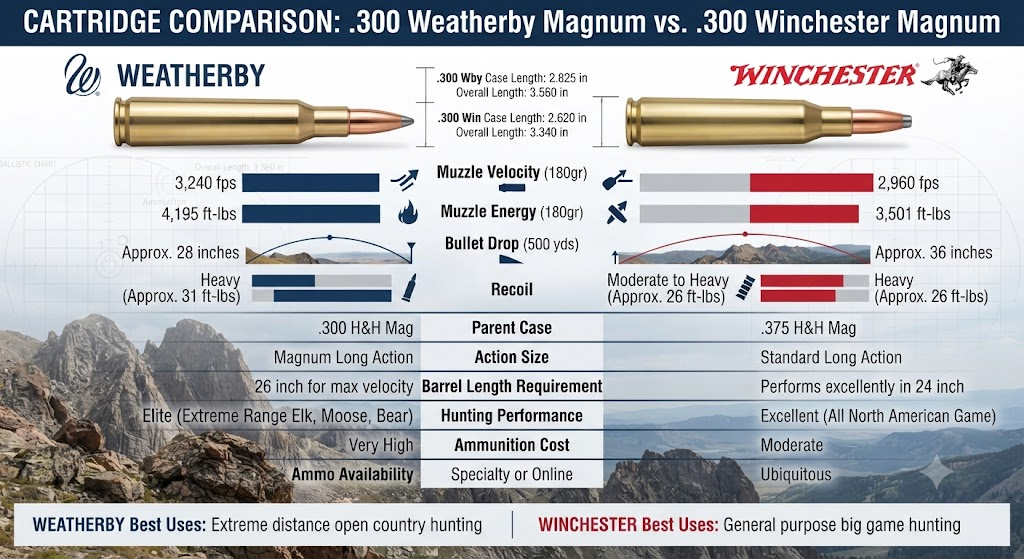
Understanding the Numbers
The technical differences between these cartridges are rooted in their case designs. Roy Weatherby designed his .300 magnum in 1944 by blowing out the .300 H&H Magnum case to maximize powder capacity, giving it his signature double radius shoulder. Because of its massive 3.560 inch overall length, it requires a specialized magnum length action.
Winchester introduced their .300 magnum nearly two decades later in 1963. They took a completely different approach by keeping the overall length at 3.340 inches. This brilliant engineering decision allowed the .300 Winchester Magnum to fit perfectly into standard long action rifles (the same size action used for the .30-06 Springfield). However, to maximize powder capacity in a shorter case, Winchester had to push the shoulder forward, resulting in a famously short case neck.
Velocity Comparison
Velocity is the primary reason hunters choose a magnum cartridge. High velocity keeps bullets supersonic longer, resists wind drift, and ensures reliable bullet expansion at extended ranges.
- .300 Weatherby Magnum (Weatherby Select 180gr): 3,240 fps
- .300 Winchester Magnum (Federal Premium 180gr): 2,960 fps
The .300 Weatherby Magnum is an absolute powerhouse. Because its elongated case holds significantly more powder, it consistently outpaces the .300 Winchester Magnum by 150 to 250 feet per second depending on the specific load. This extreme speed was Roy Weatherby’s primary goal, and it remains one of the fastest commercial .30 caliber magnums on the market.
Muzzle Energy Comparison
Muzzle energy dictates how much kinetic force the bullet carries upon impact to anchor large animals.
- .300 Weatherby Magnum (180gr): 4,195 ft-lbs
- .300 Winchester Magnum (180gr): 3,501 ft-lbs
Both cartridges generate enough energy to cleanly harvest any animal in North America. However, the .300 Weatherby Magnum easily crosses the 4,000 foot pound threshold. This massive kinetic energy advantage provides a larger margin of error on heavy boned game like Alaskan moose or large grizzly bears.
Trajectory Comparison
A flat trajectory minimizes the need for drastic holdover adjustments in the field.
Because the .300 Weatherby Magnum drives the exact same .308 caliber bullets significantly faster than the Winchester, it shoots noticeably flatter. The Weatherby reaches the target faster, giving gravity less time to pull the projectile toward the earth. This makes the Weatherby a slightly more forgiving cartridge if your range estimation is off by 20 or 30 yards in open country.
Bullet Drop Comparison
Assuming a standard 200 yard zero and a 180 grain bullet, the mathematical drop at 500 yards highlights the Weatherby advantage.
- .300 Weatherby Magnum (180gr): Drops approximately 28 inches at 500 yards.
- .300 Winchester Magnum (180gr): Drops approximately 36 inches at 500 yards.
Trimming 8 inches off your bullet drop at half a mile is a massive ballistic advantage for extreme long range hunters.
Wind Drift Comparison
Wind deflection is the primary cause of missed shots at extreme ranges. Since both cartridges can be loaded with the exact same high ballistic coefficient bullets, velocity is the only determining factor for wind drift.
Because the .300 Weatherby Magnum reaches the target faster, it spends less time exposed to crosswinds. At 500 yards in a 10 mph crosswind, the Weatherby will drift several inches less than the .300 Winchester Magnum.
Recoil Comparison
You cannot generate 4,000 foot pounds of energy without paying a heavy price in physical recoil.
The .300 Winchester Magnum is famous for producing a stout but manageable recoil impulse, usually hovering around 26 foot pounds of free recoil in an 8.5 pound rifle. Most average sized hunters can master it with practice.
The .300 Weatherby Magnum steps into heavy recoil territory. Firing massive powder charges to achieve extreme velocities pushes the free recoil past 30 foot pounds. Unbraked Weatherby rifles are notoriously punishing to shoot off the bench, and many shooters develop a flinch if they do not use a quality muzzle brake or suppressor.
Stopping Power Comparison
Both cartridges hit with devastating force. However, the .300 Weatherby Magnum delivers superior stopping power simply because it arrives at the target with higher retained velocity and more kinetic energy. This guarantees wider, more violent bullet expansion at extended ranges where the .300 Winchester Magnum might drop below the velocity threshold required to open a tough bonded bullet.
Penetration Comparison
Penetration is determined by a bullet’s sectional density and its construction. Since both cartridges fire the exact same .30 caliber projectiles, their potential for deep penetration is nearly identical.
In some cases at very close ranges (inside 100 yards), the extreme velocity of the .300 Weatherby Magnum can actually cause standard cup and core bullets to fragment prematurely upon hitting heavy bone. To get maximum penetration from the Weatherby, hunters must use premium monolithic copper or heavily bonded bullets.
Accuracy Comparison
Both cartridges are capable of elite, sub minute of angle precision.
The .300 Winchester Magnum is widely considered one of the most inherently accurate magnum cartridges ever designed. It was adopted by military snipers for decades precisely because of its predictable harmonic nodes and consistency.
The .300 Weatherby Magnum is also highly accurate, but it traditionally features a long freebore (the unrifled portion of the barrel just ahead of the chamber). This long throat allows the bullet to gain momentum before hitting the rifling, which safely keeps pressures down, but it can sometimes make tuning handloads for pinpoint accuracy slightly more challenging.
Effective Range Comparison
The .300 Winchester Magnum is a proven 1,000 yard target cartridge and a highly ethical 600 yard hunting cartridge in the hands of a skilled marksman.
The .300 Weatherby Magnum pushes those boundaries even further. Because it retains its velocity and energy over a longer distance, it stretches the ethical hunting range out to 800 yards on medium game, assuming the hunter has the skill to make the shot.
Barrel Length Performance Comparison
Magnum cartridges require long barrels to burn their massive powder charges efficiently.
The .300 Winchester Magnum performs exceptionally well in standard 24 inch barrels. If you cut it down to 22 inches, you lose some velocity, but it remains a highly effective hunting tool.
The .300 Weatherby Magnum essentially mandates a 26 inch barrel. If you try to fire a Weatherby Magnum out of a 24 inch or 22 inch barrel, a massive amount of unburnt powder will explode outside the muzzle. You will suffer blinding muzzle flash, deafening concussion, and enough velocity loss to completely negate the ballistic advantage of buying a Weatherby in the first place.
Hunting Comparison
Both cartridges are absolute hammers in the hunting woods.
For whitetail deer or antelope, both are arguably overkill. However, when hunting elk across windy canyons, or pursuing moose and grizzly bears in Alaska, they both shine brightly.
The .300 Winchester Magnum is the practical hunter’s choice. It is lighter to carry, kicks less, and will harvest any animal on the continent. The .300 Weatherby Magnum is the specialist’s choice. It provides an undeniable ballistic advantage for hunters who regularly take shots past 400 yards in open country.
Action Length and Rifle Compatibility
This is a massive logistical difference.
The .300 Winchester Magnum fits in a standard long action receiver. This means almost every rifle manufacturer in the world chambers their standard hunting rifles in .300 Win Mag. You have unlimited choices ranging from budget friendly entry level rifles to high end custom builds.
The .300 Weatherby Magnum requires a magnum length action to accommodate its 3.560 inch overall length. Very few manufacturers produce magnum length actions outside of Weatherby themselves. Consequently, your rifle choices are largely limited to Weatherby brand rifles (like the Mark V or Vanguard) or expensive custom actions.
Ammo Cost Comparison
The .300 Winchester Magnum is incredibly affordable by magnum standards. Because it is produced globally in massive quantities, you can easily find budget friendly practice ammunition and moderately priced premium hunting loads.
The .300 Weatherby Magnum is a premium, proprietary style cartridge. Practice ammunition essentially does not exist. A box of 20 premium hunting rounds for the Weatherby typically costs double or triple the price of a comparable box of .300 Winchester Magnum.
Ammo Availability Comparison
You can walk into any rural hardware store, bait shop, or big box sporting goods retailer in North America and find boxes of .300 Winchester Magnum sitting on the shelf.
The .300 Weatherby Magnum is a specialty item. While large outdoor retailers usually carry a few boxes, you will likely need to order it online. If an airline loses your luggage on a hunting trip to rural Alaska, you will easily find replacement .300 Win Mag ammo at the local general store, but you will likely never find .300 Weatherby ammo.
Reloading Comparison
Both cartridges have deep roots in the handloading community.
The .300 Winchester Magnum is extremely easy to reload. Brass is cheap, load data is infinite, and components are available everywhere. The only minor drawback is the short case neck, which can sometimes make seating very long, heavy bullets tricky.
The .300 Weatherby Magnum is a reloader’s dream for maximizing velocity, and it features a long neck that holds heavy bullets perfectly. However, Weatherby brass is very expensive, and the double radius shoulder requires specific sizing dies to shape correctly.
Pros and Cons
.300 Weatherby Magnum
Pros
- Generates over 4,000 foot pounds of kinetic energy.
- Shoots significantly flatter than standard .30 caliber magnums.
- Retains lethal velocity and energy at extreme distances.
- Long case neck holds heavy bullets very securely.
Cons
- Ammunition is very expensive and hard to find locally.
- Generates heavy, punishing recoil.
- Requires a 26 inch barrel, making the rifle long and unwieldy.
- Rifle choices are mostly limited to Weatherby brand firearms.
.300 Winchester Magnum
Pros
- Fits in standard long action rifles, keeping the weapon lighter and shorter.
- Ammunition is ubiquitous and highly affordable.
- Massive selection of rifles available from every major manufacturer.
- Milder recoil impulse is easier for average shooters to master.
- Performs excellently in standard 24 inch barrels.
Cons
- Slower velocity yields slightly more bullet drop at extreme ranges.
- Short case neck can cause seating issues with modern ultra long bullets.
- Belted case design can sometimes lead to case stretching during reloading.
Final Verdict
Choosing between the .300 Weatherby Magnum and the .300 Winchester Magnum comes down to balancing extreme ballistic performance against practical logistics.
- For Extreme Long Range Hunting: Choose the .300 Weatherby Magnum. The extra 200 feet per second provides a flatter trajectory and more kinetic energy, which is invaluable when taking shots on elk past 500 yards.
- For the Practical Hunter: Choose the .300 Winchester Magnum. It provides 90% of the Weatherby’s performance with cheaper ammunition, less recoil, and an infinitely larger selection of rifles.
- For Budget Conscious Shooters: Choose the .300 Winchester Magnum. You will save massive amounts of money on factory ammunition.
- For Handloaders Seeking Maximum Power: Choose the .300 Weatherby Magnum. The massive case capacity allows experienced handloaders to push .30 caliber bullets to their absolute limits.
- For Backcountry Mountain Hunts: Choose the .300 Winchester Magnum. You can use a lighter standard long action rifle with a 24 inch barrel, making the hike much more comfortable than carrying a heavy 26 inch Weatherby magnum.
FAQ
Is the .300 Weatherby more powerful than the .300 Win Mag?
Yes. The .300 Weatherby Magnum has a larger case capacity, allowing it to hold more powder. This results in velocities roughly 150 to 200 feet per second faster and generates significantly more kinetic energy than the .300 Winchester Magnum.
Can I shoot .300 Win Mag in a .300 Weatherby rifle?
No. Attempting to fire a .300 Winchester Magnum cartridge in a .300 Weatherby Magnum rifle is extremely dangerous. The cartridges have completely different case dimensions and shoulder angles. Firing the wrong ammunition will cause a catastrophic firearm failure.
Does the .300 Weatherby kick harder?
Yes. Because the .300 Weatherby Magnum burns more powder and drives the bullet faster, it generates noticeably more free recoil than the .300 Winchester Magnum. Many shooters rely on muzzle brakes to tame the Weatherby’s kick.
Why does the .300 Weatherby have a rounded shoulder?
Roy Weatherby designed the double radius (rounded) shoulder believing it smoothed the flow of burning powder gases into the barrel, which he theorized increased velocity and reduced pressure spikes. Today, it remains the signature hallmark of all classic Weatherby magnum cartridges.
Is the .300 Win Mag accurate enough for long range?
Absolutely. The .300 Winchester Magnum is world renowned for its precision. It was the standard issue sniper rifle cartridge for the U.S. military for many years and routinely prints sub minute of angle groups at 1,000 yards with quality ammunition.
Which ammo is easier to find?
The .300 Winchester Magnum is infinitely easier to find. It is one of the most popular hunting cartridges in the world and is stocked in almost every store that sells ammunition. Weatherby ammunition is considered a specialty item and is much harder to find locally.