A 25 Yard Zero Chart is a specialized ballistic reference table that displays the exact bullet trajectory and point of impact at various distances when a rifle is perfectly sighted in at twenty five yards. This specific zeroing method is deeply rooted in military tradition because it naturally creates a secondary zero intersection point near three hundred yards for standard velocity cartridges. Shooters utilize this chart to understand precisely how high their bullets will travel above the line of sight before gravity eventually pulls them back down. By referencing these verified ballistic values marksmen can make highly accurate elevation holds during combat applications and competitive shooting events.
25 Yard Zero Chart
| Manufacturer | Load Name | Bullet Weight | Bullet Type | Ballistic Coefficient | Muzzle Velocity | 25 Yard Impact | 50 Yard Impact | 100 Yard Impact | 200 Yard Impact | 300 Yard Impact | 400 Yard Impact | 500 Yard Impact | Maximum Point Blank Range |
| Winchester | M193 | 55 Grain | FMJ | 0.267 | 3270 FPS | 0.0 Inches | 1.5 Inches High | 4.5 Inches High | 5.5 Inches High | 0.0 Inches | 14.5 Inches Low | 42.0 Inches Low | 315 Yards |
| Hornady | V MAX | 55 Grain | Polymer Tip | 0.255 | 3240 FPS | 0.0 Inches | 1.5 Inches High | 4.6 Inches High | 5.8 Inches High | 0.8 Inches Low | 16.5 Inches Low | 46.0 Inches Low | 312 Yards |
| PMC | X TAC | 62 Grain | Green Tip LAP | 0.304 | 3100 FPS | 0.0 Inches | 1.6 Inches High | 4.8 Inches High | 6.0 Inches High | 0.5 Inches Low | 15.5 Inches Low | 44.5 Inches Low | 310 Yards |
| Black Hills | Mk 262 Mod 1 | 77 Grain | OTM | 0.372 | 2750 FPS | 0.0 Inches | 1.9 Inches High | 5.8 Inches High | 8.5 Inches High | 3.5 Inches Low | 24.5 Inches Low | 59.0 Inches Low | 290 Yards |
| Federal Premium | Gold Medal | 69 Grain | Sierra MatchKing | 0.301 | 2950 FPS | 0.0 Inches | 1.7 Inches High | 5.2 Inches High | 7.2 Inches High | 2.0 Inches Low | 20.0 Inches Low | 52.5 Inches Low | 300 Yards |
| Barnes | VOR TX | 55 Grain | TSX | 0.236 | 3220 FPS | 0.0 Inches | 1.6 Inches High | 4.7 Inches High | 6.2 Inches High | 1.5 Inches Low | 18.5 Inches Low | 50.5 Inches Low | 308 Yards |
| Speer | Gold Dot | 64 Grain | Soft Point | 0.334 | 3000 FPS | 0.0 Inches | 1.7 Inches High | 5.0 Inches High | 6.8 Inches High | 1.2 Inches Low | 17.5 Inches Low | 47.0 Inches Low | 305 Yards |
| Hornady | Frontier Match | 68 Grain | BTHP | 0.355 | 2960 FPS | 0.0 Inches | 1.7 Inches High | 5.1 Inches High | 7.0 Inches High | 1.5 Inches Low | 17.0 Inches Low | 45.0 Inches Low | 306 Yards |
| Federal | American Eagle | 62 Grain | FMJ | 0.304 | 3020 FPS | 0.0 Inches | 1.7 Inches High | 5.0 Inches High | 6.9 Inches High | 1.8 Inches Low | 19.5 Inches Low | 50.5 Inches Low | 302 Yards |
| Nosler | Varmageddon | 55 Grain | FBHP | 0.255 | 3100 FPS | 0.0 Inches | 1.6 Inches High | 4.9 Inches High | 6.5 Inches High | 1.5 Inches Low | 19.0 Inches Low | 53.0 Inches Low | 305 Yards |
| Hornady | Black | 75 Grain | BTHP | 0.395 | 2790 FPS | 0.0 Inches | 1.8 Inches High | 5.6 Inches High | 8.0 Inches High | 3.0 Inches Low | 22.5 Inches Low | 56.5 Inches Low | 295 Yards |
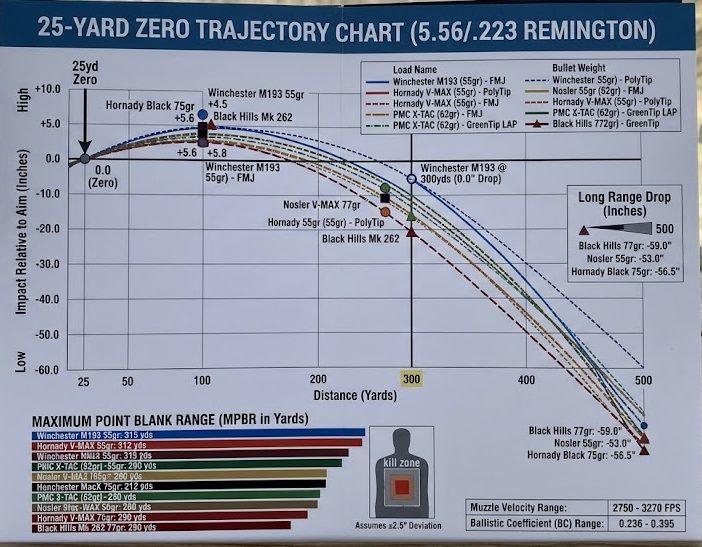
Shooters should utilize this reference table by locating their specific factory load and studying how the point of impact shifts vertically at various standard yardages. This verified information allows the operator to hold their optic reticle at the precise elevation required to strike targets accurately without guessing.
Understanding The 25 Yard Zero Chart
Point Of Impact Analysis
The provided chart demonstrates that every factory load initially strikes perfectly at the point of aim at twenty five yards before climbing significantly higher. The Winchester M193 fifty five grain load impacts one point five inches high at fifty yards because the barrel is angled slightly upward relative to the optic.
After crossing the initial zero distance the bullets continue traveling upward and reach their trajectory peak near the two hundred yard line. The Black Hills Mk 262 Mod 1 seventy seven grain load experiences the highest mid range trajectory by rising eight point five inches above the crosshairs at two hundred yards.
As the bullets travel toward three hundred yards they begin falling back down to closely intersect the line of sight for a second time. The Winchester M193 provides a practically perfect secondary zero by impacting exactly on the line of sight at this specific distance.
When the distance stretches to four hundred yards every projectile in the chart begins dropping drastically below the aiming point. The PMC X TAC sixty two grain load drops fifteen point five inches low which forces the shooter to aim well over the intended impact zone.
At the extreme distance of five hundred yards the differences in bullet weight and aerodynamic efficiency become incredibly obvious across the chart. The heavy Black Hills seventy seven grain bullet plummets fifty nine inches low while the lighter Winchester M193 drops only forty two inches low.
Trajectory Analysis
The overall flatness of a trajectory curve is determined entirely by the initial muzzle velocity and the ballistic coefficient of the specific bullet design. The Winchester M193 fifty five grain load exhibits the absolute flattest trajectory in the table out to four hundred yards by dropping only fourteen point five inches.
Heavier projectiles struggle to maintain a flat flight path at close distances because their increased mass drastically lowers their initial muzzle velocity. The Federal Premium Gold Medal sixty nine grain load peaks at seven point two inches high at two hundred yards which creates a noticeably steeper curve than lighter options.
Ultra fast bullets shoot incredibly flat inside three hundred yards but they can lose momentum rapidly if their aerodynamic profile is poor. The Barnes VOR TX fifty five grain load starts at three thousand two hundred and twenty feet per second but still drops fifty point five inches at five hundred yards.
Executing practical holdovers with this specific zero requires the shooter to aim significantly low at one hundred and two hundred yards for practically every load. If a marksman is firing the Speer Gold Dot sixty four grain soft point at two hundred yards they must aim six point eight inches below their desired target center.
Engaging targets beyond three hundred yards mandates substantial elevation corrections upward for every single ammunition type shown in the table. A tactical shooter using the Federal American Eagle sixty two grain load must dial their optic exactly nineteen point five inches to hit a target at four hundred yards.
Velocity Analysis
The speed at which a bullet leaves the muzzle determines how much time gravity has to affect the projectile before it reaches the target. The Winchester M193 load holds the highest velocity in the table by launching its fifty five grain bullet at an incredible three thousand two hundred and seventy feet per second.
This blistering muzzle velocity directly provides the longest maximum point blank range available in our entire data set. The Winchester M193 offers a three hundred and fifteen yard maximum point blank range which means the shooter can completely ignore bullet drop on large silhouette targets inside that distance.
In sharp contrast the heavy Black Hills Mk 262 seventy seven grain load leaves the barrel at a relatively slow two thousand seven hundred and fifty feet per second. This slower initial speed means gravity pulls the bullet down much faster causing a much steeper mid range trajectory arc.
Muzzle velocity is not the only factor that dictates extreme long range performance because ballistic coefficients also play a massive role in energy retention. The Hornady Frontier Match sixty eight grain load leaves the muzzle at two thousand nine hundred and sixty feet per second but retains speed efficiently due to its zero point three five five ballistic coefficient.
Moderate velocities combined with medium weight projectiles offer an outstanding balance of performance across all practical shooting distances. The Speer Gold Dot sixty four grain load exits exactly at three thousand feet per second providing a manageable trajectory that drops only seventeen point five inches at four hundred yards.
Best Factory Loads Based On The Chart
For general purpose tactical training the Winchester M193 fifty five grain full metal jacket is undeniably the most effective option listed. It features the flattest trajectory inside three hundred yards and provides a generous three hundred and fifteen yard maximum point blank range.
If the shooter needs a reliable load for defensive applications the Speer Gold Dot sixty four grain soft point is an incredible selection based on the data. The flight path is highly predictable returning to just one point two inches low at three hundred yards while delivering barrier blind terminal performance.
For precision target shooting at intermediate ranges the Federal Premium Gold Medal sixty nine grain match bullet performs flawlessly. It offers match grade consistency and drops a very manageable twenty inches at four hundred yards.
When engaging steel targets in high wind conditions the Black Hills Mk 262 Mod 1 seventy seven grain load remains completely unmatched by lighter bullets. Its massive zero point three seven two ballistic coefficient ensures it cuts through crosswinds exceptionally well despite having the most vertical drop at distance.
For versatile performance that mimics military specifications the PMC X TAC sixty two grain green tip is highly recommended for tactical carbines. It perfectly balances velocity and penetration while dropping only fifteen point five inches at four hundred yards.
Key Takeaways From The Chart
The flattest overall trajectory inside the three hundred yard marker belongs exclusively to the Winchester M193 fifty five grain load. It perfectly maximizes high muzzle velocity to keep the trajectory arc incredibly tight during the first half of its flight.
The fastest load measured in our ballistic data set is also the Winchester M193 clocking in at three thousand two hundred and seventy feet per second. This immense speed is the primary reason it features the longest point blank capabilities in the chart.
The load with the absolute least drop at four hundred yards is the Winchester M193 at fourteen point five inches low. The PMC X TAC green tip follows very closely behind by dropping exactly fifteen point five inches low.
The best overall defensive factory load listed in the table is the Speer Gold Dot sixty four grain soft point projectile. It delivers tremendous velocity for reliable hollow point expansion while keeping the mid range trajectory arc lower than most heavy loads.
The load that provides the greatest stability for extreme long range precision is the Black Hills Mk 262 Mod 1. It dominates the heavy bullet category by utilizing superior aerodynamics to remain perfectly stable through transonic flight phases.
How A 25 Yard Zero Affects Trajectory
50 Yards
When utilizing this highly specific calibration method the rifle barrel is pitched aggressively upward relative to the optical sight path. This means that when the bullet reaches the fifty yard marker it is climbing rapidly above the original point of aim.
Our data table proves that the Hornady Frontier Match sixty eight grain load impacts exactly one point seven inches high at this close distance. Shooters taking shots on very small targets at fifty yards must consciously remember to hold their reticle slightly low to guarantee a center hit.
100 Yards
The one hundred yard marker represents a massive vertical shift for practically all loads calibrated at this short distance. The bullet has fully crossed the initial line of sight and is now traveling significantly above the optical crosshairs.
Analyzing the Federal American Eagle sixty two grain load shows the bullet impacting exactly five inches high at this specific distance. If a shooter attempts to hit a small steel plate they must intentionally aim into the lower third of the target to score a perfect hit.
200 Yards
The two hundred yard distance is exactly where this calibration method peaks in its trajectory arc for standard tactical rifles. At this range the bullet is at its absolute highest altitude above the line of sight before gravity finally halts its upward momentum.
The Hornady Black seventy five grain load impacts a massive eight inches high at two hundred yards. This incredible ballistic rise means a shooter aiming dead center at a small target will likely shoot completely over the top of it.
300 Yards
By the time the projectile reaches the three hundred yard marker it is falling perfectly back downward to intersect the optical line of sight. The initial muzzle velocity has bled off significantly and gravity is pulling the bullet back toward the zero plane.
The Barnes VOR TX load drops one point five inches low at this specific yardage requiring a very minor elevation adjustment. A shooter can effectively place their reticle dead center on a silhouette target and guarantee a vital strike without touching their elevation knobs.
Beyond 300 Yards
Past three hundred yards these lightweight projectiles shed velocity so drastically that the trajectory curve becomes exceptionally steep and difficult to manage visually. Wind drift also becomes a massive variable that can push the bullet entirely off a standard silhouette target.
The Hornady V MAX fifty five grain load drops a massive forty six inches at five hundred yards. Attempting to reliably hit targets at this extreme distance requires a dedicated precision optic equipped with exposed target turrets and a thoroughly validated drop chart.
Common Bullet Weights For A 25 Yard Zero
55 Grain
Fifty five grain bullets are the undeniable global standard for the AR 15 platform and represent the most common military training load available today. They offer the absolute perfect balance of extreme speed and highly affordable manufacturing costs.
As proven by the Winchester M193 load in our chart they impact roughly four point five inches high at one hundred yards. Muzzle velocities typically sit very reliably at three thousand two hundred and seventy feet per second from standard rifle lengths.
Their primary advantage is massive commercial availability and incredibly low cost for high volume tactical training courses. A slight disadvantage is that they struggle heavily to cheat the wind at extreme long ranges when compared to heavier match grade bullets.
The absolute best application for this bullet weight is high volume carbine courses and general purpose defensive training drills. They provide a beautifully flat trajectory that allows shooters to enjoy a three hundred and fifteen yard maximum point blank range on large silhouettes.
62 Grain
Sixty two grain bullets were adopted by military forces to provide superior penetration against light barriers when compared to older fifty five grain designs. They frequently feature a steel penetrator core internally which is commonly recognized by a painted green tip.
The PMC X TAC load demonstrates that this exact weight travels at roughly three thousand one hundred feet per second. It provides an excellent tactical trajectory that lands practically dead center at the three hundred yard marker.
The major advantage is enhanced penetration against tough targets and slightly better wind deflection characteristics due to the increased mass. The main disadvantage is that surplus penetrator ammunition is rarely manufactured to precision match grade accuracy standards.
This bullet weight is best applied to defensive stockpiling and tactical scenarios where light barrier penetration might become necessary during an engagement. It is an incredibly reliable and combat proven weight for all modern sporting rifles.
64 Grain
Sixty four grain bullets were explicitly designed to bridge the difficult gap between lightweight training rounds and heavy precision target rounds. They are heavily favored by law enforcement agencies across the entire country for primary duty applications.
The Speer Gold Dot load in our chart pushes this specific weight to exactly three thousand feet per second. The resulting flight path is highly predictable and drops only seventeen point five inches at four hundred yards.
The greatest advantage of this bullet weight is massive expansion and complete weight retention through tough barriers like automotive windshield glass. There are virtually no tactical disadvantages when this projectile is used within its intended three hundred yard performance envelope.
This is the ultimate bullet weight for home defense setups and professional police patrol rifle applications. It guarantees deep penetration and massive tissue disruption while maintaining a highly reliable trajectory arc.
68 Grain
Sixty eight grain bullets are highly specialized match grade projectiles designed entirely for punching paper targets and ringing steel plates at distance. They feature a hollow point boat tail design intended purely for maximum aerodynamic efficiency in flight.
The Hornady Frontier Match load utilizes this specific weight to achieve an impressive zero point three five five ballistic coefficient. It leaves the muzzle at two thousand nine hundred and sixty feet per second and peaks at seven inches high at two hundred yards.
The main advantage is superior mid range accuracy and excellent resistance to unpredictable crosswinds on the firing line. The distinct disadvantage is that the hollow point target design is not meant for defensive use and will fragment unpredictably in soft tissue.
This specific bullet weight is best suited for local precision rifle matches and engaging steel plates out to six hundred yards. It provides match winning consistency without generating the heavy recoil associated with larger caliber precision rifles.
69 Grain
Sixty nine grain bullets are completely legendary in the competitive shooting world particularly those featuring the Sierra MatchKing profile. They are designed to extract the maximum possible inherent accuracy from standard twist barrels used in service rifle competitions.
The Federal Premium Gold Medal load perfectly shows this weight traveling at two thousand nine hundred and fifty feet per second from the muzzle. It arcs significantly higher at two hundred yards by hitting seven point two inches above the exact aiming point.
The advantage is spectacular inherent precision that frequently produces single hole groups at one hundred yards on paper targets. The disadvantage is a very looping trajectory that requires precise range estimation past the three hundred yard marker.
This weight is the gold standard application for benchrest shooting and high power service rifle target matches. It gives the dedicated marksman extreme confidence that the bullet will strike exactly where the optical crosshairs rest.
75 Grain
Seventy five grain bullets push the absolute limits of what can be seated to standard magazine length in a tactical semi automatic rifle. They require a faster barrel twist rate to properly stabilize during extended long range flight paths.
The Hornady Black load shows this massive projectile leaving the muzzle at a sluggish two thousand seven hundred and ninety feet per second. However its massive ballistic coefficient allows it to retain kinetic energy effortlessly out to extreme distances.
The primary advantage is unmatched terminal performance on tough targets and spectacular long range ballistic stability in heavy winds. The distinct disadvantage is that they will tumble wildly and lose all accuracy if fired from an older slow twist barrel.
These heavy bullets are best applied to designated marksman roles and specialized defensive applications requiring massive energy transfer. They hit targets with incredible authority and refuse to be pushed off course by sudden wind gusts.
77 Grain
Seventy seven grain bullets are the heaviest projectiles that can reliably function through standard magazines without requiring manual single loading techniques. They were developed specifically for military special operations marksmen requiring maximum lethality at extended combat ranges.
The Black Hills Mk 262 Mod 1 load clearly displays the steep initial trajectory of this massive weight peaking eight point five inches high at two hundred yards. The initial muzzle velocity is a very modest two thousand seven hundred and fifty feet per second.
The advantage is devastating terminal ballistics and absolute best in class wind resistance for this specific rifle platform. The disadvantage is a very arched trajectory curve that absolutely demands the shooter use proper drop compensation techniques at all intermediate distances.
This modern bullet weight is best applied to extreme long range target shooting and specialized military combat operations. It completely transforms a standard sporting rifle into a highly capable precision instrument at distances exceeding five hundred yards.
Is A 25 Yard Zero Good?
A twenty five yard sight in is a highly debated calibration method because it creates a massively exaggerated trajectory arc at intermediate distances. While it is excellent for military point blank engagements it can be highly problematic for precision shooters.
Looking at the Winchester M193 fifty five grain load in our table proves this method allows the bullet to strike completely center at three hundred yards. This provides infantry soldiers with a simple point and shoot solution for distant combat engagements without adjusting sights.
The massive primary disadvantage is that the projectile will strike approximately five inches high at one hundred yards and six inches high at two hundred yards. If a dedicated civilian shooter is trying to hit a small vital zone on a coyote at those distances they will completely miss their target if they forget to hold extremely low.
However for standard military silhouettes and large defensive targets this calibration distance remains incredibly lethal. It guarantees rapid hits on torso sized targets out to three hundred yards making it a highly effective combat zero for standard issue rifles.
25 Yard Zero Vs 50 Yard Zero Vs 100 Yard Zero
| Feature | 25 Yard Zero | 50 Yard Zero | 100 Yard Zero |
| Point Of Impact At 100 Yards | Approx 5.0 Inches High | Approx 1.5 Inches High | Exactly 0.0 Inches |
| Trajectory Arc | Massive rise peaking near 200 yds | Moderate rise peaking near 100 yds | Starts dropping immediately past 100 yds |
| Maximum Point Blank Range | Very Long (Approx 315 Yards) | Long (Approx 260 Yards) | Short (Approx 150 Yards) |
| Ease Of Zeroing | Extremely Easy (Short range access) | Very Easy (Moderate range access) | Moderate (Requires 100 yard range) |
| Long Range Performance | Perfect intersection at 300 yds | Perfect intersection at 200 yds | Requires massive holdovers immediately |
For purely tactical military applications the twenty five yard calibration is historically utilized due to its three hundred yard secondary intersection. It perfectly aligns with standard military qualification ranges giving the infantryman a massive point blank hitting zone on human silhouettes.
For modern defensive carbines and law enforcement applications the fifty yard sight in is objectively superior in every single metric. It dramatically flattens the intermediate trajectory curve keeping the bullet within two inches of the line of sight out to two hundred and fifty yards.
For dedicated benchrest and precision target shooting the one hundred yard sight in remains the undisputed standard choice worldwide. Target shooters absolutely demand that their bullet strikes exactly where their reticle rests at a known distance without calculating a bizarre high hold offset.
Ultimately the perfect choice depends entirely on your specific rifle setup and intended target size at intermediate distances. Shooters engaging large silhouettes benefit immensely from the twenty five yard method while shooters engaging small precision targets should strictly avoid it.
Frequently Asked Questions
What is a 25 yard zero?
It is a specific optical calibration strategy where the rifle sight is mechanically adjusted so the bullet perfectly impacts the center of the target at exactly twenty five yards. Because the barrel points upward toward the optic line of sight the bullet climbs significantly higher before falling back down to cross the zero plane near three hundred yards.
Why does the military use this specific sight in method?
The military historically prefers this exact method because it allows soldiers to aim at the center of mass on an enemy combatant and score a hit anywhere from point blank out to three hundred meters. The bullet will strike high in the chest at intermediate distances and perfectly center at extreme distances.
Does a 25 yard sight in equal a 300 yard zero?
For all practical tactical purposes with standard military fifty five grain ammunition yes it absolutely does. Our ballistic data shows that loads like the Winchester M193 impact exactly on the line of sight at three hundred yards which is a perfect mathematical intersection.
Why is my rifle shooting incredibly high at 100 yards?
Because the projectile is traveling upward on a very aggressive initial arc it will impact roughly five to six inches high at one hundred yards. You must intentionally aim at the absolute bottom of your target if you are trying to hit a small bullseye at this exact distance.
Is this a good sighting method for home defense?
It is not widely considered the best sighting method for civilian home defense due to the massive height over bore issues at intermediate ranges. Most professional instructors heavily recommend a fifty yard calibration because it keeps the bullet much closer to the line of sight across typical defensive property distances.
How much drop will I have at 400 yards?
According to our verified ballistic table standard military loads like the Winchester M193 will drop exactly fourteen point five inches at four hundred yards. Heavier match grade bullets like the Black Hills Mk 262 will drop much closer to twenty four point five inches.
Can I zero my red dot sight this way?
Yes you can certainly calibrate a standard red dot optic using this distance if you fully understand the ballistic consequences. However you must heavily memorize the trajectory arc because your red dot will aim six inches higher than your actual target at two hundred yards.
What is the maximum point blank range with this method?
Using a standard fifty five grain projectile moving at three thousand two hundred feet per second your maximum point blank range will be approximately three hundred and fifteen yards. This means you do not need to adjust your elevation hold for any torso sized target inside that entire massive zone.
Will a heavier bullet change my trajectory arc?
Yes heavily increasing the bullet weight will drastically alter your trajectory curve due to the immediate loss in muzzle velocity. If you initially zero with a fifty five grain bullet and switch to a seventy seven grain bullet your intermediate impacts will climb even higher above the crosshairs.
Can I sight in at 25 yards at an indoor range?
Yes indoor shooting ranges are perfectly suited for establishing this exact sighting calibration. Because environmental factors like wind do not affect the bullet at such a short distance you can establish a perfectly precise mechanical zero before confirming the trajectory curve at an outdoor facility.