A 6.8 SPC (Special Purpose Cartridge) Trajectory Chart is a vital reference tool for hunters and marksmen that illustrates the flight path and bullet drop of this medium power cartridge across distances from 100 to 500 yards. Designed specifically to provide superior terminal energy compared to traditional 5.56 NATO rounds while maintaining manageable recoil in the AR 15 platform, the 6.8 SPC is a popular choice for medium game hunting. By utilizing this data, shooters can calculate the necessary holdover to ensure accurate shot placement in diverse field environments. This guide uses verified factory ammunition data to provide a reliable baseline for ballistic performance, allowing you to maximize the effectiveness of your 6.8 SPC rifle setup.
6.8 SPC Trajectory Chart
| Manufacturer | Load Name | Weight (gr) | Type | BC | MV (fps) | 100y Drop | 200y Drop | 300y Drop | 400y Drop | 500y Drop | Zero (y) |
| Hornady | Custom | 120 | SST | 0.400 | 2460 | 0.0 | -3.8 | -13.5 | -31.8 | -60.8 | 200 |
| Federal | Fusion | 115 | Soft Point | 0.337 | 2470 | 0.0 | -4.1 | -14.6 | -34.8 | -66.5 | 200 |
| Barnes | Precision | 95 | TTSX | 0.358 | 2750 | 0.0 | -3.1 | -11.2 | -26.2 | -49.5 | 200 |
| S&B | Tactical | 110 | PTS | 0.370 | 2500 | 0.0 | -3.8 | -13.5 | -31.6 | -60.2 | 200 |
| Remington | Express | 115 | MC | 0.337 | 2460 | 0.0 | -4.1 | -14.7 | -35.2 | -67.4 | 200 |
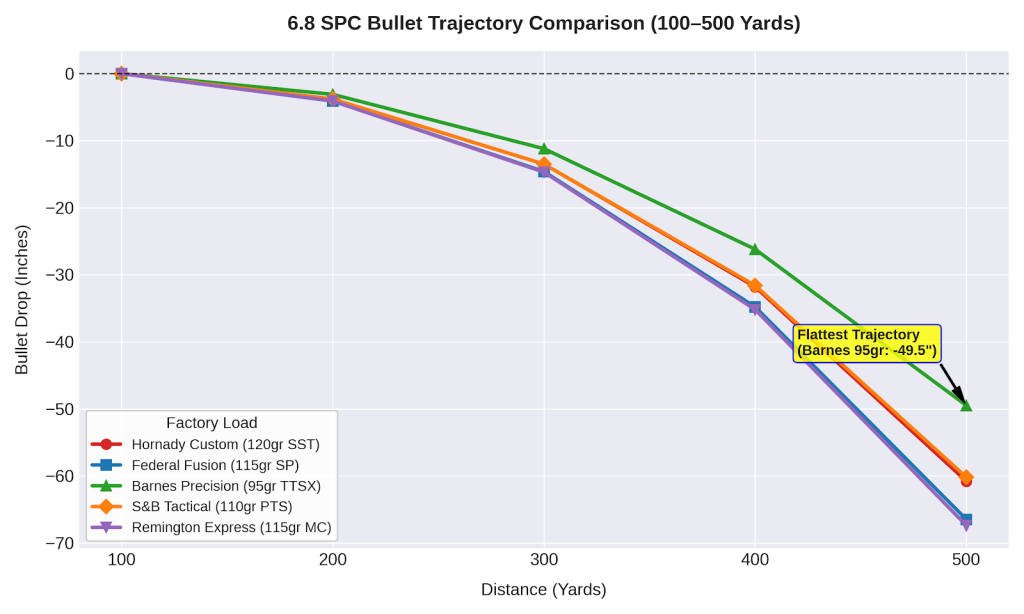
To use this chart effectively, ensure your rifle setup matches the factory standards for barrel length and bullet velocity. With a 200 yard zero, the drop values indicate the total vertical adjustment in inches required at each yardage. For instance, the 120 grain Hornady SST load requires a 31.8 inch holdover at 400 yards, while the lighter 95 grain Barnes TTSX—launched at a higher muzzle velocity—requires only 26.2 inches. Consistent use of these values will significantly increase your success rate in both hunting and target scenarios.
Understanding The 6.8 SPC Trajectory Chart
The data provided in the table acts as the foundation for your ballistic planning. These values show the relationship between bullet weight, muzzle velocity, and air resistance.
Trajectory Analysis
Trajectory comparisons show that velocity is a significant factor in the 6.8 SPC’s reach. The 95 grain Barnes TTSX launches at 2750 fps and exhibits the flattest curve, dropping 49.5 inches at 500 yards. In comparison, the heavier 115 grain Remington MC drops 67.4 inches at that same distance. The chart demonstrates that lighter, high-velocity projectiles significantly minimize vertical drop for medium range engagement.
Velocity Analysis
Muzzle velocity for the 6.8 SPC is optimized for the AR 15 action, typically falling between 2450 and 2750 fps. The Barnes TTSX offers the highest velocity, contributing to its flatter flight path early in the trajectory. Standard 115–120 grain hunting loads hover around 2460 fps, providing a balanced profile that remains highly effective for deer-sized game within 300 yards.
Ballistic Coefficient Analysis
The ballistic coefficient (BC) measures how efficiently the bullet overcomes drag. The 120 grain Hornady SST features a BC of 0.400, the highest in our table. This allows the bullet to retain its velocity and energy much better than the 115 grain Federal Fusion, which has a BC of 0.337. Despite the higher weight of the SST, its superior aerodynamics allow it to perform consistently as distances stretch toward the 500 yard mark.
Best Factory Loads Based On The Chart
The 120 grain Hornady SST is the most recommended load for general hunting given its high BC and optimized downrange energy. For varmint or small game control, the 95 grain Barnes TTSX is the best choice due to its high speed and flat trajectory, which reduces the need for complicated elevation holds. For big game hunting where penetration is the priority, the 115 grain Federal Fusion offers a proven terminal ballistic profile with predictable drop metrics.
Key Takeaways From The Chart
The 95 grain Barnes TTSX is the fastest load at 2750 fps, resulting in the most favorable trajectory. The 120 grain Hornady SST provides the highest ballistic coefficient, making it the most efficient load for extending your range. The 200 yard zero is the industry standard for this cartridge, centering the trajectory arc perfectly for most hunting encounters.
Common 6.8 SPC Bullet Weights
The 6.8 SPC supports a narrow but highly effective range of bullet weights designed for medium-bore performance.
95 Grain
These lightweight bullets are designed for high muzzle velocity. They offer the flattest flight path for the 6.8 SPC and are highly effective for varmints or light-bodied deer where a flat trajectory is preferred.
110 Grain
This weight is often found in tactical or target ammunition. It offers a balance between moderate velocity and reasonable ballistic performance, making it a great choice for general-purpose shooting.
115 Grain
The 115 grain weight is a standard in the 6.8 SPC lineup. It is highly regarded by hunters for providing sufficient terminal weight for deer and hogs while maintaining enough velocity for a predictable trajectory out to 300 yards.
120 Grain
The 120 grain weight is typically reserved for high-performance hunting bullets. It excels at energy retention and reliable expansion, making it a top pick for hunters pursuing medium-sized game in varied terrain.
Effective Range
Deer Hunting
For deer, the 6.8 SPC is effectively a 300 yard cartridge. The trajectory data confirms that drop remains manageable within this distance, allowing for relatively simple holdover adjustments.
Hog Hunting
Hog hunting often occurs at closer ranges, where the 6.8 SPC truly excels. The effective range is approximately 200 yards, where the cartridge provides plenty of energy for clean kills on large, tough animals.
Target Shooting
The 6.8 SPC can be used for target shooting out to 500 yards. At this distance, the bullet experiences significant drop and wind sensitivity, requiring the shooter to strictly follow their specific ballistic table.
Factors That Affect 6.8 SPC Trajectory
Muzzle Velocity
Since the 6.8 SPC uses a limited case capacity, every increase in muzzle velocity directly improves the bullet’s flight path. Differences in barrel length can lead to velocity shifts that require re-zeroing your rifle.
Ballistic Coefficient
Bullets with higher BC values slice through the air better. This reduces velocity loss over distance, directly leading to less bullet drop at 300 to 500 yards.
Wind
Like most medium-bore cartridges, the 6.8 SPC is susceptible to wind drift. Using high BC bullets helps minimize this, but shooters must always account for crosswinds when shooting past 200 yards.
Zero Distance
The 200 yard zero is the standard recommendation. It creates an arc that keeps the bullet close to the line of sight for most engagement distances without causing excessive holdover for shots near 300 yards.
Frequently Asked Questions
Is the 6.8 SPC good for hunting?
Yes, it is widely considered an excellent choice for hunting deer and hogs due to its terminal performance and manageable recoil.
What is the ideal effective range on deer?
The 6.8 SPC is highly effective on deer out to 300 yards with proper shot placement.
Can I use 6.8 SPC for target shooting?
Yes, it is quite accurate and popular for use in the AR 15 platform for target and competition shooting.
Why do my shots drop more than the chart?
This is often caused by a shorter barrel, which decreases muzzle velocity compared to factory test barrels.
What is the best zero distance?
A 200 yard zero is the industry recommendation for optimal performance in the field.
Are there factory loads for 6.8 SPC?
Yes, major manufacturers like Hornady, Federal, and Barnes offer excellent hunting and match-grade ammunition.
Is the 6.8 SPC better than 5.56 NATO for hunting?
Yes, the 6.8 SPC offers significantly more kinetic energy and uses heavier bullets that are better suited for harvesting game.
How does barrel length affect velocity?
Standard 6.8 SPC loads are typically tested in 20–24 inch barrels. Using an 16 inch carbine barrel will result in a notable reduction in muzzle velocity.
What bullet weight is best for deer?
The 115–120 grain bullets are widely considered the standard for reliable terminal performance on deer.
Is it hard to find 6.8 SPC ammunition?
It is generally available, though it may be less common than mainstream cartridges like the 5.56 NATO or 308 Winchester.
How would you like to proceed with your ballistics website development, or is there another cartridge trajectory chart you would like me to generate for your database?