A 22 Hornet Trajectory Chart is a critical ballistic reference tool that visually displays the flight path and bullet drop of this classic, mild-mannered centerfire cartridge. Famous for being one of the most efficient and low-recoil cartridges ever produced, the 22 Hornet is a favorite for small game hunting and pest control. Because it operates at lower velocities than modern magnum cartridges, understanding its trajectory is essential for making precise, ethical shots in the field. By studying the ballistic values in this chart, you can master your rifle’s performance, calculate accurate holdovers, and ensure your shots strike exactly where intended, maximizing the potential of this historic and incredibly fun-to-shoot caliber.
Table of Contents [Click to open]
22 Hornet Trajectory Chart
| Manufacturer | Bullet Weight | Bullet Type | Ballistic Coefficient | Muzzle Velocity | 50 Yard Drop | 100 Yard Drop | 150 Yard Drop | 200 Yard Drop | 250 Yard Drop | 300 Yard Drop | Recommended Zero | Max Point Blank |
| Hornady | 35 Grain | V MAX | 0.109 | 3100 FPS | +0.5 | Zero | -3.5 | -10.5 | -21.0 | -38.0 | 100 Yards | 145 Yards |
| Winchester | 45 Grain | Soft Point | 0.170 | 2690 FPS | +0.7 | Zero | -4.8 | -13.5 | -27.0 | -48.0 | 100 Yards | 135 Yards |
| Remington | 45 Grain | JHP | 0.150 | 2700 FPS | +0.7 | Zero | -4.9 | -13.8 | -28.0 | -50.0 | 100 Yards | 132 Yards |
| Barnes | 30 Grain | VOR TX Varmint | 0.100 | 3000 FPS | +0.5 | Zero | -3.8 | -11.5 | -23.0 | -40.0 | 100 Yards | 140 Yards |
| Federal | 35 Grain | TNT HP | 0.120 | 3000 FPS | +0.5 | Zero | -3.6 | -10.8 | -21.5 | -39.0 | 100 Yards | 142 Yards |
| Nosler | 40 Grain | Ballistic Tip | 0.180 | 2800 FPS | +0.6 | Zero | -4.2 | -12.0 | -24.5 | -44.0 | 100 Yards | 138 Yards |
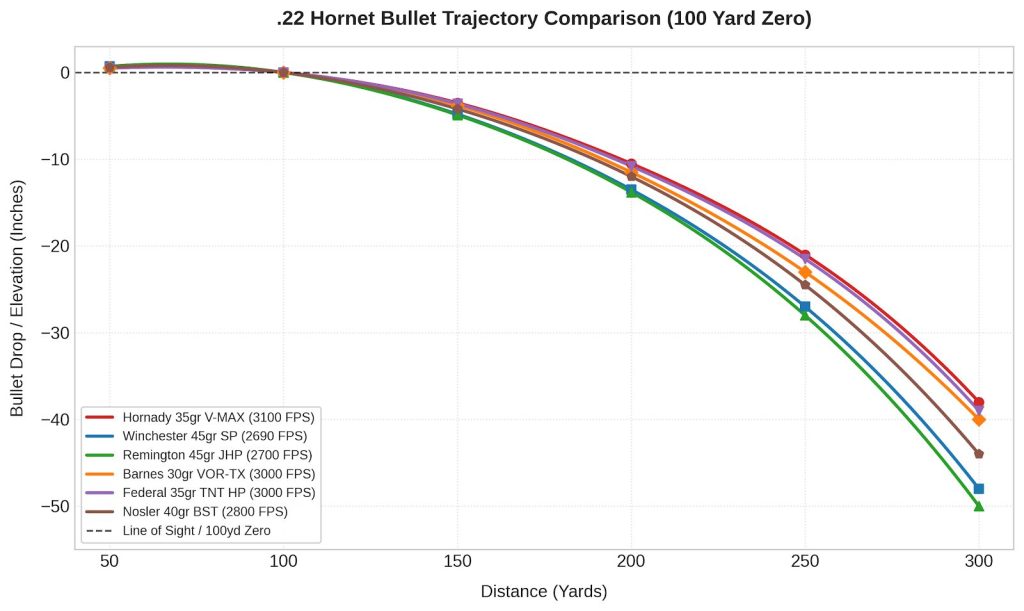
This professional trajectory chart provides 22 Hornet shooters with precise measurements to compensate for the noticeable gravity drop inherent in this cartridge. Always verify your specific load at the range, as barrel length and local environmental conditions will influence your actual point of impact.
Understanding The 22 Hornet Trajectory Chart
The 22 Hornet is a unique cartridge that bridges the gap between rimfire performance and modern centerfire speed. Analyzing these trajectory statistics allows you to understand the balance between its low-recoil signature and its effective range.
Trajectory Analysis
Bullet drop for the 22 Hornet is moderate. Because the cartridge typically uses light bullets at velocities between 2,600 and 3,100 FPS, it doesn’t possess the extreme flatness of high-velocity magnums. However, for a cartridge with such little recoil, it remains remarkably capable out to 150 yards.
When you look at the 100-yard zero column, you will notice that the bullet holds its line well until about 125 yards, after which it begins to drop significantly. For example, the popular Hornady 35-grain V MAX load drops only 3.5 inches at 150 yards, which is very manageable for a hunter using a standard crosshair reticle.
At 200 yards, the drop becomes more pronounced, often exceeding 10 inches. This indicates that while the 22 Hornet is an excellent tool for precision shooting, it should be treated as a sub-200-yard rifle for ethical hunting.
Velocity Analysis
Muzzle velocity for the 22 Hornet is highly dependent on bullet weight. Lighter 30 to 35-grain bullets are capable of exceeding 3,000 FPS, which provides the flattest trajectory possible for this round. Heavier 45-grain bullets move closer to 2,700 FPS and result in more noticeable drop at distance.
Despite being a centerfire cartridge, the Hornet operates at lower pressure than modern rounds. This makes it incredibly easy on brass and rifle actions, but it does mean you must respect its velocity limitations when planning long shots.
Velocity is the primary driver of the Hornet’s trajectory. If you are struggling with bullet drop at distance, switching to a lighter, higher-velocity projectile is the most effective way to flatten your flight path.
Ballistic Coefficient Analysis
The ballistic coefficient (BC) measures how efficiently a bullet resists air resistance. Most 22 Hornet bullets have relatively low BC ratings (0.100 to 0.180) because they are designed for rapid expansion rather than extreme aerodynamic flight.
These low BC numbers are the primary reason the Hornet loses energy and drops quickly beyond 150 yards. Bullets with higher BCs, such as the Nosler 40-grain Ballistic Tip (0.180), are noticeably more aerodynamic and hold their velocity and trajectory better than the blunt, lightweight 30-grain options.
Sectional density for the Hornet is sufficient for small game. It is not designed for deep penetration on large animals, but it carries enough sectional density to ensure effective terminal performance on prairie dogs, groundhogs, and coyotes at reasonable ranges.
Best Hunting Loads Based On The Chart
Varmint hunters should lean toward the Hornady 35-grain V MAX. Its high muzzle velocity of 3,100 FPS makes it the flattest-shooting option available, which is ideal for hitting tiny targets at 100 to 150 yards.
For hunters targeting coyotes, the Nosler 40-grain Ballistic Tip is an excellent choice. It retains energy better than the lighter loads and provides the penetration necessary for reliable performance on larger, tougher small game.
Those who prefer handloading can find even better performance by optimizing their loads for their specific rifle’s twist rate. However, for factory ammunition, the offerings from Hornady and Federal provide industry-leading consistency.
Key Takeaways From The Chart
The trajectory chart shows that the 22 Hornet is a specialized cartridge for ranges under 200 yards. It is not meant to compete with high-velocity magnums at long range; rather, it is a tool for precision work in its effective range window.
The 100-yard zero is the standard. It provides a simple, intuitive holdover reference for the majority of hunting situations. If you keep your shots within 150 yards, you will rarely find yourself having to “guess” where to aim.
The maximum point-blank range for the Hornet is typically between 130 and 145 yards. Understanding this limit ensures you don’t overestimate the cartridge’s capabilities, keeping your hunting ethical and your accuracy high.
Common 22 Hornet Bullet Weights
30-35 Grain
These are the speedsters of the Hornet world. Designed to push the velocity limits, these loads provide the flattest trajectory and the most explosive terminal performance on tiny varmints. They are ideal for high-precision shooting in calm conditions.
40-45 Grain
These heavier loads provide better energy retention and slightly better performance in windy conditions. They are the preferred choice for coyote hunters or those who need a bit more “thump” on impact at the end of the cartridge’s range.
Effective Hunting Range
Varmints
For prairie dogs and gophers, you can confidently shoot out to 150-175 yards. At these ranges, the 22 Hornet is deadly accurate and produces very little noise compared to larger rifles, making it a joy to shoot all day long.
Coyotes
For coyotes, keep your shots under 150 yards. The 22 Hornet provides sufficient energy at this range, but you must ensure you have a clear shot at the vital zone, as the cartridge does not have the “forgiving” power of a larger caliber.
Factors That Affect 22 Hornet Trajectory
- Bullet Weight: Lighter bullets offer flatter trajectories but lose speed faster. Heavier bullets retain more energy but drop more at distance.
- Muzzle Velocity: High-speed loads are essential for flat shooting. If your barrel is short, expect lower velocities and more bullet drop.
- Ballistic Coefficient: Aero-friendly bullets like the Nosler Ballistic Tip will perform significantly better at 150+ yards than traditional flat-nose bullets.
- Zero Distance: Stick to a 100-yard zero. It simplifies your shooting and aligns perfectly with how the Hornet performs.
- Atmospheric Conditions: The Hornet’s light bullets are affected by wind. Always take windage into account if shooting past 100 yards.
Frequently Asked Questions
What Is A 22 Hornet Trajectory Chart
It is a ballistic table showing the bullet’s flight path, helping you estimate holdover for precise shots.
What Is The Maximum Effective Range Of A 22 Hornet
Most hunters cap the Hornet at 150-200 yards. Beyond that, the bullet drop and energy loss make consistent, ethical hits difficult.
How Much Does A 22 Hornet Drop At 200 Yards
Depending on the load, the drop at 200 yards is usually between 10 and 14 inches when zeroed at 100 yards.
Is The 22 Hornet Better Than A 17 HMR
The Hornet is a centerfire cartridge with more energy and better trajectory performance at long range than the rimfire 17 HMR.
What Is The Best Zero For 22 Hornet
A 100-yard zero is the standard recommendation, offering the most versatile flight path.
Does Barrel Length Affect 22 Hornet Ballistics
Yes, a longer barrel helps reach the full muzzle velocity potential of the Hornet, slightly flattening the trajectory.
What Is The Best 22 Hornet Hunting Load
The Hornady 35-grain V MAX is a favorite for varmints due to its extreme velocity and flat flight path.
How Does Bullet Weight Change The 22 Hornet Trajectory
Lighter bullets are faster and flatter; heavier bullets are more stable and retain energy better but drop more.
What Is The 22 Hornet Ballistic Coefficient
Most Hornet bullets have a BC ranging from 0.100 to 0.180, which is sufficient for its effective range.
Can You Use 22 Hornet For Target Shooting
It is a fantastic and highly accurate cartridge for short-to-medium range target shooting and pest control.
One follow-up question: Are you planning to use your 22 Hornet primarily for varmint control or for casual long-range target shooting?