A 9mm Trajectory Chart is a critical ballistic reference tool that displays the flight path and bullet drop of the world’s most popular handgun cartridge across various distances. While this round is primarily engineered for effective performance at close range, understanding its ballistic arc is essential for shooters who want to master their accuracy, whether they are training for competition or verifying their capabilities at the range. By diligently studying these precise ballistic values, marksmen can confidently calculate their holdovers and understand how the 9mm performs as it travels beyond traditional defensive distances. Reviewing this comprehensive trajectory data guarantees you will fully understand the capabilities of your firearm and ensure every shot lands with precision.
9mm Trajectory Chart
| Bullet Weight | Bullet Type | Ballistic Coefficient | Muzzle Velocity | 25 Yard Drop | 50 Yard Drop | 75 Yard Drop | 100 Yard Drop | 125 Yard Drop | 150 Yard Drop | Recommended Zero | Max Point Blank |
| 115 Grain | JHP | 0.125 | 1180 FPS | +0.2 | Zero | -2.5 | -7.5 | -15.5 | -27.0 | 50 Yards | 70 Yards |
| 115 Grain | FMJ | 0.140 | 1150 FPS | +0.2 | Zero | -2.6 | -7.8 | -16.0 | -28.0 | 50 Yards | 68 Yards |
| 124 Grain | JHP | 0.145 | 1120 FPS | +0.3 | Zero | -2.8 | -8.2 | -16.5 | -29.0 | 50 Yards | 65 Yards |
| 124 Grain | FMJ | 0.155 | 1100 FPS | +0.3 | Zero | -2.9 | -8.5 | -17.0 | -30.0 | 50 Yards | 64 Yards |
| 147 Grain | JHP | 0.190 | 980 FPS | +0.5 | Zero | -3.8 | -11.0 | -21.5 | -38.0 | 50 Yards | 55 Yards |
| 147 Grain | Subsonic | 0.210 | 950 FPS | +0.6 | Zero | -4.0 | -11.8 | -23.0 | -40.0 | 50 Yards | 52 Yards |
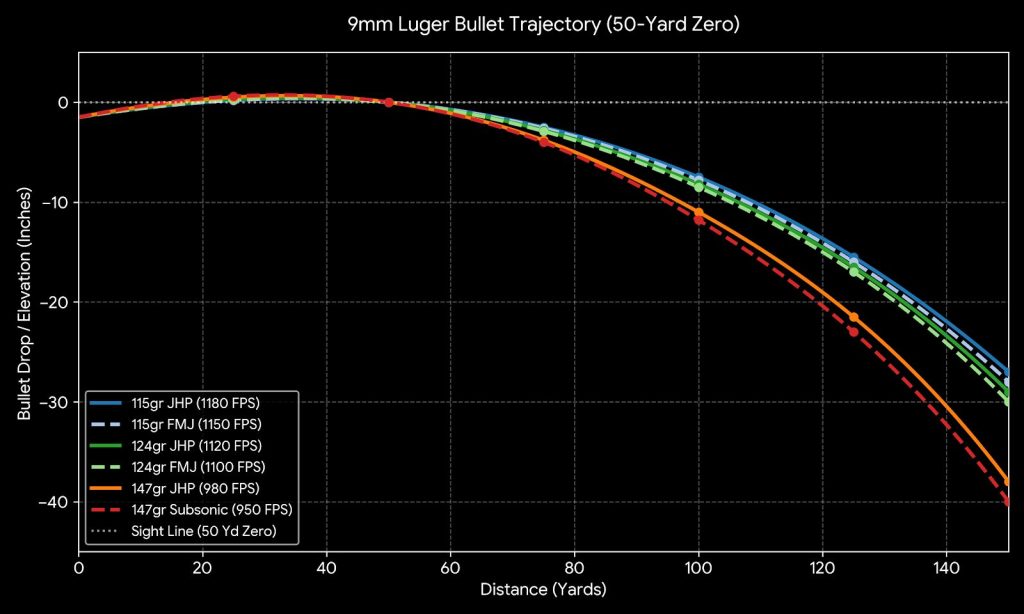
This professional trajectory chart clearly provides handgun shooters with precise bullet drop measurements across various distances so they can accurately compensate for gravity. You should always properly match your chosen factory load with the recommended zero distance to truly maximize your effective shooting range and ensure consistent hits.
Understanding The 9mm Trajectory Chart
The data in this table is vital for any shooter carrying a 9mm, as the cartridge is famous for its performance at close quarters. By analyzing these statistics, you can master your firearm’s performance and understand exactly how your chosen ammunition behaves as it travels downrange.
Trajectory Analysis
Bullet drop for the 9mm is more pronounced than high velocity rifle cartridges because the round is designed for subsonic or near subsonic performance. When you look at the 50-yard zero column, you will notice that the bullet begins to fall off sharply as soon as it passes that distance.
For example, a standard 115-grain FMJ load drops roughly 7.8 inches at 100 yards. This means if you are aiming at a target at 100 yards, you must hold significantly higher than your target to account for the rapid decline of the bullet.
Heavy 147-grain loads drop even faster, with some showing over 11 inches of drop at 100 yards. This data clearly illustrates that the 9mm is a specialized cartridge designed for rapid, close-range engagement rather than long-range precision.
Velocity Analysis
Muzzle velocity is the speed of the bullet as it leaves the barrel, and in the 9mm, it generally falls between 950 and 1,200 feet per second. High velocity 115-grain loads push harder, resulting in a slightly flatter arc compared to heavier options.
Subsonic loads, such as the 147-grain options, move much slower. This slower speed leads to a more pronounced bullet drop, requiring the shooter to be more diligent with range estimation and holdover at distances beyond 50 yards.
Because 9mm bullets rely more on mass and expansion than sheer speed for their effectiveness, velocity is usually prioritized for terminal performance rather than long-range flat shooting. Always remember that barrel length in your pistol or carbine can also affect your actual muzzle velocity.
Ballistic Coefficient Analysis
The ballistic coefficient (BC) measures how well a bullet resists air resistance. 9mm bullets typically have very low BC ratings, usually ranging from 0.125 to 0.210, because they are often shaped for reliable feeding in semi-automatic pistols rather than long-range flight.
These low BC numbers are the reason the 9mm loses speed and drops quickly after the first 50 yards. Bullets with slightly higher BCs, like the 147-grain subsonic loads, are more aerodynamic, but their slow start makes them drop just as much or more than lighter rounds.
Sectional density remains important for 9mm performance, as it ensures the bullet penetrates adequately. Even though 9mm is not a “long-range” cartridge, its sectional density ensures that when it does reach the target, it carries sufficient momentum to be effective.
Best Hunting Loads Based On The Chart
Target shooters should look to the 115-grain FMJ. It is the most economical round for practicing at 25 and 50 yards, and its trajectory is very predictable, making it perfect for honing your marksmanship skills.
Defensive shooters require reliable expansion, and the 124-grain JHP is widely considered the industry standard. It provides a balance of velocity and trajectory that is very easy to manage in a high-stress defensive situation.
For those using a suppressor or wanting the quietest performance, the 147-grain subsonic load is the choice. While you must account for a steeper trajectory, the benefit of silence is worth the extra holdover for most users.
Common 9mm Bullet Weights
115 Grain
The 115-grain projectile is the most common weight for 9mm Luger and offers the highest muzzle velocities. These bullets are ideal for shooters who want a flatter trajectory and lower overall cost for high-volume practice.
The primary advantage is speed, which flattens the trajectory compared to heavier 147-grain loads. These bullets expand reliably on soft targets, making them a popular choice for both target practice and defensive carry.
The disadvantage is a lower sectional density, which can lead to less penetration on very tough barriers compared to heavier 147-grain options. They also lose velocity very quickly past the 75-yard mark due to their shape.
124 Grain
The 124-grain bullet is widely considered the “sweet spot” for 9mm performance. It balances high velocity with a slightly heavier mass, making it a favorite for both law enforcement and civilian shooters.
The advantage here is terminal performance; it provides excellent expansion and deep penetration. It is the preferred weight for those who value a versatile, all-around load for every situation.
The disadvantage is that it has slightly more drop than the 115-grain load, though this is negligible within defensive ranges. Shooters find it to be a very comfortable, accurate round to shoot in almost any pistol platform.
147 Grain
These heavy-duty projectiles are built for subsonic performance and deep penetration. They move slower but carry significant momentum, making them the standard for suppressed pistol setups.
The advantage is unrivaled penetration and quiet performance, making them the choice for those using sound suppressors. They will drive deep through tissue and resist being pushed off-target as easily by minor air disturbances.
The disadvantage is the significant bullet drop at distance. Shooters must become adept at estimating range, as the bullet drops significantly more than the 115-grain or 124-grain options.
Factors That Affect 9mm Trajectory
Bullet Weight
Weight significantly impacts performance. Heavier bullets provide more energy and momentum but follow a much steeper arc. Lighter bullets offer a flatter trajectory, but they give up some of the deep penetration the cartridge is known for.
Muzzle Velocity
This is defined by the pressure and the firearm itself. Higher velocity flattens the trajectory, effectively extending the point-blank range of your handgun. Note that +P ammunition will provide a flatter path than standard pressure loads.
Ballistic Coefficient
Because most 9mm bullets are shaped for semi-auto reliability, they have low BCs. This causes them to lose energy rapidly. Choosing modern, more aerodynamic JHP bullets can slightly improve your trajectory performance.
Zero Distance
A 50-yard zero is standard for 9mm. It allows you to hold dead-on from point-blank range out to 50 yards. Beyond 50 yards, you must hold high, which is simple and effective for a pistol-caliber round.
Frequently Asked Questions
What Is A 9mm Trajectory Chart
It is a ballistic table showing the bullet’s path. It helps you see how much the bullet falls at different distances so you can adjust your aim for longer shots.
What Is The Maximum Effective Range Of A 9mm
While defensive encounters occur within 25 yards, the 9mm is capable of hitting targets at 100 yards, though bullet drop becomes very difficult to manage accurately.
How Much Does A 9mm Drop At 100 Yards
Depending on the load, the drop at 100 yards typically ranges from 7 to 14 inches. This is why 50-75 yards is often considered the practical limit for consistent accuracy.
Is The 9mm Better Than The .45 ACP
The 9mm has a flatter trajectory and higher capacity, while the .45 ACP is a larger, heavier projectile with a much steeper trajectory arc.
What Is The Best Zero For 9mm
A 50-yard zero is the standard. It provides the most intuitive holdovers and reduces the risk of shooting over targets at close range.
One follow-up question: Are you using this 9mm trajectory information primarily for training at the range, or for setting up a pistol-caliber carbine for longer-range shooting?