The .300 Blackout cartridge is optimized for short barrels, burning its fast pistol-powder charge quickly to generate maximum efficiency in compact platforms.
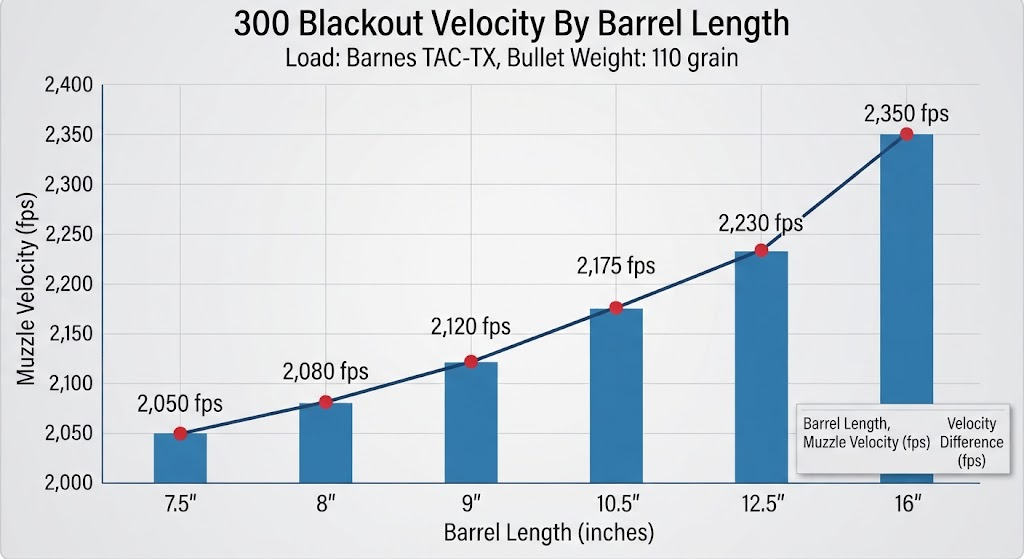
When firing a 110-grain supersonic load, muzzle velocities typically average 2,080 fps from an 8-inch barrel and 2,120 fps from a 9-inch barrel.
As barrel length increases, this velocity scales to approximately 2,175 fps from a 10.5-inch barrel, 2,230 fps from a 12.5-inch barrel, and 2,350 fps from a 16-inch barrel.
Conversely, heavy subsonic ammunition shows minimal variation, generally staying safely below the speed of sound around 1,000 fps across all these lengths.
It is critical to note that exact velocity varies by ammunition, bullet weight, barrel profile, chamber tolerances, and environmental test conditions.
Analyzing these chronograph statistics allows shooters to choose the ideal barrel length for their specific ballistic needs without sacrificing performance.
300 Blackout Velocity By Barrel Length Chart
| Barrel Length | Load | Bullet Weight | Muzzle Velocity | Velocity Difference |
| 7.5 inches | Barnes TAC-TX | 110 grain | 2,050 fps | – |
| 8 inches | Barnes TAC-TX | 110 grain | 2,080 fps | +30 fps |
| 9 inches | Barnes TAC-TX | 110 grain | 2,120 fps | +40 fps |
| 10.5 inches | Barnes TAC-TX | 110 grain | 2,175 fps | +55 fps |
| 12.5 inches | Barnes TAC-TX | 110 grain | 2,230 fps | +55 fps |
| 16 inches | Barnes TAC-TX | 110 grain | 2,350 fps | +120 fps |
How Much Velocity Does 300 Blackout Gain From Barrel Length?
While there is no universal “fps per inch” rule, chronograph testing provides a reliable baseline for how much velocity .300 Blackout gains as barrel length increases. Based on measured supersonic loads, .300 Blackout gains approximately 25 to 35 fps per inch of barrel added between 7.5 and 16 inches.
However, this gain is not perfectly linear. Moving from an 8-inch to a 9-inch barrel yields a noticeable jump, but after the 9- to 10.5-inch mark, the cartridge reaches near-complete powder burn. Going from 10.5 inches to 16 inches requires an additional 5.5 inches of barrel but only yields an estimated 175 fps increase (averaging roughly 31 fps per inch). These numbers are calculations based on aggregate data for 110-grain loads, and actual results will vary depending on specific ammunition and lot variations.
Does Barrel Length Affect 300 Blackout Velocity?
Yes, barrel length directly affects .300 Blackout velocity, but it impacts different types of ammunition at vastly different rates.Because .300 Blackout uses fast-burning powders, the powder column is completely ignited very early in the bullet’s travel.For supersonic ammunition, adding barrel length allows the expanding gases to push the bullet faster, though with heavily diminishing returns past 10.5 inches.
If different shooters report slightly different velocities for the exact same barrel length, the discrepancy is usually due to factors outside of barrel length alone. Variables such as temperature, test equipment (chronograph calibration), barrel condition, tight vs. loose chamber tolerances, and differences in ammunition lots can all cause velocity shifts of 30 to 50 fps.
300 Blackout Supersonic Velocity By Barrel Length
Supersonic ammunition is designed to break the sound barrier (roughly 1,125 fps at sea level). These loads benefit the most from added barrel length.
- 110 Grain:Loads like the Barnes TAC-TX or Hornady V-MAX are the fastest commercially available .300 Blackout rounds.They typically start around 2,080 fps out of an 8-inch barrel and can hit 2,350 fps from a 16-inch barrel.
- 125 Grain: Bullets like the Hornady OTM or Speer TNT are slightly slower. They achieve approximately 2,030 fps from a 9-inch barrel and crest 2,215 fps out of a 16-inch barrel.
- 150 Grain:On the heavier side of supersonic, 150-grain bullets (like the Winchester Power Point) push around 1,650 fps from a 16-inch barrel, losing significantly more speed as the barrel is shortened to 8 or 9 inches due to their weight and powder charge requirements.
300 Blackout Subsonic Velocity By Barrel Length
Subsonic .300 Blackout is intentionally loaded to stay below the speed of sound, eliminating the supersonic “crack” and making it exceptionally quiet when suppressed.
Because these rounds must stay below ~1,100 fps regardless of barrel length, they utilize very fast powders and heavy bullets. A heavy 190-grain Hornady Sub-X or 220-grain Remington OTM does not gain meaningful velocity from a 16-inch barrel.From an 8-inch barrel, a 190-grain load might clock in at 989 fps.Move that exact same load to a 16-inch barrel, and it may only reach 1,050 fps. In some tight-bored 16-inch barrels, the increased friction can actually slow a subsonic bullet down compared to a 10.5-inch barrel.
300 Blackout 8 Inch Barrel Velocity
An 8-inch barrel is an incredibly popular choice for dedicated suppressed setups because it keeps the overall platform exceptionally short.
- Supersonic: A Barnes TAC-TX 110-grain bullet yields roughly 2,080 fps.
- Subsonic:A Hornady Sub-X 190-grain bullet sits comfortably around 989 fps, guaranteeing it will stay subsonic even on hot days or at higher elevations.
300 Blackout 10.5 Inch Barrel Velocity
The 10.5-inch barrel is widely considered the optimal “do-all” length for the .300 Blackout, offering a complete powder burn and stabilizing both light and heavy projectiles.
- Supersonic:A Hornady V-MAX 110-grain load achieves approximately 2,175 fps, retaining tremendous energy and reliable expansion capabilities.
- Subsonic:A 220-grain OTM load will reliably sit at 1,000 fps, allowing enough dwell time to easily cycle the rifle’s gas system without needing an adjustable gas block.
300 Blackout 12.5 Inch Barrel Velocity
A 12.5-inch barrel caters to shooters who want slightly flatter trajectories and more kinetic energy for hunting, without stepping up to a full 16-inch rifle.
- Supersonic: A Barnes TAC-TX 110-grain load typically registers around 2,230 fps, adding about 50-60 fps over a 10.5-inch barrel.
- Subsonic: Heavier 208-grain or 220-grain rounds sit close to 1,020 fps, easily remaining subsonic while giving a tiny bump in energy.
300 Blackout 16 Inch Barrel Velocity
A 16-inch barrel produces the absolute highest velocities for .300 Blackout, though the gains are marginal compared to 5.56 NATO in the same length.
- Supersonic:A 110-grain Barnes TAC-TX load maximizes at roughly 2,350 fps.
- Subsonic:Heavy 200+ grain loads max out at 1,050 to 1,060 fps. Some shooters report that factory subsonic ammunition loaded perfectly for a 9-inch barrel may occasionally break the sound barrier in a 16-inch barrel on very hot days due to the extra dwell time and pressure.
300 Blackout Velocity And Energy By Barrel Length
The following table calculates muzzle energy based on tested velocity averages for a standard 110-grain supersonic load.
| Barrel Length | Bullet Weight | Velocity | Muzzle Energy |
| 8 inches | 110 grain | 2,080 fps | 1,056 ft-lbs |
| 9 inches | 110 grain | 2,120 fps | 1,098 ft-lbs |
| 10.5 inches | 110 grain | 2,175 fps | 1,155 ft-lbs |
| 12.5 inches | 110 grain | 2,230 fps | 1,214 ft-lbs |
| 16 inches | 110 grain | 2,350 fps | 1,349 ft-lbs |
What Is The Best Barrel Length For 300 Blackout?
What barrel length gets the best balance of velocity and practicality for .300 Blackout? The data strongly points to the 9 to 10.5-inch range.
Choosing the “best” length comes down to managing inherent tradeoffs. A 16-inch barrel maximizes velocity and energy, making it the best choice for hunting medium game past 150 yards where expansion relies on sheer speed. However, hanging a 6-inch suppressor off a 16-inch barrel creates a cumbersome, front-heavy rifle, defeating the cartridge’s primary design purpose.
Conversely, a 10.5-inch barrel strikes the perfect balance. It sacrifices only about 150 to 175 fps compared to a 16-inch barrel while maintaining over 1,150 ft-lbs of energy.With a suppressor attached, a 10.5-inch platform remains highly maneuverable for home defense or short-range hunting, while reliably cycling both supersonic and subsonic loads.
Pros and Cons
Short Barrel Pros
- Superior maneuverability in confined spaces and vehicles.
- Ideal overall length when combined with a suppressor.
- Guaranteed to keep 190-220 grain ammunition safely subsonic.
- Less than 10% velocity loss compared to a 16-inch barrel.
Short Barrel Cons
- Reduced effective range for supersonic ammunition (steeper bullet drop).
- Decreased muzzle energy due to velocity loss.
- Pistols and SBRs can fall under strict NFA/ATF legal regulations.
16-Inch Barrel Pros
- Generates the absolute maximum velocity and kinetic energy.
- Flatter trajectory for extended ranges (200+ yards).
- Non-NFA item (no tax stamp or specific pistol brace regulations).
- Longer sight radius for iron sights.
16-Inch Barrel Cons
- Extremely long and front-heavy when suppressed.
- Some subsonic loads may approach the supersonic threshold in hot weather.
- Diminishing returns; the last 5 inches of barrel only provide marginal velocity gains.
300 Blackout Velocity Barrel Length: What The Data Shows
The chronograph data clearly proves that the .300 Blackout is uniquely efficient. The 16-inch barrel produces the highest tested velocity (reaching up to 2,350 fps for 110-grain loads), but the speed gained over a 10.5-inch barrel is relatively insignificant.
By analyzing the data, a shooter loses roughly 175 fps by cutting down from 16 inches to 10.5 inches. This represents less than an 8% drop in velocity, a difference that is practically unnoticeable in close-quarters or suppressed shooting scenarios.
The statistics also highlight the stark contrast between load types: supersonic loads rely on longer barrels for maximum expansion and terminal ballistics, while subsonic loads see almost zero practical benefit from longer barrels. For the vast majority of applications—including home defense, suppressed fire, and standard hunting inside 150 yards—a barrel length between 8 and 10.5 inches makes the most practical sense.
FAQs
How fast is 300 Blackout from an 8-inch barrel?
From an 8-inch barrel, a 110-grain supersonic load averages around 2,080 fps, while a heavy 190-220 grain subsonic load averages roughly 989 fps.
How fast is 300 Blackout from a 10.5-inch barrel?
A 10.5-inch barrel pushes a 110-grain supersonic bullet to roughly 2,175 fps. Subsonic 220-grain rounds travel at approximately 1,000 fps.
How fast is 300 Blackout from a 16-inch barrel?
A 16-inch barrel yields the highest velocities, pushing 110-grain supersonic loads to 2,350 fps and keeping 220-grain subsonic loads between 1,010 and 1,060 fps.
Does barrel length affect 300 Blackout velocity?
Yes. While it has a noticeable effect on supersonic ammunition (gaining speed as length increases), it has very little impact on the velocity of heavy subsonic ammunition.
How much velocity does 300 Blackout lose per inch?
Based on chronograph testing between 8 and 16 inches, .300 Blackout loses an estimated 25 to 35 fps per inch of reduced barrel length.
What is the fastest 300 Blackout barrel length?
A 16-inch barrel (or longer, up to 24 inches for extreme test platforms) produces the fastest .300 Blackout muzzle velocity, as it allows maximum time for the expanding gases to act upon the bullet.
What is the best barrel length for 300 Blackout?
The 9 to 10.5-inch range is widely considered the best barrel length for .300 Blackout. It provides near-complete powder burn, excellent velocity, and leaves enough room to attach a suppressor while keeping the overall weapon compact.
Does 300 Blackout gain velocity from a longer barrel?
Yes, but with aggressively diminishing returns. It gains significantly from 7 inches up to 10.5 inches, but the velocity gain per inch drops drastically between 10.5 and 16 inches.
How fast is subsonic 300 Blackout?
Subsonic .300 Blackout travels below the speed of sound, which is 1,125 fps at sea level. Most commercial subsonic loads are calibrated to fly between 980 and 1,050 fps.
How fast is supersonic 300 Blackout?
Depending on the bullet weight (110gr to 150gr) and barrel length, supersonic .300 Blackout travels between 1,650 fps and 2,350 fps.
What is the velocity difference between an 8 and 16 inch 300 Blackout barrel?
For a 110-grain supersonic load, the velocity difference is roughly 270 fps (2,080 fps vs. 2,350 fps). For subsonic loads, the difference is negligible, often varying by less than 50 fps.