A 350 Legend Trajectory Chart is a specialized ballistic data table that displays the exact vertical bullet drop of various three hundred fifty Legend ammunition types at increasing distances. Shooters utilize this highly specific ballistic information to precisely understand how gravity and atmospheric drag affect their chosen straight wall cartridge from the muzzle out to practical hunting ranges. Comparing these specific trajectory values helps dedicated hunters select the absolute perfect ammunition for their individual woodland hunting requirements. Understanding this critical data ensures complete accuracy and highly ethical shot placement when engaging deer at unknown distances in the field.
Table of Contents [Click to open]
350 Legend Trajectory Chart
| Ammunition Load | Typical Bullet Weight | Muzzle Velocity | 100 Yard Drop | 200 Yard Drop | 300 Yard Drop | 400 Yard Drop | 500 Yard Drop | 600 Yard Drop | Typical Ballistic Coefficient | Recommended Zero Distance |
| Winchester Full Metal Jacket | 145 Grains | 2350 FPS | 0.0 Inches | 8.1 Inches | 31.2 Inches | 59.6 Inches | 131.4 Inches | Not Applicable | 0.186 | 100 Yards |
| Winchester Deer Season XP | 150 Grains | 2325 FPS | 0.0 Inches | 7.6 Inches | 28.1 Inches | 51.5 Inches | 111.6 Inches | Not Applicable | 0.226 | 100 Yards |
| Federal Fusion Soft Point | 160 Grains | 2300 FPS | 0.0 Inches | 8.2 Inches | 30.5 Inches | 64.0 Inches | Not Applicable | Not Applicable | 0.264 | 100 Yards |
| Winchester Power Max Bonded | 160 Grains | 2225 FPS | 0.0 Inches | 9.4 Inches | 35.8 Inches | 72.0 Inches | Not Applicable | Not Applicable | 0.206 | 100 Yards |
| Hornady Custom FTX | 165 Grains | 2200 FPS | 0.0 Inches | 9.2 Inches | 34.8 Inches | 71.0 Inches | Not Applicable | Not Applicable | 0.254 | 100 Yards |
| Hornady American Whitetail | 170 Grains | 2200 FPS | 0.0 Inches | 9.5 Inches | 36.5 Inches | 74.5 Inches | Not Applicable | Not Applicable | 0.215 | 100 Yards |
| Winchester Power Point | 180 Grains | 2100 FPS | 0.0 Inches | 9.8 Inches | 36.0 Inches | 75.0 Inches | 138.0 Inches | Not Applicable | 0.221 | 100 Yards |
| Federal Power Shok | 180 Grains | 2100 FPS | 0.0 Inches | 10.2 Inches | 38.5 Inches | 79.5 Inches | Not Applicable | Not Applicable | 0.225 | 100 Yards |
| Hornady Subsonic Sub X | 250 Grains | 1050 FPS | 15.0 Inches | 61.5 Inches | 172.5 Inches | Not Applicable | Not Applicable | Not Applicable | 0.265 | 50 Yards |
| Winchester Super Suppressed | 255 Grains | 1060 FPS | 14.5 Inches | 61.4 Inches | 172.0 Inches | 339.9 Inches | Not Applicable | Not Applicable | 0.225 | 50 Yards |
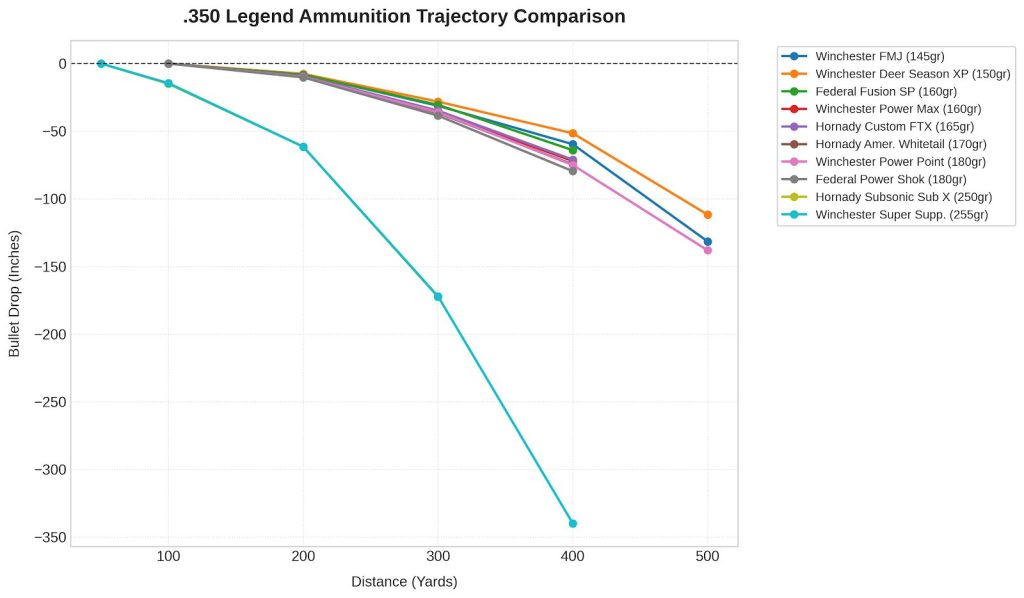
Readers should consistently closely compare trajectory between loads by carefully examining the precise drop values at their absolute maximum intended shooting distance. A highly significantly smaller number exactly at two hundred yards perfectly indicates a remarkably flatter shooting load that safely provides a comfortably wider margin for error when rapidly estimating unknown range in the heavy field.
Understanding The Trajectory Chart
Fastest Shooting Loads
The fastest shooting loads in this specific caliber utilize extremely light bullets paired with highly optimized powder charges. This combination creates a noticeably flat trajectory curve inside of two hundred yards.
Looking directly at the data table reveals that the Winchester one hundred forty five grain load leads the pack in pure velocity. It rapidly launches a full metal jacket bullet at two thousand three hundred fifty feet per second.
This highly impressive speed allows the bullet to easily reach the target before gravity pulls it downward significantly. Target shooters greatly appreciate this exact performance because it requires absolutely minimal holdover at close ranges.
Best Long Range Loads
Identifying the best options for extended distances requires understanding that this is primarily a short range brush cartridge. It was originally designed strictly to comply with straight wall hunting regulations rather than winning extreme distance target competitions.
However the Federal Fusion one hundred sixty grain soft point performs remarkably well when stretched past two hundred yards. This specific projectile retains its speed much better due to a highly respectable ballistic coefficient.
While a lightweight bullet absolutely starts faster it bleeds critical velocity rapidly because of very poor aerodynamic properties. A slightly heavier bullet with a better aerodynamic profile cuts through the turbulent air much more efficiently.
Best Hunting Loads
Evaluating a bullet drop chart is absolutely crucial for hunters who passionately want to ensure highly ethical shots on game. Dense woodland hunting environments rarely offer perfectly measured ranges to the specific target.
The Winchester Deer Season XP one hundred fifty grain load has quickly become a premier hunting choice precisely because of its very predictable trajectory. Dropping only seven point six inches at two hundred yards allows hunters to easily hold dead center on a large deer chest cavity.
The Winchester Power Point one hundred eighty grain load shows significantly more vertical drop at the exact same distance. However it reliably delivers noticeably more penetrating kinetic energy upon impact than the lighter polymer tipped rounds.
Bullet Drop Comparison
A direct vertical drop comparison reveals highly fascinating differences between various bullet weights in this exact same chambering. The provided data clearly shows exactly how bullet weight and aerodynamic velocity interact during flight.
Compare the lightweight one hundred fifty grain Winchester load to the heavy one hundred eighty grain Federal load at three hundred yards. The lighter bullet drops twenty eight point one inches while the heavier bullet drops thirty eight point five inches.
The lighter bullet actually shoots significantly flatter at medium ranges due entirely to its massive initial muzzle velocity advantage. However the heavier bullet absolutely carries much more retained kinetic energy to the distant woodland target.
Best Overall Trajectory
Finding the best overall trajectory absolutely requires perfectly balancing short range flatness with sufficient retained terminal energy. The provided data strongly points toward the medium weight polymer tipped designs as the very clear winners.
The Winchester Deer Season XP offers an absolutely incredible blend of impressive speed and highly sleek modern bullet design. It smoothly shoots incredibly flat out to two hundred yards and confidently maintains excellent terminal performance.
Another fantastic premium option is the Hornady Custom one hundred sixty five grain load which reliably rivals pure velocity performance without sacrificing any hunting utility. It drops only nine point two inches at two hundred yards while providing absolutely devastating controlled expansion.
Trajectory By Popular Bullet Weight
145 Grain Trajectory
The one hundred forty five grain bullet is exceptionally light for this specific caliber and strictly serves primarily for target practice applications. Its entire trajectory is completely defined by screaming initial velocity followed by highly rapid downrange deceleration.
At two hundred yards the flying bullet only drops eight point one inches which strongly makes it incredibly easy to shoot accurately. Target shooters can practically ignore normal environmental bullet drop inside this highly specific short distance.
However the light full metal jacket bullet rapidly loses forward momentum when pushed past three hundred yards. By four hundred yards the total vertical drop reaches a highly significant fifty nine point six inches.
150 Grain Trajectory
The one hundred fifty grain bullet fiercely represents the absolute modern gold standard for straight wall deer hunting cartridges. It easily achieves highly impressive muzzle velocity while aggressively firing bullets tough enough for excellent deep penetration.
Looking directly at the trajectory chart clearly shows a very forgiving and highly predictable curve strictly inside two hundred yards. A minimal drop of only seven point six inches at two hundred yards is absolutely phenomenal for a dedicated straight wall cartridge.
This reliably flat trajectory strongly makes the one hundred fifty grain load an excellent practical choice for youth hunters and absolute beginners. It requires completely minimal mental math or complicated optical holdover when shooting across a very typical farm field.
160 Grain Trajectory
The one hundred sixty grain bullet perfectly bridges the wide gap between pure velocity and heavy hitting terminal performance. Its overall trajectory is best described as an incredibly efficient compromise for all around woodland hunting.
With a standard premium bullet the total drop at two hundred yards is exactly eight point two inches for the Federal Fusion load. This requires a very minor dedicated scope dial adjustment or a highly deliberate reticle holdover technique at longer ranges.
At three hundred yards the flying bullet drops thirty point five inches which is highly typical for this straight wall caliber. Engaging any targets at this extreme distance absolutely requires exact range estimation and very precise dial adjustments.
165 Grain Trajectory
The one hundred sixty five grain bullet was specifically engineered by Hornady to absolutely dominate thick timber hunting environments. It confidently accomplishes this by utilizing a modern flexible polymer tip design at highly consistent moderate velocities.
Inside one hundred fifty yards its flight trajectory is largely mathematically identical to standard hunting cartridges of similar weight. The real terminal magic happens when the bullet efficiently travels past two hundred yards in the open woods.
Because the modern bullet retains its velocity very well it actively provides exceptional flight predictability at typical medium hunting distances. By three hundred yards it safely drops thirty four point eight inches while resisting minor wind deflection beautifully.
170 Grain Trajectory
The one hundred seventy grain bullet utilizes a highly traditional exposed lead soft point design for absolutely massive terminal expansion. Its reliable trajectory is heavily optimized for engaging medium sized game at distances firmly under two hundred yards.
Firing a slightly heavier traditional projectile allows the bullet to easily shrug off minor brush and light crosswinds. The initial flight trajectory remains very steady with exactly nine point five inches of vertical drop at two hundred yards.
At three hundred yards the slower bullet vertically drops thirty six point five inches which strictly requires substantial scope adjustment. The sheer metallic mass of the heavy bullet forcefully helps it perfectly maintain devastating momentum through the thick dense atmosphere.
180 Grain Trajectory
The one hundred eighty grain bullet is an absolute heavy powerhouse strictly designed to aggressively deliver massive kinetic energy. It reliably provides completely incredible terminal penetration and highly exceptional bone breaking field performance.
Pushing this heavy metallic bullet at two thousand one hundred feet per second forcefully generates a noticeably arched trajectory curve. The total vertical drop at exactly two hundred yards is a very significant ten point two inches.
This plunging flight trajectory absolutely requires hunters to be completely certain of their exact target distance before confidently pulling the trigger. It significantly increases the required guesswork during high stress shooting situations if the true range remains completely unknown.
250 Grain Trajectory
The two hundred fifty grain bullet strongly represents the extremely specialized heavy subsonic category for this unique straight wall caliber. Its overall ballistic performance is completely restricted to exceptionally close range tactical or hunting applications using a sound suppressor.
Propelling this absolutely massive projectile at only one thousand fifty feet per second creates an incredibly severe trajectory arc. The extremely heavy bullet forcefully drops an incredible sixty one point five inches at just two hundred yards.
Shooters completely relying on this exceptionally quiet heavy load must strictly limit their hunting shots to firmly under one hundred yards. The massive rainbow trajectory simply does not allow for accurate medium range field engagements without highly specialized optical equipment.
Factors That Affect Bullet Trajectory
Bullet Weight
Bullet weight absolutely plays a primary and highly critical role in determining exactly how quickly a projectile accelerates and decelerates. Lighter bullets easily achieve much higher initial velocities which perfectly creates a very flat trajectory at short practical ranges.
Heavier bullets consistently launch noticeably slower but tightly possess far greater mass momentum to forcefully push through thick air resistance. This highly preserved momentum perfectly allows heavy bullets to hit much harder at specific extended woodland distances.
Shooters must constantly carefully balance exact bullet weight against their specific intended target distance to smoothly achieve the best possible trajectory.
Muzzle Velocity
Muzzle velocity is the initial highly calculated speed at which the metallic bullet completely exits the rifle barrel. This precise measurable speed determines exactly how long the flying bullet is highly exposed to the downward pull of gravity.
Higher velocity strictly strictly equals completely less total time in flight which directly dynamically translates to significantly less vertical drop. This is exactly precisely why light hyper velocity loads easily appear so incredibly impressive on short range ballistic drop charts.
However pushing standard traditional bullets too fast can quickly degrade precision accuracy and violently destroy the exposed projectile in mid air.
Ballistic Coefficient
The ballistic coefficient is a highly complex mathematical number that perfectly represents exactly how efficiently a specific bullet cuts through the air. A noticeably higher coefficient number heavily indicates superior aerodynamics and significantly strictly less drag during actual flight.
Bullets uniquely crafted with high ballistic coefficients beautifully retain their forward velocity much better than very blunt or flat nosed hunting bullets. This highly critical velocity retention safely leads directly to a much flatter trajectory curve at specific extended woodland distances.
When comparing a highly traditional round nose bullet to a sleek polymer tipped design the exact difference in aerodynamic efficiency remains absolutely massive.
Wind
Wind is the totally invisible natural force that absolutely violently destroys perfectly calculated trajectory charts in the real actual world. While gravity is a completely constant rigid downward force wind can strongly push the bullet horizontally in completely any random direction.
A highly strong direct headwind will actually naturally increase atmospheric drag and firmly cause the bullet to drop much faster than the chart precisely predicts. Conversely a very strong fast tailwind can physically firmly make a bullet strike significantly much higher than expected on the steel target.
Altitude
Altitude directly and profoundly mathematically affects actual bullet trajectory by heavily changing the exact density of the air the bullet must travel through. Higher mountainous elevations naturally feature much thinner air which perfectly creates significantly less aerodynamic drag on the actively flying projectile.
A standard hunting rifle perfectly carefully zeroed at sea level will absolutely always shoot noticeably higher when taken on a hunt in the high mountains. The actively flying bullet simply safely faces much less thick atmospheric resistance and easily retains its high velocity significantly longer.
Temperature
Temperature drastically severely alters standard bullet trajectory through two distinctly totally different scientific mechanisms that precision shooters must absolutely always securely account for. First the natural ambient air temperature physically directly changes the local air density much like geographical altitude actively does.
Hot summer air is noticeably completely less dense than freezing winter air which safely allows the bullet to smoothly fly flatter and faster on a warm day. Second extreme ambient temperature directly effectively affects the chemical internal burn rate of the gunpowder safely contained inside the brass cartridge case.
Barrel Length
Barrel length strictly firmly dictates exactly how long the rapidly violently expanding powder gases can actively aggressively push against the copper base of the bullet. Longer heavy steel barrels generally completely produce much higher muzzle velocities which directly strongly results in a flatter trajectory curve.
Cutting a standard factory rifle barrel down from twenty inches to sixteen inches will significantly noticeably reduce the exit speed of the projectile. This specific measured velocity loss completely forcefully forces the shooter to securely dial more optical scope elevation to absolutely reach the exact same target.
Zero Distance
Your heavily chosen exact zero distance forcefully serves directly as the absolute firm baseline foundation for your entire personal trajectory chart. The exact established zero distance is the specific exact yardage where the actively flying bullet smoothly intersects your optical line of sight perfectly.
If you deliberately precisely change your mechanical zero distance every other single printed number on your ballistic chart will immediately cleanly change simultaneously. A closer mechanical zero distance usually directly effectively results in far more highly pronounced severe bullet drop at extreme extended ranges.
Best Zero Distance By Application
50 Yard Zero
A fifty yard zero is the absolute firm gold standard strictly for heavy subsonic loads and extremely dense thick brush hunting applications. This highly specific short distance beautifully allows for absolute surgical precision without constantly worrying about the heavy bullet striking high at very close ranges.
With a fifty yard zero the confident careful shooter accurately knows the massive slow bullet will almost completely never comfortably travel above their optical line of sight. This strict mechanical zero is highly incredibly ideal for the very heavy two hundred fifty grain loads routinely used heavily in suppressed hunting rifles.
100 Yard Zero
A one hundred yard zero is completely traditionally the most highly heavily recommended setup for standard general purpose straight wall hunting rifles. This extremely highly practical distance perfectly precisely takes absolute advantage of the natural flat shooting characteristics of modern premium lightweight hunting cartridges.
When using a one hundred yard zero a fast cartridge will predictably consistently strike perfectly dead center at exactly one hundred yards. The primary distinct huge benefit is that the hunter can successfully securely hold perfectly exactly dead center on a woodland target anywhere from the rifle muzzle out to nearly one hundred fifty yards.
150 Yard Zero
A one hundred fifty yard zero is a highly totally specialized aggressive setup reserved almost completely exclusively for open farm field hunting. It is specifically perfectly designed for extreme rare situations where a very close range woodland shot is highly totally unlikely to ever realistically occur.
Using this highly aggressive zero securely pushes the maximum point blank range safely firmly past two hundred yards for extremely fast modern cartridges. However the flying bullet will absolutely consistently arc several full inches high at standard closer mid range woodland distances.
Flattest Shooting Loads
The ultimate top title of flattest shooting load configuration absolutely entirely depends directly entirely on the specific exact distance being actively carefully measured. At highly short practical ranges hyper velocity lightweight polymer tipped cartridges absolutely completely rule the straight wall shooting hunting world.
The one hundred forty five grain and one hundred fifty grain loads heavily offer the absolute best flattest possible trajectory strictly purely inside of two hundred yards. Their absolutely heavily blazing initial speed practically easily smoothly defeats gravity effortlessly across highly typical flat wide farm fields.
However as the actual target distance steadily naturally increases thick severe air resistance severely punishes these highly incredibly lightweight flying projectiles very heavily. For maximum extended range straight wall performance the medium weight premium polymer tipped hunting cartridges quickly efficiently aggressively take over the absolute top trajectory spots.
Frequently Asked Questions
What is a trajectory chart?
A bullet trajectory chart is a highly detailed complex mathematical table that precisely visually displays exactly how far a bullet firmly drops over specific cleanly measured distances. It perfectly actively helps shooters clearly safely visualize the completely invisible arched downward path a projectile takes immediately rapidly after leaving the steel rifle barrel.
Why do heavier bullets drop more at short range?
Heavier bullets consistently reliably launch at much slower initial muzzle velocities which directly strongly exposes them completely to the downward pull of gravity much longer. While they strictly perfectly retain momentum very beautifully their totally slower initial speed completely forcefully guarantees a significantly more arched trajectory strictly at closer woodland ranges.
Does a lighter bullet shoot flatter?
Yes a much incredibly lighter bullet securely shoots significantly remarkably flatter at standard highly short distances strictly due to extremely high initial launch velocity. The much vastly higher muzzle velocity firmly totally gives it a massive practical hunting advantage firmly out to about exactly two hundred yards.
How much does this caliber drop at 200 yards?
Using a standard premium one hundred fifty grain hunting bullet it reliably consistently drops approximately exactly seven point six inches at exactly two hundred yards with a one hundred yard zero. This specific minor vertical drop is incredibly highly predictable and very extremely easy to precisely mentally account for using a modern standard tactical hunting rifle scope.
What is the best zero distance for deer hunting?
A one hundred yard zero is very totally widely heavily considered the absolute perfect best mechanical setup for most highly typical woodland deer hunting situations. It safely cleanly allows the perfectly prepared hunter to easily comfortably aim directly cleanly at the center of the animal chest from the muzzle heavily out to about exactly one hundred fifty yards.
Does barrel length change the drop chart?
Yes physical steel barrel length has a truly remarkably massive direct impact on your printed ballistic trajectory chart because it strictly cleanly dictates exact true muzzle velocity. A much significantly shorter tactical barrel strongly severely generates noticeably totally less initial speed which strictly heavily causes the flying bullet to violently quickly drop much faster.
What is the flattest shooting deer hunting load?
For standard traditional medium game the highly extremely lightweight one hundred fifty grain premium polymer tipped loads are truly absolutely legendary for their incredibly totally flat short range trajectories. They reliably firmly offer absolutely completely blistering initial speed and highly very minimal vertical drop without aggressively highly punishing the careful shooter with extremely heavily felt recoil.
How does wind affect vertical bullet drop?
Strong cross wind primarily severely pushes the flying bullet totally horizontally but severe aerodynamic drag strictly completely from heavy incoming headwinds can actively securely alter true exact vertical drop. A highly extremely strong severe headwind aggressively quickly slows the flying bullet down much significantly faster which strongly fully exposes it to gravity completely longer.
Can I trust the drop chart on my ammo box?
The printed graphic chart proudly officially displayed on a factory ammunition box is strictly firmly only a generalized mathematical estimate and should absolutely completely never be fully totally trusted for extreme absolute precision shots. Your exact unique personal rifle barrel specific totally atmospheric field conditions and highly distinct chosen zero distance will absolutely naturally easily create a completely totally different drop profile.
Why do some bullets cross the line of sight twice?
Bullets violently incredibly fire from a physical steel barrel that is actively purposely mechanically angled slightly totally upward relative to the purely perfectly straight optical line of sight. The flying heavy bullet strictly cleanly arcs upward predictably beautifully crossing the visual line exactly purely once at very short range before rapidly completely peaking and dropping back down aggressively.