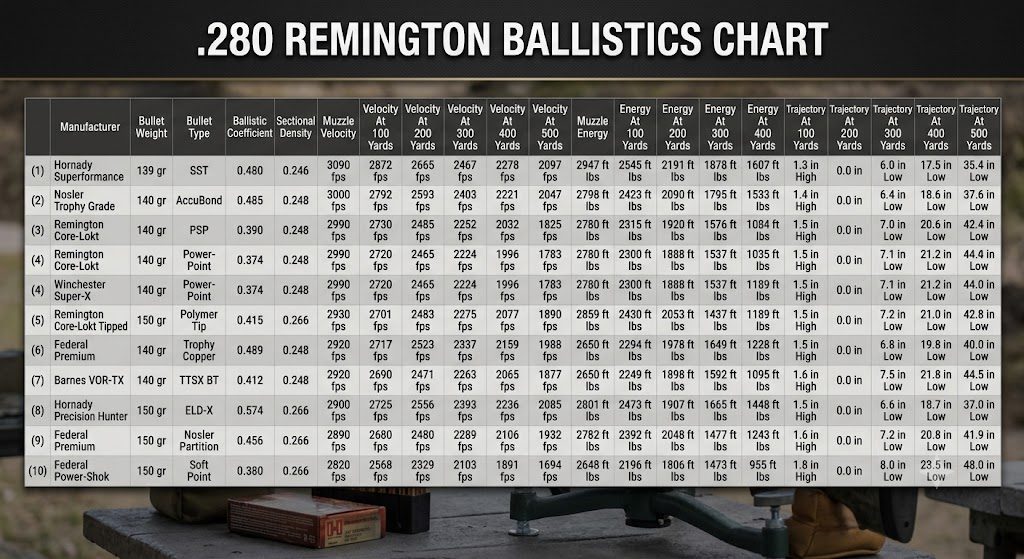
A 280 Remington Ballistics Chart is a highly detailed visual data reference that tracks the velocity, kinetic energy, bullet trajectory, and aerodynamic efficiency of the classic seven millimeter hunting cartridge across various engagement distances. This comprehensive chart allows hunters and precision marksmen to evaluate how different commercial factory loads perform under real world atmospheric conditions. By analyzing these critical flight metrics, shooters can calculate precise elevation holdovers and guarantee ethical terminal impact forces. Utilizing this specialized data ensures maximum accuracy and supreme field performance when deploying this perfectly balanced cartridge.
280 Remington Ballistics Chart
| Manufacturer | Bullet Weight | Bullet Type | Ballistic Coefficient | Sectional Density | Muzzle Velocity | Velocity At 100 Yards | Velocity At 200 Yards | Velocity At 300 Yards | Velocity At 400 Yards | Velocity At 500 Yards | Muzzle Energy | Energy At 100 Yards | Energy At 200 Yards | Energy At 300 Yards | Energy At 400 Yards | Energy At 500 Yards | Trajectory At 100 Yards | Trajectory At 200 Yards | Trajectory At 300 Yards | Trajectory At 400 Yards | Trajectory At 500 Yards |
|---|---|---|---|---|---|---|---|---|---|---|---|---|---|---|---|---|---|---|---|---|---|
| Hornady Superformance | 139 gr | SST | 0.480 | 0.246 | 3090 fps | 2872 fps | 2665 fps | 2467 fps | 2278 fps | 2097 fps | 2947 ft lbs | 2545 ft lbs | 2191 ft lbs | 1878 ft lbs | 1602 ft lbs | 1357 ft lbs | 1.3 in High | 0.0 in | 6.0 in Low | 17.5 in Low | 35.4 in Low |
| Nosler Trophy Grade | 140 gr | AccuBond | 0.485 | 0.248 | 3000 fps | 2792 fps | 2593 fps | 2403 fps | 2221 fps | 2047 fps | 2798 ft lbs | 2423 ft lbs | 2090 ft lbs | 1795 ft lbs | 1533 ft lbs | 1302 ft lbs | 1.4 in High | 0.0 in | 6.4 in Low | 18.6 in Low | 37.6 in Low |
| Remington Core Lokt | 140 gr | PSP | 0.390 | 0.248 | 2990 fps | 2730 fps | 2485 fps | 2252 fps | 2032 fps | 1825 fps | 2780 ft lbs | 2315 ft lbs | 1920 ft lbs | 1576 ft lbs | 1284 ft lbs | 1035 ft lbs | 1.5 in High | 0.0 in | 7.0 in Low | 20.6 in Low | 42.4 in Low |
| Winchester Super X | 140 gr | Power Point | 0.374 | 0.248 | 2990 fps | 2720 fps | 2465 fps | 2224 fps | 1996 fps | 1783 fps | 2780 ft lbs | 2300 ft lbs | 1888 ft lbs | 1537 ft lbs | 1238 ft lbs | 988 ft lbs | 1.5 in High | 0.0 in | 7.1 in Low | 21.2 in Low | 44.0 in Low |
| Remington Core Lokt Tipped | 150 gr | Polymer Tip | 0.415 | 0.266 | 2930 fps | 2701 fps | 2483 fps | 2275 fps | 2077 fps | 1890 fps | 2859 ft lbs | 2430 ft lbs | 2053 ft lbs | 1723 ft lbs | 1437 ft lbs | 1189 ft lbs | 1.5 in High | 0.0 in | 7.2 in Low | 21.0 in Low | 42.8 in Low |
| Federal Premium | 140 gr | Trophy Copper | 0.489 | 0.248 | 2920 fps | 2717 fps | 2523 fps | 2337 fps | 2159 fps | 1988 fps | 2650 ft lbs | 2294 ft lbs | 1978 ft lbs | 1698 ft lbs | 1449 ft lbs | 1228 ft lbs | 1.5 in High | 0.0 in | 6.8 in Low | 19.8 in Low | 40.0 in Low |
| Barnes VOR TX | 140 gr | TTSX BT | 0.412 | 0.248 | 2920 fps | 2690 fps | 2471 fps | 2263 fps | 2065 fps | 1877 fps | 2650 ft lbs | 2249 ft lbs | 1898 ft lbs | 1592 ft lbs | 1325 ft lbs | 1095 ft lbs | 1.6 in High | 0.0 in | 7.5 in Low | 21.8 in Low | 44.5 in Low |
| Hornady Precision Hunter | 150 gr | ELD X | 0.574 | 0.266 | 2900 fps | 2725 fps | 2556 fps | 2393 fps | 2236 fps | 2085 fps | 2801 ft lbs | 2473 ft lbs | 2176 ft lbs | 1907 ft lbs | 1665 ft lbs | 1448 ft lbs | 1.5 in High | 0.0 in | 6.6 in Low | 18.7 in Low | 37.0 in Low |
| Federal Premium | 150 gr | Nosler Partition | 0.456 | 0.266 | 2890 fps | 2680 fps | 2480 fps | 2289 fps | 2106 fps | 1932 fps | 2782 ft lbs | 2392 ft lbs | 2048 ft lbs | 1745 ft lbs | 1477 ft lbs | 1243 ft lbs | 1.6 in High | 0.0 in | 7.2 in Low | 20.8 in Low | 41.9 in Low |
| Federal Power Shok | 150 gr | Soft Point | 0.380 | 0.266 | 2820 fps | 2568 fps | 2329 fps | 2103 fps | 1891 fps | 1694 fps | 2648 ft lbs | 2196 ft lbs | 1806 ft lbs | 1473 ft lbs | 1191 ft lbs | 955 ft lbs | 1.8 in High | 0.0 in | 8.0 in Low | 23.5 in Low | 48.0 in Low |
This extensive ballistics chart illustrates exactly how differences in bullet mass, muzzle velocity, and aerodynamic design affect the external flight path of the cartridge over five hundred yards.
Understanding The 280 Remington Ballistics Chart
Analyzing the provided data reveals that minor variations in projectile shape and factory powder charges create massive differences in downrange authority.
Velocity Analysis
Evaluating the velocity metrics within the table shows that the Hornady Superformance 139 grain SST is the undisputed speed leader with an incredible muzzle velocity of 3090 feet per second.
This exceptional starting speed gives the lightweight polymer tipped projectile a massive advantage across the first three hundred yards of open air flight.
However, examining the heavier bullets reveals that aerodynamic efficiency plays a crucial role in velocity retention over extreme distances.
The Hornady Precision Hunter 150 grain ELD X starts at a slower 2900 feet per second but retains an impressive 2085 feet per second at the 500 yard mark.
In contrast, the traditional Winchester Super X 140 grain Power Point starts much faster at 2990 feet per second but slows down to 1783 feet per second by the time it reaches 500 yards.
This specific velocity data proves that for extended long range hunting, aerodynamically superior projectiles preserve their supersonic stability far better than older blunt nose designs.
Energy Analysis
Muzzle energy dictates the sheer physical shock delivered to a target upon initial bullet impact.
The table data highlights that the Hornady Superformance 139 grain SST produces the highest initial strike force with 2947 foot pounds of muzzle energy.
Heavy duty hunting options like the Remington Core Lokt Tipped 150 grain also start incredibly strong, generating 2859 foot pounds of energy at the barrel exit.
Downrange energy retention is where high ballistic coefficient bullets truly separate themselves from standard hunting ammunition.
By the time the projectiles reach the 500 yard line, the Hornady Precision Hunter 150 grain ELD X retains a massive 1448 foot pounds of lethal kinetic force.
Meanwhile, the Federal Power Shok 150 grain Soft Point bleeds off power rapidly, arriving at 500 yards with only 955 foot pounds of energy remaining.
High retained energy values guarantee that the bullet maintains enough momentum to penetrate thick hide and expand reliably at extreme hunting distances.
Trajectory Analysis
Reviewing the trajectory profile with a standard 200 yard zero demonstrates how flat this magnificent cartridge can shoot across open terrain.
The flattest shooting factory load in the chart is the Hornady Superformance 139 grain SST, which exhibits a minimal bullet drop of only 35.4 inches at 500 yards.
The Hornady Precision Hunter 150 grain ELD X also provides a stellar trajectory, dropping just 37.0 inches at the same half mile distance.
As distance increases beyond the 300 yard line, older projectile designs begin to fall away rapidly due to massive air drag.
The Federal Power Shok 150 grain Soft Point plunges drastically, dropping a full 48.0 inches by the time it reaches the 500 yard target.
Practical holdover estimates using these chart values indicate that shooters using modern polymer tipped ammunition require significantly less optical dialing than those utilizing exposed lead soft points.
Ballistic Coefficient Analysis
The ballistic coefficient values listed in the table reveal a massive technological divide between traditional hunting ammunition and modern match grade designs.
The Hornady Precision Hunter 150 grain ELD X dominates this category with an incredibly high rating of 0.574.
Traditional brush hunting configurations like the Winchester Super X 140 grain Power Point feature a much lower aerodynamic rating of 0.374.
The high rating of the ELD X allows the heavy bullet to easily slice through dense atmospheric resistance without shedding precious velocity.
According to the chart data, this massive aerodynamic advantage guarantees that high coefficient bullets arrive at distant targets with significantly flatter pathways and reduced lateral wind drift.
Sectional Density Analysis
Sectional density directly influences how stable a hunting bullet remains during flight and how deeply it penetrates thick muscle and bone upon arrival.
The chart confirms that all 150 grain projectiles possess the highest sectional density rating of 0.266.
The lighter 139 grain and 140 grain options exhibit a slightly lower sectional density value between 0.246 and 0.248.
A higher sectional density means the bullet concentrates its physical mass over a smaller cross sectional area, which forces it deeper into the vital cavity of large game animals.
This specific data confirms that hunters pursuing heavy bodied elk or moose should rely on the 150 grain projectiles to maximize deep pass through penetration.
Best Factory Loads Based On The Chart
For Extreme Long Range Shooting, the Hornady Precision Hunter 150 grain ELD X is the absolute best choice due to its massive 0.574 ballistic coefficient and exceptional energy retention.
For Precision Shooting and formal open field hunting, the Nosler Trophy Grade 140 grain AccuBond provides a perfectly balanced trajectory with an impressive 37.6 inch drop at 500 yards.
If Maximum Velocity is your primary goal, the Hornady Superformance 139 grain SST takes the absolute top spot by reaching 3090 feet per second.
When seeking Maximum Retained Energy at extended distances, the Hornady Precision Hunter 150 grain ELD X wins easily by preserving 1448 foot pounds of strike force at 500 yards.
For General Purpose Shooting and close quarters woods hunting, the Federal Power Shok 150 grain Soft Point offers reliable terminal expansion and moderate velocities that prevent meat damage.
Key Takeaways From The Chart
The fastest factory load in the entire chart is the Hornady Superformance 139 grain SST at 3090 feet per second.
The highest initial muzzle energy is produced by the Hornady Superformance 139 grain SST at 2947 foot pounds.
The highest retained kinetic energy at 500 yards belongs to the Hornady Precision Hunter 150 grain ELD X at 1448 foot pounds.
The flattest trajectory at 500 yards is achieved by the Hornady Superformance 139 grain SST with a minimal 35.4 inches of bullet drop.
The highest overall ballistic coefficient listed is the Hornady Precision Hunter 150 grain ELD X at 0.574.
The best overall long range hunting performer based on combined energy retention and trajectory metrics is the Hornady Precision Hunter 150 grain ELD X.
Common 280 Remington Bullet Weights
The specialized internal case capacity of this cartridge allows it to utilize an incredibly wide spectrum of projectile weights optimized for distinct hunting roles.
139 Grain
The 139 grain projectile weight is a proprietary offering from Hornady that maximizes the velocity potential of the seven millimeter caliber.
Typical muzzle velocity for this specific weight easily breaks the 3000 feet per second barrier when paired with specialized high energy propellants.
The primary advantage of this weight is its incredibly high initial velocity, which creates a laser flat mid range shooting path.
The main disadvantage is that the slightly lighter mass can result in shallower penetration on tough angles when hunting large game.
This specific weight is best applied in general target practice, open country antelope hunting, and long distance predator control.
140 Grain
The 140 grain projectile represents the classic industry standard for perfectly balanced deer hunting ammunition.
Typical muzzle velocity sits comfortably around 2920 to 3000 feet per second, which generates roughly 2700 foot pounds of energy at the muzzle.
The primary advantages of 140 grain options are brilliant velocity retention, moderate recoil, and a massive selection of premium factory loads.
The primary disadvantage is that these bullets lack the extreme mass required for reliable pass through shots on heavy animals like grizzly bears.
This weight is the absolute ideal choice for open country mule deer hunting and precise shot placement on medium sized game.
150 Grain
The 150 grain projectile weight represents the sweet spot for heavy hitting kinetic energy within this specific cartridge family.
Typical muzzle velocity is roughly 2850 to 2930 feet per second, which translates into a massive 2800 foot pounds of initial muzzle energy.
The single biggest advantage of this weight is its exceptional sectional density, which guarantees deep wound channels through thick muscle tissue.
The primary disadvantage is a slight reduction in absolute muzzle velocity compared to the hyper fast 139 grain options.
This weight is the ultimate choice for hunters who require deep penetration on elk and moose alongside a remarkably flat trajectory curve.
160 Grain
The 160 grain bullet is an incredibly heavy option used primarily by handloaders and specialized custom ammunition manufacturers.
Typical muzzle velocity drops down to around 2700 feet per second, though it maintains immense structural momentum at extended yardages.
The advantage of the 160 grain bullet is its unmatched wind resisting capabilities and phenomenal deep penetration on heavy dangerous game.
The main disadvantage is the severely restricted selection of commercial factory loaded options, requiring most shooters to handload these specific components.
This extreme weight is reserved almost exclusively for specialized timber hunting where deep penetration is prioritized over a flat flight path.
Effective Range
Understanding the realistic limits of this cartridge helps hunters select the correct equipment and optical setups for their specific field goals.
Target Shooting
For standard large scale paper and steel targets, the effective range easily spans from 100 yards out to 1000 yards using quality match grade ammunition.
At these extended distances, the seven millimeter projectile remains comfortably supersonic, keeping its flight path predictable and highly stable through varying atmospheric conditions.
Extreme Long Range Shooting
When participating in extreme long range hunting activities, ethical marksmen restrict this cartridge to a maximum distance of 600 yards.
Achieving success at this specific distance requires premium high ballistic coefficient ammunition like the ELD X to ensure the bullet retains enough kinetic energy for rapid expansion.
Military Applications
This specific cartridge was never officially adopted by any major global military force for standard front line infantry combat.
However, the seven millimeter projectile diameter it utilizes has a massive military history, offering a perfect balance of low recoil and high lethality.
The ballistic properties of this cartridge actually exceed many modern military sniper rounds in terms of wind deflection and retained energy.
Today, its military connection remains purely historical, serving as a testament to the brilliant ballistic efficiency of the seven millimeter bullet class.
Competition Shooting
Within local sporting rifle matches and metallic silhouette events, the cartridge performs admirably out to the 500 yard line.
At this specific distance, the high ballistic coefficient of modern polymer tipped ammunition allows shooters to achieve incredible accuracy despite shifting lateral wind currents.
Factors That Affect 280 Remington Ballistics
External environmental variables and physical firearm attributes combine to shape how a bullet behaves once it leaves the muzzle.
Barrel Length
Barrel length plays a crucial role in determining how much velocity the cartridge can generate before the bullet exits into the open atmosphere.
A standard 24 inch barrel allows the slow burning powder inside the case to completely ignite, maximizing the initial velocity.
Shorter barrels, such as 20 inch mountain rifle configurations, can cause a loss of up to 150 feet per second, which noticeably diminishes downrange performance.
Bullet Weight
Bullet weight dictates the core relationship between quick initial exit speed and late flight momentum conservation as shown in our primary chart.
Lighter bullets leave the barrel much faster but lose speed quickly, whereas heavier bullets start slightly slower but hold their velocity over massive distances.
Bullet Construction
The physical design of the projectile, whether it is an exposed lead core, a solid copper turning, or a polymer tipped boat tail, heavily affects flight efficiency.
Smooth aerodynamic tipped match bullets track perfectly straight because they minimize flight imbalances and slice through the air cleanly.
Ballistic Coefficient
The ballistic coefficient measures exactly how easily a bullet overcomes raw air resistance during its long journey to the target.
A higher ballistic coefficient directly reduces vertical bullet drop and minimizes the lateral drift caused by harsh crosswinds in the field.
Altitude
High altitude mountain environments feature thinner air, which drastically reduces the aerodynamic drag forces acting against a flying bullet.
Hunters operating in elevated mountain ranges will notice flatter overall pathways and much higher retained velocities than those shooting near sea level.
Temperature
Air temperature heavily impacts air density, with freezing cold temperatures creating denser air that slows down projectiles much faster.
Additionally, extreme ammunition temperature fluctuations can alter powder burn rates inside the cartridge, causing unexpected changes in initial muzzle velocity.
Wind
Due to the extreme distances this cartridge can cover, crosswinds have a profound effect on the downrange trajectory of the bullet.
A strong crosswind will push the bullet sideways over long distances, requiring precise windage alignment based on detailed ballistic chart evaluations.
Zero Distance
The specific distance at which a rifle is zeroed determines the entire arc of the flight trajectory relative to the shooter looking through the optic.
An inappropriate zero distance can require excessive physical adjustments on an optics turret when suddenly moving between close brush and distant open targets.
Best Zero Distance
Choosing the correct zero distance establishes an incredibly efficient baseline for dialing or holding over targets at extended ranges.
100 Yard Zero
A 100 yard zero is highly popular among civilian hunters who frequent standard local shooting ranges and dense heavy timber woods.
The primary advantage is that wind interference is practically eliminated during the sight in process, ensuring a perfectly centered rifle alignment.
The main disadvantage is that you must dial a large amount of vertical elevation adjustment when transitioning to longer open field targets.
This zero is best for general target practice, initial rifle testing, and short range white tailed deer hunting in thick brush.
200 Yard Zero
A 200 yard zero serves as an exceptional general purpose baseline for a wide variety of open country shooting and hunting conditions.
As demonstrated in our primary chart, utilizing a 200 yard zero keeps the bullet path incredibly flat through the first 200 yards of travel.
The disadvantage is a very slight mid range rise, though it remains small enough to completely ignore when aiming at the vital zone of medium sized game animals.
This zero is highly recommended for mule deer hunters and field marksmen who require instant readiness without immediate turret manipulation.
500 Yard Zero
A 500 yard zero is an incredibly specialized configuration utilized only by extreme long range specialists testing the maximum limits of this specific cartridge.
The massive advantage is that it eliminates the need to dial elevation corrections when engaging distant steel targets right at the half mile mark.
The severe disadvantage is that the bullet flies significantly higher than the line of sight at 200 and 300 yards, which guarantees massive misses on close targets.
This approach is best reserved for dedicated medium to long range field experiments where steel target distances are consistently uniform.
1000 Yard Zero
A 1000 yard zero is entirely theoretical for a standard hunting rifle and is used exclusively by extreme experimental long range marksmen.
The major benefit of attempting this zero is exploring the absolute maximum trajectory arc that the seven millimeter projectile can physically achieve.
The disadvantage is that the shooter must use specialized sloped optical mounts just to dial the massive amount of elevation required to reach this distance.
This zero is strictly an academic target exercise and should never be applied to ethical hunting or practical field shooting scenarios.
280 Remington Compared To Similar Cartridges
To understand exactly where this cartridge stands, it helps to compare its performance against other prominent large game hunting options.
| Cartridge | Velocity | Energy | Trajectory At 500 Yards | Ballistic Coefficient | Effective Range | Recoil | Extreme Long Range Performance |
|---|---|---|---|---|---|---|---|
| 280 Remington | 2900 fps | 2801 ft lbs | 37.0 in Low | 0.574 | 800 yd | Moderate | Excellent High BC Retention |
| 270 Winchester | 3060 fps | 2700 ft lbs | 36.0 in Low | 0.496 | 800 yd | Moderate | Extremely Flat Path |
| 30 06 Springfield | 2800 fps | 2900 ft lbs | 42.0 in Low | 0.450 | 800 yd | Heavy | Massive Initial Impact Force |
| 7mm Remington Magnum | 3100 fps | 3200 ft lbs | 30.0 in Low | 0.574 | 1000 yd | Heavy | Ultimate Long Range Authority |
| 280 Ackley Improved | 3050 fps | 2950 ft lbs | 33.0 in Low | 0.574 | 900 yd | Moderate Heavy | Superb Velocity Enhancement |
The major difference shown above is that the 280 Remington provides an absolutely perfect middle ground between the 270 Winchester and the 30 06 Springfield. It delivers higher ballistic coefficients than the 270 Winchester while generating noticeably less recoil than the heavy 30 06 Springfield. When compared to the massive 7mm Remington Magnum, the standard 280 Remington uses significantly less powder and extends barrel life while still delivering incredible lethality on large game.
Frequently Asked Questions
What is the typical muzzle velocity of a 280 Remington?
Typical factory ammunition muzzle velocity ranges between 2820 and 3090 feet per second depending on the specific bullet weight and powder charge.
How much bullet drop does a 280 Remington have at 500 yards?
With a standard 200 yard zero, a typical factory cartridge experiences between 35.4 and 48.0 inches of drop at 500 yards.
Which factory load retains velocity best at long range?
The Hornady Precision Hunter 150 grain ELD X retains velocity incredibly well due to its ultra sleek polymer tip and exceptionally high aerodynamic rating.
Is the 280 Remington effective past 500 yards?
Yes, the cartridge maintains supersonic stability well past 800 yards, and modern high BC bullets ensure it retains ethical hunting energy past 500 yards.
What is the average muzzle energy of a 280 Remington cartridge?
Average muzzle energy spans from 2648 to over 2947 foot pounds, making it a highly capable and devastatingly powerful large game hunting round.
Why do heavier bullets drop less at extreme distances?
Heavier high coefficient bullets resist air drag incredibly efficiently, which allows them to retain high velocity and spend far less time in flight where gravity pulls them down.
What is the difference between the 280 Remington and the 270 Winchester?
The 280 Remington utilizes a larger seven millimeter bullet which offers superior ballistic coefficients and heavier bullet weight options than the standard 270 Winchester.
Does barrel length significantly change 280 Remington ballistics?
Yes, longer 24 inch barrels maximize internal powder combustion, while short 20 inch carbine barrels can reduce muzzle velocity noticeably and limit extreme range capability.
What is the best zero distance for a 280 Remington hunting rifle?
A 200 yard zero provides the best general purpose balance, keeping mid range trajectory totally flat while leaving plenty of adjustment room for distant targets.
How does wind affect a 280 Remington bullet compared to smaller calibers?
Due to its heavy mass and exceptional aerodynamic profile, it resists wind deflection far better than tiny varmint calibers and remains incredibly stable during harsh crosswinds.