A 22 Hornet Ballistics Chart is an essential reference table for any shooter looking to understand the velocity, kinetic energy, and trajectory curve of this historic small-bore cartridge. By reviewing this chart, you can visualize exactly how your lightweight .22 caliber bullet will perform from the moment it leaves your barrel until it reaches its target. This data is critical for accurately predicting bullet drop, compensating for wind drift, and ensuring your projectile retains enough energy for an ethical harvest on varmints and small predators.
Shooters, hunters, reloaders, and classic firearm enthusiasts use a 22 Hornet Ballistics Chart to unlock the true potential of one of the oldest commercial centerfire cartridges still in production today. Developed in the 1920s and standardized by Winchester in 1930, the .22 Hornet bridged the massive gap between rimfire cartridges like the .22 LR and early high-power centerfires. By studying the numbers, a dedicated predator hunter can confidently take a challenging shot on a fox or coyote at 150 yards, knowing exactly how their expanding bullet will perform. In this comprehensive guide, you will learn how to analyze ballistics data, choose the right bullet weight, determine the optimal zero distance, and see how this classic cartridge holds its own in the modern hunting landscape.
22 Hornet Ballistics Chart
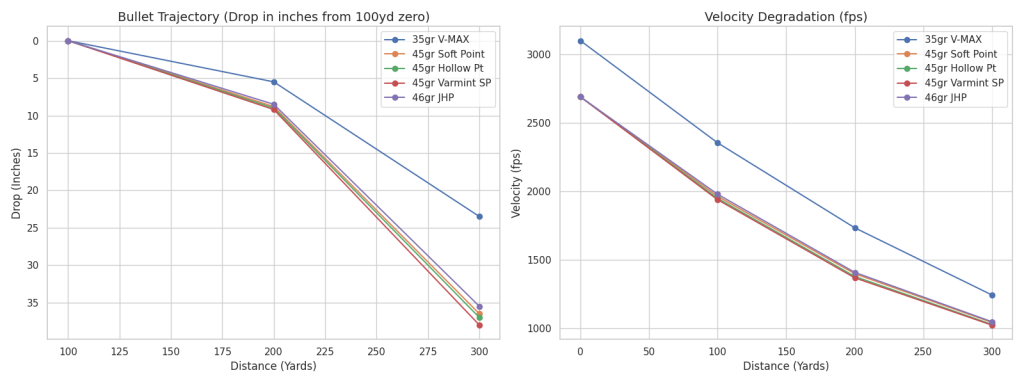
Below is a detailed ballistics table featuring popular factory-loaded ammunition available for the .22 Hornet today. The data represents a standard 24-inch test barrel and assumes a 100-yard zero under standard sea-level atmospheric conditions.
| Bullet Weight | Bullet Type | Manufacturer | Muzzle Velocity | Velocity At 100 Yards | Velocity At 200 Yards | Velocity At 300 Yards | Muzzle Energy | Energy At 100 Yards | Energy At 200 Yards | Energy At 300 Yards | Trajectory At 100 Yards | Trajectory At 200 Yards | Trajectory At 300 Yards | Ballistic Coefficient |
|---|---|---|---|---|---|---|---|---|---|---|---|---|---|---|
| 35 Grain | V-MAX | Hornady | 3100 fps | 2355 fps | 1735 fps | 1245 fps | 747 ft lbs | 431 ft lbs | 234 ft lbs | 120 ft lbs | 0 inches | 5.5 inches drop | 23.5 inches drop | 0.109 |
| 45 Grain | Soft Point | Winchester | 2690 fps | 1965 fps | 1400 fps | 1045 fps | 723 ft lbs | 386 ft lbs | 196 ft lbs | 109 ft lbs | 0 inches | 8.8 inches drop | 36.5 inches drop | 0.116 |
| 45 Grain | Hollow Point | Remington | 2690 fps | 1950 fps | 1380 fps | 1030 fps | 723 ft lbs | 380 ft lbs | 190 ft lbs | 106 ft lbs | 0 inches | 9.0 inches drop | 37.0 inches drop | 0.114 |
| 45 Grain | Varmint Soft Point | Federal | 2690 fps | 1940 fps | 1370 fps | 1025 fps | 723 ft lbs | 376 ft lbs | 187 ft lbs | 105 ft lbs | 0 inches | 9.2 inches drop | 38.0 inches drop | 0.111 |
| 46 Grain | Jacketed Hollow Point | Winchester | 2690 fps | 1980 fps | 1410 fps | 1050 fps | 739 ft lbs | 400 ft lbs | 203 ft lbs | 112 ft lbs | 0 inches | 8.5 inches drop | 35.5 inches drop | 0.120 |
Understanding The Chart
A ballistics chart displays several technical variables that dictate how a round performs downrange. Breaking down these metrics helps clarify the flight characteristics of the .22 Hornet.
Muzzle Velocity
Muzzle velocity is the speed at which the bullet exits the barrel, measured in feet per second (fps). The .22 Hornet achieves impressive velocities for its incredibly small case capacity. Modern lightweight loads (like the 35-grain V-MAX) can exceed 3,100 fps, while traditional 45-grain loads hover around 2,690 fps. This speed provides a flat trajectory at close to medium ranges, significantly outperforming any rimfire cartridge.
Retained Velocity
Retained velocity refers to the speed of the bullet at specific distances downrange. Because the .22 Hornet fires lightweight, relatively blunt bullets, they experience significant aerodynamic drag. As a result, retained velocity drops rapidly. While it starts fast, a standard 45-grain bullet often drops below the speed of sound just past 300 yards.
Kinetic Energy
Kinetic energy represents the striking force of the projectile, expressed in foot-pounds (ft-lbs). Energy is calculated using both the bullet’s mass and its velocity. The .22 Hornet produces roughly 700 to 750 ft-lbs of energy at the muzzle. This provides devastating explosive energy on small varmints and sufficient penetration for medium predators like coyotes at close ranges.
Trajectory
Trajectory details the flight path of the bullet relative to the sight line, tracking drop in inches. The .22 Hornet exhibits a relatively flat trajectory inside 150 yards. However, due to rapid velocity loss, the bullet drops steeply past 200 yards, requiring accurate distance estimation for longer shots.
Ballistic Coefficient
The Ballistic Coefficient (BC) measures a bullet’s aerodynamic efficiency. Higher numbers indicate better air-cutting capability and less velocity degradation. Traditional .22 Hornet bullets have exceptionally low Ballistic Coefficients, often ranging between 0.100 and 0.120. This makes them highly susceptible to wind drift and rapid speed loss.
Common .22 Hornet Bullet Weights
The .22 Hornet utilizes lightweight .224-inch (or older .223-inch) diameter bullets. Selecting the appropriate bullet weight depends on your target and the specific rifling twist rate of your firearm.
35 Grain
The 35-grain weight class represents the pinnacle of modern .22 Hornet performance. Utilizing polymer-tipped bullets like the Hornady V-MAX, these loads achieve the highest muzzle velocities (over 3,100 fps) and the flattest trajectories available for the caliber. They are the premier choice for hunting small varmints like prairie dogs and woodchucks, providing explosive terminal performance and minimizing the risk of ricochets.
45 to 46 Grain
The 45 and 46-grain weights are the historical standard for the .22 Hornet. Available in traditional soft point and hollow point designs, they launch at roughly 2,690 fps. While they drop faster than the lightweight 35-grain loads, they offer slightly deeper penetration, making them a more reliable choice for tougher predators like foxes and close-range coyotes.
Effective Hunting Range
The .22 Hornet is a specialized, light-duty cartridge. Understanding its effective range is critical for ethical hunting.
Varmints (Prairie Dogs, Woodchucks, Ground Squirrels)
For small, thin-skinned varmints, the .22 Hornet is highly effective out to 200 yards. The high muzzle velocity and explosive expanding bullets provide instant, ethical kills. Its extremely low recoil allows shooters to watch impacts through the scope, and the mild report makes it an excellent choice for hunting near populated agricultural areas where noise is a concern.
Predators (Foxes, Bobcats, Coyotes)
When targeting medium predators, the effective ethical range is generally restricted to 150 yards or less. While it carries enough energy to dispatch a coyote at close range, the lightweight bullets lack the momentum for deep penetration through heavy bone at extended distances. Precise shot placement on coyotes is absolutely mandatory.
Whitetail Deer
Hunting whitetail deer or any big game with the .22 Hornet is highly unethical and universally illegal in almost all jurisdictions. The lightweight, fragile bullets lack the kinetic energy and structural integrity required to penetrate to the vital organs of a large animal, resulting in terrible, non-lethal surface wounds.
Factors That Affect .22 Hornet Ballistics
Several physical and mechanical variables influence the downrange performance of the .22 Hornet.
Wind Drift
Because .22 Hornet bullets have terrible aerodynamic efficiency (low BCs) and shed velocity quickly, they are heavily bullied by crosswinds. Even a moderate 10 mph crosswind will deflect a 45-grain bullet several inches at 200 yards. Reading the wind is the greatest challenge when using the .22 Hornet at extended ranges.
Bore Diameter Variations (.223 vs .224)
A crucial quirk of the .22 Hornet’s history is its bore diameter. Older rifles manufactured before the 1950s often feature a .223-inch bore diameter, while modern rifles utilize the standard .224-inch bore diameter. Reloaders must be acutely aware of their rifle’s specific bore dimension. Firing modern .224 bullets through an older .223 bore can cause dangerous pressure spikes.
Best Zero Distance
Choosing a zero distance depends on your intended target and hunting style.
100-Yard Zero
A 100-yard zero is the standard baseline for the .22 Hornet. It keeps the bullet trajectory very close to the line of sight for typical varmint hunting distances and provides a clear, mathematical starting point for understanding bullet drop at 150 and 200 yards.
150-Yard Zero (Maximum Point Blank Range)
For hunters looking to maximize the effective range without dialing turrets, a 150-yard zero is an excellent strategy when using fast 35-grain loads. The bullet will strike roughly 1.5 inches high at 100 yards and drop about 2 inches at 175 yards. This allows a hunter to hold dead-center on a small target out to nearly 175 yards without complicated holdover math.
.22 Hornet Ballistics Compared To Other Cartridges
The following table compares the .22 Hornet against other popular small-bore cartridges at 200 yards.
| Cartridge | Muzzle Velocity | Muzzle Energy | Trajectory At 200 Yds (100yd Zero) | Recoil | Effective Range |
|---|---|---|---|---|---|
| .22 Hornet (35gr) | 3100 fps | 747 ft lbs | 5.5 inches drop | Minimal | 200 Yards |
| .22 WMR (30gr) | 2200 fps | 322 ft lbs | 16.0 inches drop | None | 125 Yards |
| .17 Hornet (20gr) | 3650 fps | 592 ft lbs | 3.5 inches drop | Minimal | 300 Yards |
| .223 Remington (50gr) | 3300 fps | 1209 ft lbs | 2.5 inches drop | Very Light | 400 Yards |
The .22 Hornet completely eclipses the most powerful rimfire cartridges, like the .22 WMR, offering vastly superior velocity, energy, and range. However, when compared to modern centerfires like the .223 Remington, the .22 Hornet’s limitations become obvious. The .223 pushes heavier bullets much faster, resulting in a significantly flatter trajectory and doubling the effective hunting range. The modern .17 Hornet offers a flatter trajectory and better wind resistance than the .22 Hornet, but utilizes a smaller, lighter bullet.
Conclusion
Understanding a 22 Hornet Ballistics Chart highlights the enduring utility of this historic centerfire cartridge. While it cannot compete with the long-range performance of modern varmint rounds like the .223 Remington or .22-250, the .22 Hornet fills a brilliant niche. It offers a massive step up from rimfire ballistics, providing a quiet, incredibly mild-shooting option that is devastating on small pests and predators inside 150 yards. For the classic firearm enthusiast or the small-property landowner managing predators, mastering the trajectory and wind drift of the .22 Hornet ensures a highly enjoyable and effective hunting experience.