A 308 Winchester Ballistics Chart utilizing a 50-yard zero is an incredibly specialized and highly comprehensive reference table. While most hunters default to a traditional 100-yard zero, establishing a 50-yard zero on a .308 Winchester is a brilliant Maximum Point Blank Range (MPBR) strategy. By reviewing this specific chart, you can visualize exactly how your bullet will behave from the precise moment it leaves your barrel. Because the bullet arcs upward to meet the line of sight at 50 yards, it continues to rise slightly, striking roughly an inch or two high at 100 yards, before dropping back down to intersect the line of sight perfectly again near 200 yards.
Shooters, woodland hunters, tactical marksmen, and AR-10 platform enthusiasts heavily rely on a 50-yard zero ballistics chart to unlock the absolute true potential of this legendary short-action cartridge. Introduced commercially by Winchester in 1952 (shortly before its military adoption as the 7.62x51mm NATO), the .308 Winchester remains the undisputed king of versatile big game hunting. By utilizing a 50-yard zero, a dedicated hunter can confidently aim dead-center on the chest of a whitetail deer or a wild hog anywhere from the muzzle out to 250 yards, completely eliminating the need to calculate complex holdovers in the heat of the moment. In this comprehensive guide, you will learn how to analyze ballistics data, choose the absolute best bullet weight for your specific needs, understand the mechanics of the 50-yard zero, and see exactly why this timeless cartridge continues to dominate the hunting woods today.
308 Ballistics Chart 50 Yard Zero
Below is a detailed ballistics table featuring the most popular and proven factory ammunition loads available for the .308 Winchester today. The data represents a standard 20-inch to 24-inch test barrel and assumes a 50-yard zero with a standard scope height (roughly 1.5 inches above the bore) under standard sea-level atmospheric conditions.
| Bullet Weight | Bullet Type | Manufacturer | Muzzle Velocity | Velocity At 100 Yards | Velocity At 200 Yards | Velocity At 300 Yards | Velocity At 400 Yards | Velocity At 500 Yards | Muzzle Energy | Energy At 100 Yards | Energy At 200 Yards | Energy At 300 Yards | Energy At 400 Yards | Energy At 500 Yards | Trajectory At 50 Yards | Trajectory At 100 Yards | Trajectory At 200 Yards | Trajectory At 300 Yards | Trajectory At 400 Yards | Trajectory At 500 Yards | Ballistic Coefficient | Sectional Density |
| 150 Grain | SST Superformance | Hornady | 2820 fps | 2605 fps | 2400 fps | 2205 fps | 2020 fps | 1845 fps | 2648 ft lbs | 2260 ft lbs | 1918 ft lbs | 1619 ft lbs | 1359 ft lbs | 1133 ft lbs | 0 inches | +1.5 inches | 0 inches | 8.0 inches drop | 24.0 inches drop | 48.0 inches drop | 0.415 | 0.226 |
| 150 Grain | Core-Lokt | Remington | 2820 fps | 2555 fps | 2305 fps | 2070 fps | 1850 fps | 1645 fps | 2648 ft lbs | 2174 ft lbs | 1769 ft lbs | 1427 ft lbs | 1140 ft lbs | 901 ft lbs | 0 inches | +1.6 inches | 0.5 inches drop | 9.0 inches drop | 26.5 inches drop | 53.0 inches drop | 0.314 | 0.226 |
| 165 Grain | AccuBond | Nosler | 2700 fps | 2515 fps | 2340 fps | 2170 fps | 2010 fps | 1855 fps | 2671 ft lbs | 2318 ft lbs | 2006 ft lbs | 1725 ft lbs | 1480 ft lbs | 1261 ft lbs | 0 inches | +1.8 inches | 0.5 inches drop | 9.5 inches drop | 27.0 inches drop | 53.0 inches drop | 0.475 | 0.248 |
| 168 Grain | Gold Medal Match | Federal Premium | 2650 fps | 2465 fps | 2285 fps | 2115 fps | 1950 fps | 1795 fps | 2619 ft lbs | 2267 ft lbs | 1948 ft lbs | 1669 ft lbs | 1418 ft lbs | 1202 ft lbs | 0 inches | +2.0 inches | 0.8 inches drop | 10.5 inches drop | 28.5 inches drop | 55.0 inches drop | 0.462 | 0.253 |
| 175 Grain | Terminal Ascent | Federal Premium | 2600 fps | 2445 fps | 2295 fps | 2150 fps | 2010 fps | 1875 fps | 2627 ft lbs | 2323 ft lbs | 2047 ft lbs | 1796 ft lbs | 1570 ft lbs | 1366 ft lbs | 0 inches | +2.1 inches | 1.0 inches drop | 10.8 inches drop | 29.0 inches drop | 56.0 inches drop | 0.520 | 0.264 |
| 178 Grain | ELD-X | Hornady | 2600 fps | 2440 fps | 2285 fps | 2135 fps | 1990 fps | 1855 fps | 2672 ft lbs | 2353 ft lbs | 2064 ft lbs | 1802 ft lbs | 1565 ft lbs | 1360 ft lbs | 0 inches | +2.0 inches | 0.8 inches drop | 10.2 inches drop | 28.0 inches drop | 54.0 inches drop | 0.552 | 0.268 |
| 180 Grain | Partition | Federal Premium | 2620 fps | 2420 fps | 2230 fps | 2050 fps | 1875 fps | 1715 fps | 2743 ft lbs | 2340 ft lbs | 1987 ft lbs | 1680 ft lbs | 1405 ft lbs | 1175 ft lbs | 0 inches | +2.1 inches | 1.5 inches drop | 12.0 inches drop | 32.0 inches drop | 60.0 inches drop | 0.474 | 0.271 |
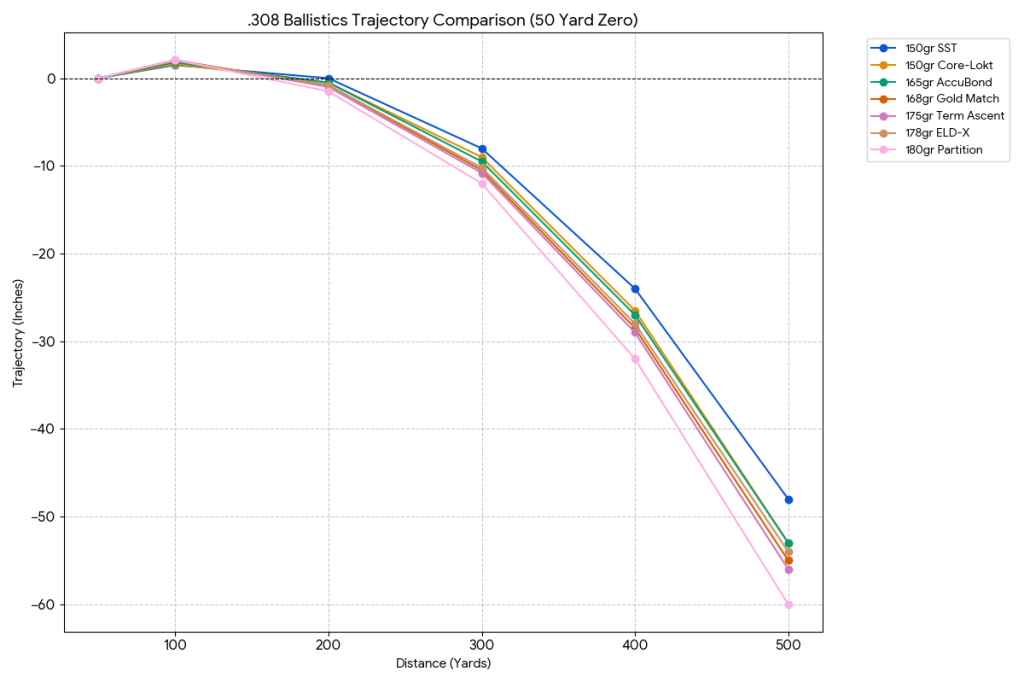
The 50-Yard Zero Strategy (Maximum Point Blank Range)
Understanding exactly how a 50-yard zero works is absolutely vital for making the most of the .308 Winchester in the field.
When you look through your rifle scope, your line of sight is perfectly straight. However, your rifle barrel is mounted below the scope and is angled very slightly upward. When the bullet leaves the muzzle, it crosses your line of sight on its way up (the first zero), reaches its maximum height (the apex), and then falls back down, crossing your line of sight a second time (the second zero).
When you zero a standard .308 Winchester at exactly 50 yards, the bullet is crossing your line of sight on its way up.
- At 100 yards, the bullet is near its apex, traveling roughly 1.5 to 2 inches high above your crosshairs.
- At 200 yards, gravity has pulled the bullet back down, perfectly intersecting your line of sight again (it will hit exactly where you aim, or within a fraction of an inch).
- At 250 yards, the bullet has dropped roughly 3 to 4 inches below your crosshairs.
By utilizing a 50-yard zero, you create a Maximum Point Blank Range (MPBR) of roughly 250 yards. This means that if an elk or deer steps out anywhere between 10 yards and 250 yards, you simply place your crosshairs dead-center on its lungs and pull the trigger. The bullet will never rise or fall more than a few inches from your point of aim, guaranteeing a fatal hit without any frantic holdover calculations.
Understanding The Chart
A ballistics chart displays several technical variables that dictate how a round performs downrange. Breaking down these metrics helps clarify the flight characteristics of the .308 Winchester.
Muzzle Velocity
Muzzle velocity is the speed at which the bullet exits the barrel, measured in feet per second (fps). The .308 Winchester achieves highly efficient, moderate velocities by utilizing a highly optimized short-action case. Lightweight 150-grain bullets launch at roughly 2,820 fps, while heavy 180-grain bullets comfortably leave the barrel at 2,620 fps. This moderate speed provides excellent barrel life and highly manageable recoil.
Retained Velocity
Retained velocity measures the speed of the projectile at designated points downrange. Retained velocity is critical for hunters because most expanding hunting bullets require a minimum velocity threshold (typically 1,800 fps) to expand reliably upon impact. Thanks to the highly efficient aerodynamic profiles of modern .30 caliber bullets, the .308 Winchester easily retains lethal velocity past 400 yards.
Kinetic Energy
Kinetic energy represents the striking force of the projectile, expressed in foot-pounds (ft-lbs). Energy is calculated using both the bullet’s mass and its velocity. The cartridge generates over 2,600 ft-lbs of energy at the muzzle and comfortably retains over 1,500 ft-lbs at 300 yards with medium-to-heavy bullets, guaranteeing deep penetration on tough game like elk and black bear.
Ballistic Coefficient
The Ballistic Coefficient (BC) measures a bullet’s aerodynamic efficiency. Higher numbers indicate better air-cutting capability and less velocity degradation. High BC bullets also resist lateral displacement from crosswinds much better than lower-rated projectiles. Modern tipped bullets like the Hornady ELD-X (BC 0.552) drastically improve the long-range performance of the .308 Winchester.
Sectional Density
Sectional density (SD) compares a bullet’s mass directly to its diameter. A higher sectional density corresponds to greater penetration potential in target tissues. Heavy .308 bullets weighing 165 to 180 grains feature exceptionally high sectional densities (0.248 to 0.271), allowing them to penetrate deeply through thick muscle and heavy shoulder bone on massive game animals.
Common 308 Winchester Bullet Weights
The performance characteristics of the .308 Winchester shift noticeably based on bullet weight selection, making it one of the most versatile short-action cartridges in existence.
150 Grain
The 150-grain weight class offers the highest muzzle velocities for the cartridge, often exceeding 2,820 fps. These fast projectiles deliver flat trajectories out to 300 yards, making them ideal choices for open-country hunting of medium game like antelope, mule deer, and whitetails. They provide devastating hydrostatic shock and drop medium game instantly.
165 to 168 Grain
The 165 to 168-grain range represents the true sweet spot for the .308 Winchester. Bullets like the Nosler AccuBond or Federal Gold Medal Match strike a perfect balance between high velocity, heavy bullet integrity, and deep penetration. This weight is widely considered the ultimate “do-it-all” option for taking everything from whitetails to bull elk without producing punishing recoil.
175 to 178 Grain
The 175 to 178-grain category includes highly advanced, high-BC designs like the Federal Terminal Ascent and Hornady ELD-X. These specialized bullets are explicitly engineered to combat wind drift and retain massive amounts of momentum far downrange. They are ideal for open-country hunters and target shooters who regularly engage targets past 500 yards.
180 Grain
The 180-grain bullets are reserved for the absolute largest heavy-boned game and extreme deep penetration. While they launch slower (around 2,620 fps), traditional 180-grain round-nose or partitioned bullets act as incredible sledgehammers for moose, elk, and black bear hunting in thick timber where maximum penetration is required.
Effective Hunting Range
The .308 Winchester’s effective range is highly impressive, bringing efficiency and medium-game hunting power into the modern short-action platform.
Whitetail Deer and Antelope
For deer, sheep, and antelope, the .308 Winchester is incredibly effective out to 500 yards in the hands of a highly skilled marksman. With proper expanding ammunition, it maintains a completely reliable flight path, massive kinetic energy, and velocity levels that guarantee rapid ethical expansion.
Elk and Moose
Elk and moose require heavy energy delivery and deep bone-crushing penetration. The .308 Winchester retains over 1,500 ft-lbs of kinetic energy past 300 yards with heavy 165-grain to 180-grain projectiles. This makes it a premier woodland and moderate-range mountain cartridge for massive game.
Black Bear and Wild Hogs
Black bears and wild hogs feature dense muscle tissue and thick fat layers that require reliable projectile expansion and structural integrity. Heavy bonded or solid copper 165-grain bullets fired from the .308 Win easily penetrate to vital organs in heavy timber clearings, guaranteeing complete pass-through penetration and excellent blood trails.
Factors That Affect 308 Ballistics
Several physical and mechanical variables influence downrange performance.
Barrel Length
Barrel length directly influences final velocity. Standard factory test data is based on 24-inch barrels. However, because the .308 Winchester burns its powder charge extremely efficiently, it is highly popular in short 16-inch or 18-inch barrels (especially on AR-10s or scout rifles). Shortening the barrel typically results in a minor velocity drop of approximately 20 to 25 feet per second per inch removed, maintaining incredible ballistic efficiency even in short-barreled rifles.
Altitude and Air Density
Because heavy .30 caliber bullets have excellent aerodynamic ratings, high elevation significantly reduces atmospheric drag. Shooting the .308 Winchester in mountain environments yields noticeably flatter trajectories and less velocity loss compared to sea-level shooting.
Wind Drift
Crosswinds deflect projectiles laterally over long distances. High velocity, high-BC projectiles like the 178-grain ELD-X minimize the bullet’s time of flight, drifting far less in variable crosswinds compared to lighter, less aerodynamic bullets. Reading wind velocity and direction is absolutely critical for any shots past 300 yards.
308 Winchester Ballistics Compared To Other Cartridges
The following table compares the .308 Winchester against other popular hunting cartridges at 300 yards under standard sea-level conditions.
| Cartridge | Muzzle Velocity | Muzzle Energy | Trajectory At 300 Yds (100yd Zero) | Recoil | Action Size | Bolt Face |
| 308 Winchester (165gr) | 2700 fps | 2671 ft lbs | 14.5 inches drop | Moderate | Short Action | Standard (.473″) |
| 6.5 Creedmoor (140gr) | 2700 fps | 2266 ft lbs | 13.5 inches drop | Light | Short Action | Standard (.473″) |
| 7mm-08 Remington (140gr) | 2800 fps | 2437 ft lbs | 12.5 inches drop | Light | Short Action | Standard (.473″) |
| 30-06 Springfield (165gr) | 2800 fps | 2872 ft lbs | 12.8 inches drop | Mod-Heavy | Long Action | Standard (.473″) |
| 270 Winchester (130gr) | 3060 fps | 2702 ft lbs | 10.5 inches drop | Moderate | Long Action | Standard (.473″) |
When comparing the .308 Winchester to the modern 6.5 Creedmoor, the differences lie in bullet mass and wind drift. The 6.5 Creedmoor fires a lighter, highly aerodynamic bullet that drifts less in the wind and drops slightly less at extended ranges. However, the .308 Winchester fires a much heavier bullet, retaining significantly more kinetic energy inside 400 yards, making the .308 a vastly superior choice for punching through heavy bone on large elk or moose at moderate ranges.
Against its big brother, the .30-06 Springfield, the .308 Winchester utilizes a shorter case, meaning it holds slightly less powder. The .30-06 will push identical bullets roughly 100 to 150 fps faster, resulting in slightly more energy and a flatter trajectory. However, the .308 fits into lighter, more compact short-action rifles and generates noticeably less recoil while delivering 95% of the .30-06’s performance.