The .17 Winchester Super Magnum (17 WSM) is widely recognized as the fastest, hardest-hitting rimfire cartridge in the world. Engineered by Winchester in 2013 by necking down a 0.27-caliber industrial nail-gun blank casing, the 17 WSM operates at an unprecedented 33,000 PSI chamber pressure. This allows it to launch lightweight, highly aerodynamic bullets at speeds exceeding 3,000 feet per second (fps), leaving traditional rimfires like the .22 LR, .22 WMR, and .17 HMR far behind.
Whether you are controlling agricultural pests, hunting predators like coyotes out to 250 yards, or dialing in your optics for long-range precision rimfire target shooting, understanding the 17 WSM’s trajectory, velocity decay, wind drift, and energy retention is essential.
17 WSM Ballistics Chart
Below is a ballistics table featuring the primary factory loads available for the .17 WSM. The data assumes a standard 24-inch test barrel, a 100-yard zero, and standard sea-level atmospheric conditions.
| Bullet Weight | Bullet Type | Manufacturer | Muzzle Velocity | Velocity @ 100 yds | Velocity @ 200 yds | Velocity @ 300 yds | Muzzle Energy | Energy @ 100 yds | Energy @ 200 yds | Energy @ 300 yds | Drop @ 100 yds | Drop @ 200 yds | Drop @ 300 yds | Ballistic Coefficient (BC) |
| 15 Grain | NTX (Lead-Free) | Hornady | 3,300 fps | 2,570 fps | 1,940 fps | 1,410 fps | 363 ft-lbs | 220 ft-lbs | 125 ft-lbs | 66 ft-lbs | 0.0″ | -3.1″ | -15.2″ | 0.115 |
| 20 Grain | V-MAX | Hornady / Winchester | 3,000 fps | 2,480 fps | 2,010 fps | 1,600 fps | 400 ft-lbs | 273 ft-lbs | 180 ft-lbs | 114 ft-lbs | 0.0″ | -4.1″ | -18.7″ | 0.185 |
| 20 Grain | Poly-Tipped | Federal Premium | 3,000 fps | 2,480 fps | 2,010 fps | 1,600 fps | 400 ft-lbs | 273 ft-lbs | 180 ft-lbs | 114 ft-lbs | 0.0″ | -4.1″ | -18.7″ | 0.185 |
| 25 Grain | V-MAX | Winchester | 2,600 fps | 2,210 fps | 1,850 fps | 1,530 fps | 375 ft-lbs | 271 ft-lbs | 190 ft-lbs | 130 ft-lbs | 0.0″ | -5.8″ | -23.5″ | 0.230 |
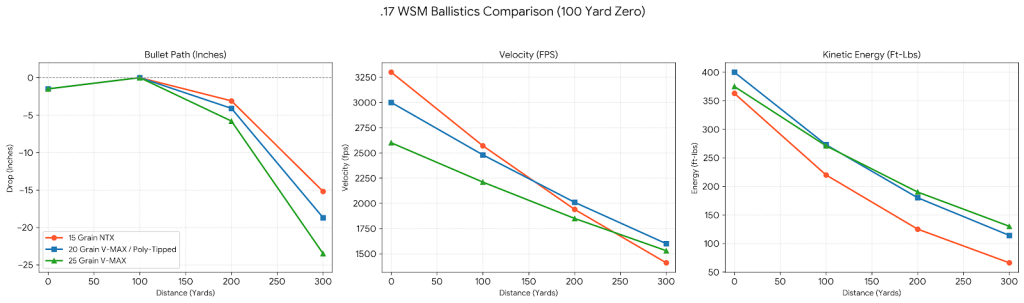
Key Ballistic Metrics Explained
Muzzle Velocity & Retained Speed
By utilizing an industrial blank casing, the 17 WSM achieves a staggering 3,000 to 3,300 fps at the muzzle. While standard .17 HMR rounds drop to subsonic speeds shortly after 200 yards, the 17 WSM remains supersonic out past 250 to 300 yards (depending on bullet weight and air density). This extended supersonic envelope keeps flight paths predictable and prevents destabilization caused by passing through the transonic barrier.
Kinetic Energy & Terminal Shock
Generating 360 to 400 ft-lbs of energy at the muzzle, the 17 WSM carries roughly double the muzzle energy of the .17 HMR and significantly outpaces the .22 WMR beyond 50 yards. At 100 yards, a 20-grain V-MAX out of a 17 WSM still delivers more kinetic energy than a .17 HMR produces at the muzzle.
Flatter Trajectory
When zeroed at 100 yards:
- The 20-grain load drops roughly 4.1 inches at 200 yards.
- The 25-grain load drops roughly 5.8 inches at 200 yards.
This flat trajectory minimizes the need for aggressive scope turret dialing or steep holdovers within practical hunting distances.
Ballistic Coefficient & Wind Drift
The polymer-tipped spitzer bullets (.174 diameter) feature impressive BC values for a rimfire caliber. The 25-grain V-MAX (BC ~0.230) resists crosswinds better than almost any other rimfire bullet, drifting roughly half as much as a .17 HMR in a 10 mph crosswind at 200 yards.
Choosing the Right 17 WSM Bullet Load
| Bullet Load | Best Application | Key Advantage |
| 15-Grain Lead-Free NTX | California / Lead-restricted zones & small pest control | Highest velocity (3,300 fps), instant explosive fragmentation on small varmints |
| 20-Grain V-MAX / Tipped | General varmint hunting (prairie dogs, groundhogs, crows) | Flattest flight path out to 200 yards, maximum fragmentation and hydrostatic shock |
| 25-Grain V-MAX | Predators (coyotes, foxes, bobcats) & windy conditions | Highest BC, superior energy retention past 150 yards, deeper penetration |
Effective Hunting Ranges
- Prairie Dogs & Groundhogs: Highly effective out to 250–300 yards. The polymer tip ensures instant expansion and rapid fragmentation, minimizing ricochets.
- Coyotes, Foxes & Bobcats: Best kept within 150–200 yards using the 25-grain load. Shot placement in the vitals is critical, as rimfire projectiles do not carry the massive hydraulic energy of centerfire cartridges like the .223 Remington or .22-250.
- Whitetail Deer & Big Game: Unsuitable and unethical. In almost all jurisdictions, using rimfire cartridges for big game is illegal.
Recommended Zero Distance: The 100-Yard vs. 150-Yard Zero
100-Yard Zero (Precision / Dialing Setup)
- 0–100 Yards: Point of impact stays within 0.5 inches of point of aim.
- 150 Yards: ~1.2″ drop.
- 200 Yards: ~4.1″ drop (20-grain load).
- Best for shooters using scopes with custom ballistic turrets or Christmas-tree reticles.
150-Yard Maximum Point Blank Range (MPBR) Zero
- 50 Yards: +0.6″ high
- 100 Yards: +0.8″ high
- 150 Yards: Dead Center (0.0″)
- 200 Yards: -2.5″ low
- Best for field hunting where you want to aim dead-center on a coyote or groundhog anywhere from 25 to 175 yards without dialing turrets.
17 WSM vs. Other Rimfire Cartridges (At 100 Yards)
| Cartridge | Muzzle Velocity | 100-Yd Velocity | 100-Yd Energy | 200-Yd Drop (100-Yd Zero) |
| 17 WSM (20 gr) | 3,000 fps | 2,480 fps | 273 ft-lbs | -4.1″ |
| 17 HMR (17 gr) | 2,550 fps | 1,900 fps | 136 ft-lbs | -8.5″ |
| 22 WMR (40 gr) | 1,875 fps | 1,319 fps | 155 ft-lbs | -18.9″ |
| 22 LR (40 gr High Vel) | 1,250 fps | 1,015 fps | 91 ft-lbs | -32.0″ (approx) |
Compared to its rimfire siblings, the .17 WSM delivers vastly superior speed, flatter trajectories, and significantly higher energy downrange—effectively filling the performance gap between traditional rimfire cartridges and entry-level centerfire rounds like the .17 Hornet and .223 Remington.