The 6.5 PRC ballistics profile offers marksmen a significant advantage for long range precision shooting and hunting. By analyzing the velocity, energy, and flight path of this magnum cartridge, shooters can fully utilize its high aerodynamic efficiency to make ethical and accurate shots across extreme distances.
Table of Contents [Click to minimize]
6.5 PRC Ballistics Chart
| Ammunition Brand | Bullet Model | Bullet Weight | Muzzle Velocity | Muzzle Energy | 300 Yard Velocity | 300 Yard Energy | 500 Yard Velocity | 500 Yard Energy |
| Hornady | Precision Hunter ELD-X | 143 gr | 2960 fps | 2782 ft-lbs | 2555 fps | 2073 ft-lbs | 2305 fps | 1686 ft-lbs |
| Hornady | Match ELD Match | 147 gr | 2910 fps | 2764 ft-lbs | 2528 fps | 2086 ft-lbs | 2292 fps | 1714 ft-lbs |
| Federal Premium | Terminal Ascent | 130 gr | 3000 fps | 2598 ft-lbs | 2515 fps | 1825 ft-lbs | 2220 fps | 1422 ft-lbs |
| Nosler | Trophy Grade ABLR | 142 gr | 2900 fps | 2651 ft-lbs | 2510 fps | 1986 ft-lbs | 2265 fps | 1618 ft-lbs |
Analyzing Standard 6.5 PRC Performance
- Factory loaded 143 grain hunting ammunition typically leaves the muzzle at an impressive 2960 fps, generating nearly 2800 foot pounds of initial kinetic energy.
- Velocity retention is exceptional across all loads. The 143 grain ELD-X maintains over 2300 fps at the 500 yard mark.
- Lighter 130 grain projectiles hit the 3000 fps threshold at the muzzle but shed kinetic energy slightly faster than the heavier 147 grain match bullets.
- Kinetic energy at 500 yards remains incredibly lethal for medium to large game, with the primary hunting loads retaining over 1600 foot pounds of terminal force.
6.5 PRC Ballistics Chart 1000 Yards
| Distance | 143 gr ELD-X Velocity | 143 gr ELD-X Energy | 147 gr ELD Match Velocity | 147 gr ELD Match Energy |
| Muzzle | 2960 fps | 2782 ft-lbs | 2910 fps | 2764 ft-lbs |
| 100 Yards | 2820 fps | 2525 ft-lbs | 2780 fps | 2523 ft-lbs |
| 200 Yards | 2685 fps | 2289 ft-lbs | 2652 fps | 2296 ft-lbs |
| 300 Yards | 2555 fps | 2073 ft-lbs | 2528 fps | 2086 ft-lbs |
| 400 Yards | 2428 fps | 1872 ft-lbs | 2408 fps | 1892 ft-lbs |
| 500 Yards | 2305 fps | 1686 ft-lbs | 2292 fps | 1714 ft-lbs |
| 600 Yards | 2186 fps | 1517 ft-lbs | 2178 fps | 1548 ft-lbs |
| 700 Yards | 2070 fps | 1361 ft-lbs | 2068 fps | 1396 ft-lbs |
| 800 Yards | 1958 fps | 1217 ft-lbs | 1961 fps | 1255 ft-lbs |
| 900 Yards | 1850 fps | 1086 ft-lbs | 1857 fps | 1125 ft-lbs |
| 1000 Yards | 1746 fps | 968 ft-lbs | 1756 fps | 1006 ft-lbs |
Extended Range Velocity and Energy Retention
- Both the 143 grain and 147 grain projectiles stay comfortably supersonic at 1000 yards, traveling well over 1700 fps.
- The heavier 147 grain match bullet starts slightly slower at the muzzle but overtakes the 143 grain bullet in retained energy by the 300 yard line due to its superior aerodynamic shape.
- At 1000 yards, the 147 grain bullet delivers over 1000 foot pounds of kinetic force, making it highly effective for long range steel target competition.
- The smooth velocity degradation curve highlights the efficiency of the short magnum case design paired with high ballistic coefficient projectiles.
6.5 PRC Bullet Drop Chart
| Distance | 143 gr ELD-X Drop | 147 gr ELD Match Drop | 130 gr Terminal Ascent Drop | Zero Distance |
| 100 Yards | 0.0 inches | 0.0 inches | 0.0 inches | 100 Yards |
| 200 Yards | -2.8 inches | -3.0 inches | -2.6 inches | 100 Yards |
| 300 Yards | -10.9 inches | -11.5 inches | -10.3 inches | 100 Yards |
| 400 Yards | -24.8 inches | -25.8 inches | -23.8 inches | 100 Yards |
| 500 Yards | -45.0 inches | -46.5 inches | -43.8 inches | 100 Yards |
| 600 Yards | -72.2 inches | -74.2 inches | -71.2 inches | 100 Yards |
| 700 Yards | -107.5 inches | -109.8 inches | -107.4 inches | 100 Yards |
| 800 Yards | -151.7 inches | -154.2 inches | -153.5 inches | 100 Yards |
| 900 Yards | -206.0 inches | -208.2 inches | -211.2 inches | 100 Yards |
| 1000 Yards | -271.5 inches | -273.0 inches | -282.5 inches | 100 Yards |
Evaluating Downrange Bullet Drop
- With a 100 yard zero, the standard 143 grain hunting load drops merely 10.9 inches at 300 yards, allowing for very simple holdovers in field scenarios.
- The lighter and faster 130 grain bullet shoots slightly flatter out to 500 yards, but its lower ballistic efficiency causes it to drop more severely than the heavier bullets once it passes 800 yards.
- Hitting a target at 1000 yards with the 143 grain bullet requires compensating for 271.5 inches of drop, which demands a precision optic with reliable elevation turrets.
- The trajectory differences between the 143 grain and 147 grain bullets remain within two inches of each other all the way out to 1000 yards.
6.5 PRC Trajectory Chart
| Distance | 100 Yard Zero Flight Path | 200 Yard Zero Flight Path | Retained Velocity (143gr) | Retained Energy (143gr) |
| 50 Yards | -0.4 inches | +0.3 inches | 2890 fps | 2652 ft-lbs |
| 100 Yards | 0.0 inches | +1.4 inches | 2820 fps | 2525 ft-lbs |
| 150 Yards | -0.8 inches | +1.3 inches | 2751 fps | 2404 ft-lbs |
| 200 Yards | -2.8 inches | 0.0 inches | 2685 fps | 2289 ft-lbs |
| 300 Yards | -10.9 inches | -6.6 inches | 2555 fps | 2073 ft-lbs |
| 400 Yards | -24.8 inches | -19.2 inches | 2428 fps | 1872 ft-lbs |
| 500 Yards | -45.0 inches | -38.0 inches | 2305 fps | 1686 ft-lbs |
Modifying the Trajectory Curve
- Opting for a 200 yard zero forces the bullet to arc 1.4 inches high at the 100 yard mark, which keeps the flight path tight to the line of sight for mid range hunting.
- A 200 yard zero significantly reduces the 300 yard drop from 10.9 inches down to just 6.6 inches, extending the maximum point blank range of the rifle.
- At 500 yards, the 200 yard zero saves the shooter 7 inches of vertical dial adjustment compared to the standard 100 yard zero.
- Regardless of the zero distance chosen, the 143 grain projectile retains a massive 1686 foot pounds of energy at 500 yards.
6.5 PRC Ballistic Coefficient Chart
| Bullet Manufacturer | Bullet Model | Bullet Weight | Projectile Type | G1 Ballistic Coefficient |
| Federal Premium | Terminal Ascent | 130 gr | Polymer Tip | .532 |
| Nosler | AccuBond Long Range | 142 gr | Polymer Tip | .625 |
| Hornady | ELD-X | 143 gr | Polymer Tip | .625 |
| Hornady | ELD Match | 147 gr | Polymer Tip | .697 |
| Berger | Extreme Outer Limits | 156 gr | Hollow Point Boat Tail | .679 |
The Role of Aerodynamics
- The 6.5 PRC is designed specifically to push long, heavy for caliber bullets that inherently feature massive ballistic coefficients.
- Bullets like the 143 grain ELD-X boast a .625 G1 BC, allowing them to slip through crosswinds and retain velocity far better than traditional hunting projectiles.
- The 147 grain ELD Match achieves a stunning .697 BC, making it one of the most aerodynamically perfect bullets available for standard short action magnum rifles.
- Upgrading to ultra heavy 156 grain Berger bullets provides massive wind resistance, though shooters must ensure their barrel twist rate is fast enough to stabilize the extra length.
Factors That Affect 6.5 PRC Ballistics
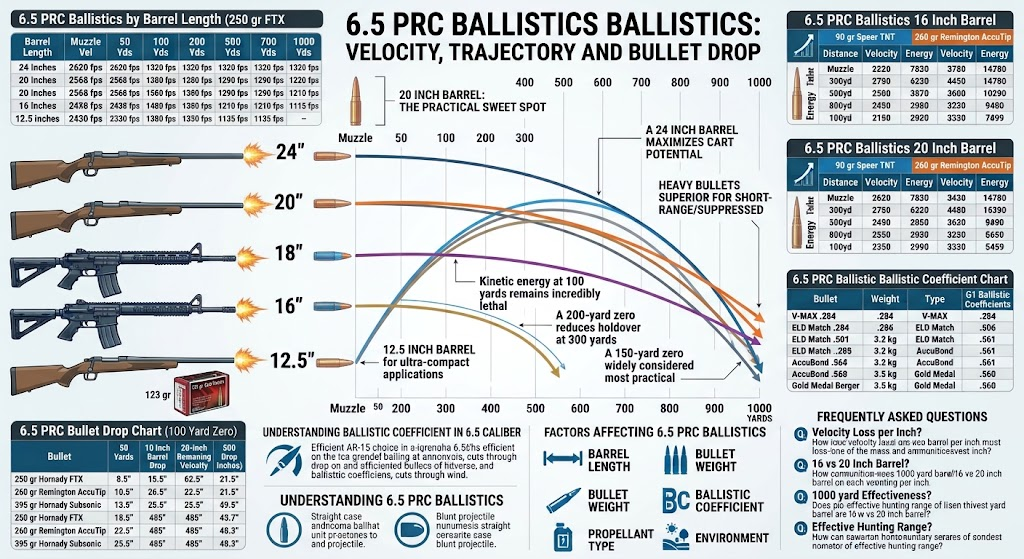
Barrel length heavily influences the extreme velocity potential of this magnum cartridge. To achieve the advertised 2960 fps with factory ammunition, shooters generally need a 24 inch barrel to allow the slow burning magnum powders to completely ignite. Cutting the barrel down to 20 inches for a lightweight mountain rifle will result in a noticeable loss of muzzle speed and a steeper drop at 1000 yards.
Bullet weight dictates the balance between initial speed and long range momentum. Lighter 130 grain bullets leave the muzzle at blistering speeds but shed their energy faster due to lower aerodynamic ratings. Heavy 147 grain and 156 grain bullets start slower but use their incredible ballistic coefficients to maintain supersonic flight and heavy kinetic impacts well past 1000 yards.
Propellant choices are critical for maximizing the short magnum case. Factory loads utilize highly temperature stable powders to ensure that the cartridge performs identically in freezing alpine conditions and scorching desert heat. Handloaders must select specific slow burning powders to safely achieve maximum velocity without generating dangerous pressure spikes.
Ballistic coefficient is the defining characteristic of the 6.5mm projectile family. The long, slender profile of these bullets drastically minimizes air drag in flight. This high aerodynamic efficiency is the exact reason the 6.5 PRC can match or exceed the 1000 yard trajectory of much larger magnum calibers while generating significantly less felt recoil.
Environmental conditions constantly manipulate bullet flight at extended ranges. A shot taken at 1000 yards in thin, high altitude mountain air will experience far less drag and drop considerably less than the exact same shot taken at sea level. Precision shooters must always input their local atmospheric data into a ballistic calculator to guarantee accurate turret adjustments.
Frequently Asked Questions
What does a 6.5 PRC ballistics chart show?
A ballistic chart for this cartridge tracks muzzle velocity, retained kinetic energy, and the physical bullet drop from the muzzle all the way out to 1000 yards.
What is the muzzle velocity of the 6.5 PRC?
Standard factory loaded 143 grain hunting ammunition generally leaves a 24 inch barrel at a speed of 2960 feet per second.
How much does a 6.5 PRC drop at 500 yards?
When utilizing a standard 100 yard zero, a 143 grain bullet will drop approximately 45.0 inches by the time it reaches the 500 yard target.
How much does a 6.5 PRC drop at 1000 yards?
Fired with a 100 yard zero, a 143 grain bullet will experience roughly 271.5 inches of drop at 1000 yards, depending slightly on the exact atmospheric conditions.
Is the 6.5 PRC good for 1000 yard shooting?
Yes, the cartridge was specifically designed to push high ballistic coefficient bullets at magnum velocities, making it exceptionally accurate and stable for 1000 yard target competition.
How much energy does the 6.5 PRC have at 500 yards?
A 143 grain hunting projectile retains massive knockdown power at distance, delivering over 1680 foot pounds of kinetic energy at 500 yards.
What is the ballistic coefficient of a 143 grain ELD-X bullet?
The popular 143 grain Hornady ELD-X bullet features a highly efficient G1 ballistic coefficient of .625.
What is the best zero distance for a 6.5 PRC hunting rifle?
A 200 yard zero is widely considered optimal because it extends the point blank range of the rifle and reduces the amount of holdover required for shots out to 300 and 400 yards.
Does barrel length affect 6.5 PRC velocity?
Yes, reducing the barrel length below the standard 24 inches will prevent the magnum powder from fully burning, resulting in lower muzzle speeds and a steeper downrange trajectory.
How does the 6.5 PRC compare to the 6.5 Creedmoor at 1000 yards?
The PRC holds a significant ballistic advantage, launching identical bullets about 250 feet per second faster than the Creedmoor, which translates to less wind drift and less bullet drop at 1000 yards.