The main difference between the 7.62×51 and the 308 Winchester is their maximum operating pressure and internal case capacity. While they look practically identical on the outside and share the same external dimensions, the commercial 308 Winchester is loaded to higher pressures and generates slightly higher muzzle velocities than its military counterpart. The 7.62×51 cartridge features thicker brass case walls designed to withstand violent extraction in fully automatic machine guns, which slightly reduces its internal powder capacity. You can safely fire 7.62×51 ammunition in a modern rifle chambered for 308 Winchester, but firing high pressure commercial 308 Winchester ammunition in older surplus military rifles chambered strictly for 7.62×51 is generally not recommended due to headspace differences. For hunters and civilian shooters, the 308 Winchester offers far more factory ammunition choices featuring expanding bullets, while the 7.62×51 is typically found as full metal jacket target or military surplus ammunition.
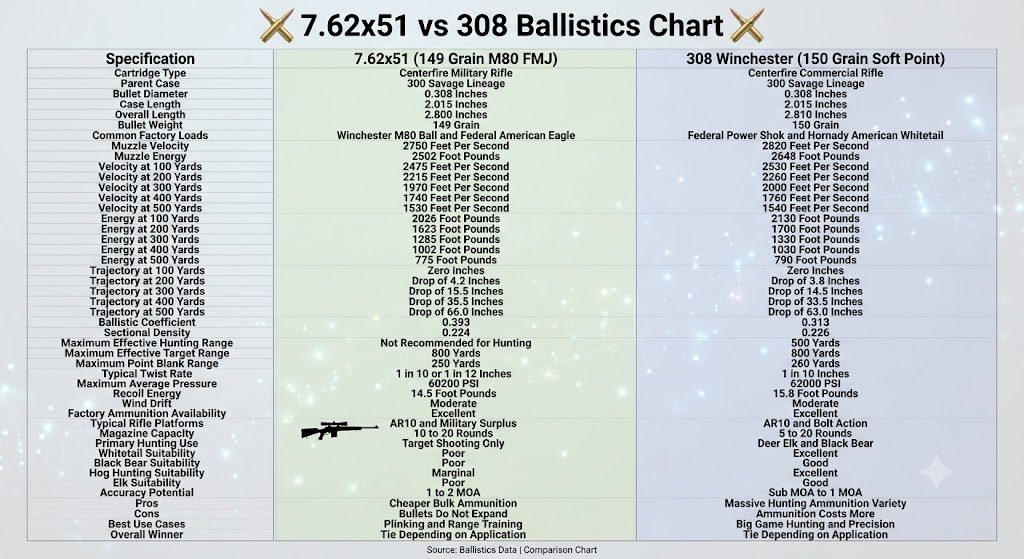
7.62×51 vs 308 Ballistics Chart
| Specification | 7.62×51 (149 Grain M80 FMJ) | 308 Winchester (150 Grain Soft Point) |
| Cartridge Type | Centerfire Military Rifle | Centerfire Commercial Rifle |
| Parent Case | 300 Savage Lineage | 300 Savage Lineage |
| Bullet Diameter | 0.308 Inches | 0.308 Inches |
| Case Length | 2.015 Inches | 2.015 Inches |
| Overall Length | 2.800 Inches | 2.810 Inches |
| Bullet Weight | 149 Grain | 150 Grain |
| Common Factory Loads | Winchester M80 Ball and Federal American Eagle | Federal Power Shok and Hornady American Whitetail |
| Muzzle Velocity | 2750 Feet Per Second | 2820 Feet Per Second |
| Muzzle Energy | 2502 Foot Pounds | 2648 Foot Pounds |
| Velocity at 100 Yards | 2475 Feet Per Second | 2530 Feet Per Second |
| Velocity at 200 Yards | 2215 Feet Per Second | 2260 Feet Per Second |
| Velocity at 300 Yards | 1970 Feet Per Second | 2000 Feet Per Second |
| Velocity at 400 Yards | 1740 Feet Per Second | 1760 Feet Per Second |
| Velocity at 500 Yards | 1530 Feet Per Second | 1540 Feet Per Second |
| Energy at 100 Yards | 2026 Foot Pounds | 2130 Foot Pounds |
| Energy at 200 Yards | 1623 Foot Pounds | 1700 Foot Pounds |
| Energy at 300 Yards | 1285 Foot Pounds | 1330 Foot Pounds |
| Energy at 400 Yards | 1002 Foot Pounds | 1030 Foot Pounds |
| Energy at 500 Yards | 775 Foot Pounds | 790 Foot Pounds |
| Trajectory at 100 Yards | Zero Inches | Zero Inches |
| Trajectory at 200 Yards | Drop of 4.2 Inches | Drop of 3.8 Inches |
| Trajectory at 300 Yards | Drop of 15.5 Inches | Drop of 14.5 Inches |
| Trajectory at 400 Yards | Drop of 35.5 Inches | Drop of 33.5 Inches |
| Trajectory at 500 Yards | Drop of 66.0 Inches | Drop of 63.0 Inches |
| Ballistic Coefficient | 0.393 | 0.313 |
| Sectional Density | 0.224 | 0.226 |
| Maximum Effective Hunting Range | Not Recommended for Hunting | 500 Yards |
| Maximum Effective Target Range | 800 Yards | 800 Yards |
| Maximum Point Blank Range | 250 Yards | 260 Yards |
| Typical Twist Rate | 1 in 10 or 1 in 12 Inches | 1 in 10 Inches |
| Maximum Average Pressure | 60200 PSI | 62000 PSI |
| Recoil Energy | 14.5 Foot Pounds | 15.8 Foot Pounds |
| Wind Drift | Moderate | Moderate |
| Factory Ammunition Availability | Excellent | Excellent |
| Typical Rifle Platforms | AR10 and Military Surplus | AR10 and Bolt Action |
| Magazine Capacity | 10 to 20 Rounds | 5 to 20 Rounds |
| Primary Hunting Use | Target Shooting Only | Deer Elk and Black Bear |
| Whitetail Suitability | Poor | Excellent |
| Black Bear Suitability | Poor | Good |
| Hog Hunting Suitability | Marginal | Excellent |
| Elk Suitability | Poor | Good |
| Accuracy Potential | 1 to 2 MOA | Sub MOA to 1 MOA |
| Pros | Cheaper Bulk Ammunition | Massive Hunting Ammunition Variety |
| Cons | Bullets Do Not Expand | Ammunition Costs More |
| Best Use Cases | Plinking and Range Training | Big Game Hunting and Precision |
| Overall Winner | Tie Depending on Application | Tie Depending on Application |
Pressure and Chamber Specifications Comparison
The most critical difference between these two loads involves internal pressures and rifle chamber headspace. The commercial 308 Winchester is certified by SAAMI to safely operate at 62000 PSI. The military 7.62×51 is loaded to a slightly lower pressure specification to ensure reliable extraction in dirty combat environments. Furthermore military rifles chambered in 7.62×51 often have slightly longer headspace to accommodate dirty ammunition. Firing higher pressure commercial ammunition in a military chamber with longer headspace can sometimes lead to ruptured brass cases and firearm damage.
Muzzle Velocity Comparison
Because the 308 Winchester is loaded to higher commercial pressures, it consistently delivers higher muzzle velocities. A standard 150 grain hunting bullet leaves the 308 Winchester barrel at 2820 feet per second. The military 7.62×51 M80 ball ammunition pushes a 149 grain bullet at 2750 feet per second. While 70 feet per second might seem insignificant, this extra speed gives the commercial sporting cartridge a noticeably flatter trajectory and more kinetic energy transfer upon impact.
Muzzle Energy Comparison
Hunters rely on kinetic energy to create ethical and quick harvests on big game animals. The commercial 308 Winchester produces roughly 2648 foot pounds of energy at the muzzle. The 7.62×51 produces roughly 2502 foot pounds of energy. Even out at 300 yards the commercial load maintains a slight energy advantage. This translates directly into better terminal ballistics when hitting heavy bone or thick shoulder muscles on game like elk and black bear.
Trajectory Comparison
Both cartridges fly along nearly identical ballistic arcs at typical hunting and shooting distances. When zeroed at 100 yards, the 308 Winchester drops 33.5 inches at 400 yards. The military 7.62×51 load drops 35.5 inches at the exact same distance. A two inch difference at 400 yards is virtually indistinguishable for the average shooter. However precision rifle competitors often favor the 308 Winchester because commercial match grade loads are manufactured to much tighter tolerances than bulk military ball ammunition.
Ammunition Availability Comparison
You will never struggle to find ammunition for either of these choices. The 308 Winchester is arguably the most popular big game hunting cartridge in North America and is available in every bullet weight and design imaginable. The 7.62×51 is a global military standard meaning vast quantities of cheap surplus full metal jacket ammunition are constantly imported and sold in bulk. Many shooters buy bulk military ammunition for cheap practice and save their expensive commercial ammunition for hunting season.
Which Cartridge Is Better for Hunting
The 308 Winchester is indisputably the better choice for hunting. Military 7.62×51 ammunition almost exclusively uses full metal jacket bullets which are specifically designed not to expand upon impact. Shooting a deer with a full metal jacket bullet often results in a clean hole that produces very little blood trail and a lost animal. Commercial 308 Winchester ammunition is loaded with soft point or polymer tipped bullets that expand violently upon impact to ensure a quick and humane harvest.
Frequently Asked Questions
Can I shoot 7.62×51 in my 308 Winchester rifle?
Yes it is perfectly safe to fire military 7.62×51 ammunition in a modern commercial rifle chambered for 308 Winchester. The military ammunition operates at a lower pressure than the commercial rifle is designed to handle. This makes surplus military ammunition an excellent and affordable choice for target practice.
Can I shoot 308 Winchester in my 7.62×51 rifle?
Firing commercial 308 Winchester ammunition in an older military surplus rifle chambered strictly for 7.62×51 is generally not recommended. Commercial ammunition generates higher pressures and military chambers often have slightly longer headspace. This combination can occasionally cause catastrophic brass failure and potential injury to the shooter.
Why does the 7.62×51 have thicker brass?
Military cartridges are designed to function flawlessly in fully automatic machine guns. These weapons extract spent casings violently while the chamber is still extremely hot and dirty. Thicker brass case walls prevent the cartridge from ripping apart or getting stuck during this violent mechanical extraction process.
Is 7.62×51 good for deer hunting?
Standard military surplus ammunition is terrible for deer hunting because it uses full metal jacket bullets that do not expand. Many states actually make it illegal to hunt big game with non expanding ammunition. If you want to hunt deer with a military surplus rifle you should purchase commercial soft point ammunition designed specifically for hunting.
Are the bullets exactly the same diameter?
Yes both cartridges use the exact same 0.308 inch diameter projectiles. The only difference is the bullet construction and weight. Commercial manufacturers use expanding lead core bullets while military factories produce solid copper jacketed projectiles that meet international warfare regulations.
Which cartridge is more accurate?
The commercial 308 Winchester is inherently more accurate simply because it is manufactured to tighter commercial tolerances. Premium match grade ammunition is carefully loaded with perfectly balanced bullets and exact powder charges. Bulk military ammunition is mass produced rapidly meaning slight variations in powder charges and bullet weights will open up your group sizes on paper.
Why is 7.62×51 ammunition usually cheaper?
It is cheaper because it is manufactured by the millions for global military contracts using less expensive full metal jacket bullets. Once militaries rotate their old stock or close out a contract the surplus ammunition is sold to the civilian market at a massive discount. Commercial hunting ammunition requires expensive expanding bullets and is produced in much smaller seasonal batches.