The main difference between the .243 Winchester and the .270 Winchester is that the .243 Winchester offers exceptionally mild recoil and a short-action footprint ideal for varmints and medium game, while the .270 Winchester provides a massive increase in kinetic energy and stopping power for taking larger animals like elk and mule deer across wide open spaces. Both cartridges are legendary American hunting rounds based on classic military parents, but they serve different field purposes. The .243 Winchester is highly revered as the perfect dual-purpose cartridge, light enough to hunt coyotes without destroying pelts, yet powerful enough to cleanly harvest whitetail deer. The .270 Winchester, famously championed by Jack O’Connor, relies on a long-action case to push heavier bullets at blistering speeds, making it an iconic open-country hunting tool. Deciding between these two legends requires you to analyze your recoil tolerance and the maximum size of the game you intend to hunt.
243 vs 270 Ballistics Chart
| Specification / Metric | .243 Winchester (95 gr SST) | .270 Winchester (130 gr SST) |
| Cartridge | .243 Winchester | .270 Winchester |
| Parent Case | .308 Winchester | .30-06 Springfield |
| Bullet Diameter | .243 inches (6mm) | .277 inches |
| Typical Bullet Weight | 55 to 105 grains | 130 to 150 grains |
| Muzzle Velocity | 3,100 fps | 3,060 fps |
| Velocity at 100 Yards | 2,860 fps | 2,840 fps |
| Velocity at 200 Yards | 2,630 fps | 2,630 fps |
| Velocity at 300 Yards | 2,415 fps | 2,430 fps |
| Velocity at 500 Yards | 2,015 fps | 2,060 fps |
| Muzzle Energy | 2,027 ft-lbs | 2,702 ft-lbs |
| Energy at 100 Yards | 1,725 ft-lbs | 2,328 ft-lbs |
| Energy at 200 Yards | 1,460 ft-lbs | 1,996 ft-lbs |
| Energy at 300 Yards | 1,230 ft-lbs | 1,704 ft-lbs |
| Energy at 500 Yards | 855 ft-lbs | 1,225 ft-lbs |
| Bullet Drop (500 Yds, 200 Yd Zero) | -36.0 inches | -36.5 inches |
| Wind Drift (500 Yds, 10 mph Wind) | 23.5 inches | 18.5 inches |
| Ballistic Coefficient (G1) | 0.350 to 0.450 | 0.460 |
| Sectional Density | 0.230 | 0.242 |
| Effective Hunting Range | 400 yards (medium game) | 500 to 600 yards (medium game) |
| Maximum Effective Range | 800 yards | 800 yards |
| Typical Twist Rate | 1:9 to 1:10 | 1:10 |
| Recoil (Free Recoil Energy) | ~9.0 ft-lbs | ~17.0 ft-lbs |
| Trajectory | Exceptionally flat to 400 yds | Exceptionally flat |
| Barrel Life | 1,500 to 2,500 rounds | 3,000 to 4,000 rounds |
| Accuracy Potential | Excellent for hunting and target | Excellent for hunting |
| Hunting Performance | Varmints, coyotes, deer, antelope | Mule deer, sheep, antelope, elk |
| Target Shooting Performance | Great for mid-range steel | Good for long range hunting practice |
| Long-Range Performance | Supersonic past 800 yards | Supersonic past 1,000 yards |
| Ammunition Availability | Universal | Very High |
| Ammunition Cost | Low to moderate | Moderate |
| Rifle Availability | Universal in short actions | Common in long actions |
| Magazine Compatibility | Standard short action | Standard long action |
| Suppressor Compatibility | Excellent | Excellent |
| Best Use Cases | Dedicated varmint and deer hunting | Traditional open plains hunting |
| Main Advantages | Extremely low recoil, versatile | Flat trajectory, massive initial velocity |
| Main Disadvantages | Lacks kinetic energy for massive game | Requires long action, heavier recoil |
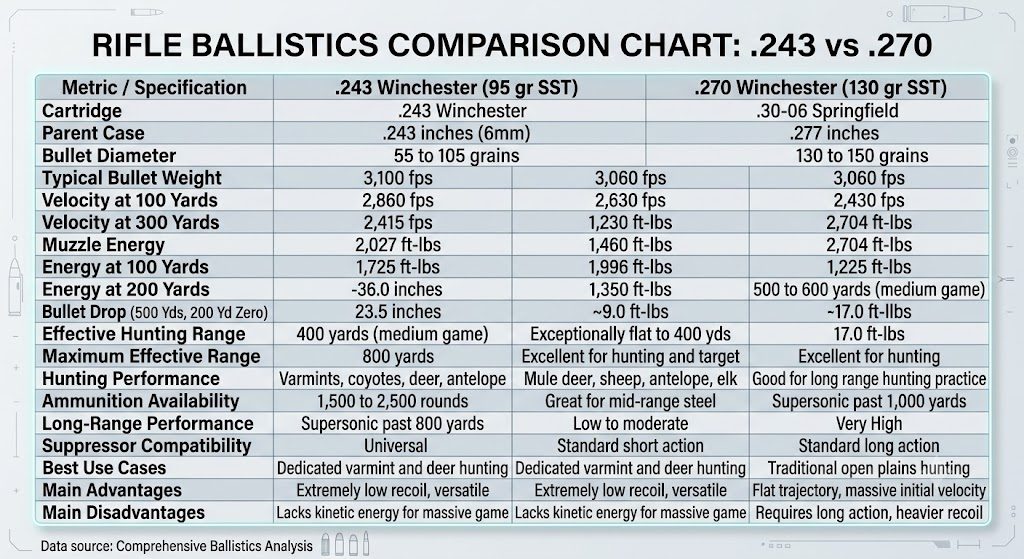
The comparison table reveals how bullet mass heavily influences terminal ballistics despite similar speeds. Both cartridges leave the muzzle flying incredibly fast, hovering right around 3,100 fps. Because they start at similar velocities, their bullet drop trajectories are practically identical out to 500 yards. A hunter aiming at a target 400 yards away will use almost the exact same holdover for both cartridges.
However, the .270 Winchester achieves that velocity while pushing a significantly heavier bullet (130 grains vs. 95 grains). This larger mass generates nearly 700 foot-pounds more kinetic energy at the muzzle. This massive energy gap remains consistent downrange. At 300 yards, the .270 Winchester hits with the same force that the .243 Winchester delivers at 100 yards. This makes the .270 Winchester a much more reliable option for large, tough-boned game like elk.
To explore how these variables diverge over distance, use the interactive comparison tool below:
Key insight: While both cartridges shoot remarkably flat, the .270 Winchester will handle shifting crosswinds noticeably better due to its heavier mass and higher ballistic coefficient.
Detailed Comparison Sections
Understanding the Comparison Chart
To fully grasp the capabilities of these cartridges, look at their origins. The .243 Winchester is a necked-down .308 Winchester, giving it a compact short-action footprint that cycles fast and fits in lightweight rifles. The .270 Winchester is a necked-down .30-06 Springfield, requiring a longer action receiver to accommodate its massive powder charge. This fundamental difference in case size dictates their power limits.
How to Read the Ballistics Chart
When reading this chart for hunting purposes, focus heavily on kinetic energy and wind drift. Both cartridges shoot so flat that bullet drop is rarely the deciding factor. However, kinetic energy determines what size animal you can ethically harvest, and wind drift determines your margin of error on breezy days.
Velocity Comparison
Both cartridges are renowned for blistering speed. The .243 Winchester pushes a 95-grain bullet at roughly 3,100 feet per second. The .270 Winchester pushes a 130-grain bullet at 3,060 fps. Because the .270 Winchester bullet has a slightly better aerodynamic profile, it retains its speed slightly better over extreme distances, but functionally, both maintain incredibly high velocity inside practical hunting ranges.
Energy Comparison
Kinetic energy is where the .270 Winchester completely separates itself. Generating 2,702 foot-pounds at the muzzle, it is a true big-game cartridge. The .243 Winchester generates 2,027 foot-pounds. This 700 foot-pound difference is monumental when hunting heavy animals. At 500 yards, the .243 Winchester drops to 855 foot-pounds (below the recommended threshold for deer), while the .270 Winchester maintains a robust 1,225 foot-pounds.
Trajectory Comparison
A flat trajectory takes the guesswork out of field shooting, and both of these cartridges excel in this category.
Bullet Drop Comparison
If you zero both rifles at 200 yards, their flight paths are nearly identical. At 500 yards, the .243 Winchester drops roughly 36.0 inches, while the .270 Winchester drops 36.5 inches. For all practical hunting situations, you can use the exact same dope chart for elevation adjustments.
Wind Drift Comparison
Wind pushes lightweight bullets off course much faster than heavy ones. In a 10 mph crosswind at 500 yards, the .243 Winchester will drift 23.5 inches. The heavier .270 Winchester slices through the wind much better, drifting only 18.5 inches. This 5-inch difference can easily mean the difference between a clean harvest and a wounded animal.
Ballistic Coefficient Comparison
Ballistic Coefficient (BC) measures how efficiently a bullet slices through the air. The long, sleek 130-grain bullets of the .270 Winchester boast excellent G1 BC ratings around 0.460. Standard .243 Winchester hunting bullets generally feature lower BC ratings between 0.350 and 0.450. This BC advantage helps the .270 retain its massive energy downrange.
Accuracy Potential
Both cartridges are inherently accurate. The .243 Winchester is legendary for printing tiny groups and consistently hitting small varmints at unknown distances. The .270 Winchester is highly accurate in a quality hunting rifle, providing more than enough precision for vital-zone hits on big game across open canyons.
Effective Range Comparison
For practical varmint hunting, the .243 Winchester is absolutely devastating out to 500 yards. For medium game like deer, it is highly effective out to 300 or 400 yards. The .270 Winchester stretches the effective ethical hunting range for deer and elk out to 500 or 600 yards.
Hunting Performance Comparison
If you are hunting coyotes, foxes, or prairie dogs, the .243 Winchester is the ultimate dual-purpose tool. It shoots incredibly flat and minimizes pelt damage on small predators while remaining an exceptional whitetail deer cartridge. If you plan to hunt elk, moose, or large mule deer, the .270 Winchester provides the necessary deep penetration and heavy retained energy required for a clean kill.
Target Shooting Comparison
The .243 Winchester is a fantastic choice for casual target shooting. The recoil is incredibly mild, allowing shooters to practice for hours without shoulder fatigue, and the short action cycles quickly. The .270 Winchester produces significantly more recoil and heats up rifle barrels faster, making it less ideal for high-volume range days.
Long-Range Performance Comparison
Both cartridges perform admirably at long ranges, but the .270 Winchester has the advantage due to its heavier mass. While neither is commonly used in modern precision rifle competitions (which are dominated by the 6.5 Creedmoor and 6mm ARC), they are both entirely capable of ringing steel plates out to 800 yards and beyond.
Recoil Comparison
Felt recoil dictates how comfortable a rifle is to shoot. The .243 Winchester generates roughly 9.0 foot-pounds of free recoil energy, which is incredibly mild and perfect for children, beginners, or recoil-sensitive shooters. The .270 Winchester generates roughly 17.0 foot-pounds. This is completely manageable for an average adult, but it produces a noticeably sharper, snappier kick.
Barrel Life Comparison
Pushing massive amounts of gunpowder through a small bore creates intense heat and pressure. The .243 Winchester is known for being slightly tough on barrels, often losing its peak accuracy between 1,500 and 2,500 rounds. The .270 Winchester has a better bore-capacity ratio, allowing quality barrels to easily last 3,000 to 4,000 rounds before accuracy degrades.
Ammunition Cost Comparison
Both cartridges have been on the market for decades, resulting in abundant, budget-friendly hunting ammunition. Prices for both are generally low to moderate compared to modern specialty magnums.
Ammunition Availability
You can reliably find both .243 Winchester and .270 Winchester ammunition in almost any well-stocked sporting goods store, rural gun shop, or hardware store in North America. You will never struggle to find boxes of either caliber.
Rifle Compatibility
The .243 Winchester is chambered in practically every short-action bolt rifle available, making for extremely lightweight, compact hunting rigs. The .270 Winchester requires a standard long-action receiver, meaning the rifles are generally slightly heavier and require a longer bolt throw to cycle a new round.
Pros and Cons of .243 Winchester
Pros:
- Extremely fast muzzle velocities.
- Exceptionally flat trajectory out to 400 yards.
- Practically zero felt recoil makes it perfect for beginners.
- The ultimate dual-purpose varmint and deer cartridge.
Cons:
- Lacks the kinetic energy for large game like elk.
- Lightweight bullets are susceptible to wind drift.
Pros and Cons of .270 Winchester
Pros:
- Exceptionally flat trajectory forgives range-estimation errors.
- Massive initial velocity and kinetic energy.
- Over a century of proven big-game reliability.
- Very manageable recoil for an open-country hunting cartridge.
Cons:
- Requires a heavier long-action rifle.
- Snappier recoil than dedicated short-action cartridges.
Which Cartridge Is Better for Beginners?
The .243 Winchester is arguably the absolute best centerfire rifle cartridge for a beginner. The incredibly low recoil ensures a new shooter will not develop a flinch, and the flat trajectory inside 300 yards makes it easy to successfully hit targets without calculating scope adjustments.
Which Cartridge Is Better for Hunting?
If you are a dedicated predator hunter who also hunts whitetail deer, the .243 Winchester is flawless. If you primarily hunt large game like mule deer, antelope, sheep, or elk across open country, the .270 Winchester provides the necessary knockdown power and heavy bullet mass required for deep, ethical penetration.
Which Cartridge Is Better for Long-Range Shooting?
For hitting targets in the wind past 500 yards, the .270 Winchester holds an advantage. Its heavier bullets resist wind drift much better than the lightweight 95-grain projectiles of the .243 Winchester, making long-range mathematical calculations much more forgiving.
Which Cartridge Should You Choose?
Choose the .243 Winchester if you want a proven, ultra-low recoil rifle for varmint eradication, predator hunting, and medium-game hunting inside 300 yards. Choose the .270 Winchester if you want a classic, blazing-fast hunting rifle capable of anchoring heavy big game across wide-open canyons.
Verdict
The .243 Winchester and the .270 Winchester perfectly define the difference between a high-utility short-action and a dedicated big-game long-action. The .243 Winchester remains the ultimate introductory and dual-purpose cartridge. It eliminates recoil, shoots like a laser, and effectively bridges the gap between pest control and freezer-filling deer hunts. The .270 Winchester is a specialized heavy-hitter for open spaces. It harnesses massive powder capacity to ensure that when a hunter steps out onto the plains or into the mountains, they have the kinetic energy required to anchor large game instantly. If you value versatility and shooting comfort, the .243 Winchester is unmatched. If you demand heavy-hitting power at extended ranges, the .270 Winchester remains an absolute legend.
FAQs
Is the .270 Winchester too big for whitetail deer?
No, the .270 Winchester is an exceptional whitetail deer cartridge. While it is incredibly powerful, using a well-constructed 130-grain or 150-grain expanding bullet ensures a rapid, ethical harvest without excessive meat damage, provided you avoid striking major shoulder bones directly.
Can you use a .243 Winchester for elk hunting?
While expert marksmen have successfully harvested elk with a .243 Winchester using perfect shot placement, it is widely considered underpowered for such a massive animal. The lightweight bullets lack the mass required to reliably penetrate thick elk shoulder bones. The .270 Winchester is a vastly superior choice for elk.
Why does the .243 Winchester have so little recoil?
Recoil is a product of powder charge weight, bullet weight, and rifle weight. Because the .243 Winchester fires a very lightweight bullet using a moderate powder charge from a .308-sized case, there is simply less physical mass being pushed out the barrel, resulting in a very gentle rearward push.
Can a .243 Winchester shoot further than a .270 Winchester?
Mechanically, both bullets can travel for miles. Practically, the .270 Winchester remains effective at longer distances because its heavier bullet retains more kinetic energy and resists wind drift better than the lighter .243 Winchester bullets as they slow down.