The main difference between the .223 Remington and the .308 Winchester is that the .308 Winchester fires a significantly larger and heavier bullet that delivers massive kinetic energy for hunting big game, while the .223 Remington offers negligible recoil and inexpensive ammunition perfect for high volume training and varmint control. Choosing between these two legendary cartridges comes down to your intended target. The .223 Remington, famous as the standard chambering for the AR-15 platform, is unmatched in terms of versatility, affordability, and ease of use. However, its lightweight projectiles lack the necessary power to reliably harvest large animals. The .308 Winchester solves this problem completely. As a premier short action hunting and precision cartridge, it delivers devastating terminal performance and superior wind resistance at extended distances. Understanding the ballistic realities of each round will guide you toward the perfect rifle setup.
223 vs 308 Ballistics Chart
| Specification / Metric | .223 Remington (55 gr FMJ) | .308 Winchester (150 gr SST) |
| Cartridge | .223 Remington | .308 Winchester |
| Parent Case | .222 Remington | .300 Savage |
| Bullet Diameter | .224 inches | .308 inches |
| Typical Bullet Weight | 55 to 77 grains | 150 to 175 grains |
| Muzzle Velocity | 3,240 fps | 2,820 fps |
| Velocity at 100 Yards | 2,865 fps | 2,600 fps |
| Velocity at 200 Yards | 2,518 fps | 2,390 fps |
| Velocity at 300 Yards | 2,198 fps | 2,190 fps |
| Velocity at 500 Yards | 1,634 fps | 1,825 fps |
| Muzzle Energy | 1,282 ft-lbs | 2,648 ft-lbs |
| Energy at 100 Yards | 1,002 ft-lbs | 2,250 ft-lbs |
| Energy at 200 Yards | 774 ft-lbs | 1,900 ft-lbs |
| Energy at 300 Yards | 589 ft-lbs | 1,600 ft-lbs |
| Energy at 500 Yards | 326 ft-lbs | 1,110 ft-lbs |
| Bullet Drop (500 Yds, 200 Yd Zero) | -43.5 inches | -45.0 inches |
| Wind Drift (500 Yds, 10 mph Wind) | 35.0 inches | 23.5 inches |
| Ballistic Coefficient (G1) | 0.250 to 0.350 | 0.400 to 0.500 |
| Sectional Density | 0.157 to 0.219 | 0.226 to 0.264 |
| Effective Hunting Range | 300 yards (varmints) | 500 yards (large game) |
| Maximum Effective Range | 600 yards | 800 to 1,000 yards |
| Typical Twist Rate | 1:7 to 1:12 | 1:10 to 1:12 |
| Recoil (Free Recoil Energy) | ~4.5 ft-lbs | ~16.5 ft-lbs |
| Trajectory | Arcs moderately past 300 yds | Pronounced arc past 400 yds |
| Barrel Life | 8,000 to 10,000+ rounds | 5,000 to 8,000 rounds |
| Accuracy Potential | Excellent | Superb for precision rifle |
| Hunting Performance | Varmints to small deer | Deer, elk, bear, and hogs |
| Target Shooting Performance | Excellent general purpose | Superior past 600 yards |
| Long-Range Performance | Supersonic past 600 yards | Supersonic past 800 yards |
| Ammunition Availability | Exceptionally high | Exceptionally high |
| Ammunition Cost | Low to moderate | Moderate to high |
| Rifle Availability | Universal | Universal |
| Magazine Compatibility | Standard AR-15 / STANAG | Standard AR-10 / SR-25 |
| Suppressor Compatibility | Excellent | Excellent |
| Best Use Cases | Plinking, defense, varmints | Big game hunting, precision |
| Main Advantages | Low recoil, cheap ammunition | Massive energy, big game capable |
| Main Disadvantages | Lacks kinetic energy for elk | Heavy recoil, heavier rifles |
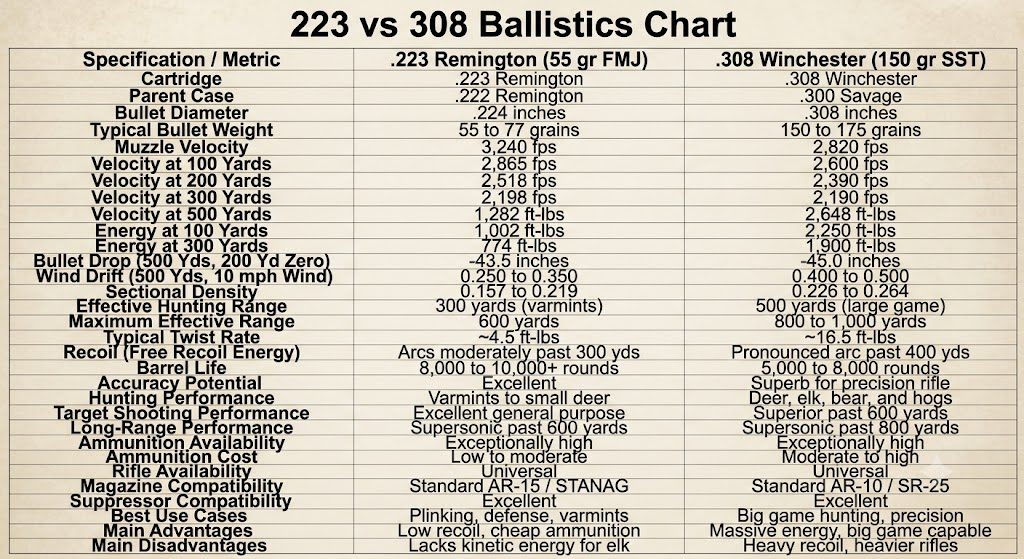
The comparison table above reveals a classic matchup between extreme velocity and massive kinetic energy. The .223 Remington begins its flight with a substantial speed advantage. Because it pushes a very lightweight projectile, it leaves the muzzle significantly faster than the heavier .308 Winchester bullet. This initial speed gives the .223 Remington a flat trajectory at close ranges.
However, velocity alone cannot overcome the laws of physics. The .308 Winchester fires a bullet that is nearly three times heavier than the .223 Remington. This massive weight difference results in roughly double the kinetic energy at the muzzle. More importantly, the heavier .308 bullet retains that immense energy all the way downrange. At 500 yards, the .308 Winchester still possesses more stopping power than the .223 Remington produces at 100 yards.
When applied to real world shooting, these numbers dictate completely different use cases. The .223 Remington is the ultimate lightweight cartridge, providing a flat trajectory with zero punishing recoil for small targets and tactical training. The .308 Winchester is a heavy hitting powerhouse. While it has a slightly steeper arc at extreme distances, it bucks the wind beautifully and delivers the deep penetration necessary to take down North America’s largest game animals ethically.
Detailed Comparison Sections
Understanding the Comparison Chart
To truly understand how these cartridges perform, you have to look at the relationship between bullet mass and air resistance. The lightweight .223 bullet starts fast but sheds its speed quickly as it battles the atmosphere. The heavy .308 bullet acts like a freight train. It takes more energy to get it moving, but once it builds momentum, it crushes through wind resistance and carries its power for incredible distances.
How to Read the Ballistics Chart
When analyzing this ballistics chart, pay special attention to kinetic energy and wind drift. Kinetic energy represents the sledgehammer force of the bullet upon impact, which is the primary factor for hunting large game. Wind drift reveals how easily a bullet is blown off course, which dictates how difficult it will be to accurately hit distant targets in field conditions.
Velocity Comparison
The .223 Remington is noticeably faster out of the gate. A standard 55 grain .223 bullet exits the barrel at roughly 3,240 feet per second. A standard 150 grain .308 Winchester bullet leaves at about 2,820 feet per second. Because the .223 is traveling over 400 feet per second faster, it reaches a 100 yard target quicker. However, because the heavy .308 bullet is more aerodynamically efficient, it eventually overtakes the .223 in retained velocity around the 400 yard mark.
Energy Comparison
This category is not a competition. The .308 Winchester generates absolutely massive kinetic energy compared to the .223 Remington. At the muzzle, the .308 produces over 2,600 foot-pounds of energy. The .223 manages roughly 1,280 foot-pounds. This gap widens as the distance increases. At 500 yards, the .308 retains over 1,100 foot-pounds of energy, which is still enough power to ethically harvest a deer. At that same distance, the .223 retains just over 300 foot-pounds.
Trajectory Comparison
Trajectory dictates the arc of the bullet. While many shooters assume the .308 Winchester is a flat shooting laser, its heavy bullets actually create a pronounced arc at long ranges compared to modern magnum cartridges.
Bullet Drop Comparison
If you zero both rifles at 200 yards, their bullet drop out to 400 yards is relatively similar. At 500 yards, a standard 55 grain .223 Remington will drop about 43.5 inches. A 150 grain .308 Winchester will drop roughly 45 inches. The .223 actually drops slightly less because of its blistering initial muzzle velocity, but the margin is minimal.
Wind Drift Comparison
Wind drift is where the .308 Winchester asserts its dominance. Heavy bullets ignore the wind much better than light bullets. In a 10 mph crosswind at 500 yards, the .223 Remington will be blown 35 inches off target. Under those exact same conditions, the .308 Winchester drifts only 23.5 inches. That massive reduction in wind deflection is why military snipers historically relied on the .308 for precision engagements.
Ballistic Coefficient Comparison
Ballistic Coefficient (BC) measures how well a bullet cuts through the air. Higher numbers mean better aerodynamics. The short, light bullets of the .223 Remington generally have BC numbers between 0.250 and 0.350. The longer, heavier bullets of the .308 Winchester boast impressive BC ratings ranging from 0.400 to over 0.500 for heavy match projectiles. This high BC is the secret behind the superior wind resistance of the .308.
Accuracy Comparison
Both cartridges are capable of astounding accuracy. The .223 Remington consistently wins service rifle competitions, and the .308 Winchester has decades of proven performance in military sniper rifles. In a high quality bolt action rifle with match grade ammunition, both cartridges will easily shoot groups smaller than one inch at 100 yards.
Effective Range Comparison
For target shooting, the .223 Remington is highly effective out to 600 yards before the wind makes spotting impacts too difficult. The .308 Winchester stretches that target range comfortably to 800 or 1,000 yards. For hunting, the effective range of the .223 is strictly limited by its low kinetic energy. The .308 carries enough energy to be an effective hunting tool well past 500 yards for skilled shooters.
Hunting Performance Comparison
If you are hunting coyotes, groundhogs, or small pests, the .223 Remington is perfect. It will not destroy pelts, and the rifles are easy to carry all day. However, if you are hunting deer, feral hogs, black bear, or elk, the .308 Winchester is the mandatory choice. The deep penetration and massive energy transfer of the .308 ensure rapid, humane harvests on big game animals that the .223 simply cannot guarantee.
Target Shooting Comparison
For casual weekends at the range shooting paper and steel plates inside 300 yards, the .223 Remington is the ultimate target cartridge. It is cheap, low recoiling, and incredibly fun. For Precision Rifle Series (PRS) training or shooting long distance steel at 800 yards, the .308 Winchester gives shooters the wind bucking capability and heavy steel impact required for long range success.
Long-Range Performance Comparison
The .308 Winchester is a legendary long range cartridge. While it drops significantly past 600 yards, its trajectory is highly predictable and it punches through the wind reliably. The .223 Remington struggles in high winds at extreme distances, and its lightweight bullets lack the momentum to splash loudly on distant steel targets, making it difficult for shooters to spot their own hits.
Recoil Comparison
Recoil is the biggest tradeoff when stepping up to a .308 Winchester. A standard .223 Remington generates a tiny 4.5 foot-pounds of free recoil energy, which is easily managed by children and sensitive shooters. The .308 Winchester produces roughly 16.5 foot-pounds of recoil. While not punishing by magnum standards, the .308 requires proper shoulder placement and good shooting fundamentals to manage comfortably over a long range session.
Barrel Life Comparison
Both cartridges are incredibly gentle on rifle barrels because they operate at moderate pressures with large bore diameters relative to their powder charges. A typical .308 Winchester barrel will maintain peak match grade precision for 5,000 to 8,000 rounds. A .223 Remington barrel can easily last 8,000 to over 10,000 rounds before the average shooter notices any drop in accuracy.
Ammunition Cost Comparison
The .223 Remington is arguably the cheapest centerfire rifle cartridge on the planet. You can buy bulk cases of training ammunition for very low prices. The .308 Winchester requires significantly more brass, copper, and gunpowder to manufacture. Therefore, practice ammunition for the .308 costs roughly twice as much as practice ammunition for the .223.
Ammunition Availability
You will never struggle to find ammunition for either of these cartridges. The .223 Remington and the .308 Winchester are the two most popular centerfire rifle rounds in America. Every sporting goods store, rural hardware store, and online retailer stocks massive quantities of both calibers in a huge variety of bullet weights.
Rifle Compatibility
The .223 Remington is the undisputed king of the AR-15 platform. The .308 Winchester is the standard chambering for the larger, heavier AR-10 platform. In the bolt action world, the .308 Winchester is considered the standard short action cartridge, and virtually every rifle manufacturer on earth offers multiple models chambered in it.
Pros and Cons of .223 Remington
Pros:
- Incredibly cheap and abundant ammunition.
- Virtually zero felt recoil.
- Phenomenal barrel life.
- The standard cartridge for the lightweight AR-15.
Cons:
- Lacks kinetic energy for big game hunting.
- Susceptible to heavy wind drift at distance.
Pros and Cons of .308 Winchester
Pros:
- Massive stopping power for all North American big game.
- Excellent wind resistance at long ranges.
- Predictable, proven ballistic performance.
- Universal availability of hunting and match ammunition.
Cons:
- Noticeably heavier recoil.
- Ammunition is more expensive for high volume training.
- Requires a larger and heavier rifle platform.
Which Cartridge Is Better for Beginners?
The .223 Remington is the absolute best centerfire cartridge for teaching a beginner. The total lack of recoil prevents new shooters from developing a flinch, and the extremely cheap ammunition allows them to shoot hundreds of rounds to perfect their fundamentals. The recoil of a .308 can easily intimidate a new shooter.
Which Cartridge Is Better for Hunting?
The .308 Winchester is vastly superior for hunting anything larger than a coyote. Whether you are chasing whitetail deer in dense woods, pursuing feral hogs in the brush, or stalking elk on a mountainside, the .308 delivers the necessary terminal ballistics to ensure an ethical harvest. The .223 is strictly a varmint and small game round.
Which Cartridge Is Better for Long-Range Shooting?
If long range means shooting past 500 yards, the .308 Winchester is the better tool. Its heavier, high BC bullets fight the wind much better, and the retained energy makes spotting impacts on steel targets significantly easier. The .223 is too easily blown off course at extended ranges to be a reliable long distance trainer in windy conditions.
Which Cartridge Should You Choose?
Choose the .223 Remington if you want a lightweight, low recoil rifle for home defense, tactical training, plinking, or varmint hunting. The savings in ammunition cost will be substantial. Choose the .308 Winchester if you intend to hunt deer, elk, or hogs, or if you want to stretch your target shooting skills out to 1,000 yards.
Verdict
The .223 Remington and the .308 Winchester are the two most essential rifle cartridges in the modern shooting world, and every serious gun owner should eventually own both. The .223 Remington represents the pinnacle of utility. It is cheap to feed, fun to shoot, and serves perfectly in a defensive or training role. However, it simply cannot replace the heavy hitting power of a true big game cartridge. The .308 Winchester remains one of the most successful hunting and precision rounds ever designed. It hits like a hammer, ignores the wind, and drops big game with absolute authority. Assess your primary targets and your ammunition budget, and the choice between the two will be perfectly clear.
FAQs
Can a .223 kill a deer?
While a .223 Remington can technically kill a deer with absolutely perfect shot placement using heavy hunting bullets, it is generally considered underpowered for the task. Many states completely ban the use of .22 caliber rifles for deer hunting to prevent unethical wounding. The .308 Winchester is a much safer and more humane choice.
Is 5.56 the same as .223?
They are nearly identical in physical dimensions, but the 5.56 NATO is loaded to higher internal pressures. You can safely fire .223 Remington ammunition in a 5.56 chambered rifle. However, it is not recommended to fire 5.56 NATO ammunition in a rifle specifically chambered for .223 Remington.
Is 7.62×51 the same as .308?
The 7.62x51mm NATO is the military equivalent of the commercial .308 Winchester. Much like the 5.56 and .223 relationship, they are physically very similar. You can generally fire 7.62x51mm safely in a modern .308 Winchester rifle without any issues.
How far will a .308 remain supersonic?
Depending on the barrel length, bullet weight, and environmental conditions, a standard .308 Winchester firing a 175 grain match bullet will typically remain supersonic out to 800 or 900 yards before dropping into the transonic zone.
Does a .308 kick hard?
The .308 Winchester produces moderate recoil. It kicks significantly harder than a .223 Remington, but it is much milder than magnum hunting cartridges like the .300 Winchester Magnum. Most average sized adults can learn to shoot a .308 comfortably with basic instruction.