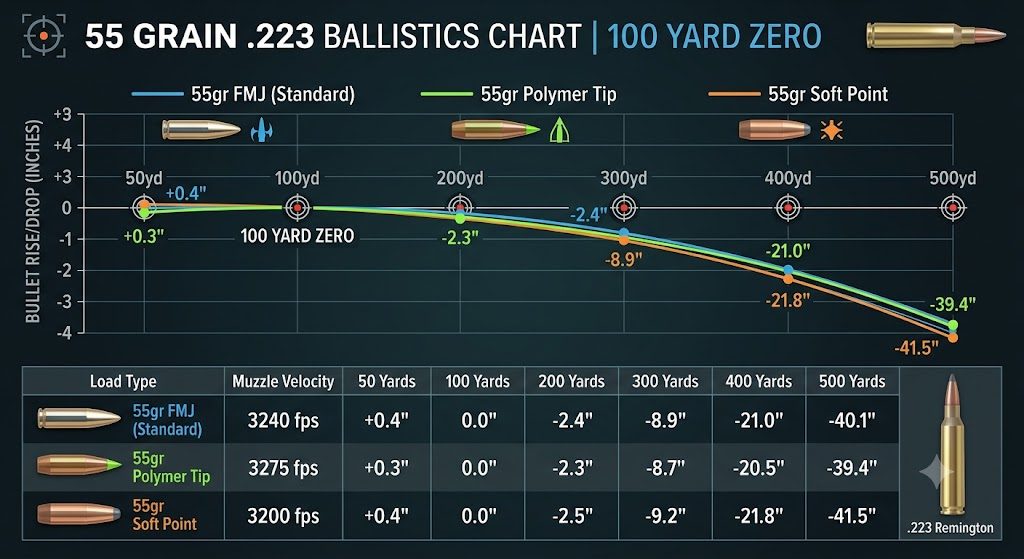
A 55 grain 223 ballistics chart 100 yard zero provides the essential trajectory data for one of the most popular and versatile projectile weights available for the .223 Remington cartridge. When zeroed at 100 yards, the 55 grain projectile offers a predictable flight path that is ideal for high volume target shooting, small game hunting, and recreational plinking. This article details the specific drop, velocity, and energy statistics for 55 grain loads, allowing shooters to understand exactly how their rifle will perform at various distances.
55 Grain 223 Ballistics Chart 100 Yard Zero
| Load Type | Muzzle Velocity | 50 Yards | 100 Yards | 200 Yards | 300 Yards | 400 Yards | 500 Yards |
| 55gr FMJ (Standard) | 3240 fps | +0.4″ | 0.0″ | -2.4″ | -8.9″ | -21.0″ | -40.1″ |
| 55gr Polymer Tip | 3275 fps | +0.3″ | 0.0″ | -2.3″ | -8.7″ | -20.5″ | -39.4″ |
| 55gr Soft Point | 3200 fps | +0.4″ | 0.0″ | -2.5″ | -9.2″ | -21.8″ | -41.5″ |
Understanding the Chart
Load Type
This identifies the construction of the bullet. Full Metal Jacket (FMJ) is standard for target practice, while polymer tips are designed for enhanced expansion during hunting, and soft points offer a balance of expansion and penetration.
Muzzle Velocity
This is the velocity of the 55 grain bullet measured in feet per second as it clears the muzzle. Variations in barrel length and powder charge from different manufacturers will shift these numbers, which in turn affects the entire trajectory.
50 Yards
This measurement shows the bullet’s position halfway to the zero point. At 50 yards with a 100 yard zero, the bullet is typically still on its upward arc as it climbs toward the line of sight.
100 Yards
This marks the primary zero distance. At 100 yards, the bullet path intersects the line of sight, meaning the point of aim equals the point of impact.
200 Yards
This value indicates the bullet drop at 200 yards. Because the bullet is descending after passing the 100 yard zero, shooters must account for this decline when engaging targets at this distance.
300 Yards
At 300 yards, the 55 grain bullet has experienced significant gravity pull. This measurement is crucial for shooters to determine their necessary holdover or scope adjustment to maintain accuracy.
400 Yards
This represents the drop at long range. At 400 yards, air resistance has significantly reduced the velocity of the 55 grain bullet, making precise distance calculation and wind compensation mandatory.
500 Yards
This is the extreme end of the effective range for most 55 grain .223 loads. By 500 yards, the bullet is traveling at a substantially lower velocity and requires major elevation compensation to compensate for the severe drop.