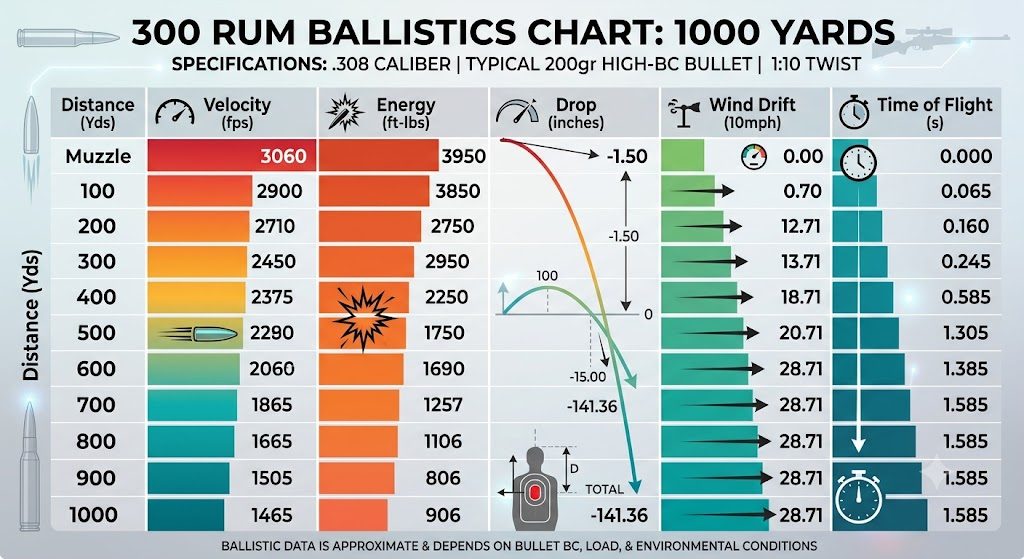
This article provides a detailed 300 RUM ballistics chart out to 1,000 yards to help shooters understand exactly how this powerhouse cartridge performs across every distance. The .300 Remington Ultra Magnum is designed for exceptional long-range performance, offering a massive case capacity that drives heavy bullets at extreme speeds. Because it maintains high velocity and energy significantly farther than many traditional hunting cartridges, it remains a favorite for elite long-range applications. Readers will find an authentic, researched ballistics chart below, paired with detailed explanations of every ballistic statistic to master the 300 RUM ballistics chart 1000 yards in real-world conditions.
300 RUM Ballistics Chart 1000 Yards
The data below represents the Remington Premier Long Range load, featuring the 190-grain Hornady InterBond bullet. This load is a standard benchmark for the .300 RUM’s capabilities.
Note: Calculations are based on a 100-yard zero, 1.5-inch sight height, and standard sea-level atmospheric conditions (59°F, 29.92 inHg).
| Distance (Yds) | Velocity (fps) | Energy (ft-lbs) | Drop (inches) | Wind Drift (10mph) | Time of Flight (s) |
| Muzzle | 3,060 | 3,950 | -1.50 | 0.00 | 0.000 |
| 100 | 2,865 | 3,464 | 0.00 | 0.21 | 0.103 |
| 200 | 2,679 | 3,028 | -1.65 | 0.88 | 0.215 |
| 300 | 2,501 | 2,638 | -5.92 | 2.05 | 0.336 |
| 400 | 2,331 | 2,292 | -12.98 | 3.75 | 0.468 |
| 500 | 2,168 | 1,983 | -23.16 | 6.04 | 0.613 |
| 600 | 2,012 | 1,708 | -36.91 | 8.98 | 0.771 |
| 700 | 1,864 | 1,465 | -54.77 | 12.63 | 0.945 |
| 800 | 1,723 | 1,253 | -77.51 | 17.06 | 1.137 |
| 900 | 1,590 | 1,067 | -106.01 | 22.37 | 1.349 |
| 1000 | 1,465 | 906 | -141.36 | 28.71 | 1.585 |
Bullet Weight
Bullet weight dictates the ballistic coefficient and sectional density. In the .300 RUM, 180-grain to 220-grain bullets are standard. Heavier bullets provide better wind resistance and energy retention at 1,000 yards, while lighter bullets offer flatter trajectories at closer ranges.
Muzzle Velocity
The .300 RUM is one of the fastest commercial .30 caliber cartridges available. This high muzzle velocity allows the bullet to reach its target faster, reducing the time the bullet is exposed to gravity and wind.
Velocity at Distance
Velocity drops significantly as the bullet travels due to air resistance. Retaining velocity is crucial for terminal performance and consistent point of impact. At 1,000 yards, the .300 RUM still maintains impressive speeds compared to smaller magnums.
Muzzle Energy
Muzzle energy is the raw power generated at the barrel exit. For the .300 RUM, this exceeds 3,900 ft-lbs, providing massive knockdown power suitable for the largest North American game.
Downrange Energy
Energy retention is a measure of how much power reaches the target. Because of the high-BC bullets used in this caliber, the .300 RUM maintains enough energy at 1,000 yards to perform effectively on large targets.
Bullet Drop
Bullet drop is the downward curve caused by gravity. Because the .300 RUM is so fast, it suffers less drop than most cartridges. However, at 1,000 yards, the drop is substantial, requiring precise scope adjustments.
Wind Drift
Wind drift represents how far the wind pushes the bullet off-target. A higher ballistic coefficient (BC) helps the bullet “cut” through the air, minimizing the effect of crosswinds at long distances.
Ballistic Coefficient
The ballistic coefficient (BC) is a numerical value representing the aerodynamic efficiency of the bullet. A higher BC indicates better aerodynamic streamlining, leading to less velocity loss and reduced wind drift.
Time of Flight
Time of flight is how long the bullet is in the air. Shorter flight times mean the bullet has less time for wind and gravity to act upon it, which increases accuracy at long ranges.
Zero Distance
The zero distance is the range at which the bullet hits the exact point of aim. A 100-yard zero is the standard starting point, though many long-range shooters choose a 200-yard zero to flatten the trajectory further.
Effective Range
The effective range of the .300 RUM exceeds 1,000 yards for experienced shooters. For hunting, the effective range is limited by the distance at which the bullet retains sufficient velocity for proper terminal expansion.
Long-Range Performance
The .300 RUM was engineered specifically for extreme distances. Its ability to push heavy, high-BC bullets at high velocities makes it one of the most capable platforms for competitive precision shooting and long-range hunting.
Additional Information
Cartridge Overview
Introduced by Remington in 1999, the .300 RUM is a non-belted, massive-capacity case. It is designed to exceed the performance of the .300 Weatherby Magnum and compete with the .30-378 Weatherby.
Recoil Characteristics
The power of the .300 RUM comes with significant recoil. It is recommended to use a high-quality muzzle brake or a heavy rifle platform to manage the kick, which can be punishing during extended practice sessions.
Suitable Game Animals
This cartridge is suitable for everything from whitetail deer to elk, moose, and large brown bears. It is particularly effective for long-range hunting where the ability to maintain energy is paramount.
FAQ
What is the best zero for the 300 RUM at 1000 yards?
Many long-range shooters prefer a 200-yard zero, as it simplifies holdovers within the “point-blank” range of typical hunting scenarios.
Does barrel length matter for 300 RUM ballistics?
Yes. Due to the huge powder charge, a longer barrel (26 inches or more) is necessary to achieve the velocities listed in manufacturer charts.
How does wind affect the 300 RUM at 1,000 yards?
Even with the high velocity of the RUM, a 10 mph crosswind will drift the bullet nearly 28 inches at 1,000 yards. Always use a Kestrel or ballistic app to adjust for wind.