The main difference between the 7mm Remington Magnum and the .300 Winchester Magnum lies in their bore diameter and intended ballistic performance: the 7mm Rem Mag uses a slender .284-inch projectile to achieve a flat trajectory with moderate recoil, whereas the .300 Win Mag utilizes a heavier .308-inch projectile to deliver significantly more kinetic energy and penetration for large-bodied game. While both are members of the legendary belted magnum family and excel at long-range hunting, the 7mm Rem Mag is often favored for its efficiency and flatter flight path at distance with less recoil, whereas the .300 Win Mag is the superior choice for hunters needing maximum stopping power on heavy-boned animals at any range. Choosing between them depends on whether you prioritize a manageable, high-BC rifle system or the authoritative terminal performance of a full-size .30-caliber magnum, making this 7mm vs 300 win mag ballistics chart essential for your next big game adventure.
Table of Contents [Click to open]
7mm Vs 300 Win Mag Ballistics Chart
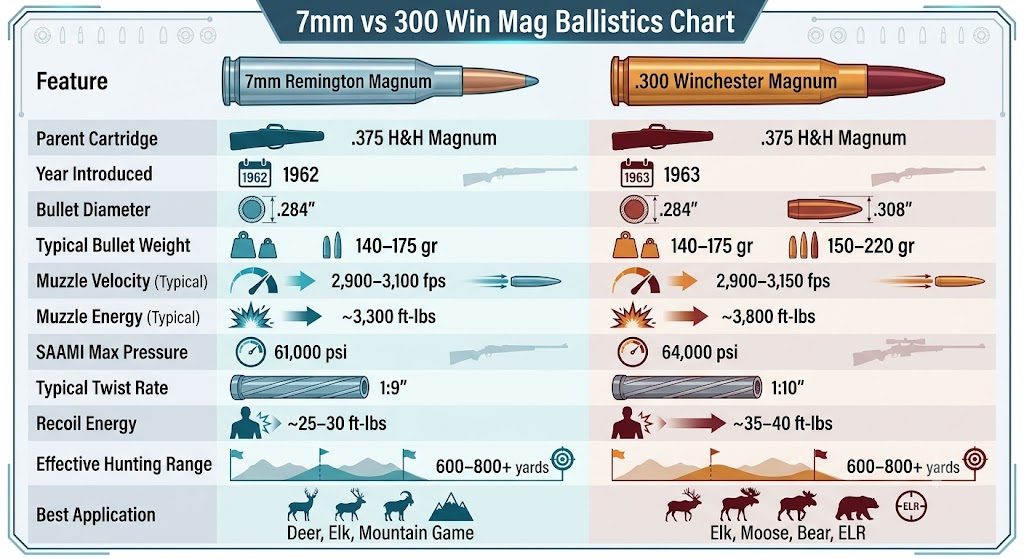
| Feature | 7mm Remington Magnum | .300 Winchester Magnum |
| Parent Cartridge | .375 H&H Magnum | .375 H&H Magnum |
| Year Introduced | 1962 | 1963 |
| Bullet Diameter | .284″ | .308″ |
| Typical Bullet Weight | 140–175 gr | 150–220 gr |
| Muzzle Velocity (Typical) | 2,900–3,100 fps | 2,900–3,150 fps |
| Muzzle Energy (Typical) | ~3,300 ft-lbs | ~3,800 ft-lbs |
| SAAMI Max Pressure | 61,000 psi | 64,000 psi |
| Typical Twist Rate | 1:9″ | 1:10″ |
| Recoil Energy | ~25–30 ft-lbs | ~35–40 ft-lbs |
| Effective Hunting Range | 600–800+ yards | 600–800+ yards |
| Best Application | Deer, Elk, Mountain Game | Elk, Moose, Bear, ELR |
Muzzle Velocity Comparison
Both cartridges provide excellent velocity, typically hovering around 3,000 fps at the muzzle. However, the .300 Win Mag often edges out the 7mm Rem Mag by 50 to 100 fps when firing bullets of similar sectional density. While the 7mm Rem Mag is remarkably fast, the .300 Win Mag takes advantage of its larger case capacity to push heavier .30-caliber bullets at speeds that rival the lighter 7mm projectiles, giving it a slight velocity-based energy advantage.
Muzzle Energy Comparison
The .300 Win Mag is the clear winner in terms of raw power. It generates significantly higher muzzle energy, often exceeding 3,800 ft-lbs compared to the 3,300 ft-lbs typical of the 7mm Rem Mag. On the other hand, the 7mm Rem Mag provides more than enough energy to ethically harvest any North American big game, but the .300 Win Mag provides a larger margin of terminal power, especially when dealing with dense muscle and heavy bone.
Downrange Energy Comparison
As distance increases, the higher projectile weight of the .300 Win Mag ensures that it maintains superior kinetic energy at long range. While the 7mm Rem Mag uses high-ballistic-coefficient bullets to minimize drag, the mass of the .300 Win Mag bullets allows them to retain more knockdown power at 500 yards and beyond. For hunters targeting large game like moose or grizzly bears, this extra downrange energy is a decisive factor compared to the 7mm Rem Mag.
Bullet Drop and Trajectory
The 7mm Rem Mag is famous for its flat shooting, which is a result of pairing high-BC, aerodynamic bullets with magnum velocities. In many load configurations, the 7mm Rem Mag will exhibit slightly less drop than the .300 Win Mag at mid-range distances. However, both cartridges are exceptionally flat-shooting, and the performance gap is minimal enough that the average hunter will notice little difference in holdover requirements out to 500 yards.
Recoil Comparison
Recoil is the most significant differentiator. The .300 Win Mag produces notably more recoil energy, often 20% to 30% more than the 7mm Rem Mag. This makes the 7mm Rem Mag a more shooter-friendly option for those who are recoil-sensitive or those who plan to spend a lot of time practicing at the range. The .300 Win Mag’s recoil can lead to shooter fatigue, potentially impacting precision, whereas the 7mm Rem Mag remains more manageable.
Accuracy and Performance
Both cartridges are known for excellent accuracy and are popular choices for custom rifle builds. The 7mm Rem Mag is often praised for its inherent efficiency and ability to handle wind well due to the high-BC bullets typically used in the 7mm bore. The .300 Win Mag, while having more recoil, offers slightly more versatility in bullet selection, allowing shooters to choose everything from light, fast bullets for deer to heavy, deep-penetrating bullets for dangerous game.
Which Is Better?
The 7mm Rem Mag is better for the hunter who wants a high-performance long-range rifle but prioritizes manageable recoil and a flatter trajectory for lighter, mountain-style game. It is a fantastic choice for deer, sheep, and elk where shot placement is critical and you want to maintain your sight picture through the shot.
The .300 Win Mag is better for the hunter who regularly targets large-bodied or tough game like moose, brown bear, or elk at extended ranges. If you need the maximum possible terminal energy and do not mind the extra recoil of a heavier, more powerful platform, the .300 Win Mag is the more authoritative choice.
FAQ
Is 7mm Rem Mag better than 300 Win Mag for long range?
The 7mm Rem Mag is often considered easier to shoot due to lower recoil and a flatter trajectory, but the .300 Win Mag has a ballistic advantage in energy retention at extreme distances.
Which is better for elk?
Both are excellent elk cartridges. The 7mm Rem Mag is sufficient for any elk hunt, while the .300 Win Mag provides a better cushion of energy and penetration for tough shots in heavy cover.
Does 300 Win Mag have more barrel wear?
Yes, due to its larger powder capacity and higher pressures, the .300 Win Mag generally experiences faster throat erosion compared to the 7mm Rem Mag.
Can I use the same rifle for both?
No, they require different barrels because of the bullet diameter differences, although they are similar enough that they often utilize the same bolt face and long-action receiver specifications.