Are you trying to determine how much velocity you lose or gain based on your specific firearm configuration? You are not alone. A common point of confusion for shooters is how the 300 blackout ballistics chart barrel length relationship actually works in the real world. Unlike long range magnums that require 26 inches of steel to reach peak velocity, the 300 Blackout is unique because it is designed to achieve a complete powder burn in a very short distance. This guide provides a massive master table comparing ballistic performance across four common barrel lengths, helping you understand exactly what to expect from your specific setup.
300 Blackout Ballistics Chart Barrel Length
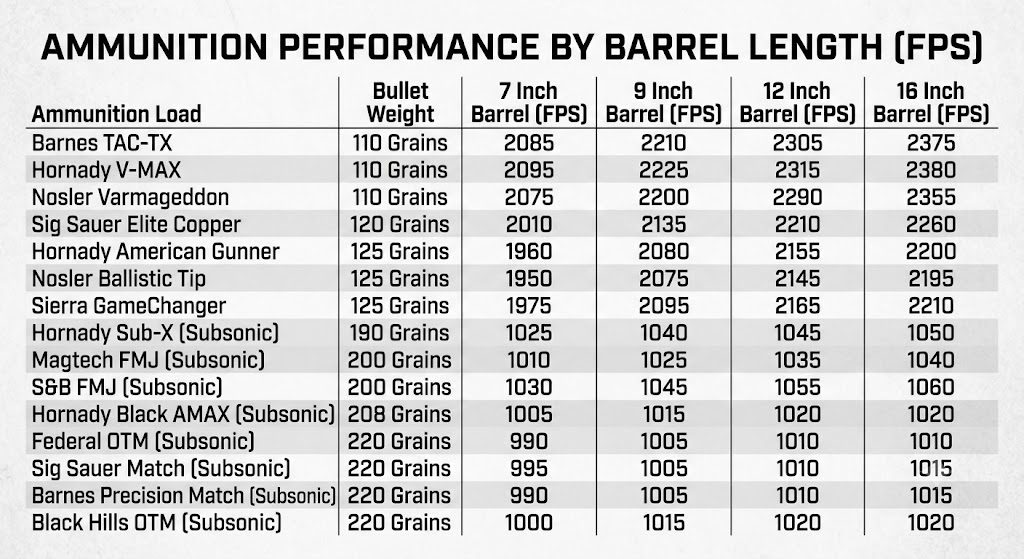
This table illustrates the velocity performance of a standard 110 grain supersonic load across different barrel lengths. The 300 Blackout is famous for being incredibly efficient; notice how the velocity gains diminish significantly once you move past 16 inches.
| Ammunition Load | Bullet Weight | 7 Inch Barrel (FPS) | 9 Inch Barrel (FPS) | 12 Inch Barrel (FPS) | 16 Inch Barrel (FPS) |
| Barnes TAC-TX | 110 Grains | 2085 | 2210 | 2305 | 2375 |
| Hornady V-MAX | 110 Grains | 2095 | 2225 | 2315 | 2380 |
| Nosler Varmageddon | 110 Grains | 2075 | 2200 | 2290 | 2355 |
| Sig Sauer Elite Copper | 120 Grains | 2010 | 2135 | 2210 | 2260 |
| Hornady American Gunner | 125 Grains | 1960 | 2080 | 2155 | 2200 |
| Nosler Ballistic Tip | 125 Grains | 1950 | 2075 | 2145 | 2195 |
| Sierra GameChanger | 125 Grains | 1975 | 2095 | 2165 | 2210 |
| Hornady Sub-X (Subsonic) | 190 Grains | 1025 | 1040 | 1045 | 1050 |
| Magtech FMJ (Subsonic) | 200 Grains | 1010 | 1025 | 1035 | 1040 |
| S&B FMJ (Subsonic) | 200 Grains | 1030 | 1045 | 1055 | 1060 |
| Hornady Black AMAX (Subsonic) | 208 Grains | 1005 | 1015 | 1020 | 1020 |
| Federal OTM (Subsonic) | 220 Grains | 990 | 1005 | 1010 | 1010 |
| Sig Sauer Match (Subsonic) | 220 Grains | 995 | 1005 | 1010 | 1015 |
| Barnes Precision Match (Subsonic) | 220 Grains | 990 | 1005 | 1010 | 1015 |
| Black Hills OTM (Subsonic) | 220 Grains | 1000 | 1015 | 1020 | 1020 |
Understanding the Barrel Length Factor
7 Inch Barrels
This is the “ultra-compact” configuration. You will experience a noticeable velocity loss compared to a 16 inch barrel, but the maneuverability is unmatched. This length is ideal for personal defense or tight tactical environments where the weapon must be as short as possible.
9 Inch Barrels
The 9 inch barrel is widely considered the “sweet spot” for this caliber. It provides an excellent balance of velocity, reliable cycling with subsonic loads, and ease of use when a suppressor is attached. You lose very little effective range compared to a full length rifle.
12 Inch Barrels
Often found on short barreled rifles (SBRs) or custom builds, the 12 inch barrel captures nearly all the available velocity from the fast burning powder. It offers a slightly flatter trajectory than the 9 inch setup while still remaining much more compact than a standard 16 inch carbine.
16 Inch Barrels
This is the standard legal length for most jurisdictions. While it provides the maximum velocity, the gains over a 12 inch barrel are often marginal. The primary benefit of the 16 inch barrel is that it eliminates the legal paperwork and restrictions associated with owning an SBR in many regions.
How Barrel Length Affects Subsonic Performance
The data shows that barrel length has almost zero impact on subsonic velocity. Because subsonic ammunition is engineered to stay below the speed of sound (roughly 1,125 fps), pushing it through a longer barrel does not make it go faster—it simply causes the powder to burn up inside the tube. You do not gain energy by using a 16 inch barrel for subsonic rounds; you only add weight and length to your firearm.
The Supersonic Advantage
For supersonic loads, the increase in velocity from a 7 inch to a 16 inch barrel is roughly 250 to 300 fps. While this seems significant, you must remember that 300 Blackout is a short to medium range cartridge. Whether your bullet leaves the muzzle at 2,100 fps or 2,375 fps, it will be dropping rapidly past 200 yards regardless. The barrel length you choose should be based on your intended use—suppression, hunting, or home defense—rather than chasing pure speed.
Frequently Asked Questions
Does a shorter barrel make the gun louder?
Yes. A 7 inch barrel will have significantly more muzzle blast and noise than a 16 inch barrel because the powder is still burning and expanding as it leaves the muzzle. However, if you are using a high quality suppressor, this noise difference becomes much less noticeable.
Which barrel length is best for hunting?
A 12 inch to 16 inch barrel is ideal for hunting. These lengths provide the most consistent velocity, which ensures your expanding bullets will reliably open upon impact at distances up to 200 yards.
Does barrel length affect accuracy?
Generally, no. Modern manufacturing means that a quality 9 inch barrel is just as accurate as a 16 inch barrel. Accuracy in this caliber is determined more by the quality of the rifling and the consistency of your ammunition than by the length of the barrel itself.