The ballistics for 300 blackout chart provides shooters with essential trajectory metrics, allowing hunters, tactical operators, and home-defense owners to maximize the performance of this highly versatile caliber. By utilizing a comprehensive ballistics chart, shooters can accurately predict downrange bullet path, compensate for drop, and understand kinetic energy retention.
For this ultimate guide, our primary reference data utilizes the premium Hornady Critical Defense 110 gr FTX factory supersonic load. Note that real-world ballistic performance will always fluctuate based on your rifle’s barrel length (such as an ultra-compact 9-inch short-barreled rifle vs. a standard 16-inch carbine), choice of ammunition (supersonic vs. subsonic), and current local environmental conditions.
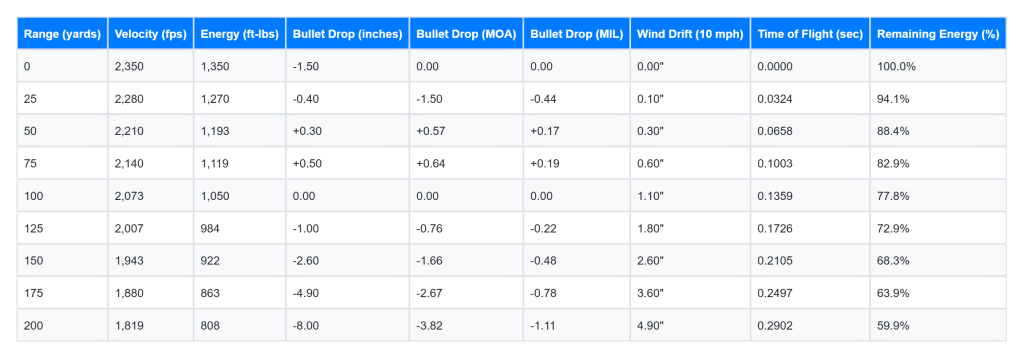
300 Blackout Ballistics Chart
| Range (yards) | Velocity (fps) | Energy (ft-lbs) | Bullet Drop (inches) | Bullet Drop (MOA) | Bullet Drop (MIL) | Wind Drift (10 mph) | Time of Flight (sec) | Remaining Energy (%) |
| 0 | 2,350 | 1,350 | -1.50 | 0.00 | 0.00 | 0.00″ | 0.0000 | 100.0% |
| 25 | 2,280 | 1,270 | -0.40 | -1.50 | -0.44 | 0.10″ | 0.0324 | 94.1% |
| 50 | 2,210 | 1,193 | +0.30 | +0.57 | +0.17 | 0.30″ | 0.0658 | 88.4% |
| 75 | 2,140 | 1,119 | +0.50 | +0.64 | +0.19 | 0.60″ | 0.1003 | 82.9% |
| 100 | 2,073 | 1,050 | 0.00 | 0.00 | 0.00 | 1.10″ | 0.1359 | 77.8% |
| 125 | 2,007 | 984 | -1.00 | -0.76 | -0.22 | 1.80″ | 0.1726 | 72.9% |
| 150 | 1,943 | 922 | -2.60 | -1.66 | -0.48 | 2.60″ | 0.2105 | 68.3% |
| 175 | 1,880 | 863 | -4.90 | -2.67 | -0.78 | 3.60″ | 0.2497 | 63.9% |
| 200 | 1,819 | 808 | -8.00 | -3.82 | -1.11 | 4.90″ | 0.2902 | 59.9% |
Load Specifications: Data modeled from Hornady Critical Defense 110 grain FTX. Fired from a 16-inch test barrel with a 100-yard sight zero and a standard 1.5-inch sight height above the bore axis.
300 Blackout Ballistics Chart Image
How to Read the 300 Blackout Ballistics Chart
Understanding how to read each metric ensures you translate data into accurate field adjustments:
- Range (yards): The linear distance measured from the firearm muzzle to the target plane.
- Velocity (fps): Bullet speed measured in feet per second. Slower velocities lead to steeper arcs over long distances.
- Energy (ft-lbs): Kinetic impact energy measured in foot-pounds. This value determines the terminal punch and tissue deformation of the projectile upon impact.
- Bullet Drop (inches): The vertical deviation of the bullet path relative to your point of aim when zeroed at 100 yards.
- Bullet Drop (MOA): Minutes of Angle adjustment values required on your optic’s turret to compensate for gravity.
- Bullet Drop (MIL): Milliradian angular units used for tactical reticle holdovers or modern turret adjustments.
- Wind Drift (10 mph Crosswind): The horizontal lateral displacement of the bullet caused by a full 90-degree 10 mph crosswind.
- Time of Flight (seconds): The exact duration of time elapsed between ignition and the moment the bullet impacts the target.
- Remaining Energy (%): The percentage of the initial muzzle energy retained by the bullet downrange.
Velocity Performance
The 300 Blackout achieves remarkable velocity efficiency, particularly out of shorter rifle configurations. Leaving a 16-inch barrel at 2,350 fps, a lightweight 110 gr supersonic round drops its speed linearly due to atmospheric drag but maintains a healthy 1,819 fps even at the 200-yard mark.
Unlike older cartridges like 5.56 NATO, which bleed massive amounts of velocity and suffer heavily when chopped into short barrel platforms, the fast-burning powder chemistry of the 300 Blackout achieves complete powder burn in just 9 inches of barrel length. Going from a 16-inch barrel down to a 9-inch barrel costs only about 200 to 250 fps in muzzle velocity, making it unmatched in ultra-short carbine performance.
Energy Performance
Supersonic 300 Blackout loads carry severe terminal weight, providing roughly 1,350 foot-pounds of muzzle energy—closely tracking the hard-hitting characteristics of classical 7.62x39mm Russian military rounds.
- Self-Defense: At typical self-defense and home defense spaces (under 25 yards), 1,270+ ft-lbs of energy ensures massive hydrostatic shock and instantaneous energy transfer.
- Target Shooting: Provides satisfying impact energy to drop steel silhouettes instantly out to 300+ yards.
- Recreational Shooting: Fun and highly accurate to handle, offering clean operations on standard range targets without brutalizing shooters with aggressive shoulder slap.
Bullet Drop
The trajectory curve of the 300 Blackout is noticeably more pronounced than flat-shooting varmint cartridges like the .223 Remington. Because a large 30-caliber slug is pushed by a relatively small case volume, the drop increases significantly as you extend beyond its primary envelope.
With a 100-yard zero, the bullet rides slightly high (+0.5 inches) at 75 yards, hits dead-on at 100, and experiences a manageable, clean drop of 8 inches at 200 yards. Beyond 200 yards, the drop arc steepens substantially, requiring crisp MOA or MIL click-adjustments to score precise hits on target centerlines.
Wind Drift
A standard 10 mph crosswind pushes a 110 gr supersonic projectile roughly 1.1 inches off target at 100 yards, which stretches out to 4.9 inches at 200 yards. Because the 300 Blackout flies slower than typical light hyper-velocity cartridges, it stays inside the air column slightly longer, allowing ambient winds to push the larger surface area of its .308-inch diameter bullet body sideways across extended distances.
Time of Flight
Handgun-based calibers and intermediate compact cartridges remain in flight significantly longer than high-velocity rifle cartridges. The 300 Blackout needs 0.2902 seconds to reach 200 yards, whereas a lightning-fast varmint rifle clears that same exact gap in almost half the time. This delay emphasizes why accurate leading on running targets or accounting for ambient crosswinds is mandatory.
Effective Range
The real-world practical effective range depends heavily on whether you load supersonic or heavy subsonic ammunition.
| Application | Supersonic (110 gr – 125 gr) | Subsonic (200 gr – 220 gr) |
| Self-Defense / Home Defense | 0 – 300 yards | 0 – 75 yards |
| Recreational Target Shooting | 0 – 500 yards | 0 – 200 yards |
| Medium Game / Small Pest Control | 0 – 200 yards | 0 – 50 yards (Varmints Only) |
Supersonic vs. Subsonic Loads
| Load Type | Typical Velocity | Typical Energy | Recoil | Best Use | Advantages | Disadvantages |
| Supersonic | 2,150 – 2,400 fps | 1,300 – 1,400 ft-lbs | Moderate | Hunting, Defense | Flatter trajectory, high energy | Loud muzzle blast |
| Subsonic | 950 – 1,050 fps | 450 – 500 ft-lbs | Ultra-Light | Suppressed Ops | Quiet performance | Extreme bullet drop |
Best Factory Loads for 300 Blackout
| Manufacturer | Bullet | Weight (gr) | Bullet Type | Velocity (fps) | Energy (ft-lbs) | Primary Use |
| Hornady | Critical Defense FTX | 110 | Polymer Tip | 2,350 | 1,350 | Personal Defense |
| Federal | American Eagle | 130 | FMJ | 2,230 | 1,435 | Range Plinking |
| Speer | Gold Dot Duty | 135 | Soft Point | 2,210 | 1,465 | Law Enforcement |
| Winchester | Deer Season XP | 150 | Extreme Point | 1,900 | 1,200 | Medium Game Hunting |
| Remington | Premier Match | 125 | Match OTM | 2,215 | 1,360 | Precision / Competition |
| Buffalo Bore | Tactical Ammunition | 125 | JHP | 2,250 | 1,405 | Serious Defensive Use |
| Underwood | Controlled Chaos | 110 | Fracturing Solid | 2,400 | 1,407 | Home Defense / Hunting |
| PMC | Bronze Line | 147 | FMJ | 2,075 | 1,404 | Budget Training |
Factors That Affect 300 Blackout Ballistics
- Barrel Length: Shortening a barrel drops overall velocity, though the efficiency loss is minor compared to alternative short-barreled systems.
- Bullet Weight: Lightweight bullets (110 gr) fly flatter and faster, while heavy options (220 gr) intentionally drop into slow, quiet subsonic fields.
- Bullet Construction: Polymer tips maximize aerodynamic drag reduction, whereas blunt open-tip match profiles favor pure stability over raw terminal expansions.
- Load Configurations: Swapping mid-session from supersonic rounds to quiet subsonic variations completely rewrites your zero profiles.
- Atmospheric Dynamics: Dropping ambient temperatures reduces structural internal gas pressures, while climbing up to higher altitudes decreases air density resistance for flat downrange travel.
Frequently Asked Questions
How far is a 300 Blackout accurate?
With quality supersonic loads, it maintains excellent mechanical precision out to 400–500 yards. However, drop mechanics require proper optical holdovers past 200 yards.
Is 300 Blackout good for self-defense?
It is exceptional. Loaded with proper expanding defensive ammunition, it delivers heavy barrier blindness and stopping power that easily outperforms traditional pistol calibers and standard lightweight carbines.
What is the effective range of a 300 Blackout?
For deer and hog hunting, the maximum recommended ethical threshold is 200 yards. For hitting tactical steel plates, it functions reliably out to 400+ yards.
How much does a 300 Blackout drop at 100 yards?
When zeroed perfectly at 100 yards, there is exactly 0 inches of drop. If your rifle is instead zeroed closer at 50 yards, it will rise roughly 0.5 to 1.0 inches at the 100-yard mark.
Does supersonic ammunition shoot flatter?
Yes, significantly so. Supersonic ammunition leaves the barrel over twice as fast as subsonic loads, creating a much shallower trajectory arc.
What barrel length gives the best velocity?
While a full 16-inch barrel squeezes maximum speed out of the case, a compact 9-inch barrel retains roughly 90% of that total performance, making it the sweet spot for maximum size reduction.
Is the 300 Blackout Still a Good Defensive Cartridge?
The 300 Blackout remains a premier close-quarters defensive selection. Its structural architecture yields flawless firearm feeding reliability in standard AR platforms, minimal snappy recoil sensations, and high operational handling ease.
When combined with premium tactical expanding projectiles, it delivers massive tissue cavitation and stops threats instantly. For home defense inside tight corridors or concealed multi-role configurations, its unmatched short-barrel efficiency and readily available commercial ammunition choices secure its position as a top-tier modern defensive solution.