When evaluating personal defense or range ammunition, understanding the real world performance of different calibers is essential. Ballistics data such as muzzle velocity and muzzle energy dictate how a round behaves upon leaving the barrel and striking a target. The data below compares standard factory loads from top manufacturers like Federal, Hornady, Winchester, and Speer, giving you a clear picture of how popular handgun cartridges stack up.
| Caliber | Ammunition Load | Bullet Weight (gr) | Muzzle Velocity (fps) | Muzzle Energy (ft-lbs) |
| 9mm Luger | Speer Gold Dot JHP | 124 | 1068 | 315 |
| 9mm Luger | Hornady Critical Defense FTX | 115 | 1126 | 324 |
| .40 S&W | Federal Premium HST JHP | 165 | 1150 | 485 |
| .40 S&W | Winchester Defender JHP | 180 | 1000 | 400 |
| .45 ACP | Federal Premium HST JHP | 230 | 890 | 404 |
| .45 ACP | Hornady Custom XTP JHP | 200 | 845 | 318 |
| .380 Auto | Hornady Critical Defense FTX | 90 | 1000 | 200 |
| 10mm Auto | Federal Premium HST JHP | 200 | 1130 | 567 |
To see how these calibers relate to one another in terms of raw power and speed, this interactive plot maps out the data:
Key insight: Lighter bullets driven at higher speeds (like the 9mm) rely heavily on velocity for terminal performance, while slower, heavier bullets (like the .45 ACP) rely on sheer mass.
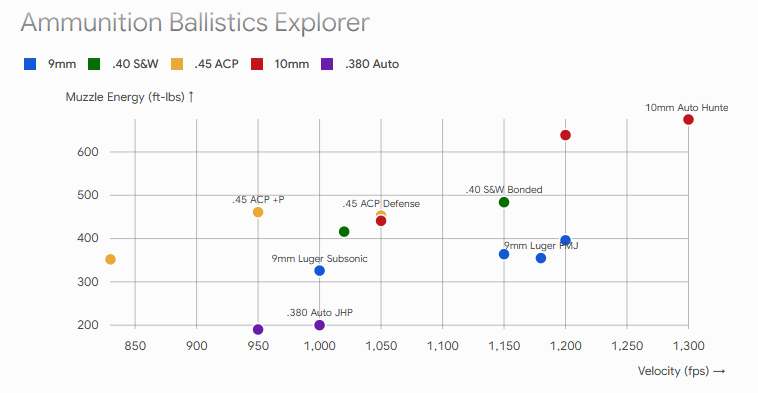
| Load | Cal. | Gr. | FPS | Ft-Lb |
|---|---|---|---|---|
| 9mm Luger FMJ | 9mm | 115gr | 1180 | 355 |
| 9mm Luger +P | 9mm | 124gr | 1200 | 396 |
| 9mm Luger Subsonic | 9mm | 147gr | 1000 | 326 |
| .40 S&W Target | .40 S&W | 180gr | 1020 | 416 |
| .40 S&W Bonded | .40 S&W | 165gr | 1150 | 484 |
| .45 ACP Hardball | .45 ACP | 230gr | 830 | 352 |
| .45 ACP Defense | .45 ACP | 185gr | 1050 | 453 |
| 10mm Auto Full Power | 10mm | 200gr | 1200 | 639 |
| 10mm Auto Hunter | 10mm | 180gr | 1300 | 675 |
| .380 Auto Range | .380 Auto | 95gr | 950 | 190 |
| .380 Auto JHP | .380 Auto | 90gr | 1000 | 200 |
| 9mm NATO | 9mm | 124gr | 1150 | 364 |
| .45 ACP +P | .45 ACP | 230gr | 950 | 461 |
| 10mm Auto Practice | 10mm | 180gr | 1050 | 441 |
Understanding the Metrics
To make sense of handgun performance, you need to understand the relationship between bullet weight, velocity, and energy.
- Bullet Weight: Measured in grains (gr), this is the physical mass of the projectile. Heavier bullets typically penetrate deeper but travel slower.
- Muzzle Velocity: Measured in feet per second (fps), this indicates how fast the bullet is traveling the instant it leaves the barrel. Higher velocity contributes to reliable expansion in hollow point ammunition.
- Muzzle Energy: Measured in foot-pounds (ft-lbs), this represents the destructive potential or kinetic energy transferred to the target upon impact.
9mm vs .40 S&W vs .45 ACP
The debate between the three most popular semi automatic pistol calibers often comes down to a balance of capacity, recoil, and terminal ballistics.
9mm Luger
The 9mm is the global standard for law enforcement and civilian carry. It offers higher magazine capacity and lower felt recoil, which allows for faster and more accurate follow up shots. Modern jacketed hollow point (JHP) ammunition has bridged the performance gap, allowing the 9mm to expand and penetrate just as reliably as larger calibers.
.40 S&W
Developed to bridge the gap between 9mm and 10mm, the .40 S&W fires a larger and heavier bullet than the 9mm, resulting in higher muzzle energy. While it offers excellent barrier penetration and stopping power, it produces sharper recoil and reduces overall magazine capacity compared to the 9mm.
.45 ACP
Known for firing heavy, large diameter bullets, the .45 ACP relies on mass rather than velocity to deliver kinetic energy. The standard 230 grain bullet creates a larger permanent wound channel. Because it operates at lower chamber pressures and velocities, the .45 ACP typically produces a smoother “push” recoil impulse rather than a sharp snap, making it highly manageable despite its physical size.