Understanding the Nosler ballistic coefficient chart is essential for maximizing the performance of your rifle, whether you are preparing for a hunt or competing in precision rifle matches. Shooters rely on Nosler BC values to accurately predict trajectory, wind drift, and retained energy at various distances.
Ballistic coefficients are typically measured using either the G1 or G7 standard. The G1 standard is older and better suited for flat-based bullets, while the G7 standard provides a more accurate drag model for modern, long-range boat tail bullets. In the chart below, you will find the most current and official G1 and G7 ballistic coefficients, sectional densities, and recommended twist rates for Nosler’s premier bullet families.
Nosler Ballistic Coefficient Chart
| Caliber | Bullet | Bullet Weight (gr) | Bullet Family | G1 Ballistic Coefficient | G7 Ballistic Coefficient | Sectional Density | Recommended Twist Rate | Primary Use |
| .224 | Custom Competition | 52 | HPBT Match | 0.220 | N/A | N/A | N/A | Target / Match |
| .224 | Partition | 60 | Spitzer | 0.228 | N/A | 0.171 | N/A | Hunting |
| .224 | Custom Competition | 69 | HPBT Match | 0.305 | N/A | N/A | N/A | Target / Match |
| .224 | RDF | 70 | HPBT Match | 0.416 | 0.211 | N/A | N/A | Target / Match |
| .224 | Custom Competition | 77 | HPBT Match | 0.340 | N/A | N/A | N/A | Target / Match |
| .224 | RDF | 77 | HPBT Match | 0.454 | 0.228 | N/A | N/A | Target / Match |
| .224 | Custom Competition | 80 | HPBT Match | 0.415 | N/A | N/A | N/A | Target / Match |
| .224 | RDF | 85 | HPBT Match | 0.498 | 0.245 | N/A | N/A | Target / Match |
| 6mm | Partition | 85 | Spitzer | 0.315 | N/A | 0.206 | N/A | Hunting |
| 6mm | Partition | 95 | Spitzer | 0.365 | N/A | 0.230 | N/A | Hunting |
| 6mm | Partition | 100 | Spitzer | 0.384 | N/A | 0.242 | N/A | Hunting |
| 6mm | RDF | 105 | HPBT Match | 0.571 | 0.280 | N/A | N/A | Target / Match |
| 6mm | Custom Competition | 107 | HPBT Match | 0.525 | N/A | N/A | N/A | Target / Match |
| 6mm | RDF | 115 | HPBT Match | 0.634 | 0.312 | N/A | N/A | Target / Match |
| .257 | Partition | 100 | Spitzer | 0.377 | N/A | 0.216 | N/A | Hunting |
| .257 | Partition | 115 | Spitzer | 0.389 | N/A | 0.249 | 1-12″ | Hunting |
| .257 | Partition | 120 | Spitzer | 0.391 | N/A | 0.260 | N/A | Hunting |
| 6.5mm | Partition | 100 | Spitzer | 0.326 | N/A | 0.205 | N/A | Hunting |
| 6.5mm | Custom Competition | 123 | HPBT Match | 0.510 | N/A | N/A | N/A | Target / Match |
| 6.5mm | Partition | 125 | Spitzer | 0.449 | N/A | 0.256 | N/A | Hunting |
| 6.5mm | AccuBond Long Range | 129 | Spitzer | 0.530 | 0.267 | N/A | N/A | Hunting / Long Range |
| 6.5mm | RDF | 130 | HPBT Match | 0.615 | 0.307 | N/A | N/A | Target / Match |
| 6.5mm | Partition | 140 | Spitzer | 0.490 | N/A | 0.287 | N/A | Hunting |
| 6.5mm | Custom Competition | 140 | HPBT Match | 0.529 | N/A | 0.266 | N/A | Target / Match |
| 6.5mm | RDF | 140 | HPBT Match | 0.658 | 0.330 | 0.287 | N/A | Target / Match |
| 6.5mm | AccuBond Long Range | 142 | Spitzer | 0.625 | 0.315 | N/A | N/A | Hunting / Long Range |
| 6.5mm | RDF | 150 | HPBT Match | 0.670 | 0.342 | N/A | N/A | Target / Match |
| 6.5mm | AccuBond Long Range | 150 | Spitzer | 0.634 | 0.319 | N/A | N/A | Hunting / Long Range |
| 6.8mm | Custom Competition | 115 | HPBT Match | 0.375 | N/A | N/A | N/A | Target / Match |
| .270 | Partition | 130 | Spitzer | 0.416 | N/A | 0.242 | N/A | Hunting |
| .270 | Partition | 140 | Spitzer | 0.432 | N/A | 0.261 | N/A | Hunting |
| .270 | Partition | 150 | Spitzer | 0.465 | N/A | 0.279 | N/A | Hunting |
| .270 | AccuBond Long Range | 150 | Spitzer | 0.591 | 0.298 | N/A | N/A | Hunting / Long Range |
| .270 | Partition | 160 | Semi-Spitzer | 0.434 | N/A | 0.298 | N/A | Hunting |
| .270 | AccuBond Long Range | 165 | Spitzer | 0.620 | 0.312 | N/A | N/A | Hunting / Long Range |
| 7mm | Partition | 140 | Spitzer | 0.434 | N/A | 0.248 | N/A | Hunting |
| 7mm | Partition | 150 | Spitzer | 0.456 | N/A | 0.266 | N/A | Hunting |
| 7mm | AccuBond Long Range | 150 | Spitzer | 0.546 | 0.275 | N/A | N/A | Hunting / Long Range |
| 7mm | Partition | 160 | Spitzer | 0.475 | N/A | 0.283 | N/A | Hunting |
| 7mm | Custom Competition | 168 | HPBT Match | 0.520 | N/A | N/A | N/A | Target / Match |
| 7mm | AccuBond Long Range | 168 | Spitzer | 0.616 | 0.310 | N/A | N/A | Hunting / Long Range |
| 7mm | Partition | 175 | Spitzer | 0.519 | N/A | 0.310 | N/A | Hunting |
| 7mm | AccuBond Long Range | 175 | Spitzer | 0.648 | 0.326 | N/A | N/A | Hunting / Long Range |
| 7mm | RDF | 185 | HPBT Match | 0.719 | 0.357 | N/A | N/A | Target / Match |
| .30 Cal | Partition | 150 | Spitzer | 0.387 | N/A | 0.226 | N/A | Hunting |
| .30 Cal | Custom Competition | 155 | HPBT Match | 0.450 | N/A | N/A | N/A | Target / Match |
| .30 Cal | Partition | 165 | Spitzer | 0.410 | N/A | 0.248 | N/A | Hunting |
| .30 Cal | Custom Competition | 168 | HPBT Match | 0.462 | N/A | N/A | N/A | Target / Match |
| .30 Cal | RDF | 168 | HPBT Match | 0.505 | 0.253 | N/A | N/A | Target / Match |
| .30 Cal | AccuBond Long Range | 168 | Spitzer | 0.525 | 0.265 | N/A | N/A | Hunting / Long Range |
| .30 Cal | Custom Competition | 175 | HPBT Match | 0.505 | N/A | N/A | N/A | Target / Match |
| .30 Cal | RDF | 175 | HPBT Match | 0.536 | 0.270 | N/A | N/A | Target / Match |
| .30 Cal | Partition | 180 | Protected Point | 0.474 | N/A | 0.271 | N/A | Hunting |
| .30 Cal | Custom Competition | 190 | HPBT Match | 0.530 | N/A | N/A | N/A | Target / Match |
| .30 Cal | AccuBond Long Range | 190 | Spitzer | 0.597 | 0.301 | N/A | N/A | Hunting / Long Range |
| .30 Cal | Partition | 200 | Spitzer | 0.481 | N/A | 0.301 | N/A | Hunting |
| .30 Cal | RDF | 210 | HPBT Match | 0.707 | 0.348 | N/A | N/A | Target / Match |
| .30 Cal | AccuBond Long Range | 210 | Spitzer | 0.661 | 0.333 | N/A | N/A | Hunting / Long Range |
| .30 Cal | Custom Competition | 220 | HPBT Match | 0.690 | N/A | N/A | N/A | Target / Match |
| .30 Cal | Partition | 220 | Semi-Spitzer | 0.426 | N/A | 0.274 | N/A | Hunting |
| .338 | Partition | 210 | Spitzer | 0.400 | N/A | 0.263 | N/A | Hunting |
| .338 | Partition | 225 | Spitzer | 0.454 | N/A | 0.281 | N/A | Hunting |
| .338 | Custom Competition | 250 | HPBT Match | 0.590 | N/A | N/A | N/A | Target / Match |
| .338 | Partition | 250 | Spitzer | 0.473 | N/A | 0.313 | N/A | Hunting |
| .338 | AccuBond Long Range | 265 | Spitzer | 0.732 | 0.369 | N/A | N/A | Hunting / Long Range |
| .338 | Custom Competition | 300 | HPBT Match | 0.800 | N/A | N/A | N/A | Target / Match |
| .338 | AccuBond Long Range | 300 | Spitzer | 0.785 | 0.394 | N/A | N/A | Hunting / Long Range |
| .338 | RDF | 300 | HPBT Match | 0.826 | 0.415 | N/A | N/A | Target / Match |
Nosler Ballistic Coefficient Chart Image
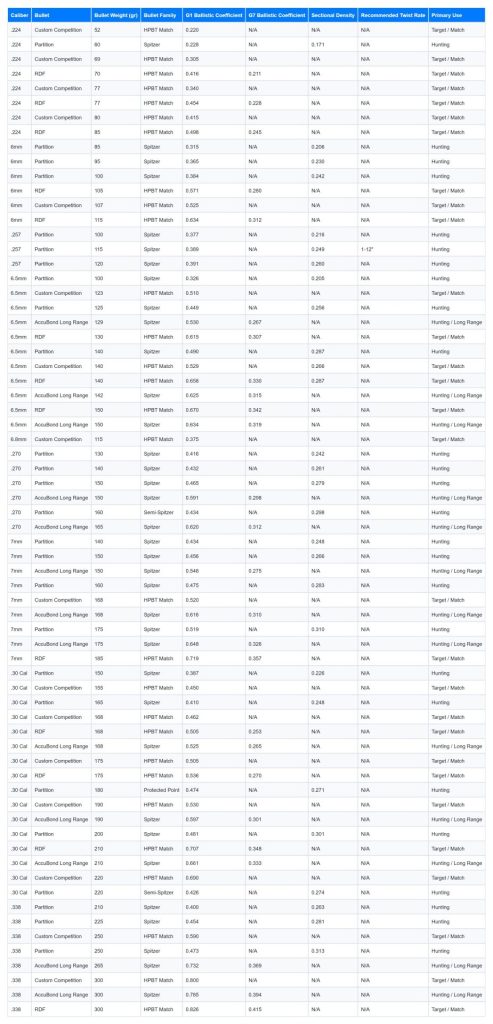
You might want to use Nosler Ballistic Calculator in this context.
How to Read the Nosler Ballistic Coefficient Chart
Reading a ballistic table accurately ensures your data output in a ballistic calculator matches reality.
- Caliber & Bullet: Identifies the diameter and the specific product line.
- Bullet Weight (gr): Measured in grains. Heavier bullets in the same caliber typically yield higher BCs due to increased length.
- Bullet Family: The specific design model, such as Partition or RDF.
- G1 Ballistic Coefficient: The aerodynamic drag rating compared to the older, flat based G1 standard projectile.
- G7 Ballistic Coefficient: The aerodynamic drag rating compared to the modern, boat tail G7 standard projectile.
- Sectional Density (SD): The ratio of a bullet’s weight to its diameter, which is a critical indicator of hunting penetration.
- Recommended Twist Rate: The minimum barrel twist required to properly stabilize long, high BC bullets.
- Primary Use: Indicates if the bullet is constructed for target shooting or lethal expansion on game.
Nosler Bullets with the Highest Ballistic Coefficients
The highest ballistic coefficients in the Nosler lineup belong to the RDF (Reduced Drag Factor) and AccuBond Long Range (ABLR) families.
These bullets excel at extended distances because of meticulously optimized compound ogives and long, drag reducing boat tails. The .338 caliber 300 grain RDF leads the pack with a staggering G1 BC of 0.826 and a G7 BC of 0.415. For hunting applications, the .338 caliber 300 grain ABLR offers tremendous performance with a G1 BC of 0.785. High BCs allow these bullets to slice through the air with minimal resistance, which reduces wind deflection and keeps velocities supersonic at extreme ranges.
Ballistic Tip vs AccuBond vs AccuBond Long Range vs RDF
Different bullet families are engineered with unique jacket tapers, cores, and tip geometries to serve specific shooting disciplines.
| Feature | Ballistic Tip | AccuBond | AccuBond Long Range (ABLR) | RDF (Reduced Drag Factor) |
| Ballistic Coefficient | Moderate | Moderate to High | Very High | Extremely High |
| Intended Use | Hunting / Varmint | Big Game Hunting | Long Range Hunting | Precision Target / Match |
| Hunting Performance | Rapid expansion | Controlled expansion (bonded) | Reliable expansion down to 1300 fps | Not recommended for hunting |
| Long Range Capability | Average | Very Good | Excellent | Maximum Performance |
G1 vs G7 Ballistic Coefficients
Ballistic coefficients reference a standard projectile shape to predict how a bullet will lose velocity over time.
- G1 Standard: Based on a short nosed, flat based projectile. It changes drastically depending on the bullet’s velocity.
- G7 Standard: Based on a long, boat tailed projectile with a sharp nose. It remains much more constant across all velocity brackets for modern match and long range hunting bullets.
| Feature | G1 | G7 |
| Best Used For | Flat base bullets, older bullet designs, and general comparisons | Modern boat tail bullets, VLD shapes, and extreme long range |
| Stability Across Velocities | Fluctuates depending on Mach number | Highly stable across all velocities |
| Numerical Value | Always higher | Always lower |
Best Nosler Bullets for Hunting
Selecting the right bullet for the game you are pursuing is more important than chasing the absolute highest ballistic coefficient.
- Deer: The Ballistic Tip is legendary for rapid, lethal expansion on thin skinned game. The standard AccuBond is also exceptional for ensuring an exit wound.
- Elk: The Nosler Partition and AccuBond are ideal. Both retain the mass required to penetrate heavy muscle and bone.
- Moose: Heavy for caliber Partition bullets or the monolithic E-Tip provide the deep, straight line penetration needed for massive animals.
- Dangerous Game: The Nosler Solid and large caliber Partitions (like the .375 or .416) are the industry standard for dangerous game where failure is not an option.
- Varmints: The Ballistic Tip Varmint and Varmageddon lines are designed with ultra thin jackets for explosive terminal performance.
Best Nosler Bullets for Long-Range Shooting
For precision target competition and long range steel, the Nosler RDF bullet is the definitive choice. The RDF line eliminates the need to trim or point meplats out of the box.
If you are hunting at extended ranges, the AccuBond Long Range (ABLR) is the clear winner. The ABLR maintains a high enough retained velocity to reduce wind drift, while the bonded jacket ensures proper expansion at impact velocities as low as 1300 fps.
Why Ballistic Coefficient Changes
A ballistic coefficient is not a static number. The drag a bullet experiences changes dynamically as it flies downrange.
The primary cause of BC variation is velocity. As a bullet transitions from supersonic flight through the transonic zone and into subsonic speeds, the aerodynamic drag shifts. This is why a G1 BC is technically only accurate for a specific velocity band. Additionally, local atmospheric conditions alter the air density. Higher altitudes, hotter temperatures, and higher humidity reduce air density, which mathematically reduces the drag on the bullet.
Does a Higher Ballistic Coefficient Mean Better Performance?
A higher ballistic coefficient absolutely provides better aerodynamic performance. High BC bullets retain their velocity longer, which directly translates to less wind drift, a flatter trajectory, and higher retained energy upon impact.
However, a high BC does not automatically equal practical accuracy or hunting success. If your rifle barrel does not have a fast enough twist rate to stabilize a long, high BC bullet, your groups will fall apart. Furthermore, target bullets like the RDF have incredibly high BCs but are entirely inappropriate for hunting because they do not reliably expand on game. Ballistic coefficient is a powerful tool, but it must be balanced with the correct bullet construction for your specific application.