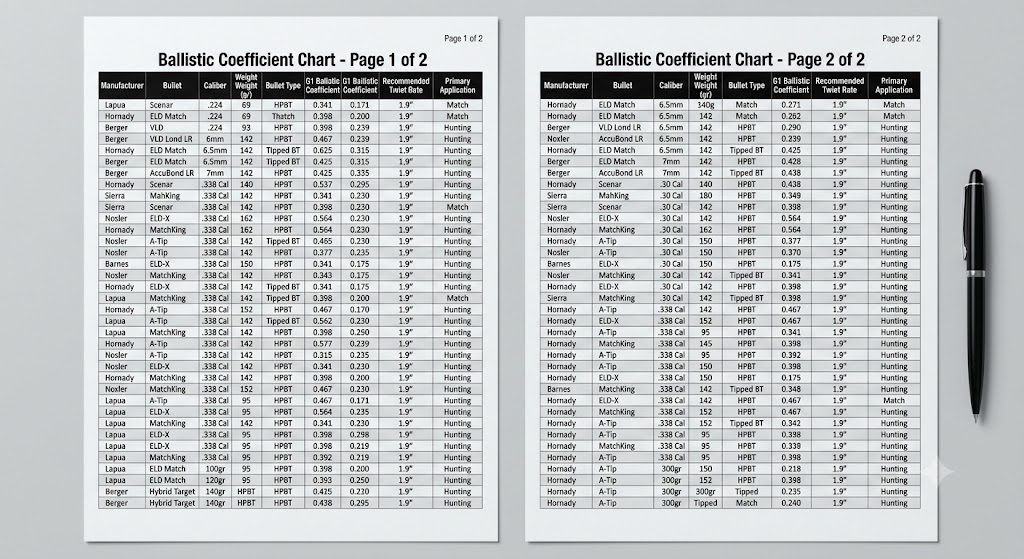
A ballistic coefficient (BC) is a mathematical measurement of a bullet’s ability to overcome air resistance during flight. A high BC matters because it directly dictates how efficiently a projectile retains velocity and energy downrange while simultaneously resisting wind deflection. This comprehensive ballistic coefficient chart includes verified G1 and G7 data from the industry’s top manufacturers, providing shooters with a direct comparison of modern match and hunting projectiles to help you select the ideal bullet for your specific application.
Ballistic Coefficient Chart
| Manufacturer | Bullet | Caliber | Bullet Weight (gr) | Bullet Type | G1 Ballistic Coefficient | G7 Ballistic Coefficient | Recommended Twist Rate | Primary Application |
| Lapua | Scenar | .224 | 69 | HPBT | 0.341 | 0.171 | N/A | Match |
| Hornady | ELD Match | .224 | 73 | Tipped Match | 0.398 | 0.200 | N/A | Match |
| Lapua | Scenar | .224 | 77 | HPBT | 0.386 | 0.193 | N/A | Match |
| Hornady | ELD Match | .224 | 88 | Tipped Match | 0.545 | 0.274 | N/A | Match |
| Hornady | A-Tip | .224 | 90 | Tipped Match | 0.585 | 0.295 | N/A | Match |
| Lapua | Scenar | 6mm | 90 | HPBT | 0.434 | 0.216 | N/A | Match |
| Berger | VLD Hunting | 6mm | 95 | HPBT | 0.467 | 0.239 | 1:9″ | Hunting |
| Hornady | ELD-X | 6mm | 103 | Tipped | 0.512 | 0.258 | N/A | Hunting |
| Lapua | Scenar | 6mm | 105 | HPBT | 0.472 | 0.236 | N/A | Match |
| Hornady | ELD Match | 6mm | 108 | Tipped Match | 0.536 | 0.270 | N/A | Match |
| Sierra | MatchKing | 6mm | 110 | HPBT | 0.547 | 0.273 | N/A | Match |
| Hornady | A-Tip | 6mm | 110 | Tipped Match | 0.604 | 0.304 | N/A | Match |
| Hornady | ELD-X | .25 Cal | 110 | Tipped | 0.465 | 0.234 | N/A | Hunting |
| Lapua | Scenar | 6.5mm | 123 | HPBT | 0.527 | 0.263 | N/A | Match |
| Barnes | LRX | 6.5mm | 127 | Polymer Tip BT | 0.468 | N/A | N/A | Hunting |
| Lapua | Scenar | 6.5mm | 139 | HPBT | 0.578 | 0.290 | N/A | Match |
| Berger | Hybrid Target | 6.5mm | 140 | HPBT | 0.607 | 0.311 | 1:8″ | Match |
| Hornady | ELD Match | 6.5mm | 140 | Tipped Match | 0.646 | 0.326 | N/A | Match |
| Sierra | MatchKing | 6.5mm | 140 | HPBT | 0.535 | 0.264 | N/A | Match |
| Nosler | AccuBond LR | 6.5mm | 142 | Tipped BT | 0.625 | 0.315 | N/A | Hunting |
| Hornady | ELD-X | 6.5mm | 143 | Tipped | 0.623 | 0.314 | N/A | Hunting |
| Hornady | ELD Match | 6.5mm | 147 | Tipped Match | 0.697 | 0.351 | N/A | Match |
| Hornady | A-Tip | 6.5mm | 153 | Tipped Match | 0.704 | 0.355 | N/A | Match |
| Hornady | ELD-X | .270 Cal | 145 | Tipped | 0.536 | 0.270 | N/A | Hunting |
| Hornady | ELD-X | 7mm | 150 | Tipped | 0.574 | 0.289 | N/A | Hunting |
| Hornady | ELD Match | 7mm | 162 | Tipped Match | 0.670 | 0.338 | N/A | Match |
| Hornady | ELD-X | 7mm | 162 | Tipped | 0.631 | 0.318 | N/A | Hunting |
| Hornady | ELD-X | 7mm | 175 | Tipped | 0.689 | 0.347 | N/A | Hunting |
| Hornady | ELD Match | 7mm | 180 | Tipped Match | 0.777 | 0.391 | 1:8.75″ | Match |
| Hornady | A-Tip | 7mm | 190 | Tipped Match | 0.838 | 0.422 | N/A | Match |
| Sierra | MatchKing PALMA | .30 Cal | 155 | HPBT | 0.437 | 0.224 | N/A | Match |
| Hornady | ELD Match | .30 Cal | 155 | Tipped Match | 0.461 | 0.232 | N/A | Match |
| Lapua | Scenar | .30 Cal | 155 | HPBT | 0.460 | 0.230 | N/A | Match |
| Hornady | ELD Match | .30 Cal | 168 | Tipped Match | 0.523 | 0.263 | N/A | Match |
| Hornady | ELD-X | .30 Cal | 178 | Tipped | 0.552 | 0.278 | N/A | Hunting |
| Hornady | ELD Match | .30 Cal | 178 | Tipped Match | 0.547 | 0.275 | N/A | Match |
| Lapua | Scenar | .30 Cal | 185 | HPBT | 0.482 | 0.241 | N/A | Match |
| Berger | Hybrid Target | .30 Cal | 200 | HPBT | 0.616 | 0.316 | 1:10″ | Match |
| Hornady | ELD-X | .30 Cal | 200 | Tipped | 0.597 | 0.301 | N/A | Hunting |
| Hornady | ELD Match | .30 Cal | 208 | Tipped Match | 0.690 | 0.348 | N/A | Match |
| Hornady | ELD-X | .30 Cal | 212 | Tipped | 0.663 | 0.334 | 1:10″ | Hunting |
| Hornady | ELD-X | .30 Cal | 220 | Tipped | 0.654 | 0.329 | N/A | Hunting |
| Hornady | ELD Match | .30 Cal | 225 | Tipped Match | 0.777 | 0.391 | 1:10″ | Match |
| Hornady | A-Tip | .30 Cal | 230 | Tipped Match | 0.823 | 0.414 | N/A | Match |
| Hornady | A-Tip | .30 Cal | 250 | Tipped Match | 0.878 | 0.442 | N/A | Match |
| Hornady | ELD-X | .338 Cal | 230 | Tipped | 0.616 | 0.310 | N/A | Hunting |
| Hornady | ELD-X | .338 Cal | 270 | Tipped | 0.757 | 0.381 | N/A | Hunting |
| Hornady | ELD Match | .338 Cal | 285 | Tipped Match | 0.829 | 0.417 | N/A | Match |
| Hornady | A-Tip | .338 Cal | 300 | Tipped Match | 0.863 | 0.435 | N/A | Match |
What Is Ballistic Coefficient?
In external ballistics, the ballistic coefficient is a numerical index representing how effectively a bullet cuts through the air. You can think of it as a measurement of aerodynamic efficiency. A higher number indicates that the bullet experiences less aerodynamic drag relative to its mass and diameter.
Technically, a ballistic coefficient is calculated by dividing the bullet’s sectional density by its form factor. When a bullet travels through the atmosphere, it faces constant air resistance. A projectile with a high ballistic coefficient sheds its velocity at a much slower rate than a projectile with a low BC.
Because the high-BC bullet retains its velocity longer, several critical things happen during its flight path:
- Retained Energy: The bullet strikes the target with more foot-pounds of energy, which is crucial for ethical hunting at extended ranges.
- Trajectory: By maintaining a higher average velocity over the course of its flight, the bullet experiences less drop due to gravity, creating a noticeably flatter trajectory.
- Wind Drift: The most important benefit for precision shooters is wind deflection. A bullet that reaches the target faster is exposed to crosswinds for a shorter duration. Consequently, high BC bullets suffer significantly less wind drift, acting as an insurance policy against poor wind calls.
How to Read This Ballistic Coefficient Chart
To make the most of the comparison table above, it is vital to understand exactly what each metric signifies in the context of load development and trajectory calculation.
G1 BC
This is the legacy standard of measuring drag. The G1 standard references a projectile shape with a flat base and a blunt, tangent ogive nose. While it is the most commonly advertised number because the values look artificially high, it is not the most accurate model for modern, sleek rifle bullets.
G7 BC
The G7 standard references a much more modern projectile design: a bullet with a long boat tail and a sharp, secant ogive. Since most modern match and long range bullets mimic this shape, the G7 ballistic coefficient provides a far more accurate representation of the bullet’s actual flight, especially at varying distances and velocities.
Bullet Weight
Expressed in grains (gr), weight dictates the mass of the projectile. Typically, within the same caliber, a heavier bullet requires a longer profile, which in turn increases its sectional density and drastically improves its ballistic coefficient.
Primary Application
Bullets are constructed differently based on their intended use. “Match” or “Target” bullets feature extremely thin jackets and are strictly optimized for accuracy and aerodynamic consistency, lacking reliable terminal expansion for game. “Hunting” bullets feature bonded cores, thicker jackets, and specialized polymer tips to ensure controlled expansion and weight retention upon impacting tissue.
Recommended Twist Rate
Heavy, high-BC bullets are inherently long. To stabilize a long projectile in flight, a barrel must impart a faster spin. If the twist rate of a rifle barrel is too slow for a specific bullet length, the bullet will yaw, tumble, and lose all accuracy and aerodynamic efficiency.
G1 vs G7 Ballistic Coefficient
The ongoing debate between G1 and G7 drag models is easily resolved when you understand how modern long-range bullets fly.
When you enter a G1 BC into a ballistic calculator for a modern boat tail bullet, the calculator is forcing the flight characteristics of a sleek, aerodynamic dart into the mathematical model of a flat-based artillery shell. Because the real bullet flies differently than the G1 standard model, the bullet’s drag changes drastically depending on its speed. To counteract this, manufacturers have to provide “stepped” or velocity-banded G1 BCs.
Conversely, because the G7 standard projectile actually looks and behaves like modern boat tail bullets, a G7 ballistic coefficient remains incredibly stable across the entire supersonic flight path.
When configuring a modern ballistic calculator (such as Hornady 4DOF, Applied Ballistics, or Strelok), shooters should almost always select the G7 drag model for boat-tail rifle bullets. Using G7 removes the velocity dependence errors that plague G1 trajectories past 600 yards.
| Feature | G1 Ballistic Coefficient | G7 Ballistic Coefficient |
| Standard Projectile Shape | Flat base, blunt nose | Boat tail, sharp secant ogive |
| Best Used For | Handgun bullets, flat-base hunting bullets | Modern match, VLD, and long-range hunting bullets |
| Numeric Value | Artificially higher (e.g., 0.646) | Numerically lower (e.g., 0.326) |
| Velocity Dependence | Highly variable across speed ranges | Constant across supersonic speeds |
| Calculator Accuracy | Poor beyond 500 yards | Exceptional at extreme long range |
Why Ballistic Coefficient Changes
A common misconception is that a ballistic coefficient is a static, unchanging number. In reality, a bullet’s BC is dynamic and shifts continuously throughout its flight path. If you notice manufacturers like Hornady publishing multiple BC values (e.g., Mach 2.25 vs Mach 1.75), it is to account for this exact phenomenon.
Velocity and Mach Number
As a bullet slows down, the way air flows over its surface changes. At high supersonic velocities (above Mach 2.0), the shockwave attached to the nose creates a specific drag profile. As the bullet approaches the transonic zone (Mach 1.2 down to Mach 0.8), the aerodynamic center of pressure shifts dramatically, often causing the bullet’s BC to degrade.
Bullet Shape and Stability
If a bullet is marginally stabilized due to a slow twist rate or cold weather, it will exhibit “yaw” or “coning” in flight. A bullet flying with its nose slightly offset from its flight path presents a larger physical profile to the oncoming air, drastically increasing drag and effectively ruining its advertised ballistic coefficient. Furthermore, polymer tips on some hunting bullets have historically melted or deformed at high velocities, significantly degrading the BC mid-flight. Modern materials, such as Hornady’s Heat Shield tip, were specifically engineered to solve this aerodynamic degradation.
Environmental Variables
While the BC of the bullet itself doesn’t change due to the weather, the air density it must push through does. Temperature, barometric pressure, and altitude dictate Density Altitude (DA). Cold, low-altitude air is thick and heavy, causing high drag and acting as though the bullet has a lower BC. Hot, high-altitude air is thin, allowing bullets to fly with noticeably less drag.
High Ballistic Coefficient Bullets
Bullets with exceptionally high ballistic coefficients dominate the realms of Precision Rifle Series (PRS) competitions and Extreme Long Range (ELR) shooting.
Examples of phenomenally high BC bullets include:
- Hornady 30 Cal 250 gr A-Tip Match: (G1: 0.878 / G7: 0.442)
- Hornady 338 Cal 300 gr A-Tip Match: (G1: 0.863 / G7: 0.435)
- Hornady 7mm 190 gr A-Tip Match: (G1: 0.838 / G7: 0.422)
These bullets perform flawlessly at extended ranges because their massive sectional density and aggressively long, aluminum-tipped ogives allow them to slice through the atmosphere with almost zero resistance. By retaining so much velocity, they remain supersonic well beyond 1,500 yards. This is critical because transitioning into subsonic speeds introduces turbulence that severely destabilizes most projectiles.
Best Hunting Bullets by Ballistic Coefficient
Selecting a hunting bullet requires balancing high aerodynamic efficiency with guaranteed terminal performance. A high BC does you no good if the bullet pencils straight through an animal without expanding.
Deer and Antelope
For medium game, the Hornady ELD-X and Nosler AccuBond Long Range are premier choices. For example, the 6.5mm 143 gr ELD-X (G1 0.623) delivers a phenomenally flat trajectory that takes the guesswork out of holdovers for open-country mule deer.
Elk and Moose
Heavy, tough game requires deep penetration combined with retained energy. The Barnes LRX utilizes a monolithic solid copper construction that retains 99% of its weight. Because copper is lighter than lead, LRX bullets are naturally longer than lead-core bullets of the same weight, granting them higher ballistic coefficients while ensuring they have the structural integrity to break heavy elk bones.
Long-Range Hunting
The Berger VLD Hunting bullet is famous among long-range hunters. Berger’s design purposefully utilizes a thin J4 Precision jacket that penetrates 2 to 3 inches into tissue before violently fragmenting, dumping 100% of its kinetic energy into the vital cavity. Combined with aggressive secant ogives, they offer some of the highest BCs in the hunting market.
Best Match Bullets by Ballistic Coefficient
In precision shooting, every millimeter counts. Competitive shooters prioritize BC over almost everything else because wind is the single most unpredictable variable on the firing line.
Sierra MatchKing (SMK)
The gold standard for decades. While some newer designs have pushed BC limits slightly higher, the incredibly tight manufacturing tolerances of the Sierra MatchKing provide consistent, repeatable drag across thousands of rounds.
Lapua Scenar
European long-range shooters favor the Scenar. Known for uniform jacket concentricity, Lapua Scenar bullets boast highly predictable BCs. The 6.5mm 139 gr Scenar remains a dominant force in 1,000-yard F-Class competitions.
Berger Hybrid Target
Berger’s “Hybrid” nose design revolutionized long-range match bullets. By blending a secant ogive (which provides high BC) with a tangent ogive (which makes the bullet insensitive to seating depth variations), shooters get the aerodynamic benefits of a VLD without the frustrating load development process.
Does a Higher Ballistic Coefficient Mean Better Accuracy?
There is a frequent, dangerous misconception among novice shooters that buying the bullet with the highest ballistic coefficient will automatically shrink their group sizes. The short answer is: No, a high BC does not equal high accuracy.
A ballistic coefficient dictates external ballistics—how the bullet interacts with the air after leaving the barrel. Accuracy is largely a product of internal ballistics—how the bullet interacts with the rifle chamber, the rifling, the seating depth, and the propellant burn.
A heavy, ultra-high BC bullet might be too long for your rifle’s twist rate, resulting in keyholing and massive group spread. Furthermore, high-BC secant-ogive bullets are notoriously picky about their “jump” distance to the rifling lands. If you don’t handload to the exact millimeter your rifle prefers, those high-BC bullets might shoot 2-inch groups at 100 yards.
However, at 1,000 yards, the script flips. A bullet with a lower BC might shoot tiny holes at 100 yards in a tunnel, but out in the real world, the wind will push that low-BC bullet all over the target at long range. A high-BC bullet forgives the shooter’s wind-reading errors, resulting in superior practical precision at extreme distances, provided the rifle likes the bullet in the first place.
Frequently Asked Questions
What is a good ballistic coefficient?
It depends entirely on the caliber. For a .223 Remington, a G1 BC around 0.400 is considered excellent. For a 6.5mm Creedmoor, a G1 BC over 0.600 is the benchmark for long-range performance. For large magnums like .338, shooters look for G1 BCs exceeding 0.800.
Is .500 BC good?
Yes, a G1 BC of 0.500 is generally considered the threshold for serious mid-to-long-range performance. Bullets above 0.500 will retain velocity well enough to remain supersonic past 1,000 yards in most modern short-action cartridges.
Is G7 more accurate than G1?
Absolutely. The G7 standard is mathematically far superior to the G1 standard when calculating trajectories for modern boat-tail, sharp-nosed rifle bullets. It remains stable across a wide velocity spread, eliminating the need for complex velocity-banded data entries in your ballistic calculator.
Does a higher BC shoot flatter?
Yes. Because a higher BC projectile sheds less velocity to aerodynamic drag, it travels the distance to the target faster. Less time in flight means gravity has less time to pull the bullet downward, resulting in a flatter trajectory curve.
Does bullet weight affect BC?
Directly and significantly. Because BC is calculated by dividing sectional density by the form factor, increasing the bullet weight (without changing the caliber) forces the bullet to become longer. This increased length and mass directly raises the sectional density, which in turn raises the ballistic coefficient.
Which hunting bullet has the highest BC?
Currently, bullets like the Hornady ELD-X and the Nosler AccuBond Long Range dominate the high-BC hunting market. The heavy-for-caliber offerings in these lines—such as the .338 caliber 270 gr ELD-X (G1: 0.757) or the .30 caliber 210 gr AccuBond LR—offer some of the highest verifiable ballistic coefficients explicitly designed to expand on game.