The biggest difference between the 6.5 Grendel and the 300 Blackout is their intended engagement range and case design. The 6.5 Grendel is a medium-to-long-range cartridge designed to maximize the ballistic performance of the AR-15 platform, firing high-ballistic-coefficient 6.5mm projectiles that remain supersonic past 800 yards. The 300 Blackout is a dedicated close-quarters and short-range hunting cartridge optimized for short barrels, heavy subsonic loads, and superior suppressor performance.
The 6.5 Grendel delivers significantly higher muzzle velocity, retains substantially more downrange energy, and exhibits a much flatter trajectory. At 300 yards, the 6.5 Grendel carries nearly double the kinetic energy of a supersonic 300 Blackout round. Conversely, the 300 Blackout uses standard 5.56mm bolts and magazines, making it incredibly easy to adapt to existing AR-15 lowers, whereas the Grendel requires a specialized bolt and proprietary magazines.
If you prioritize long-range accuracy and open-country hunting capabilities, choose the 6.5 Grendel. If you mainly hunt inside 150 yards, use a short-barreled rifle, or shoot suppressed, choose the 300 Blackout.
Quick Comparison Table
| Feature | 6.5 Grendel | 300 Blackout |
| Parent Case | .220 Russian / 7.62x39mm | .221 Fireball / .223 Remington |
| Bullet Diameter | .264 in (6.5mm) | .308 in (7.62mm) |
| Typical Bullet Weight | 90gr – 130gr | 110gr – 220gr |
| Typical Muzzle Velocity | 2,400 – 2,700 fps | 1,000 (Sub) – 2,350 (Super) fps |
| Typical Muzzle Energy | 1,750 – 1,850 ft-lbs | 490 (Sub) – 1,350 (Super) ft-lbs |
| Effective Hunting Range | 400 yards | 150 yards |
| Maximum Effective Range | 800+ yards | 300 yards |
| Ballistic Coefficient (Typical) | .450 – .530 (High) | .250 – .350 (Low) |
| Recoil | Mild (~9 lbs) | Very Mild (~6 lbs) |
| Wind Drift | Minimal | Severe at extended ranges |
| Trajectory | Flat | Arced / Rainbow |
| Magazine Capacity | Standard (Proprietary Mag) | Standard (5.56 Mag) |
| Typical Barrel Length | 18″ – 24″ | 7″ – 16″ |
| Best Use | Medium-to-Long-Range Hunting, PRS | CQB, Suppressed Shooting, Brush Hunting |
| Best Hunting Game | Deer, Antelope, Coyotes | Feral Hogs, Whitetail (Close Range) |
| Pros | Superb range, high energy retention | Uses 5.56 bolt, runs perfectly suppressed |
| Cons | Needs specific bolt/mags, longer barrels | Poor long-range ballistics, steep drop |
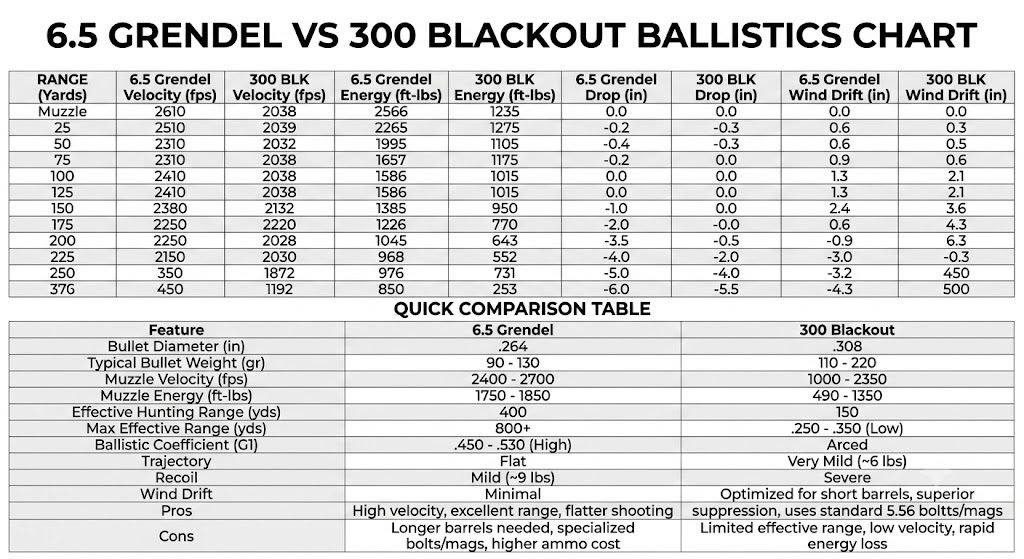
Detailed Ballistics Comparison Chart
Data reflects a 6.5 Grendel firing a 123-grain Hornady SST and a 300 Blackout firing a 110-grain Barnes TAC-TX (supersonic). Both assume a 100-yard zero and a 1.5-inch sight height over bore. Wind drift assumes a 10 mph full-value crosswind.
| Range (Yards) | 6.5 Grendel Velocity (fps) | 300 BLK Velocity (fps) | 6.5 Grendel Energy (ft-lbs) | 300 BLK Energy (ft-lbs) | 6.5 Grendel Drop (in) | 300 BLK Drop (in) | Grendel Wind Drift (in) | 300 BLK Wind Drift (in) |
| Muzzle | 2580 | 2350 | 1818 | 1349 | -1.5 | -1.5 | 0.0 | 0.0 |
| 25 | 2537 | 2270 | 1758 | 1258 | -0.5 | -0.5 | 0.1 | 0.2 |
| 50 | 2494 | 2191 | 1699 | 1173 | -0.1 | 0.0 | 0.3 | 0.5 |
| 75 | 2452 | 2114 | 1642 | 1092 | 0.0 | 0.0 | 0.7 | 1.1 |
| 100 | 2410 | 2038 | 1586 | 1015 | 0.0 | 0.0 | 1.3 | 2.1 |
| 125 | 2368 | 1964 | 1532 | 942 | -0.6 | -1.0 | 2.0 | 3.4 |
| 150 | 2327 | 1891 | 1479 | 874 | -1.7 | -2.6 | 2.9 | 5.0 |
| 175 | 2286 | 1820 | 1427 | 809 | -3.0 | -4.9 | 4.1 | 7.0 |
| 200 | 2245 | 1751 | 1376 | 749 | -4.8 | -7.9 | 5.4 | 9.5 |
| 225 | 2205 | 1684 | 1328 | 693 | -7.0 | -11.7 | 6.9 | 12.3 |
| 250 | 2165 | 1618 | 1280 | 639 | -9.7 | -16.3 | 8.6 | 15.6 |
| 275 | 2125 | 1555 | 1234 | 590 | -12.8 | -21.8 | 10.5 | 19.4 |
| 300 | 2085 | 1494 | 1187 | 545 | -16.4 | -28.3 | 12.6 | 23.6 |
| 350 | 2011 | 1379 | 1104 | 464 | -25.2 | -44.5 | 17.5 | 33.7 |
| 400 | 1937 | 1275 | 1025 | 397 | -36.2 | -65.7 | 23.4 | 46.1 |
| 450 | 1864 | 1182 | 949 | 341 | -49.6 | -92.9 | 30.1 | 60.9 |
| 500 | 1792 | 1103 | 877 | 297 | -65.7 | -127.2 | 37.9 | 78.1 |
Comparison Chart Image
1. Cartridge Overview
The 6.5 Grendel entered the market in 2003, designed by Bill Alexander of Alexander Arms. Engineers sought to push the limits of the AR-15 platform by introducing a cartridge capable of maintaining supersonic flight past 800 yards. By widening the parent .220 Russian case, the design team maximized powder capacity while accommodating long, aerodynamic 6.5mm (.264 caliber) projectiles. The resulting cartridge transformed standard AR-15 rifles into legitimate long-range precision tools and highly effective medium-game hunting platforms.
Conversely, the 300 AAC Blackout emerged in 2011 from a military requirement to create a compact, suppressed weapon system that outperformed the 9mm submachine gun while retaining the manual of arms of the M4 carbine. Advanced Armament Corporation utilized the .223 Remington parent case, shortening it and expanding the neck to accept heavy .308 caliber bullets. This ingenious design allowed shooters to convert any standard 5.56 NATO AR-15 to 300 Blackout simply by swapping the barrel. The 300 Blackout thrives in ultra-short barrels and excels at feeding heavy, subsonic ammunition alongside lighter supersonic loads with zero hardware changes.
2. Key Differences
The core differences between these cartridges lie in their design philosophies and mechanical requirements. The 6.5 Grendel prioritizes aerodynamic efficiency and downrange energy retention. To achieve this, it utilizes a wider case body that demands a proprietary bolt face and specialized magazines. This wider case restricts standard AR-15 magazine capacity slightly, but the trade-off provides the powder capacity necessary to drive high-ballistic-coefficient bullets at substantial velocities.
The 300 Blackout prioritizes modularity, platform compatibility, and close-quarters performance. Because it shares the exact rim dimensions and case taper of the 5.56 NATO cartridge, it requires nothing more than a barrel swap. You retain your standard bolt carrier group, standard magazines, and standard capacity. Furthermore, the 300 Blackout achieves complete powder burn in barrels as short as 9 inches. The 6.5 Grendel requires at least an 18-inch barrel to realize its full ballistic potential, making the associated rifles noticeably longer and heavier.
The 6.5 Grendel dominates as a purpose-built mid-to-long-range ballistic solution. The 300 Blackout dominates as a versatile, short-barreled tactical and brush-hunting cartridge.
3. Velocity Comparison
Velocity numbers heavily favor the 6.5 Grendel at every conceivable distance. Firing a standard 123-grain projectile, the 6.5 Grendel leaves a 20-inch barrel at approximately 2,580 feet per second. Even though the 300 Blackout pushes a lighter 110-grain bullet (its most popular supersonic hunting weight), it only achieves roughly 2,350 fps from a 16-inch barrel.
The initial muzzle velocity gap is significant, but the downrange velocity retention tells the true story. Because 6.5mm bullets possess superior sectional density and extremely high ballistic coefficients, they cut through the air with minimal drag. At 300 yards, the 6.5 Grendel still travels at nearly 2,100 fps. The short, blunt .30-caliber bullet of the 300 Blackout sheds velocity rapidly, dropping below 1,500 fps at the same distance.
Subsonic 300 Blackout loads intentionally leave the muzzle below the speed of sound (around 1,000 fps) and rely solely on bullet mass rather than speed. For standard supersonic applications, the 6.5 Grendel easily wins the velocity comparison, providing the speed necessary for reliable bullet expansion at extended ranges.
4. Energy Comparison
Kinetic energy dictates a bullet’s ability to create a devastating wound channel and ensure ethical harvests on game animals. At the muzzle, the 6.5 Grendel generates roughly 1,818 foot-pounds of energy. The supersonic 300 Blackout generates approximately 1,349 foot-pounds. This initial 500 ft-lb advantage sets a tone that the 300 Blackout cannot overcome.
Most hunting experts recommend a minimum of 1,000 foot-pounds of kinetic energy for ethically harvesting medium game like whitetail deer. The 6.5 Grendel maintains this critical 1,000 ft-lb threshold well past 400 yards, providing hunters with a massive margin of error and exceptional terminal performance.
The 300 Blackout drops below the 1,000 ft-lb threshold at just 125 yards. While it hits hard at close range, its rapidly depleting energy levels restrict its ethical hunting applications to dense brush or tightly confined environments. Heavy subsonic loads deliver even less energy—often mirroring the kinetic energy of a .45 ACP pistol—relying purely on a massive wound channel rather than hydrostatic shock. The 6.5 Grendel wins the energy comparison effortlessly.
5. Trajectory & Bullet Drop Comparison
Shooters demand flat trajectories to minimize the need for complex mathematical holdovers in the field. The 6.5 Grendel delivers one of the flattest trajectories available in the AR-15 platform. Assuming a 100-yard zero, a 123-grain Grendel bullet drops only 4.8 inches at 200 yards and 16.4 inches at 300 yards. A shooter can hold dead center on a deer’s vitals out to 250 yards without touching their elevation dials.
The 300 Blackout exhibits a steeply arced trajectory, often compared to the 7.62x39mm or a traditional lever-action cartridge. With the same 100-yard zero, a supersonic 110-grain 300 Blackout round drops nearly 8 inches at 200 yards and a massive 28.3 inches at 300 yards. Taking a shot at 300 yards with a 300 Blackout requires precise ranging and substantial holdovers, increasing the likelihood of an unethical miss on a live animal.
If you shoot subsonic ammunition, the drop becomes astronomical, plunging dozens of inches at 200 yards. For any application requiring a flat trajectory, the 6.5 Grendel stands as the undeniable winner.
6. Wind Drift Comparison
Wind deflection separates capable long-range cartridges from short-range brush guns. A bullet’s resistance to lateral wind push depends entirely on its ballistic coefficient (BC). Higher BC numbers indicate a more streamlined, aerodynamic profile.
Standard 6.5 Grendel projectiles boast G1 ballistic coefficients north of .500. Standard supersonic 300 Blackout projectiles rarely exceed a .300 BC. This mathematical advantage becomes glaringly obvious in real-world shooting conditions. Assuming a standard 10 mph crosswind, the 6.5 Grendel drifts just 5.4 inches at 200 yards. At the same distance, the 300 Blackout gets blown 9.5 inches off target.
By 400 yards, the wind entirely wrecks the 300 Blackout’s accuracy, pushing the bullet a staggering 46.1 inches off course. The 6.5 Grendel drifts exactly half that amount (23.4 inches). When shooting across canyons, open fields, or windy plains, the 300 Blackout leaves shooters guessing, while the 6.5 Grendel punches through the wind with consistent, predictable precision. The 6.5 Grendel wins the wind drift category by a massive margin.
7. Hunting Performance Comparison
Both cartridges excel at hunting, but they serve entirely different environments. The 300 Blackout is the ultimate brush gun for feral hogs and close-range whitetail deer. Its ability to fire out of short, maneuverable barrels makes it perfect for climbing in and out of tight hunting blinds, navigating thick vegetation, or shooting from vehicles during hog eradication operations. When paired with a suppressor, a subsonic 300 Blackout setup causes minimal disturbance to the surrounding environment, allowing hunters to take multiple hogs from a single sounder.
The 6.5 Grendel serves as a primary open-country hunting tool. It possesses the kinetic energy and flat trajectory required to take whitetail, mule deer, and antelope confidently at 300 to 400 yards. The high sectional density of the 6.5mm bullet ensures deep penetration and consistent expansion, producing devastating wound channels on tough animals. While some hunters successfully use the Grendel on elk at closer ranges, it truly shines as the premier deer cartridge for the AR-15 platform.
The 300 Blackout wins inside 100 yards and in suppressed applications. The 6.5 Grendel wins as a dedicated, all-range hunting cartridge.
8. Accuracy & Long-Range Performance
Precision shooting requires a cartridge capable of sub-MOA groupings and supersonic stability at extreme distances. The 6.5 Grendel possesses inherent accuracy derived from its parent .220 Russian lineage, a cartridge famously used in benchrest shooting competitions. High-quality Grendel factory ammunition frequently prints sub-MOA (less than 1 inch at 100 yards) groups out of factory rifles. Because the bullet stays supersonic past 800 yards, competitive shooters regularly ring steel at 1,000 yards using AR-15s chambered in 6.5 Grendel.
The 300 Blackout was never designed for precision. It operates as a combat-focused cartridge prioritizing reliability and terminal energy at close ranges. While quality rifles can achieve 1 to 1.5 MOA accuracy, the cartridge physically cannot perform at long range. Approaching 400 yards, the 300 Blackout transitions into the transonic flight zone, causing the bullet to destabilize and tumble.
For anything resembling precision marksmanship, PRS competitions, or long-range target shooting, the 6.5 Grendel completely outclasses the 300 Blackout. The Grendel wins the long-range performance category without competition.
9. Pros and Cons
A balanced look at the strengths and weaknesses of each cartridge clarifies their ideal use cases.
6.5 Grendel Pros
- Exceptional long-range ballistics for the AR-15 platform.
- Retains over 1,000 ft-lbs of hunting energy past 400 yards.
- Flat trajectory requires minimal holdovers at standard hunting distances.
- High ballistic coefficients defeat wind drift effectively.
- Inherent mechanical accuracy suitable for precision rifle competitions.
6.5 Grendel Cons
- Requires a specialized bolt face, increasing conversion costs.
- Demands proprietary magazines which can be expensive and occasionally finicky.
- Requires longer barrels (18 to 20 inches) to burn its powder charge effectively.
- Factory ammunition costs generally run higher than standard intermediate cartridges.
300 Blackout Pros
- Requires only a barrel swap to convert a standard 5.56 NATO AR-15.
- Uses standard bolts, standard magazines, and standard lower receivers.
- Achieves maximum powder burn and ballistic efficiency in barrels as short as 9 inches.
- Unrivaled performance when utilizing heavy subsonic ammunition and suppressors.
300 Blackout Cons
- Dismal long-range trajectory with massive bullet drop past 200 yards.
- Rapid kinetic energy loss restricts ethical hunting to close ranges.
- Poor wind resistance due to low-BC projectiles.
- Subsonic hunting loads provide poor expansion, requiring precise shot placement.
10. Which One Should You Choose?
Selecting the right cartridge depends entirely on your environment, target species, and rifle setup.
Best for deer hunting: The 6.5 Grendel wins easily. Its superior energy retention, deeper penetration, and flatter trajectory provide ethical kills at distances the 300 Blackout simply cannot reach.
Best for hog hunting: The 300 Blackout wins. Hog hunting often occurs at night, at close range, and from vehicles. The ability to use a short-barreled, suppressed 300 Blackout allows hunters to maneuver easily and fire rapidly without destroying their hearing.
Best for target shooting: The 6.5 Grendel wins. Punching paper or ringing steel at distances past 200 yards requires the high ballistic coefficient and precision accuracy inherent to the Grendel design.
Best for long range: The 6.5 Grendel wins. The 300 Blackout cannot physically remain stable at long-range distances, whereas the Grendel routinely handles 800-yard engagements.
Best for beginners: The 300 Blackout wins. The extremely mild recoil, combined with the simplicity of using standard AR-15 parts and magazines, makes it an incredibly forgiving platform for new shooters learning the fundamentals.
Best all-around cartridge: The 6.5 Grendel wins. While the 300 Blackout dominates the niche of short-barreled suppressed shooting, the 6.5 Grendel transforms the AR-15 into a true multi-role rifle capable of taking medium game, winning precision matches, and defending property at virtually any practical distance.