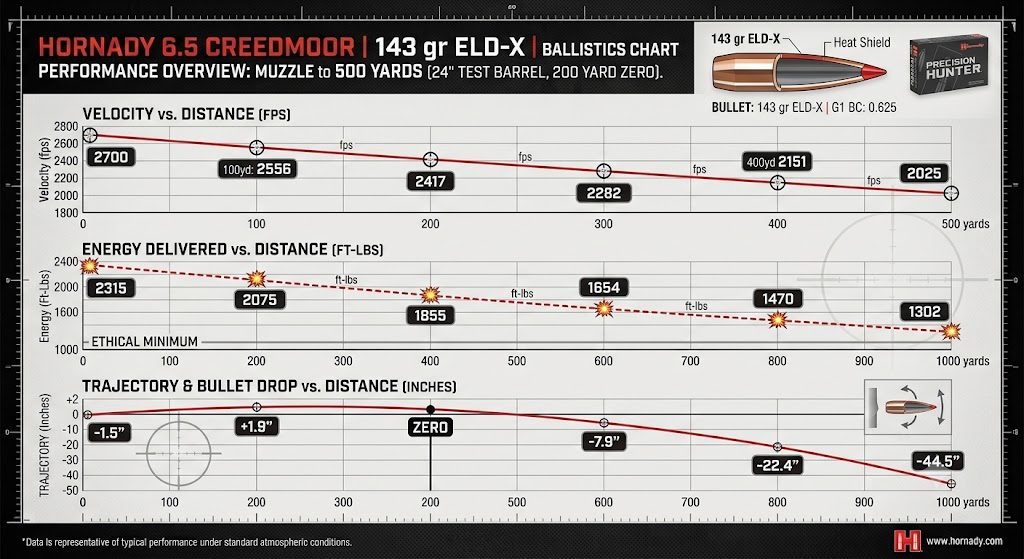
The 6.5 Creedmoor has become a dominant cartridge for precision shooting and medium game hunting, largely due to its high ballistic coefficients, manageable recoil, and remarkably low wind drift. If you are looking for the exact trajectory and performance data to build your dope card, the most critical numbers revolve around how well this cartridge retains velocity and energy at extended distances. Below is the definitive Hornady 6.5 Creedmoor ballistics chart for the highly popular 143-grain ELD-X Precision Hunter load, which features a muzzle velocity of 2,700 feet per second and a G1 ballistic coefficient of 0.625.
Hornady 6.5 Creedmoor Ballistics Chart
Data is based on a 24-inch test barrel and a 200-yard zero.
| Range (Yards) | Velocity (fps) | Energy (ft-lbs) | Trajectory (Inches) |
| Muzzle | 2,700 | 2,315 | -1.5 |
| 100 | 2,556 | 2,075 | +1.9 |
| 200 | 2,417 | 1,855 | 0.0 |
| 300 | 2,282 | 1,654 | -7.9 |
| 400 | 2,151 | 1,470 | -22.4 |
| 500 | 2,025 | 1,302 | -44.5 |
Comprehensive Explanation of the Ballistic Data
Understanding the data in the Hornady 6.5 Creedmoor ballistics chart is essential for making ethical shots on game and scoring consistent hits on steel. The numbers reveal the profound aerodynamic advantages of modern 6.5mm projectiles and how they outperform many traditional hunting calibers.
High Ballistic Coefficient and Velocity Retention
The core advantage of the 143-grain ELD-X bullet is its ability to overcome air resistance. With a G1 ballistic coefficient of 0.625 and a G7 BC of approximately 0.315, the bullet sheds its velocity very slowly. The chart shows that at 500 yards, the projectile is still traveling at 2,025 fps. This incredible velocity retention results in a flatter trajectory, meaning there is far less bullet drop to compensate for at long distances. Furthermore, a bullet that maintains its speed is significantly less affected by crosswinds, minimizing the amount of wind drift you have to account for in the field.
Kinetic Energy and Terminal Performance
For hunters, velocity means very little without sufficient kinetic energy upon impact. A widely accepted benchmark for ethically harvesting deer sized game is 1,000 ft-lbs of retained energy. The Hornady Precision Hunter load is specifically engineered for devastating terminal performance, featuring an InterLock ring that helps maintain 50 to 60 percent weight retention during high velocity, close range impacts.
As the distance increases, the bullet continues to perform reliably. The data indicates that the 143-grain ELD-X carries over 1,300 ft-lbs of energy at 500 yards. In fact, under standard conditions, this bullet does not drop below the 1,000 ft-lb threshold until roughly 700 to 750 yards out. Coupled with a sectional density of 0.293, this ensures deep penetration and a large wound cavity at practically any ethical hunting distance.
Practical Field Application and Barrel Length
It is important to note that the factory velocity of 2,700 fps is achieved using a 24-inch test barrel. If your rifle utilizes a shorter barrel, you will see a reduction in muzzle velocity. A standard rule of thumb is a loss of roughly 25 fps for every inch of barrel removed. While this slightly alters the trajectory, the aerodynamic efficiency of the Hornady ELD-X bullet ensures that even from a shorter barrel, the 6.5 Creedmoor remains an exceptionally capable round for moderate to extended distance engagements.