When comparing the .270 Winchester and the .30-06 Springfield, the main difference comes down to bullet velocity and trajectory versus raw kinetic energy. The direct answer is that the .270 Winchester is the better choice where you need a flatter-shooting, lower-recoil cartridge for long-range precision on medium game like deer or pronghorn. Conversely, the .30-06 Springfield is the superior option where you need heavier bullets and massive stopping power to cleanly take down larger, tougher game like elk, moose, or bear.
Both are legendary long-action hunting cartridges built on the same parent case, but they optimize for slightly different ballistic roles.
Table of Contents [Click to open]
270 vs 30-06 Ballistics Chart Comparison
The following data compares a standard 130-grain .270 Winchester against a 165-grain .30-06 Springfield, which represent the most popular hunting setups for each caliber.
| Specification / Metric | .270 Winchester (130 gr) | .30-06 Springfield (165 gr) |
| Bullet Diameter | .277 inches | .308 inches |
| Max Case Length | 3.34 inches | 3.34 inches |
| Muzzle Velocity | 3,050 ft/s | 2,940 ft/s |
| Velocity @ 100 yds | 2,842 ft/s | 2,731 ft/s |
| Velocity @ 200 yds | 2,643 ft/s | 2,532 ft/s |
| Velocity @ 300 yds | 2,453 ft/s | 2,341 ft/s |
| Velocity @ 400 yds | 2,270 ft/s | 2,158 ft/s |
| Velocity @ 500 yds | 2,096 ft/s | 1,984 ft/s |
| Muzzle Energy | 2,685 ft-lbs | 3,167 ft-lbs |
| Energy @ 100 yds | 2,331 ft-lbs | 2,732 ft-lbs |
| Energy @ 200 yds | 2,016 ft-lbs | 2,348 ft-lbs |
| Energy @ 300 yds | 1,737 ft-lbs | 2,007 ft-lbs |
| Energy @ 400 yds | 1,488 ft-lbs | 1,706 ft-lbs |
| Energy @ 500 yds | 1,268 ft-lbs | 1,442 ft-lbs |
| Bullet Drop @ 300 yds* | -6.4 inches | -7.0 inches |
| Bullet Drop @ 500 yds* | -37.8 inches | -42.2 inches |
| Recoil Energy | 17.1 ft-lbs | 20.1 ft-lbs |
| Recoil Velocity | 11.7 ft/s | 12.7 ft/s |
| Ideal Game Size | Deer, Sheep, Pronghorn | Elk, Moose, Bear |
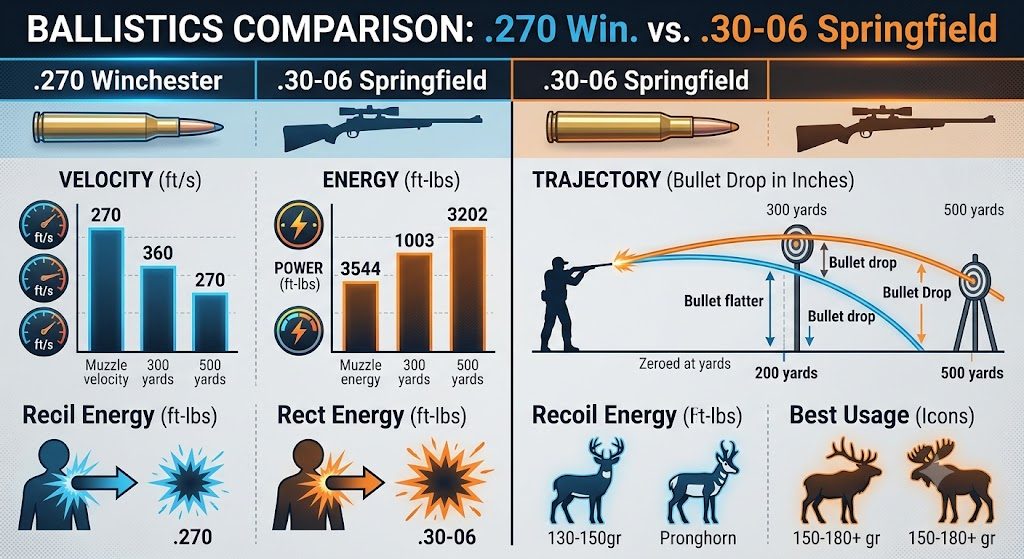
Explaining the Comparison
While these cartridges look very similar side-by-side, their on-paper differences translate to distinct experiences in the field. Here is how those numbers actually impact your hunt.
Velocity and Trajectory
Because the .270 Winchester uses a lighter bullet (typically 130 to 150 grains) pushed by a similar powder charge, it leaves the muzzle moving roughly 110 ft/s faster than the heavier .30-06.
This speed gives the .270 a distinct advantage in trajectory. A lighter, faster bullet doesn’t drop as quickly due to gravity. If you zero both rifles at 200 yards, a standard .270 will drop about 37.8 inches at 500 yards, whereas the .30-06 will drop around 42.2 inches. If you frequently hunt in open plains or mountainous regions where long-range shots are the norm, the .270 makes calculating bullet drop slightly more forgiving.
Kinetic Energy and Stopping Power
What the .30-06 gives up in speed, it more than makes up for in pure power. Out of the muzzle, the .30-06 generates nearly 500 ft-lbs more kinetic energy than the .270.
While the aerodynamic shape of the .270 helps it retain energy well over distance, the .30-06 maintains a lead at every single yardage marker. Even at 500 yards, the .30-06 delivers an extra 174 ft-lbs of energy. This deep penetration and high energy transfer are exactly why the .30-06 is trusted for North America’s largest and toughest game.
Recoil and Shooter Fatigue
The heavier bullets and higher energy of the .30-06 come at a physical cost: more recoil. The .30-06 produces about 20.1 ft-lbs of recoil energy, compared to the milder 17.1 ft-lbs of the .270.
While a 3 ft-lb difference might not sound massive, it is noticeable—especially in lightweight backcountry hunting rifles. For newer shooters, smaller-framed hunters, or anyone looking to ensure they do not develop a “flinch” when pulling the trigger, the .270 is a much more comfortable rifle to shoot accurately.
Versatility and Ammunition
Both rounds are chambered in long-action rifles and have incredible ammunition availability, but their versatility shines in different ways.
- The .270 Winchester is a specialized precision tool. It typically utilizes bullets in the 130–150 grain range, making it a masterclass cartridge for whitetail deer, mule deer, sheep, and pronghorn.
- The .30-06 Springfield is the ultimate generalist. Because it can handle massive variations in bullet weight—ranging from lightweight 150-grain rounds for deer all the way up to heavy 220-grain rounds for bears—it allows a hunter to tailor their loadout for nearly any animal on the planet using a single rifle.