The 9x19mm Parabellum is the most popular handgun cartridge in the world. But as Pistol Caliber Carbines (PCCs) and AR-9 platforms have surged in popularity, a common question arises: how does barrel length affect 9mm ballistics?
Unlike rifle calibers (like 5.56 NATO) that continuously gain massive velocity out to 20+ inches, 9mm behaves very differently. Because it is designed for short pistol barrels, it uses fast-burning powder. This means it reaches its peak velocity much earlier, and adding more barrel length eventually results in diminishing and even negative returns.
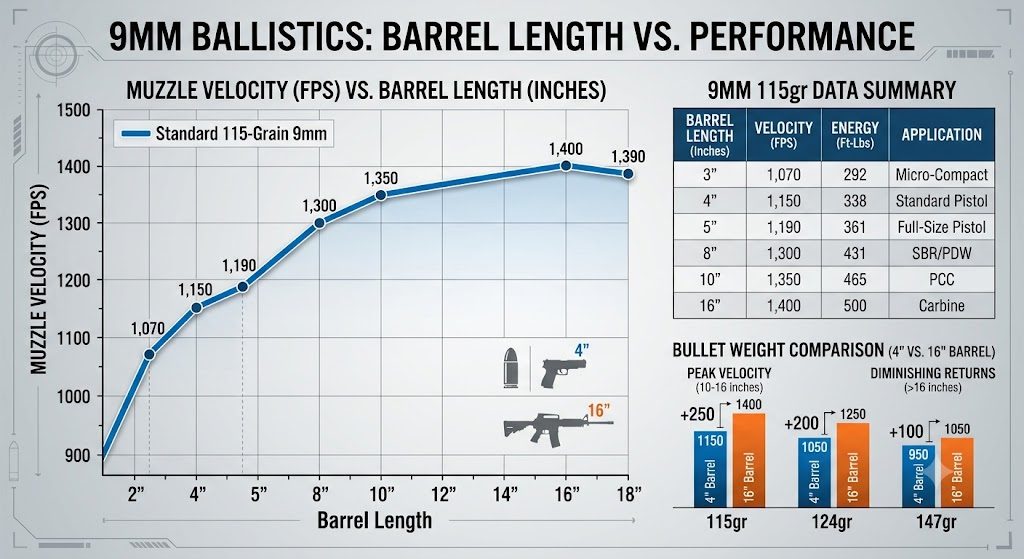
Here is a quick-reference chart showing how a standard 115-grain 9mm load performs as barrel length increases:
| Barrel Length | Avg. Velocity (fps) | Avg. Energy (ft-lbs) | Common Application |
| 3 inches | 1,070 | 292 | Micro-compact carry pistol |
| 4 inches | 1,150 | 338 | Standard duty pistol |
| 5 inches | 1,190 | 361 | Full-size / competition pistol |
| 8 inches | 1,300 | 431 | Home defense PDW / SBR |
| 10 inches | 1,350 | 465 | Short-barreled PCC |
| 16 inches | 1,400 | 500 | Standard legal carbine |
The Physics of 9mm and Barrel Length
When the primer ignites the powder in a cartridge, it creates rapidly expanding, high-pressure gas that pushes the bullet down the barrel. As long as that gas pressure pushing forward is greater than the friction of the barrel pushing backward, the bullet accelerates.
Because 9mm uses fast-burning powder, almost all of the propellant is completely burned within the first few inches. Once the powder is burned, the expanding gases start to cool and lose pressure. If the barrel is too long, the friction of the rifling will eventually overcome the gas pressure, and the bullet will actually start slowing down before it exits the muzzle.
Use this interactive tool to visualize the exact velocity curve across different bullet weights:
Performance Tiers by Barrel Length
While actual velocities vary slightly based on the specific ammunition brand, here is what you can expect in practical terms as you move up in size.
3 to 4 Inches: The Handgun Standard
- The Breakdown: The 4-inch barrel is the industry standard for 9mm ballistics testing. At this length, the round achieves its intended velocity for reliable hollow-point expansion. Shorter 3-inch “micro-compact” barrels sacrifice about 50–80 fps, resulting in slightly less energy and more muzzle flash, but remain highly effective for self-defense at close range.
5 to 8 Inches: The Sweet Spot
- The Breakdown: Moving from a 4-inch pistol to an 8-inch carbine yields the most significant performance jump you will see in 9mm. You gain roughly 150 to 200 fps. This translates to a noticeably flatter trajectory and harder-hitting terminal energy. The powder fully burns in this range, making it incredibly efficient while keeping the weapon compact enough to maneuver through tight spaces.
10 to 16 Inches: Diminishing Returns
- The Breakdown: Pushing past 10 inches gives you very little extra speed. The difference in velocity between a 10-inch barrel and a 16-inch barrel is often less than 70 fps. Most shooters opt for a 16-inch barrel simply to avoid the ATF paperwork and tax stamp required for a Short Barreled Rifle (SBR), not for the ballistic advantage. The primary benefits here are a longer sight radius for iron sights, less felt recoil, and improved shooting stability.
17+ Inches: Hitting the Brakes
If you use a barrel longer than 16 or 17 inches, the friction of the barrel begins to work against the bullet. Chronograph tests consistently show that 9mm velocity peaks right around 16 inches and will actually decrease slightly in an 18-inch or 20-inch barrel.
How Bullet Weight Factors In
The weight of the projectile heavily influences how much it benefits from a longer barrel.
| Bullet Weight | Typical Handgun (4″) | Typical Carbine (16″) | Carbine Velocity Gain |
| 115-grain (Light) | 1,150 fps | 1,400 fps | +250 fps |
| 124-grain (Standard) | 1,050 fps | 1,250 fps | +200 fps |
| 147-grain (Heavy/Subsonic) | 950 fps | 1,050 fps | +100 fps |
Key insight: Heavy 147-grain bullets are usually designed to be subsonic (traveling slower than the speed of sound, which is ~1,125 fps). Because they use smaller charges of specific powders, they gain very little velocity in a carbine. This makes them ideal for suppressed PCCs, as they stay quiet even out of longer barrels without breaking the sound barrier.