The 9mm Luger (9x19mm Parabellum) is undeniably the most popular handgun cartridge in the world. However, in recent years, it has found a permanent and highly effective home in Pistol Caliber Carbines (PCCs). When you take a cartridge that was meticulously optimized for a 4-inch pistol barrel and run it through a full 16-inch rifle barrel, the ballistic profile changes in dramatic and fascinating ways.
Because pistol powder is formulated to burn extremely quickly, a 9mm bullet reaches its maximum velocity long before it ever sees the end of a 16-inch barrel. Despite this, the extra time spent confined within the barrel, propelled by expanding gasses, provides a substantial and measurable boost to muzzle velocity. This velocity increase effectively flattens the bullet’s trajectory, drastically increases kinetic energy on the target, and extends the effective range of the cartridge.
If you are building, buying, or simply researching a 9mm carbine, understanding exactly how different loads perform is critical.
9mm Ballistics Chart (16-Inch Barrel Maximum Data)
Below is a comprehensive ballistics chart featuring maximum data for various popular 9mm loads when fired through a 16-inch barrel.
(Note: Exact ballistics will always vary slightly based on environmental conditions, temperature, elevation, and the specific tolerances of your firearm’s chamber and rifling. A 50-yard zero is assumed for the drop data below).
| Ammunition Brand & Line | Bullet Wt (gr) | Type | Muzzle Vel (fps) | Muzzle Energy (ft-lbs) | 50 Yd Vel (fps) | 50 Yd Drop (in) | 100 Yd Vel (fps) | 100 Yd Drop (in) |
| Federal American Eagle | 115 | FMJ | 1,350 | 465 | 1,180 | 0.0 | 1,050 | -4.8 |
| Winchester White Box | 115 | FMJ | 1,340 | 458 | 1,175 | 0.0 | 1,045 | -4.9 |
| Blazer Brass | 115 | FMJ | 1,320 | 445 | 1,160 | 0.0 | 1,035 | -5.1 |
| Sellier & Bellot | 115 | FMJ | 1,380 | 486 | 1,205 | 0.0 | 1,065 | -4.5 |
| Fiocchi Range Dynamics | 115 | FMJ | 1,335 | 455 | 1,170 | 0.0 | 1,040 | -5.0 |
| Magtech | 115 | FMJ | 1,365 | 476 | 1,195 | 0.0 | 1,058 | -4.6 |
| Speer Lawman | 115 | TMJ | 1,345 | 462 | 1,178 | 0.0 | 1,048 | -4.8 |
| Hornady Critical Defense | 115 | FTX | 1,310 | 438 | 1,152 | 0.0 | 1,028 | -5.2 |
| Federal HST | 124 | JHP | 1,300 | 465 | 1,150 | 0.0 | 1,038 | -5.1 |
| Speer Gold Dot | 124 | JHP | 1,315 | 476 | 1,162 | 0.0 | 1,045 | -4.9 |
| Winchester NATO (Mil-Spec) | 124 | FMJ | 1,375 | 520 | 1,215 | 0.0 | 1,085 | -4.2 |
| Blazer Brass | 124 | FMJ | 1,280 | 451 | 1,135 | 0.0 | 1,025 | -5.4 |
| Sellier & Bellot | 124 | FMJ | 1,325 | 483 | 1,170 | 0.0 | 1,050 | -4.8 |
| Federal American Eagle | 124 | FMJ | 1,290 | 458 | 1,142 | 0.0 | 1,030 | -5.3 |
| Hornady XTP | 124 | JHP | 1,270 | 444 | 1,128 | 0.0 | 1,020 | -5.5 |
| Underwood +P | 124 | JHP | 1,450 | 579 | 1,275 | 0.0 | 1,135 | -3.6 |
| Federal HST | 147 | JHP | 1,130 | 417 | 1,035 | 0.0 | 960 | -7.2 |
| Speer Gold Dot | 147 | JHP | 1,145 | 428 | 1,048 | 0.0 | 970 | -6.9 |
| Blazer Brass | 147 | FMJ | 1,100 | 395 | 1,012 | 0.0 | 945 | -7.7 |
| Winchester Defender | 147 | JHP | 1,120 | 409 | 1,028 | 0.0 | 955 | -7.4 |
| Sellier & Bellot | 147 | FMJ | 1,155 | 435 | 1,055 | 0.0 | 975 | -6.7 |
| Hornady Custom | 147 | XTP | 1,115 | 406 | 1,025 | 0.0 | 952 | -7.5 |
| Federal Syntech Action | 150 | TSJ | 1,050 | 367 | 975 | 0.0 | 915 | -8.8 |
| Underwood +P+ | 115 | JHP | 1,550 | 613 | 1,350 | 0.0 | 1,190 | -2.8 |
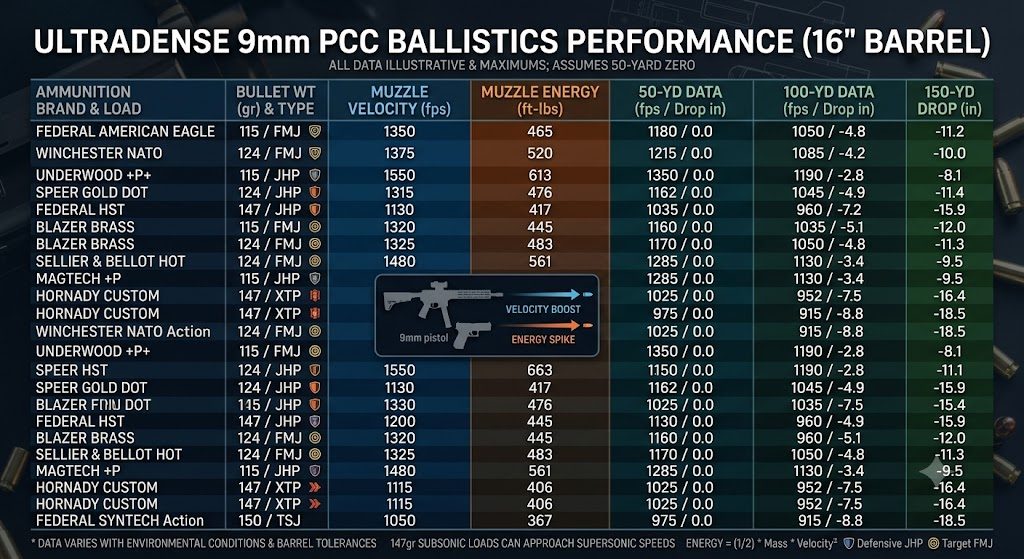
How a 16-Inch Barrel Changes the Physics of 9mm
When you transition from a standard handgun to a full-length carbine, the math changes in your favor.
The core principle at play here is kinetic energy. The formula for kinetic energy is simply: Energy = 1/2 x Mass x Velocity^2. Because velocity is squared in this calculation, even a modest increase in the speed of the bullet results in a massive increase in the destructive energy delivered to the target.
Here is what you can generally expect when moving up to a 16-inch platform:
- Significant Velocity Increases: Standard pressure 115-grain and 124-grain loads typically see a jump of 150 to 200 feet per second (fps) compared to handgun data.
- Massive Energy Spikes: A 15% increase in velocity can easily yield a 30% increase in muzzle energy. A standard 115-grain 9mm bullet might produce a modest 350 foot-pounds of energy from a Glock 19, but that exact same cartridge can push over 450 foot-pounds out of an AR-9.
- The Supersonic Shift: The speed of sound is roughly 1,125 fps at sea level. Heavy 147-grain bullets are usually favored by suppressor owners because they stay below this threshold in handguns. However, the extra velocity of a 16-inch barrel can sometimes push these heavy rounds just over the edge into supersonic territory, resulting in a loud sonic crack.
- Extended Effective Range: The extra velocity means the bullet reaches the target faster, giving gravity less time to pull it down. A 9mm fired from a carbine will drop several inches less at 100 yards than the exact same round fired from a handgun, turning the 9mm into a highly capable 100-yard to 125-yard platform.
Analyzing the Data by Bullet Weight
When looking closely at the data in the chart, distinct ballistic trends emerge based on the weight of the projectile you choose to run. Selecting the right bullet weight is the most important decision you can make for your specific use case.
115-Grain: The Speed Demon
The 115-grain bullet is the lightest standard 9mm projectile widely available. Because it lacks mass, the expanding gasses in a long barrel can accelerate it incredibly fast. Factory 115-grain ammunition easily surpasses 1,300 fps in a PCC, with hotter European loads (like Sellier & Bellot) pushing close to 1,400 fps.
This results in the absolute flattest trajectory available for the caliber. If your goal is plinking or ringing steel out to 100 yards with minimal holdover, 115-grain is the way to go. The tradeoff is that because the bullet is light, it sheds its velocity (and its energy) much faster than heavier bullets as it travels downrange.
124-Grain: The Goldilocks Round
The 124-grain bullet offers what many consider to be the perfect balance of velocity and mass. It hits hard, flies relatively flat, and penetrates deeply. Military NATO specification 124-grain ammo is naturally loaded to higher pressures (essentially functioning as +P ammo) and screams out of a 16-inch barrel at almost 1,400 fps. This generates over 500 foot-pounds of energy, effectively pushing the 9mm deep into traditional .357 Magnum territory.
For home defense or duty use in a PCC, a premium 124-grain jacketed hollow point (JHP) is generally considered the optimal choice. The high carbine velocity ensures aggressive, reliable expansion of the hollow point cavity upon impact.
147-Grain: The Heavyweight
Heavier bullets are intentionally designed to be slow. While a standard pistol will fire a 147-grain bullet at roughly 950 to 1,000 fps, a 16-inch barrel will push it up to around 1,100 to 1,150 fps.
This puts the shooter in a critical velocity zone. Because the speed of sound is approximately 1,125 fps, a 147-grain bullet fired from a 16-inch barrel might go supersonic depending on your local altitude and temperature. If you are running a suppressor and want guaranteed, whisper-quiet subsonic performance from a 16-inch barrel, standard 147-grain might occasionally give you a loud sonic crack. You may need to step up to specialty 150-grain (like Federal Syntech) or 158-grain ammunition to ensure the round stays subsonic. Furthermore, because of their slow speed, 147-grain bullets drop significantly more at 100 yards—usually around 7 to 8 inches—requiring a much higher holdover on your optic.
Conclusion: Maximizing the 9mm Carbine
The 9mm cartridge is inherently limited by its small powder capacity, but a 16-inch barrel squeezes every last drop of potential out of the casing. By reviewing the data above, you can perfectly tailor your ammunition choice to your specific needs. Whether you need the flat-shooting speed of a 115-grain FMJ for a weekend competition, the bone-crushing energy of a 124-grain +P for defense, or the heavy, quiet thud of a 150-grain subsonic round for suppressed target shooting, the 9mm PCC is one of the most versatile firearms you can own.