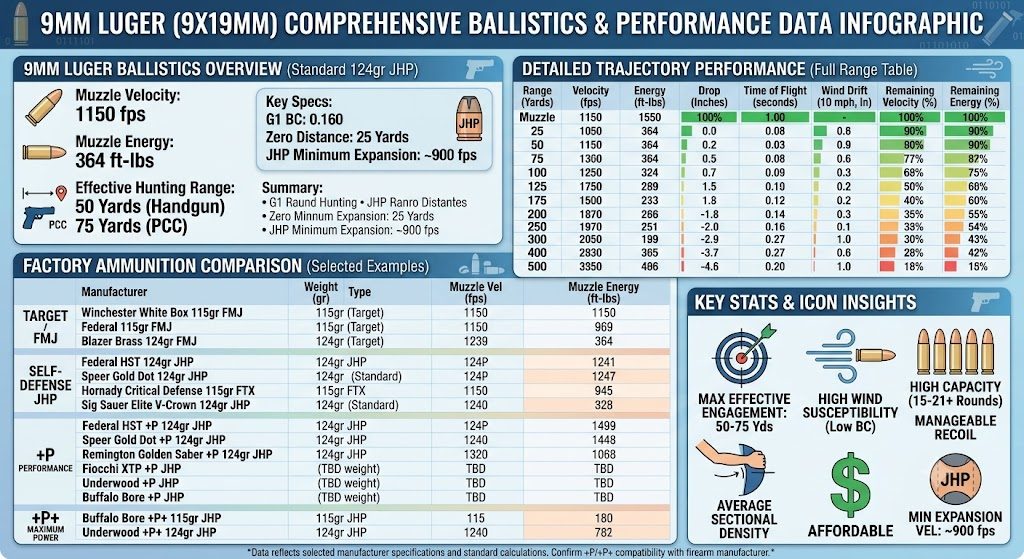
The 9mm Luger (9x19mm) is the most heavily utilized centerfire handgun cartridge globally. Based on a standard 124-grain Jacketed Hollow Point (JHP) factory load fired from a 4-inch handgun barrel, it produces a muzzle velocity of 1,150 fps and a muzzle energy of 364 ft-lbs. The effective hunting range is strictly limited to 50 yards for handguns and up to 75 yards when fired from a Pistol Caliber Carbine (PCC). While engineered primarily for personal defense and tactical applications rather than traditional field sports, shooters can use the 9mm effectively on coyotes, small predators, and very close-range wild hogs when utilizing appropriate heavy-bonded or monolithic solid ammunition. Overall, the 9mm delivers an exceptional balance of manageable recoil, high magazine capacity, and reliable short-range terminal performance.
9mm Ballistics Chart
To provide a complete picture of 9mm performance, this section includes two comprehensive tables. The first details the extended downrange trajectory of a standard 124-grain load. The second compares the muzzle velocity and energy across the most popular factory ammunition brands.
9mm Trajectory and Downrange Performance
| Range (Yards) | Velocity (fps) | Energy (ft-lbs) | Drop (inches) | Time of Flight (seconds) | Wind Drift (10 mph) | Remaining Velocity (%) | Remaining Energy (%) |
| Muzzle | 1150 | 364 | -1.5 | 0.000 | 0.0 | 100.0 | 100.0 |
| 25 | 1068 | 314 | 0.0 | 0.068 | 0.4 | 92.8 | 86.2 |
| 50 | 1004 | 277 | -1.0 | 0.141 | 1.4 | 87.3 | 76.1 |
| 75 | 951 | 249 | -4.0 | 0.218 | 3.0 | 82.7 | 68.4 |
| 100 | 906 | 226 | -9.2 | 0.299 | 5.3 | 78.7 | 62.1 |
| 125 | 866 | 206 | -16.9 | 0.384 | 8.1 | 75.3 | 56.6 |
| 150 | 830 | 190 | -27.3 | 0.472 | 11.4 | 72.1 | 52.2 |
| 175 | 797 | 175 | -40.6 | 0.565 | 15.3 | 69.3 | 48.1 |
| 200 | 767 | 162 | -56.9 | 0.661 | 19.6 | 66.7 | 44.5 |
| 250 | 712 | 140 | -100.8 | 0.865 | 29.8 | 61.9 | 38.4 |
| 300 | 664 | 121 | -161.4 | 1.083 | 41.5 | 57.7 | 33.2 |
| 400 | 582 | 93 | -341.2 | 1.564 | 68.8 | 50.6 | 25.5 |
| 500 | 512 | 72 | -623.5 | 2.112 | 100.2 | 44.5 | 19.7 |
- Zero Distance: 25 yards
- Bullet BC: 0.160 (G1)
- Bullet Weight: 124 grains
- Bullet Type: Jacketed Hollow Point (JHP)
- Barrel Length: 4.0 inches (Standard Handgun)
- Sight Height: 1.5 inches
Factory Ammunition Comparison (Muzzle Velocity & Energy)
(Data reflects manufacturer published specifications. Always verify firearm +P or +P+ compatibility with the manufacturer before use.)
| Manufacturer | Bullet Type | Weight (gr) | Muzzle Velocity (fps) | Muzzle Energy (ft-lbs) |
| Federal | FMJ (Target) | 115 | 1180 | 356 |
| Federal | Tactical HST JHP | 124 | 1150 | 364 |
| Federal | Tactical HST +P JHP | 124 | 1200 | 396 |
| Federal | Tactical HST JHP | 147 | 1000 | 326 |
| Speer | Gold Dot JHP | 115 | 1210 | 374 |
| Speer | Gold Dot JHP | 124 | 1150 | 364 |
| Speer | Gold Dot +P JHP | 124 | 1220 | 410 |
| Speer | Gold Dot JHP | 147 | 985 | 317 |
| Hornady | Critical Defense FTX | 115 | 1030 | 271 |
| Hornady | Custom XTP JHP | 124 | 1110 | 339 |
| Hornady | Custom XTP JHP | 147 | 975 | 310 |
| Winchester | White Box FMJ | 115 | 1190 | 362 |
| Winchester | Ranger T-Series JHP | 147 | 990 | 320 |
| Winchester | Ranger T-Series +P+ | 127 | 1250 | 441 |
| Sig Sauer | Elite V-Crown JHP | 115 | 1185 | 359 |
| Sig Sauer | Elite V-Crown JHP | 124 | 1165 | 374 |
| Sig Sauer | Elite V-Crown JHP | 147 | 985 | 317 |
| Remington | UMC MC (FMJ) | 115 | 1135 | 329 |
| Remington | Golden Saber JHP | 124 | 1125 | 349 |
| Remington | Golden Saber +P JHP | 124 | 1180 | 384 |
| CCI Blazer | Brass JHP | 115 | 1145 | 323 |
| CCI Blazer | Brass JHP | 124 | 1090 | 327 |
| Buffalo Bore | +P+ JHP | 115 | 1400 | 500 |
| Buffalo Bore | +P+ JHP | 124 | 1300 | 461 |
| Underwood | +P+ Gold Dot JHP | 115 | 1400 | 501 |
| Underwood | +P+ Gold Dot JHP | 124 | 1300 | 465 |
| Cor-Bon | +P JHP | 115 | 1350 | 466 |
| Fiocchi | XTP JHP | 115 | 1245 | 395 |
| Magtech | FMJ | 115 | 1135 | 330 |
1. Overview of the Ammunition
The 9x19mm Parabellum, universally known as the 9mm Luger, is a rimless, tapered pistol cartridge originally designed by Georg Luger in 1901. The primary ballistics chart above reflects a modern 124-grain Jacketed Hollow Point (JHP) factory load, which serves as the standard bullet weight favored by NATO forces and modern law enforcement agencies across the globe. This specific bullet construction utilizes a skived copper jacket heavily bonded to a soft lead core, engineered to expand reliably upon impact while maintaining sufficient weight retention for adequate tissue penetration.
Standard pressure factory ammunition operates strictly within the SAAMI maximum pressure specification of 35,000 psi. While higher-pressure +P (38,500 psi) and +P+ variants exist to drive velocities higher, standard pressure 124-grain loads offer an optimal equilibrium between mechanical wear on the firearm, recoil management, and terminal ballistics.
Shooters typically deploy this ammunition in standard 4-inch to 5-inch service pistols like the Glock 19, Sig Sauer P320, or Smith & Wesson M&P. Additionally, the cartridge sees widespread adoption in Pistol Caliber Carbines (PCCs) such as the Ruger PC Carbine or various AR-9 platforms. Firing this cartridge from a 16-inch carbine barrel drastically alters the ballistic profile, burning the powder completely and adding significant speed to the projectile.
2. Understanding the Ballistics Chart
Reading a pistol ballistics chart requires translating mathematical data into practical shooting applications. The Range column dictates the distance from the muzzle. Because the 9mm is a pistol cartridge, data provided beyond 100 yards—extending out to 500 yards in this chart—serves primarily to illustrate the severe limitations of the projectile rather than suggest ethical engagement distances.
The Velocity and Energy columns track the speed and kinetic force of the bullet as it travels downrange. These represent the most critical metrics for hunters and self-defense practitioners. JHP bullets require a specific minimum velocity threshold, usually around 900 fps, to force the mechanical expansion of the hollow point cavity upon impact.
Bullet Drop illustrates the physical path of the projectile relative to the line of sight. Utilizing a 25-yard zero and a 1.5-inch sight height typical of iron sights or low-mounted red dots, shooters can anticipate precise impact points. Time of Flight and Wind Drift reveal how environmental factors influence the bullet. A slow-moving projectile spends more time exposed to crosswinds, pushing the bullet off course rapidly. The Remaining Velocity percentages offer a stark visual representation of how quickly blunt pistol bullets lose their mechanical capability.
3. Velocity Performance
Muzzle velocity for a standard 124-grain 9mm load sits right at the supersonic threshold, clocking in at 1,150 fps from a 4-inch barrel. Because the speed of sound is approximately 1,125 fps at sea level under standard atmospheric conditions, this bullet starts its journey creating a sharp sonic crack. However, due to the blunt, non-aerodynamic shape of pistol bullets—reflected in a terribly low G1 ballistic coefficient of 0.160—velocity retention proves exceptionally poor.
By the time the bullet reaches 25 yards, it has already dropped to 1,068 fps, transitioning into the subsonic flight regime. This rapid deceleration causes the bullet to shed over 7% of its velocity within the first 75 feet of travel. Unlike bottleneck rifle cartridges firing high-BC bullets that suffer severe accuracy degradation as they cross the transonic barrier, round-nose and hollow-point pistol bullets handle this transition relatively smoothly due to their short, squat physical dimensions.
Downrange speed directly dictates terminal performance. At 100 yards, the bullet travels at just 906 fps. Many modern defensive hollow points are engineered to expand at lower velocities, but dropping below 900 fps drastically increases the risk of the hollow point cavity failing to open. When expansion fails, the bullet acts identically to a full metal jacket, over-penetrating the target and reducing tissue damage.
4. Energy Performance
Muzzle energy for this standard 9mm load measures 364 ft-lbs. In the realm of defensive handgun cartridges, this represents a highly effective baseline, offering significantly more energy than a .380 ACP but slightly less than full-power .40 S&W or .45 ACP loads. Kinetic energy in pistol calibers does not produce the massive hydrostatic shock characteristic of high-velocity rifle cartridges. Instead, energy in a 9mm is utilized exclusively to drive the bullet through dense tissue, crush bone, and force the physical expansion of the hollow point cavity.
Retained energy falls off sharply as the bullet moves downrange. At 50 yards, the 124-grain bullet retains 277 ft-lbs of energy, representing a 24% loss from the muzzle. By 100 yards, the energy drops to a meager 226 ft-lbs, which is roughly equivalent to the muzzle energy of a micro-compact .380 pocket pistol.
Knockdown capability remains a persistent myth in handgun ballistics. The 9mm relies entirely on precise shot placement and mechanical tissue disruption. For hunting applications, a minimum of 300 ft-lbs of energy is widely recommended for small deer species to ensure adequate penetration through the shoulder and into the vital organs. The standard 9mm load falls below this critical 300 ft-lbs threshold shortly after passing the 25-yard mark, underscoring its severe limitations as a medium-game hunting cartridge.
5. Trajectory and Bullet Drop
Pistol bullets follow a rainbow-like trajectory compared to modern rifle cartridges. Assuming a standard handgun sight height of 1.5 inches over the bore axis and a zero distance of 25 yards, the bullet path remains surprisingly flat for the first 50 yards of flight. The bullet starts 1.5 inches low at the muzzle, crosses the line of sight at exactly 25 yards, and drops only 1.0 inch at 50 yards. For defensive and practical pistol shooting, this allows for a center-mass hold without any thought required for elevation adjustments.
Beyond 50 yards, the trajectory steepens dramatically due to gravity acting on a slow-moving, low-BC projectile. At 75 yards, the drop measures 4.0 inches. At 100 yards, the bullet drops 9.2 inches. To successfully strike a standard 10-inch steel plate at 100 yards with a handgun, a shooter must aim near the top edge of the target.
Long-range limitations become glaringly apparent and bordering on the absurd past 100 yards. At 200 yards, the bullet falls nearly five feet (56.9 inches). By 500 yards, the bullet has dropped an astonishing 623.5 inches—over 50 feet. While skilled shooters can walk 9mm rounds onto distant steel targets using aggressive holdovers and spotters, the cartridge lacks the flat trajectory required for ethical hunting or predictable first-round hits at these extended distances.
6. Wind Drift Performance
Wind deflection represents one of the most underappreciated aspects of pistol ballistics. Because handguns are primarily fired at distances inside 25 yards, most shooters never calculate crosswind effects. However, for hunters using a PCC or shooters engaging in longer-range practical matches, wind drift severely compromises accuracy and terminal placement.
A 10 mph full-value crosswind barely affects the 9mm at 25 yards, pushing it just 0.4 inches laterally off the center of the target. But because wind drift is mathematically tied to the time of flight and the ballistic coefficient, the low-BC 9mm bullet suffers rapidly as distance increases. The bullet takes almost 0.3 seconds to reach 100 yards. During that flight time, a 10 mph wind will push the 124-grain projectile 5.3 inches off course.
Practical field implications are significant for small game hunters. If a shooter takes a 75-yard shot at a coyote in a brisk crosswind, the bullet will drift 3.0 inches. Combined with a 4.0-inch vertical drop, the margin of error on a small vital zone evaporates entirely. Shooters pushing the 9mm beyond 50 yards must practice reading mirage and vegetation to compensate for wind, treating 100-yard pistol shots with the same environmental respect required for 500-yard rifle shots.
7. Effective Hunting Range
The 9mm Luger is a dedicated combat and self-defense cartridge, not a traditional hunting round. However, its immense popularity, affordability, and the rise of Pistol Caliber Carbines mean it frequently finds its way into the woods for practical applications.
Deer: The 9mm remains highly marginal for whitetail deer. Shooters should only attempt this with specialized monolithic copper solids or heavy bonded bullets (like the 147-grain Speer Gold Dot) that guarantee deep penetration. Factory 115-grain or standard 124-grain defense loads lack the sectional density required to reliably defeat deer shoulder bones. Shots must remain strictly under 35 yards.
Hogs: Wild hogs possess thick hides and dense gristle shields that rapidly stop expanding pistol bullets. A 9mm serves well for dispatching trapped hogs or taking very close-range (under 25 yards) shots on smaller meat pigs. It lacks the kinetic energy to anchor large, mature boars reliably unless the shooter executes a perfect central nervous system (CNS) brain or spine shot.
Black Bear and Elk: The 9mm is entirely inadequate for elk and black bear hunting. Firing this cartridge at large, thick-skinned, or dangerous game is unethical and dangerous, as it lacks both the penetration and terminal energy required for clean, humane kills. The maximum ethical range for the 9mm on medium game is 35 yards, extending to 75 yards only for small predators like coyotes when utilizing a carbine.
8. Accuracy and Real-World Performance
Factory 9mm ammunition is manufactured to incredibly high tolerances in modern facilities. Most premium 124-grain JHP loads are mechanically capable of producing 2-inch to 3-inch groups at 25 yards when fired from a machine rest. In real-world performance, the limiting factor for handgun accuracy is almost entirely the shooter’s ability to manage the heavy trigger pull and properly align the short sight radius under stress.
When transitioning to a Pistol Caliber Carbine, accuracy expectations change dramatically. A quality 16-inch AR-9 firing this factory load will typically yield 2 to 4 MOA (Minute of Angle) precision at 100 yards, translating to 2-inch to 4-inch groups. The increased sight radius, multiple points of physical contact, and heavier weight of a rifle platform allow the shooter to maximize the mechanical accuracy of the cartridge.
Barrel length plays a significant role in real-world ballistics. While the charts reflect a 4-inch handgun barrel, a 16-inch carbine barrel allows for a more complete combustion of the fast-burning pistol powder. This typically results in a muzzle velocity increase of 10% to 15%, pushing the 124-grain bullet closer to 1,300 fps. This added velocity flattens the trajectory out to 75 yards and guarantees reliable hollow-point expansion at slightly longer distances.
9. Advantages and Limitations
The primary strength of the 9mm Luger lies in its extreme efficiency. It provides exceptional terminal performance inside 25 yards while maintaining low recoil, allowing shooters of all sizes to execute rapid, accurate follow-up shots. The compact dimensions of the cartridge permit modern double-stack magazines to hold 15 to 21 rounds, offering massive sustained firepower in a lightweight package. Furthermore, vast economies of scale make 9mm factory ammunition highly affordable and universally available, encouraging high-volume training.
The limitations of the cartridge stem entirely from its geometry and limited powder capacity. The blunt projectile design results in a terrible ballistic coefficient, meaning the bullet bleeds velocity and kinetic energy rapidly the moment it leaves the muzzle. It proves highly susceptible to wind drift and features a steep, looping trajectory past 75 yards.
In practical scenarios, the 9mm excels in home defense, concealed carry, close-quarters law enforcement applications, and dense brush hunting for small predators. It fails completely in open-field hunting scenarios, long-range engagements, or any application requiring the penetration of heavy bone on large game animals, where a proper bottleneck rifle cartridge like the .308 Winchester or 6.5 Creedmoor is strictly required.
10. Who Should Choose This Ammunition?
The 124-grain 9mm JHP is the definitive, uncompromising choice for the modern concealed carrier, home defender, and law enforcement officer. It strikes the perfect ballistic balance between the higher velocities of lightweight 115-grain bullets and the deeper penetration of subsonic 147-grain loads. Anyone relying on a striker-fired compact pistol for personal protection is exceptionally well-served by this specific ammunition profile.
Ideal hunters for this cartridge are those conducting short-range pest control or small predator management on rural properties, specifically when utilizing a suppressed Pistol Caliber Carbine. Recommended shooting distances for any live target should strictly remain inside 50 yards to ensure humane terminal performance and respect for the animal.
When compared to similar factory loads, the 9mm offers distinct overall value. It boasts significantly more stopping power and better barrier penetration than the .380 ACP, while generating substantially less recoil and muzzle blast than the .357 Magnum or .40 S&W. For shooters seeking the ultimate intersection of capacity, control, affordability, and close-range ballistic effectiveness, the 9mm remains the undisputed global standard.