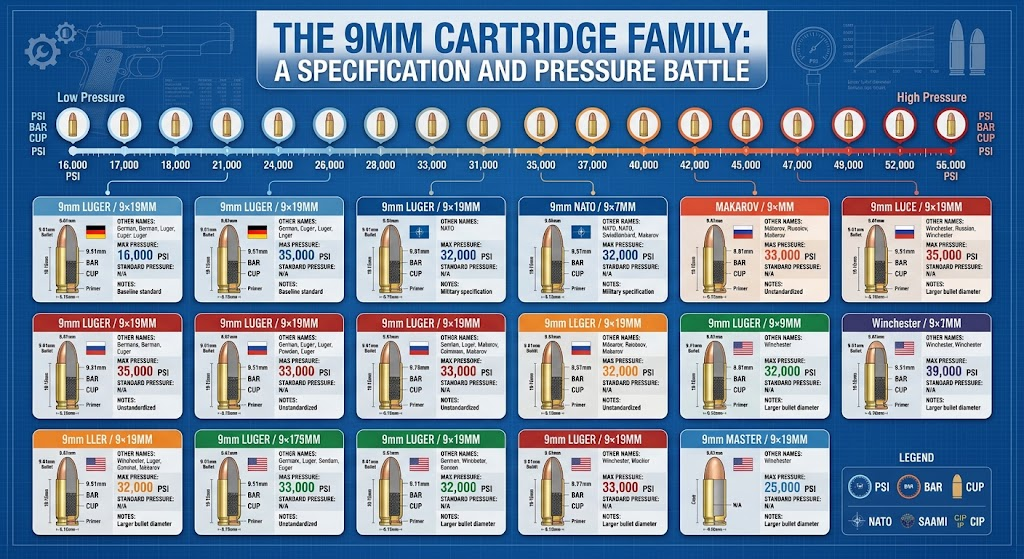
The term 9mm commonly refers to the ubiquitous 9mm Luger / 9×19mm cartridge, but several distinct 9mm caliber cartridges exist with widely differing pressure specifications. Chamber pressure varies significantly depending on the specific cartridge type, regulatory standard, and individual ammunition load. Understanding these differences ensures safe firearm operation and proper ammunition selection across various weapon platforms.
9mm Pressure
Ammunition chamber pressure differs widely across the family of 9mm cartridges. Regulatory organizations like SAAMI (Sporting Arms and Ammunition Manufacturers’ Institute) and CIP (Confédération Internationale Permanente pour l’Epreuve des Armes à Feu Portatives) establish maximum average pressure limits for safety.
| 9mm Cartridge | Other Name(s) | Standard Pressure | Maximum Pressure | Pressure Unit | Notes |
| 9mm Luger / 9×19mm | 9mm Parabellum, 9mm Para | 33,000 CUP | 35,000 PSI | PSI / bar | Baseline standard for modern handguns. |
| 9mm NATO | M882, 9mm service load | N/A | 36,500 PSI | PSI | Military specification load slightly higher than standard commercial limits. |
| 9mm +P | Plus P Luger | N/A | 38,500 PSI | PSI | Ten percent higher than standard SAAMI pressure. |
| 9mm +P+ | Ultra high pressure | N/A | Unstandardized | PSI | No universal SAAMI specification; manufacturer dependent. |
| 9mm Makarov / 9×18mm | 9x18mm Makarov | 24,100 PSI | 24,100 PSI | PSI / bar | Utilizes a larger bullet diameter (.365 in). |
| 9mm Browning Short / .380 ACP / 9×17mm | .380 Auto, 9mm Kurz | 21,500 PSI | 21,500 PSI | PSI / bar | Designed for blowback-operated pocket pistols. |
| 9mm Largo / 9×23mm | 9mm Bergmann-Bayard | Historical | ~38,000 PSI | PSI / bar | Historical military service cartridge. |
| 9mm Browning Long / 9×20mm | 9mm Browning SR | Historical | Historical | PSI / bar | Early 20th century blowback pistol cartridge. |
| 9×21mm | 9×21 IMI | CIP Standard | 38,000 PSI equivalent | PSI / bar | Developed for countries restricting military 9x19mm ownership. |
| 9×23mm Winchester | Winchester 9×23 | 55,000 PSI | 55,000 PSI | PSI | High-pressure cartridge for competition and tactical use. |
| 9mm Steyr | 9x23mm Steyr | Historical | ~32,000 PSI | PSI / bar | Obsolete Austrian military cartridge. |
| 9mm Mauser Export | 9mm Mauser | Historical | Historical | PSI / bar | Early high-velocity commercial round. |
| 9mm Ultra | 9mm Police variant | CIP Standard | 26,000 PSI equivalent | PSI / bar | Developed in the 1970s for police blowback handguns. |
| 9mm Police | 9mm Ultra variant | CIP Standard | 26,000 PSI equivalent | PSI / bar | Alternative designation for the 9mm Ultra cartridge. |
| 9mm Federal | 9mm Rimmed | 35,000 PSI | 35,000 PSI | PSI | Short-lived rimmed version of 9mm Luger for revolvers. |
| 9mm Glisenti | Italian military 9mm | Historical | ~23,000 PSI | PSI / bar | Weaker loading designed for early Italian service pistols. |
| 9mm Bergmann | Early Bergmann system | Historical | Historical | PSI / bar | Early 20th century precursor cartridge design. |
| 9mm Japanese | 9mm Nambu | Historical | ~16,000 PSI | PSI / bar | Low-pressure historic Japanese military service cartridge. |
Common 9mm Luger Pressure: 35,000 PSI (2,413 bar) – This reflects the SAAMI Maximum Average Pressure standard for standard commercial loads, though individual factory loads can vary depending on powder formulation and bullet weight.
What Is 9mm Pressure?
Ammunition chamber pressure refers to the peak force generated by expanding propellant gases inside the firearm chamber when a round is fired. This pressure forces the bullet down and out of the barrel.
It is vital to distinguish between three distinct physical measurements:
- Chamber Pressure: The maximum PSI or bar generated inside the cartridge case and chamber during ignition.
- Muzzle Pressure: The residual gas pressure remaining inside the barrel at the exact moment the bullet exits the muzzle.
- Muzzle Energy: The kinetic energy of the projectile measured in foot-pounds or joules as it leaves the barrel, calculated using its mass and velocity.
Pressure is not synonymous with velocity or muzzle energy. While higher pressure often enables higher velocity, barrel length, powder burn rate, and bullet weight heavily influence the final energy delivered downrange.
9mm Luger Pressure
The 9mm Luger (also known as 9x19mm or 9mm Parabellum) is governed by strict industry standards. Under SAAMI guidelines in the United States, the maximum average pressure limit is 35,000 PSI, while CIP standards in Europe specify a maximum limit of 2,350 bar (approximately 34,080 PSI) measured at the case mouth.
Standard-pressure ammunition operates at or below this threshold. In contrast, specialized commercial loads categorized as +P exceed standard limits to achieve higher velocities and enhanced terminal performance.
9mm +P Pressure
The designation +P stands for “plus pressure.” SAAMI defines the maximum average pressure for 9mm Luger +P ammunition at 38,500 PSI, representing a 10 percent increase over standard 9mm pressure.
This higher pressure profile yields increased muzzle velocity, flatter trajectories, and deeper penetration in defensive scenarios.However, frequent use of +P ammunition accelerates mechanical wear on firearms, meaning handguns must be specifically rated by their manufacturer to handle higher pressures safely.
9mm +P+ Pressure
The +P+ designation indicates ammunition loaded to pressures exceeding standard +P specifications.Crucially, SAAMI does not maintain an official industry standard or maximum pressure limit for +P+ ammunition.
Because there is no universal industry benchmark, +P+ loads vary wildly by manufacturer and can generate extreme chamber pressures.Shooters should only fire +P+ ammunition if the firearm manufacturer explicitly certifies the specific weapon model to handle unregulated high-pressure loads.
9mm NATO Pressure
The 9mm NATO cartridge is a military service round built to specifications managed by NATO member nations. Its maximum service pressure is typically rated around 36,500 PSI (evaluated via standardized piezoelectric testing methods).
While it generates slightly higher pressure than standard commercial SAAMI loads, it sits below the threshold of commercial +P ammunition.Most modern service pistols handle 9mm NATO reliably, but vintage firearms from early military eras should avoid it.
9mm Pressure by Cartridge Type
Cartridges sharing a similar nominal bullet diameter (approximately 9mm or 0.355 inches) often feature completely incompatible case dimensions and operating pressures.
| Cartridge | Case Length | Typical Bullet Weight | Pressure Standard | Maximum Pressure | Common Firearms | Notes |
| 9mm Luger | 0.754 in (19.15 mm) | 115 to 124 gr | SAAMI / CIP | 35,000 PSI | Glock 19, SIG P320, Beretta 92 | Standard global service round. |
| .380 ACP | 0.680 in (17.30 mm) | 95 gr | SAAMI | 21,500 PSI | Walther PPK, Ruger LCP | Compact blowback pocket pistols. |
| 9mm Makarov | 0.713 in (18.11 mm) | 95 gr | SAAMI / CIP | 24,100 PSI | Makarov PM, CZ 82 | Eastern Bloc military surplus. |
| 9mm Largo | 0.900 in (22.86 mm) | 125 gr | CIP | ~38,000 PSI | Star Model A, Astra 400 | Historical Spanish service sidearms. |
| 9x23mm Winchester | 0.900 in (22.86 mm) | 124 gr | SAAMI | 55,000 PSI | Custom 1911 pistols | High-velocity competition rounds. |
9mm Pressure vs Other Handgun Cartridges
Comparing operating pressures across popular handgun calibers demonstrates how cartridge design varies across the industry.
| Cartridge | Maximum Pressure (PSI) | Standard Pressure Unit | Typical Application |
| 9mm Luger | 35,000 PSI | PSI | Duty, self-defense, target shooting |
| .380 ACP | 21,500 PSI | PSI | Deep concealment, pocket pistols |
| .38 Special | 17,000 PSI (20,000 for +P) | PSI | Revolvers, concealed carry |
| .40 S&W | 35,000 PSI | PSI | Law enforcement, personal defense |
| .45 ACP | 21,000 PSI | PSI | Military legacy, target shooting, defense |
| 10mm Auto | 37,500 PSI | PSI | Outdoor defense, hunting, tactical use |
Note: Pressure comparisons alone do not dictate overall cartridge performance, felt recoil, muzzle energy, or firearm suitability. Factors like case volume, bullet mass, and expansion efficiency dictate external ballistic behavior.
9mm Pressure and Firearm Compatibility
Ammunition pressure ratings dictate direct firearm compatibility. Ammunition must match the specific cartridge designation stamped onto the firearm barrel or slide.
Different cartridges featuring “9mm” in their nomenclature are never inherently interchangeable. Chambering a high-pressure round like 9mm Luger or 9mm Winchester into a firearm designed for low-pressure cartridges like .380 ACP or 9mm Makarov leads to catastrophic structural failure, severe firearm damage, and potential injury.
Factors That Affect 9mm Pressure
Chamber pressure is a sensitive calculation influenced by multiple physical and environmental variables:
- Ammunition Design: Overall cartridge geometry and internal case volume.
- Bullet Weight and Construction: Heavier or monolithic solid projectiles create higher initial resistance.
- Powder Type and Charge: Burn rate and energy density of the propellant.
- Seating Depth: Deeper bullet seating reduces internal case capacity, rapidly spiking pressure.
- Environmental Temperature: Extreme heat increases propellant burn rates, elevating operating pressure.
- Chamber Dimensions and Barrel Length: Tight tolerances and rifling engagement impact peak pressure curves.
- Firearm Condition: Wear, headspace clearances, and fouling alter pressure dynamics.
- Testing Methodology: Variations between SAAMI transducer methods and CIP lead crusher or piezo procedures.
9mm Pressure FAQs
What is the pressure of a 9mm?
Standard 9mm Luger ammunition has a maximum average pressure limit of 35,000 PSI under SAAMI guidelines.
What is the maximum pressure of 9mm Luger?
The maximum pressure limit is 35,000 PSI for standard loads and 38,500 PSI for certified +P commercial loads.
What is standard 9mm pressure?
Standard 9mm pressure refers to factory loads operating at or below the 35,000 PSI threshold established by SAAMI and CIP.
What is 9mm +P pressure?
9mm +P pressure is rated to a maximum average pressure of 38,500 PSI.
What is 9mm +P+ pressure?
There is no universal standard or official SAAMI maximum pressure specification for 9mm +P+ ammunition.
Is 9mm NATO higher pressure than 9mm Luger?
Yes, 9mm NATO operates at approximately 36,500 PSI, making it slightly hotter than standard commercial 9mm Luger ammunition.
Is 9mm Luger the same as 9mm?
In commercial vernacular, “9mm” almost always refers to 9mm Luger, though other historical 9mm cartridges exist.
Does 9mm pressure vary by ammunition?
Yes, pressure varies across different brands, powder lots, bullet weights, and specialized pressure tiers like standard, +P, and NATO.
What is the pressure of 9mm Makarov?
The maximum average pressure for 9mm Makarov is 24,100 PSI.
What is the pressure of .380 ACP?
The maximum average pressure for .380 ACP is 21,500 PSI.
Are all 9mm cartridges the same pressure?
No, different 9mm cartridges feature completely distinct case designs, dimensions, and maximum pressure limits.