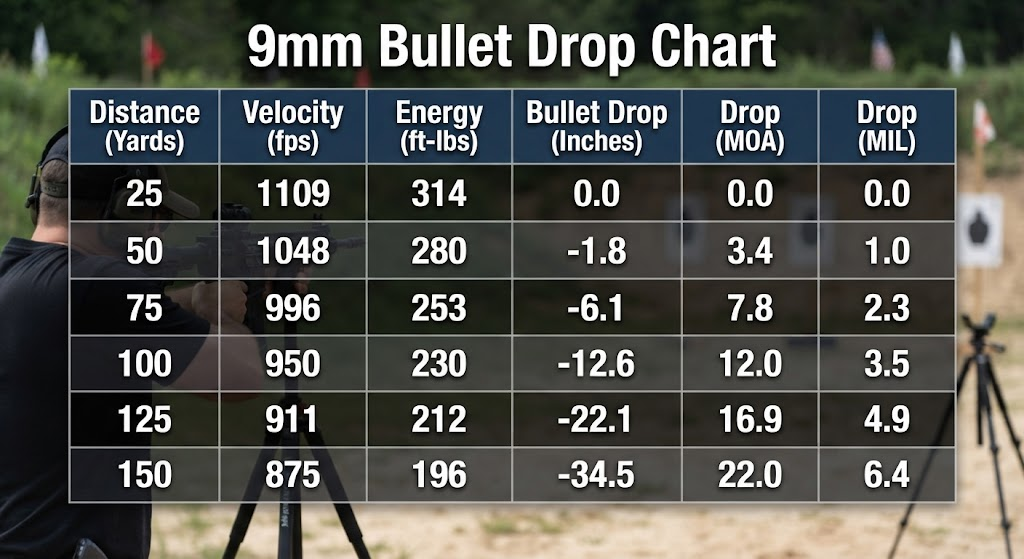
A 9mm bullet drop chart provides the precise trajectory data needed for accurate handgun shooting and pistol caliber carbine operation. A projectile’s exact flight path depends heavily on the specific load, bullet weight, muzzle velocity, ballistic coefficient, your chosen zero distance, and environmental conditions. By reviewing established ballistic data, shooters can understand how much their pistol rounds drop over distance and make the necessary holdover adjustments. The chart below details the critical flight metrics needed to effectively hit targets at realistic distances with the 9mm Luger cartridge.
9mm Bullet Drop Chart
| Distance (Yards) | Velocity (fps) | Energy (ft-lbs) | Bullet Drop (Inches) | Drop (MOA) | Drop (MIL) |
| 25 | 1109 | 314 | 0.0 | 0.0 | 0.0 |
| 50 | 1048 | 280 | -1.8 | 3.4 | 1.0 |
| 75 | 996 | 253 | -6.1 | 7.8 | 2.3 |
| 100 | 950 | 230 | -12.6 | 12.0 | 3.5 |
| 125 | 911 | 212 | -22.1 | 16.9 | 4.9 |
| 150 | 875 | 196 | -34.5 | 22.0 | 6.4 |
The parameters for the table above are based on standard ballistic data for the highly popular Federal American Eagle 115-grain FMJ load. This provides an excellent and widely applicable baseline for standard 9x19mm Parabellum target ammunition fired from a full-sized handgun.
Ballistic Parameters:
- Ammunition Load: Federal American Eagle 9mm Luger
- Bullet Weight & Type: 115-grain Full Metal Jacket (FMJ)
- Muzzle Velocity: 1180 feet per second (fps)
- Ballistic Coefficient (G1): 0.112
- Zero Distance: 25 Yards
- Sight Height: 0.8 inches above bore (Standard handgun iron sights)
- Test Barrel Length: 4 inches
- Environmental Assumptions: Sea level altitude, 59 degrees Fahrenheit
Note: Muzzle velocity and energy figures are sourced from standard manufacturer ballistic charts for this specific load. Drop figures and extended data out to 150 yards are calculated using a 0.112 ballistic coefficient under standard atmospheric conditions.
Understanding The 9mm Bullet Drop Chart
9mm Bullet Drop At 25 Yards
At 25 yards, the 115-grain projectile reaches its zero distance, perfectly intersecting your line of sight with zero bullet drop. The bullet is traveling at 1109 fps and retains 314 foot-pounds of energy. A 25-yard zero is the standard benchmark for full-sized duty pistols, providing a highly predictable point of impact for close-quarters defensive shooting and standard target practice.
9mm Bullet Drop At 50 Yards
When the bullet reaches 50 yards, the aerodynamic limitations of the short, blunt 9mm projectile begin to show. The bullet drops 1.8 inches below the center line. Shooters need to hold slightly high or adjust by 3.4 MOA. The velocity drops to roughly 1048 fps, transitioning the bullet from supersonic to subsonic flight, while kinetic energy drops to 280 foot-pounds.
9mm Bullet Drop At 75 Yards
At 75 yards, the trajectory steepens noticeably with a drop of 6.1 inches. You will need to make an elevation correction of 7.8 MOA or 2.3 MIL. The velocity sits at 996 fps. Hitting a target at this distance with a standard handgun requires a solid understanding of your holdovers and excellent trigger control, as the bullet is falling rapidly out of the sky.
9mm Bullet Drop At 100 Yards
Crossing into 100 yards, the 9mm bullet falls 12.6 inches below the line of sight. A shooter must compensate by aiming significantly higher than the target or dialing 12.0 MOA if using a specialized optic. The energy drops to 230 foot-pounds. While hitting steel silhouettes at 100 yards is a fun challenge on the range, the 9mm cartridge lacks the velocity and aerodynamic efficiency for consistent long-range precision.
9mm Bullet Drop At 150 Yards
At 150 yards, the 9mm cartridge is pushed far beyond its intended design. The bullet drop plunges to 34.5 inches. You will need a massive elevation adjustment of 22.0 MOA or 6.4 MIL. The velocity drops to 875 fps. Engaging targets at 150 yards with a 9mm pistol requires aiming several feet above the intended impact zone, acting more like artillery than direct fire.
Frequently Asked Questions
What factors change my 9mm bullet drop chart?
Your specific bullet drop will vary dramatically based on your firearm’s barrel length. The chart above assumes a standard 4-inch pistol barrel. If you fire the same 9mm ammunition from a Pistol Caliber Carbine (PCC) with a 16-inch barrel, the muzzle velocity will increase significantly. This higher starting speed results in a much flatter trajectory and considerably less bullet drop at 50 and 100 yards.
How does 115-grain 9mm compare to 124-grain or 147-grain?
A lighter 115-grain bullet leaves the muzzle faster than the heavier options, providing the flattest trajectory for the first 50 yards. A 124-grain bullet offers a middle ground, providing slightly better penetration while maintaining good velocity. A heavy 147-grain bullet is typically subsonic right out of the muzzle. Because it starts slower, the 147-grain bullet will experience more severe bullet drop at extended distances, but it is highly preferred by shooters using suppressors.
What is the best zero distance for a 9mm pistol?
For most defensive handguns and target pistols, a 15-yard or 25-yard zero is the standard recommendation. A 25-yard zero ensures that the bullet never rises or falls more than a couple of inches from the line of sight anywhere between the muzzle and 50 yards. For a Pistol Caliber Carbine equipped with a red dot, many shooters prefer a 50-yard zero to maximize their point blank range on steel targets.
What is the maximum effective range of a 9mm?
The effective range of a 9mm depends on the context. For self-defense, statistics and practical training show that most engagements happen inside of 10 yards, where bullet drop is completely irrelevant. For target shooting, a skilled marksman with a quality pistol can consistently hit a man-sized steel target at 50 to 75 yards. With a rifle-length Pistol Caliber Carbine, the maximum effective range for target shooting extends out to roughly 100 or 125 yards before the bullet drop becomes too extreme to manage easily.