Understanding 9mm ballistics requires looking at how bullet weight, barrel length, and projectile design influence overall performance. These variables dictate muzzle velocity, retained energy, and how the bullet travels downrange. The charts below provide verified manufacturer data and reliable estimates to show exactly how 9mm ammunition performs under different conditions.
Table of Contents [Click to minimize]
9mm Ballistics Chart
| Bullet Weight | Bullet Type | Manufacturer and Load | Test Barrel Length | Muzzle Velocity | Velocity at 25 Yards | Velocity at 50 Yards | Velocity at 100 Yards | Muzzle Energy | Energy at 25 Yards | Energy at 50 Yards | Energy at 100 Yards | Bullet Drop at 25 Yards | Bullet Drop at 50 Yards | Bullet Drop at 100 Yards | Ballistic Coefficient |
| 115-grain | FMJ | CCI Blazer Brass | 4 inches | 1,145 fps | Not verified | Not verified | Not verified | 335 ft-lbs | Not verified | Not verified | Not verified | 0.0 inches | -1.3 inches | -10.1 inches | 0.155 |
| 124-grain | FMJ | Federal American Eagle | 4 inches | 1,150 fps | Not verified | Not verified | Not verified | 364 ft-lbs | Not verified | Not verified | Not verified | 0.0 inches | -1.3 inches | -10.0 inches | 0.150 |
| 124-grain | FMJ | Generic Model Estimate | 4 inches | 1,090 fps | 1,048 fps | 1,014 fps | 956 fps | 327 ft-lbs | 303 ft-lbs | 283 ft-lbs | 251 ft-lbs | 0.0 inches | -1.48 inches | -10.9 inches | Not verified |
| 147-grain | FMJ | Armscor | 4 inches | 850 fps | Not verified | Not verified | Not verified | 236 ft-lbs | Not verified | Not verified | Not verified | 0.0 inches | -2.6 inches | -17.6 inches | 0.212 |
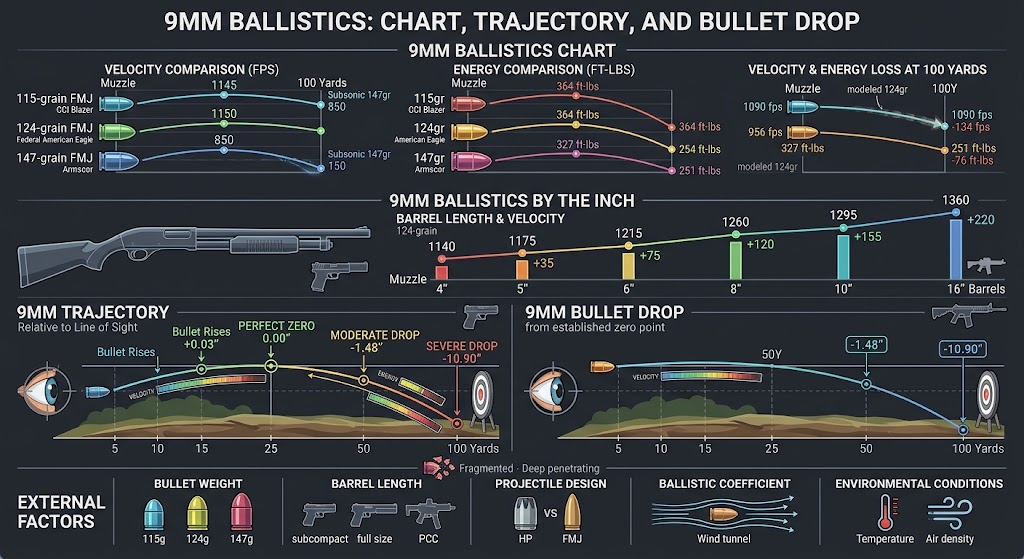
Analyzing the 9mm Ballistics Chart
- The muzzle velocity of the listed 9mm ammunition ranges from 850 fps for heavy 147-grain subsonic loads up to 1,150 fps for standard 124-grain loads.
- Lighter 115-grain and 124-grain bullets start with higher velocities but experience more air resistance over time, whereas 147-grain bullets leave the muzzle slower but often have a higher ballistic coefficient to help maintain momentum.
- Based on the modeled 124-grain estimate, velocity drops by about 134 fps and energy decreases by 76 ft-lbs when the bullet travels from the muzzle to 100 yards.
- Higher ballistic coefficients, such as the 0.212 found on the 147-grain load, indicate a more aerodynamic bullet design that resists drag better than the 0.150 coefficient of the 124-grain load.
- Manufacturer published values represent ideal test conditions, while the generic modeled estimates provide a realistic look at how velocity and energy degrade at specific intervals downrange.
9mm Ballistics by the Inch
Barrel length plays a major role in determining the muzzle velocity of 9mm ammunition. Because 9mm Luger cartridges use relatively fast burning pistol powders, they reach peak pressure quickly. A longer barrel allows the expanding gases to push the bullet for a longer duration, increasing velocity, though the gains diminish as the barrel gets significantly longer.
| Barrel Length | Bullet Weight | Manufacturer and Load | Muzzle Velocity | Difference From Reference Barrel | Muzzle Energy | Test Source or Conditions |
| 4 inches | 124-grain | Standard 124gr FMJ | 1,140 fps | Reference | 358 ft-lbs | Published test averages |
| 5 inches | 124-grain | Standard 124gr FMJ | 1,175 fps | +35 fps | 380 ft-lbs | Published test averages |
| 6 inches | 124-grain | Standard 124gr FMJ | 1,215 fps | +75 fps | 406 ft-lbs | Published test averages |
| 8 inches | 124-grain | Standard 124gr FMJ | 1,260 fps | +120 fps | 437 ft-lbs | Published test averages |
| 10 inches | 124-grain | Standard 124gr FMJ | 1,295 fps | +155 fps | 462 ft-lbs | Published test averages |
| 16 inches | 124-grain | Standard 124gr FMJ | 1,360 fps | +220 fps | 509 ft-lbs | Published test averages |
9mm Ballistics Chart Barrel Length
- Standard Test Load: 124 Grain FMJ / JHP (Standard Pressure)
- Powder Burn Mechanics: 9mm reaches its peak velocity efficiency between 12″ and 14″ of barrel length; extending to 16″ yields minimal gains or slight velocity plateauing.
| Barrel Length (Inches) | Typical Firearm Platform | Muzzle Velocity (FPS) | Velocity Gain vs. 3″ | Muzzle Energy (ft-lbs) | Velocity Gain per Inch | Peak Efficiency Status |
| 3.0″ | Sub-Compact / Pocket (Sig P938) | 1,050 | Baseline | 304 | Baseline | High Powder Blow-by |
| 3.5″ | Micro-Compact (Glock 43, Sig P365) | 1,100 | +50 FPS | 333 | +100 FPS / in | Rapid Burn Phase |
| 4.0″ | Compact Handgun (Glock 19) | 1,140 | +90 FPS | 358 | +80 FPS / in | Standard Subsonic Boundary |
| 4.5″ / 5.0″ | Full-Size / Duty (Glock 17, Beretta 92) | 1,180 | +130 FPS | 383 | +40 FPS / in | Complete Pistol Burn |
| 7.0″ / 8.0″ | AR-9 / PCC Pistol (8″ Barrel) | 1,320 | +270 FPS | 480 | +46 FPS / in | High PCC Acceleration |
| 10.0″ | Submachine Gun / Short Carbine | 1,370 | +320 FPS | 517 | +25 FPS / in | Near Peak Expansion |
| 12.0″ | Medium Carbine Barrel | 1,395 | +345 FPS | 536 | +12.5 FPS / in | Peak Velocity Threshold |
| 16.0″ | Full-Length Rifle / Rifle PCC | 1,400 | +350 FPS | 540 | +1.25 FPS / in | Friction Plateau |
Multi-Grain Performance Comparison Across Key Barrel Lengths
This table shows how different bullet weights (115 gr, 124 gr, and 147 gr) respond to changes in barrel length.
| Bullet Weight & Load Type | 3.5″ Barrel (Micro) | 4.5″ Barrel (Full-Size) | 8.0″ Barrel (AR-9) | 16.0″ Barrel (Carbine) | Total Velocity Gain (3.5″ to 16″) |
| 115 gr FMJ (Lightweight / Fast) | 1,130 FPS (326 ft-lbs) | 1,200 FPS (368 ft-lbs) | 1,360 FPS (472 ft-lbs) | 1,440 FPS (529 ft-lbs) | +310 FPS |
| 124 gr JHP (Standard Duty) | 1,090 FPS (327 ft-lbs) | 1,160 FPS (370 ft-lbs) | 1,310 FPS (472 ft-lbs) | 1,400 FPS (539 ft-lbs) | +310 FPS |
| 147 gr Subsonic (Heavyweight) | 960 FPS (301 ft-lbs) | 1,010 FPS (333 ft-lbs) | 1,110 FPS (402 ft-lbs) | 1,160 FPS (439 ft-lbs) | +200 FPS |
| 115 gr +P (High Pressure) | 1,210 FPS (374 ft-lbs) | 1,290 FPS (425 ft-lbs) | 1,450 FPS (536 ft-lbs) | 1,530 FPS (597 ft-lbs) | +320 FPS |
9mm Trajectory Chart
Trajectory describes the path the bullet takes through the air relative to the sights on the firearm. Because sights sit slightly above the barrel, the bullet starts below the line of sight, rises to meet it, and eventually falls due to gravity.
| Distance | Trajectory Relative to Line of Sight | Remaining Velocity | Remaining Energy | Ammunition Load | Assumptions |
| 5 yards | -0.24 inches | 1,081 fps | 321 ft-lbs | 124-grain FMJ | 25-yard zero, 0.5 inch sight height, estimated |
| 10 yards | -0.07 inches | 1,072 fps | 316 ft-lbs | 124-grain FMJ | 25-yard zero, 0.5 inch sight height, estimated |
| 15 yards | +0.03 inches | 1,064 fps | 312 ft-lbs | 124-grain FMJ | 25-yard zero, 0.5 inch sight height, estimated |
| 25 yards | 0.00 inches | 1,048 fps | 303 ft-lbs | 124-grain FMJ | 25-yard zero, 0.5 inch sight height, estimated |
| 50 yards | -1.48 inches | 1,014 fps | 283 ft-lbs | 124-grain FMJ | 25-yard zero, 0.5 inch sight height, estimated |
| 100 yards | -10.90 inches | 956 fps | 251 ft-lbs | 124-grain FMJ | 25-yard zero, 0.5 inch sight height, estimated |
Analyzing the 9mm Trajectory
- At 5 yards, the bullet impacts 0.24 inches below the line of sight because it is still climbing from the barrel to meet the crosshairs.
- The trajectory peaks slightly above the line of sight around 15 yards, registering a minor +0.03 inch rise.
- At 25 yards, the trajectory returns to a perfect 0.00 inches, meaning the bullet intersects exactly with the aiming point.
- Beyond 25 yards, gravity takes over visibly, pulling the bullet nearly 1.5 inches low at 50 yards and nearly 11 inches low by 100 yards.
9mm Bullet Drop Chart
Bullet drop represents how far the projectile falls below its established zero point as distance increases. This is a critical metric for understanding where a bullet will hit if a shooter does not adjust their aim at longer distances.
| Distance | Bullet Drop | Remaining Velocity | Remaining Energy | Bullet Weight | Reference and Assumptions |
| 5 yards | -0.24 inches | 1,081 fps | 321 ft-lbs | 124-grain | Drop from line of sight, 25-yard zero, estimated |
| 10 yards | -0.07 inches | 1,072 fps | 316 ft-lbs | 124-grain | Drop from line of sight, 25-yard zero, estimated |
| 15 yards | +0.03 inches | 1,064 fps | 312 ft-lbs | 124-grain | Drop from line of sight, 25-yard zero, estimated |
| 25 yards | 0.00 inches | 1,048 fps | 303 ft-lbs | 124-grain | Drop from line of sight, 25-yard zero, estimated |
| 50 yards | -1.48 inches | 1,014 fps | 283 ft-lbs | 124-grain | Drop from line of sight, 25-yard zero, estimated |
| 100 yards | -10.90 inches | 956 fps | 251 ft-lbs | 124-grain | Drop from line of sight, 25-yard zero, estimated |
Understanding 9mm Bullet Drop
- At the 25 yard zero mark, bullet drop is zero inches, providing the baseline for all subsequent measurements.
- At 50 yards, the 124-grain bullet drops 1.48 inches below the zero point, requiring a minor holdover adjustment.
- By 100 yards, the drop becomes severe, with the bullet falling 10.90 inches below the aiming point.
- These figures apply specifically to a 124-grain bullet with a muzzle velocity of 1,090 fps zeroed at 25 yards; different loads or zeros will shift these values.
Factors That Affect 9mm Ballistics
Bullet weight is the most fundamental factor dividing 9mm ammunition into three main categories: 115-grain, 124-grain, and 147-grain bullets. Lighter 115-grain bullets achieve the highest speeds but shed energy faster downrange. The 124-grain loads provide a middle ground of speed and penetration, while heavy 147-grain bullets are usually subsonic, making them excellent for suppressed shooting and deep penetration despite their slower speeds.
Barrel length directly dictates the muzzle velocity of any cartridge. A standard 4 inch pistol barrel gives the expanding powder gases just enough time to push a 9mm bullet to its rated speed. Shorter subcompact barrels will produce lower velocities and less energy, whereas longer pistol caliber carbine barrels capture more of the gas pressure to increase velocity significantly.
Projectile design and ballistic coefficient measure how well a bullet cuts through the air. Full metal jacket rounds usually have a different aerodynamic profile than hollow point defensive rounds. A higher ballistic coefficient means the bullet creates less drag, allowing it to retain its velocity and energy over longer distances and resisting wind deflection better.
Muzzle velocity and retained energy are permanently linked. Velocity is the speed of the bullet when it leaves the barrel, and energy is the destructive force it carries. Because energy depends heavily on velocity, a bullet that starts faster will usually deliver more energy up close. However, how well that energy is retained downrange depends entirely on the bullet’s aerodynamic efficiency and mass.
Sight height and zero distance establish the reference point for the bullet’s trajectory. If a handgun is zeroed at 15 yards instead of 25 yards, the measured bullet drop at 50 yards will be much steeper. Similarly, a red dot sight mounted high above the bore will create a different trajectory curve than low profile iron sights because the bullet has to angle upward more aggressively to meet the crosshairs.
Temperature, air density, and other environmental conditions influence external ballistics. Cold air is denser than warm air, creating more drag and slowing the bullet faster. High altitudes have thinner air, which allows the bullet to travel flatter and retain velocity longer. Humidity and barometric pressure also play minor roles in how a 9mm bullet flies at extended distances.
Differences between manufacturer test barrels and real world firearms mean published data is not always perfectly accurate for civilian use. Manufacturers often test ammunition in controlled laboratory fixtures with precise barrel lengths and tight tolerances. An off the shelf handgun with a worn barrel or a slightly looser chamber may produce velocities 50 to 100 fps slower than what is printed on the ammunition box.
Frequently Asked Questions
What is the muzzle velocity of a 9mm bullet? The muzzle velocity of a 9mm bullet typically ranges from 850 fps for heavy 147-grain subsonic loads up to 1,300 fps for lighter 115-grain +P ammunition fired from a 4 inch barrel.
What is a 9mm ballistics chart? A 9mm ballistics chart is a data table that lists the exact performance metrics of different 9mm ammunition loads, usually tracking velocity, energy, and bullet drop across specific distances like 25, 50, and 100 yards.
How does barrel length affect 9mm ballistics? Barrel length affects 9mm ballistics by giving the gunpowder more or less time to burn and push the bullet; longer barrels generally increase muzzle velocity and energy, while shorter barrels decrease them.
How much velocity does 9mm lose with a shorter barrel? Going from a standard 4 inch handgun barrel down to a 3 inch subcompact barrel usually results in a velocity loss of roughly 30 to 50 fps depending on the specific ammunition load.
How much does a 9mm bullet drop at 25 yards? If a 9mm handgun is zeroed at 25 yards, the bullet drop at that exact distance is 0.0 inches.
How much does a 9mm bullet drop at 50 yards? When zeroed at 25 yards, a standard 124-grain 9mm bullet will typically drop between 1.3 and 1.5 inches by the time it reaches the 50 yard mark.
What is the trajectory of a 9mm bullet? The trajectory of a 9mm bullet is an arc that starts slightly below the sights, rises to meet the aiming point at the zero distance, and then gradually drops due to gravity, falling about 10 to 12 inches low at 100 yards.
What is the difference between 115-grain, 124-grain, and 147-grain 9mm ammunition? The 115-grain rounds are lighter and faster, 124-grain rounds offer a balanced mix of speed and penetration, and 147-grain rounds are heavy and slow, often staying subsonic to reduce noise.
How much energy does a 9mm bullet retain at 50 yards? A standard 124-grain 9mm bullet that starts with around 327 ft-lbs of muzzle energy will typically retain about 283 ft-lbs of energy at 50 yards.
Does 9mm bullet drop vary between handguns? Yes, 9mm bullet drop varies between handguns because differences in barrel length change the initial muzzle velocity, and differences in sight height change the angle of the trajectory curve.