The best 8.6 Blackout twist rate is an ultra-fast 1:3 twist, which serves as the defining engineering feature of the entire cartridge.
The ideal twist rate is directly dictated by a projectile’s massive length, heavy weight, aerodynamic design, and muzzle velocity.
An extreme 1:3 twist rate imparts immense rotational energy, ensuring total stability for heavy 300-grain subsonic bullets and inducing violent terminal expansion.
Alternative factory options like a 1:4 twist provide exceptional performance, while rarer variations exist for specific platform constraints.
Matching your bullet choice to these radical twist rates is critical to achieving the explosive terminal ballistics the cartridge was built to deliver.
Table of Contents [Click to open]
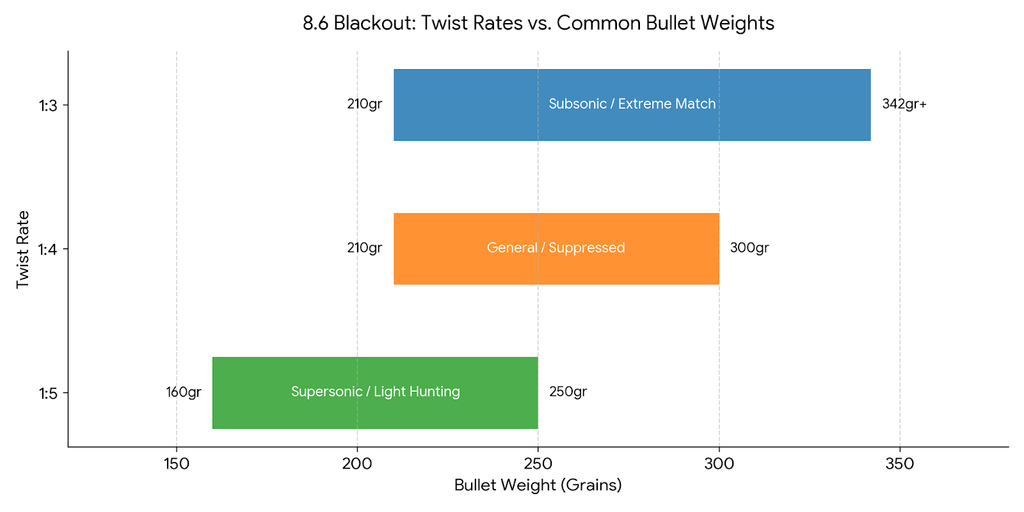
8.6 Blackout Twist Rate Chart
| Twist Rate | Common Bullet Weights | Typical Bullet Use | Stability/Compatibility |
| 1:3 | 210gr to 342gr+ | Subsonic / Extreme Match | The design standard; maximizes rotational kinetic energy and forces bullet upset at low speeds. |
| 1:4 | 210gr to 300gr | General / Suppressed | Common alternative factory twist; easily stabilizes heavy subsonics and supersonic loads. |
| 1:5 | 160gr to 250gr | Supersonic / Light Hunting | A softer alternative used by select manufacturers, though optimized more for lighter or faster loads. |
Understanding the 8.6 Blackout Twist Rate Chart
Rifling twist rate refers to the exact distance it takes for the rifling inside the barrel to complete one full 360-degree rotation. For the 8.6 Blackout, the numbers are radically unconventional:
- 1:3 Twist: One complete rifling rotation in an astonishing 3 inches of barrel length.
- 1:4 Twist:One complete rifling rotation in 4 inches of barrel length.
- 1:5 Twist: One complete rifling rotation in 5 inches of barrel length.
Why faster twists are expressed with smaller numbers:
Because the bullet is forced to complete its full 360-degree rotation in a tiny fraction of space, the rifling is cut at an extreme angle. This steep angle spins the projectile at incredible Revolutions Per Minute (RPM) counts the exact millisecond it exits the muzzle.
How twist rate affects 8.6 Blackout stability:
Conventional rifles use slow twists because standard bullets require very little spin. The 8.6 Blackout throws massive .338-caliber projectiles, particularly heavy 300-grain to 342-grain subsonics traveling around 1,000 feet per second. At such low velocities, standard rifling cannot generate enough gyroscopic stability. The 1:3 twist provides an extreme surplus of spin, ensuring the heavy payload flies dead straight while storing massive rotational energy that forces expanding bullets to open violently upon target impact.
Bullet Weight Comparison
| Bullet Weight | Recommended Twist | 1:3 | 1:4 | 1:5 |
| 160 grain | 1:5 or 1:4 | Over-spun | Excellent | Excellent |
| 210 grain | 1:4 or 1:3 | Excellent | Excellent | Excellent |
| 250 grain | 1:3 or 1:4 | Excellent | Excellent | Good |
| 300 grain | 1:3 | Excellent | Excellent | Good |
| 342 grain | 1:3 | Excellent | Good | Marginal |
What Is The Best Twist Rate For 8.6 Blackout?
The 1:3 twist rate is universally considered the ultimate and definitive choice for the 8.6 Blackout.Conceived by Q LLC, the cartridge was engineered explicitly around a 1:3 barrel to maximize spin.While other manufacturers offer 1:4 or 1:5 alternatives to simplify barrel production, a 1:3 twist delivers the signature high-octane performance, deep terminal disruption, and absolute stability that defines the platform.
8.6 Blackout 1:3 Twist Rate
The 1:3 twist is the crown jewel of the 8.6 Blackout ecosystem. It spins a 300-grain subsonic bullet so aggressively that its stability factor reaches extreme heights.This hyper-spin does more than keep the bullet flying nose-forward. When the bullet impacts soft tissue, the stored rotational energy forces the projectile to yaw and fragment violently, creating massive wound channels even at slow subsonic speeds.
8.6 Blackout 1:4 Twist Rate
The 1:4 twist is a widely adopted alternative offered by several custom barrel makers and rifle builders. It easily stabilizes heavy 300-grain subsonic loads and high-velocity supersonic hunting rounds. While it yields slightly lower rotational velocity than a 1:3 barrel, it remains well within optimal parameters for precision accuracy and reliable terminal performance.
8.6 Blackout Twist Rate For 300 Grain Bullets
The ideal 8.6 Blackout twist rate for 300 grain bullets is unequivocally a 1:3 twist. Heavy 300-grain subsonics are exceptionally long. Driving them through a 1:3 bore guarantees they remain stable over extended distances while maximizing the rotational hydraulic shock upon impact.
8.6 Blackout Twist Rate And Bullet Stability
Bullet length dictates twist rate requirements far more than raw bullet weight.
Because .338-caliber projectiles designed for the 8.6 Blackout feature high ballistic coefficients and long, sleek profiles, their length-to-diameter ratio is massive.Aerodynamic pressure on the long nose of the bullet constantly tries to flip it end over end during flight.The extreme 1:3 twist rate provides the overpowering gyroscopic force required to neutralize this pressure, ensuring stable flight regardless of whether you are pushing a light supersonic load or a heavy subsonic slug.
Barrel Length and Twist Rate
Barrel length does not change the physical rate of the rifling. A 1:3 twist completes one rotation every 3 inches whether your barrel is 12 inches or 16 inches long. However, barrel length dictates muzzle velocity. Because the 8.6 Blackout relies heavily on short-barreled rifle (SBR) platforms and pistol configurations, velocity can vary. Fortunately, the sheer magnitude of a 1:3 twist completely overrides velocity concerns, ensuring complete bullet stability even out of compact 8-inch or 12-inch barrels.
Stability Testing
Ballisticians evaluate 8.6 Blackout stability using the Miller Twist Rule to calculate a Gyroscopic Stability Factor.
- SG > 1.5: Fully stable; optimal flight dynamics.
- SG Extremely High (10 to 15+):Intentionally over-stabilized by design to maximize terminal rotational energy upon impact.
- SG < 1.0: Unstable; the bullet tumbles.
Unlike traditional cartridges where over-stabilization can sometimes degrade extreme-range precision, the 8.6 Blackout intentionally leverages ultra-high stability factors to enhance terminal ballistics on game.
Best Twist Rate By Use
| Use Case | Recommended Twist Rate | Suitable Bullet Weights |
| Ultimate Performance / Subsonic | 1:3 | 250gr to 342gr |
| General Purpose / Suppressed | 1:3 or 1:4 | 210gr to 300gr |
| Supersonic Hunting | 1:4 or 1:5 | 160gr to 220gr |
| Short-Barreled Rifle (SBR) | 1:3 | 210gr to 342gr |
| 300 Grain Subsonic Loads | 1:3 | 300gr to 342gr |
Pros And Cons
Fast Twist Rates (1:3, 1:4)
Pros:
- Provides absolute gyroscopic stability for massive 300-grain subsonic loads.
- Unlocks the signature explosive terminal performance and rotational energy transfer.
- Performs exceptionally well out of short-barreled rifle configurations.
Cons:
- Can place extreme centrifugal stress on poorly constructed, thin-jacketed bullets if pushed at ultra-high velocities.
- Requires specialized barrel manufacturing processes.
Slower Twist Rates (1:5)
Pros:
- Slightly more forgiving on lighter, high-velocity supersonic projectiles.
- Easier for traditional barrel makers to produce.
Cons:
- Waters down the core engineering intent of the 8.6 Blackout cartridge.
- Reduces the aggressive rotational kinetic energy transfer inherent to 1:3 systems.
8.6 Blackout Twist Rate Chart: Which Twist Rate Is Best?
When referencing an 8.6 Blackout twist rate chart, the 1:3 twist is undeniably the best choice. It represents the true, uncompromised vision of the cartridge. Selecting a 1:3 barrel ensures you harness the full spectrum of the system, transforming heavy subsonic ammunition into a devastating hunting and precision tool.
For specific setups, choose accordingly:
- The definitive standard for all-around use:1:3 twist.
- Readily available factory alternative builds:1:4 twist.
- Dedicated light supersonic applications:1:5 twist.
FAQs
What is the best twist rate for 8.6 Blackout?
The 1:3 twist rate is universally considered the best and most authentic option for 8.6 Blackout, as it delivers the extreme spin required for maximum subsonic terminal performance.
What is the 1:3 twist rate good for?
The 1:3 twist is engineered specifically to stabilize massive 300-grain and 342-grain subsonic bullets while imparting incredible rotational kinetic energy for violent terminal expansion.
What is the 1:4 twist rate good for?
The 1:4 twist is a highly capable alternative factory rifling rate that easily stabilizes heavy subsonics and supersonic hunting loads with great accuracy.
Why does 8.6 Blackout use such a fast twist rate?
It uses a 1:3 twist because heavy, long .338 bullets traveling at slow subsonic speeds require an immense amount of spin to stay stable and expand violently upon impact.
Will an 8.6 Blackout barrel stabilize 300 grain bullets?
Yes, standard 1:3 and 1:4 twist barrels stabilize 300-grain bullets effortlessly.
Can you shoot supersonic ammo out of a 1:3 8.6 Blackout barrel?
Yes, supersonic ammunition ranging from 160 grains to 210 grains functions safely and accurately out of 1:3 twist barrels.
Does barrel length affect twist rate in 8.6 Blackout?
Barrel length does not change the physical twist rate cut into the bore. However, shorter barrels produce lower muzzle velocities, though the aggressive 1:3 twist easily compensates to maintain total bullet stability.