A 6.5 Grendel Ballistics Chart is a comprehensive reference guide that meticulously outlines the velocity, kinetic energy, and trajectory curve of the 6.5 Grendel cartridge over various distances. By consulting this detailed chart, you can visualize exactly how your specific bullet behaves from the moment it leaves your barrel until it strikes a target hundreds of yards downrange. This critical data allows you to accurately predict bullet drop, compensate for wind drift, and verify that your projectile retains enough kinetic energy for an ethical kill on game animals.
Shooters, hunters, reloaders, and modern sporting rifle enthusiasts heavily rely on a 6.5 Grendel Ballistics Chart to unlock the true potential of this highly efficient cartridge. Designed specifically to maximize long range performance within the confines of a standard AR 15 magazine, this cartridge perfectly bridges the gap between lightweight varmint calibers and heavy recoiling full power rifle cartridges. By studying the numbers, a hunter can confidently take a challenging shot on a whitetail deer across an open field, knowing their bullet will perform flawlessly. A competitive marksman uses the trajectory data to understand exactly how much to adjust their rifle scope turrets for hitting steel targets at one thousand yards. In this comprehensive guide, you will learn how to analyze ballistics data, choose the absolute best bullet weight for your specific needs, determine the ideal zero distance, and see exactly how this cartridge dominates both the hunting woods and the competition range.
6.5 Grendel Ballistics Chart
Below is a detailed ballistics table featuring ten of the most popular and proven factory ammunition loads available today. The data represents a standard twenty four inch test barrel and assumes a one hundred yard zero. Atmospheric conditions are based on standard sea level metrics.
| Bullet Weight | Bullet Type | Manufacturer | Muzzle Velocity | Velocity At 100 Yards | Velocity At 200 Yards | Velocity At 300 Yards | Velocity At 400 Yards | Velocity At 500 Yards | Muzzle Energy | Energy At 100 Yards | Energy At 200 Yards | Energy At 300 Yards | Energy At 400 Yards | Energy At 500 Yards | Trajectory At 100 Yards | Trajectory At 200 Yards | Trajectory At 300 Yards | Trajectory At 400 Yards | Trajectory At 500 Yards | Ballistic Coefficient | Sectional Density |
| 90 Grain | CX | Hornady | 2910 fps | 2655 fps | 2415 fps | 2185 fps | 1970 fps | 1765 fps | 1692 ft lbs | 1408 ft lbs | 1165 ft lbs | 954 ft lbs | 775 ft lbs | 622 ft lbs | 0 inches | 3.1 inches drop | 12.1 inches drop | 28.5 inches drop | 54.0 inches drop | 0.356 | 0.184 |
| 90 Grain | Speer TNT | Federal | 2880 fps | 2550 fps | 2250 fps | 1970 fps | 1715 fps | 1485 fps | 1658 ft lbs | 1300 ft lbs | 1012 ft lbs | 775 ft lbs | 588 ft lbs | 441 ft lbs | 0 inches | 3.2 inches drop | 12.5 inches drop | 30.5 inches drop | 59.5 inches drop | 0.281 | 0.184 |
| 100 Grain | ELD VT | Hornady | 2730 fps | 2531 fps | 2340 fps | 2158 fps | 1984 fps | 1819 fps | 1655 ft lbs | 1422 ft lbs | 1216 ft lbs | 1034 ft lbs | 874 ft lbs | 735 ft lbs | 0 inches | 3.5 inches drop | 12.8 inches drop | 29.2 inches drop | 54.4 inches drop | 0.355 | 0.205 |
| 115 Grain | TAC TX | Barnes | 2590 fps | 2385 fps | 2190 fps | 2005 fps | 1830 fps | 1665 fps | 1713 ft lbs | 1453 ft lbs | 1225 ft lbs | 1026 ft lbs | 855 ft lbs | 708 ft lbs | 0 inches | 4.6 inches drop | 16.5 inches drop | 37.5 inches drop | 69.5 inches drop | 0.387 | 0.236 |
| 120 Grain | Fusion | Federal | 2600 fps | 2395 fps | 2200 fps | 2015 fps | 1840 fps | 1675 fps | 1801 ft lbs | 1528 ft lbs | 1290 ft lbs | 1082 ft lbs | 902 ft lbs | 747 ft lbs | 0 inches | 4.5 inches drop | 16.2 inches drop | 36.5 inches drop | 67.5 inches drop | 0.340 | 0.246 |
| 120 Grain | Ballistic Tip | Nosler | 2600 fps | 2420 fps | 2245 fps | 2075 fps | 1915 fps | 1765 fps | 1801 ft lbs | 1560 ft lbs | 1343 ft lbs | 1147 ft lbs | 977 ft lbs | 830 ft lbs | 0 inches | 4.4 inches drop | 15.5 inches drop | 34.0 inches drop | 61.5 inches drop | 0.458 | 0.246 |
| 123 Grain | SST | Hornady | 2580 fps | 2410 fps | 2247 fps | 2090 fps | 1940 fps | 1796 fps | 1818 ft lbs | 1586 ft lbs | 1379 ft lbs | 1193 ft lbs | 1028 ft lbs | 881 ft lbs | 0 inches | 4.6 inches drop | 16.0 inches drop | 35.5 inches drop | 64.2 inches drop | 0.510 | 0.252 |
| 123 Grain | ELD Match | Hornady | 2580 fps | 2409 fps | 2244 fps | 2086 fps | 1935 fps | 1791 fps | 1818 ft lbs | 1585 ft lbs | 1376 ft lbs | 1189 ft lbs | 1023 ft lbs | 876 ft lbs | 0 inches | 4.6 inches drop | 16.1 inches drop | 35.6 inches drop | 64.3 inches drop | 0.506 | 0.252 |
| 123 Grain | FMJ | Hornady | 2580 fps | 2374 fps | 2178 fps | 1991 fps | 1815 fps | 1650 fps | 1818 ft lbs | 1540 ft lbs | 1296 ft lbs | 1083 ft lbs | 900 ft lbs | 743 ft lbs | 0 inches | 5.0 inches drop | 17.5 inches drop | 39.5 inches drop | 72.0 inches drop | 0.450 | 0.252 |
| 129 Grain | AccuBond LR | Nosler | 2350 fps | 2195 fps | 2045 fps | 1900 fps | 1765 fps | 1635 fps | 1582 ft lbs | 1380 ft lbs | 1198 ft lbs | 1034 ft lbs | 892 ft lbs | 766 ft lbs | 0 inches | 5.8 inches drop | 19.5 inches drop | 42.0 inches drop | 75.0 inches drop | 0.530 | 0.264 |
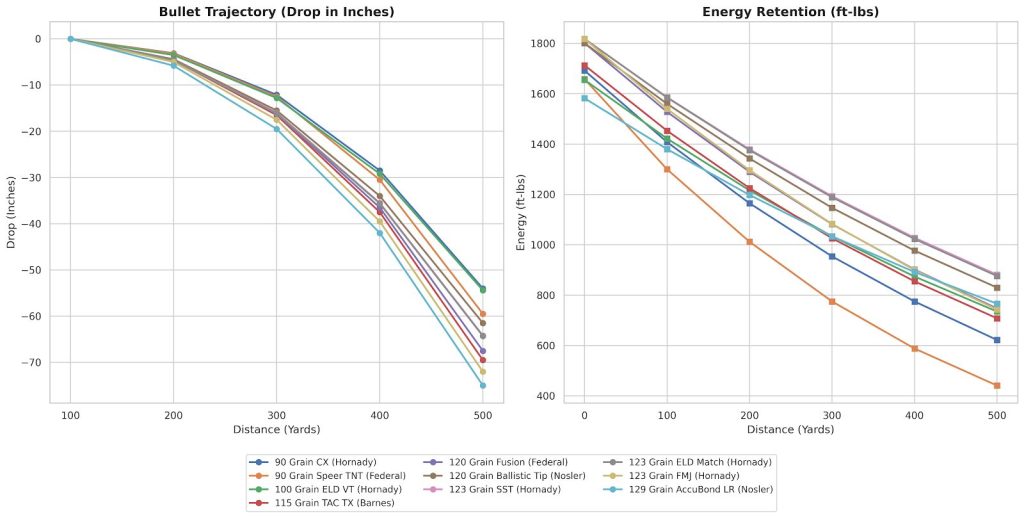
Understanding The Chart
A ballistics chart can look overwhelming at first glance due to the sheer amount of data presented. However, once you break down each column, the numbers paint a clear picture of how a specific load will perform in the field. Understanding these individual metrics is absolutely crucial for maximizing your success whether you are hunting large game animals or shooting steel targets at extreme distances.
Muzzle Velocity
Muzzle velocity is the exact speed at which the bullet exits the barrel of the firearm. It is measured in feet per second. This cartridge was meticulously engineered to provide an optimal balance of velocity and heavy bullet mass within a compact receiver format. A higher muzzle velocity generally results in a flatter trajectory because gravity has less time to pull the bullet downward before it reaches the intended target. The 6.5 Grendel generates highly respectable muzzle velocities that perform exceptionally well in short barrel platforms.
Retained Velocity
Retained velocity refers to the speed of the bullet at specific distances downrange, such as one hundred or five hundred yards. Air resistance constantly slows the bullet down as it travels through the atmosphere. Retained velocity is incredibly important for hunters because most expanding bullets require a specific minimum velocity to open up properly upon impact. Because this cartridge utilizes highly aerodynamic projectiles, it retains its speed much better than older traditional calibers.
Kinetic Energy
Kinetic energy is the amount of destructive force the bullet carries, measured in foot pounds. It is calculated using the weight of the bullet and its velocity at any given distance. Hunters must pay close attention to this metric on any 6.5 Grendel Energy Chart to ensure they have enough power to ethically harvest game animals. Generally, one thousand foot pounds of energy is the standard minimum recommended for deer size game, a threshold this cartridge comfortably exceeds past three hundred yards.
Trajectory
Trajectory indicates the actual path the bullet takes as it flies through the air, factoring in the constant downward pull of gravity. The 6.5 Grendel Trajectory Chart displays the bullet drop in inches at various yardages relative to your line of sight. By knowing the exact trajectory curve, shooters can adjust their aim to hit targets precisely without guessing. This cartridge experiences incredibly low bullet drop for its size, making distance estimation errors much more forgiving in the field.
Ballistic Coefficient
The Ballistic Coefficient is a numerical value that represents how efficiently a bullet cuts through the air. A higher number means the bullet is more aerodynamic and will retain its velocity and energy far better over long distances. High Ballistic Coefficient bullets also resist wind drift much better than bullets with a lower rating. The primary design goal of the 6.5 Grendel was to utilize bullets with incredibly high Ballistic Coefficient ratings in a short package.
Sectional Density
Sectional density is the ratio of a bullet weight to its diameter. This metric is a fantastic indicator of how deeply a bullet will penetrate into a target. A higher sectional density generally results in deeper penetration. Because this cartridge fires a relatively slender six and a half millimeter bullet, even moderate bullet weights possess excellent sectional density, which allows them to penetrate deeply through thick muscle and heavy bone on medium game animals.
Common 6.5 Grendel Bullet Weights
The cartridge is incredibly versatile, largely due to the wide variety of premium bullet weights it can fire accurately. Selecting the proper weight is the most important decision a shooter can make for a specific field application.
90 Grain
The 90 grain bullet is among the lightest options practically available for this cartridge. It offers blisteringly fast muzzle velocities that can approach three thousand feet per second. This weight is primarily used for target shooting or varmint hunting where flat trajectories are preferred over deep penetration. While it provides explosive terminal performance on coyotes, its lighter weight makes it shed velocity faster at extreme ranges compared to heavier alternatives.
95 Grain
The 95 grain bullet is heavily favored by predator hunters who utilize polymer tipped bullets like the Hornady V MAX. This weight provides an exceptional balance of speed and explosive terminal ballistics. It shoots incredibly flat out to three hundred yards and disintegrates upon impact, which prevents dangerous over penetration in areas where livestock or property might be a concern. It remains an absolute staple for dedicated coyote hunters.
100 Grain
Moving up slightly in weight, the 100 grain category includes advanced modern hunting designs like the Hornady ELD VT. These bullets offer an excellent balance of high velocity and highly reliable weight retention. This weight provides devastating terminal performance on predators and small deer. It shoots exceptionally flat at short distances and delivers tremendous hydrostatic shock upon impact, ensuring rapid and ethical harvests.
110 Grain
The 110 grain bullet bridges the gap perfectly between blazing speed and long range stability. This weight is often chosen by target shooters who desire low recoil combined with excellent aerodynamic properties. While slightly less popular for big game hunting, it serves exceptionally well for training drills and tactical shooting matches where rapid follow up shots are required.
115 Grain
The 115 grain category is heavily dominated by solid copper monolithic bullets like the Barnes TAC TX. Because solid copper is lighter than traditional lead, these bullets are naturally longer and retain nearly one hundred percent of their weight upon impact. They provide incredibly deep penetration on medium game while shooting remarkably flat. They are the ideal choice for hunting tough feral hogs or for hunters operating in jurisdictions that mandate lead free ammunition.
120 Grain
The 120 grain bullet is an industry standard weight for this caliber. Bullets in this class offer a phenomenal balance of incredible speed, manageable recoil, and massive kinetic energy. They slice through the wind effortlessly and provide outstanding terminal performance on medium game. For the average sportsman, a high quality 120 grain bonded bullet is arguably one of the most versatile choices available for general purpose hunting.
123 Grain
The 123 grain bullet is the flagship weight that launched this cartridge into legendary status. Options like the Hornady SST and ELD Match were purpose built to provide the ultimate performance. This specific weight strikes the perfect balance between muzzle velocity, massive kinetic energy retention, and unparalleled long range stability. It hits hard enough for ethical kills on large deer while maintaining a laser flat trajectory for open country hunting.
129 Grain
The 129 grain category includes modern high performance hunting bullets specifically engineered for extended ranges. Bullets like the Nosler AccuBond Long Range boast massive aerodynamic ratings, allowing them to retain lethal kinetic energy far beyond traditional hunting distances. They are ideal for shooters who want maximum wind resistance combined with highly reliable terminal performance on big game animals across wide open agricultural fields.
130 Grain
The 130 grain bullet represents the heaviest practical option commonly used in factory ammunition for this cartridge. These massive projectiles feature the highest aerodynamic ratings available and require significant energy to push down the barrel. While they launch at a slower muzzle velocity, they retain their momentum brilliantly. They are favored by specialized target shooters who demand maximum wind resistance at one thousand yards.
Effective Hunting Range
The 6.5 Grendel Effective Range is one of the most impressive attributes of the cartridge. It was designed from the ground up to be an absolute powerhouse for taking game animals at extended distances within a compact platform. Knowing the strict capabilities of the cartridge ensures ethical hunting practices in the field and prevents wounded game animals.
Whitetail Deer
For whitetail deer, this cartridge is highly effective out to four hundred yards when using proper expanding ammunition. The cartridge was specifically born to dominate the deer woods by providing high sectional density bullets that create massive wound channels. It delivers devastating hydrostatic shock and provides excellent knockdown power on medium game animals. The exceptionally flat trajectory makes hitting the vital zone remarkably simple for experienced marksmen.
Elk
Hunting elk with this cartridge is highly controversial and generally discouraged by most industry professionals. Elk are massive heavily boned animals that require deep penetration and massive kinetic energy transfer. While a perfectly placed heavy solid copper bullet could theoretically harvest a small elk at very close range, the cartridge simply lacks the required foot pounds of energy to guarantee a clean and ethical harvest on such large game. Hunters should utilize a larger caliber for elk.
Black Bear
Black bears share similar anatomy and toughness to wild hogs and large deer. A quality 120 grain to 123 grain bonded bullet will deliver devastating results on a black bear inside two hundred and fifty yards. The cartridge provides plenty of bone crushing penetration to reach the vital organs of a bear quickly and ethically, making it an absolute favorite among spot and stalk hunters operating in rugged woodland terrain.
Wild Hogs
Feral hogs are perhaps the perfect target for this cartridge. Tactical hog hunters who operate at night heavily favor the AR 15 platform for its rapid follow up shots. The cartridge provides significantly more knockdown power than standard intermediate rounds while maintaining incredibly low recoil. The deep penetrating ability of the six and a half millimeter bullets allows hunters to anchor large boars efficiently across massive agricultural fields.
Coyotes
When hunting coyotes and other predators, this cartridge performs flawlessly. With its laser flat trajectory and highly explosive bullet options, it hits with massive authority. Using lightweight 90 grain or 95 grain supersonic bullets, you can accurately harvest coyotes out to five hundred yards. The extreme energy transfer ensures instant ethical kills even with marginal shot placement on fast moving small predators.
Target Shooting
For general steel target shooting and range practice, the cartridge is incredibly fun and wildly effective. The exceptionally mild recoil makes it an absolute joy to shoot during long training sessions. The wide availability of affordable full metal jacket ammunition makes it highly economical for shooters who want to run their semi automatic rifles vigorously at the local shooting bay without destroying their shoulders or their wallets.
Long Range Shooting
In competitive precision rifle series matches and long range recreational shooting, the 6.5 Grendel Long Range Ballistics provide a massive advantage. The heavy 123 grain and 130 grain match bullets slice through the wind incredibly well. The cartridge easily reaches out past one thousand yards in the hands of an experienced marksman. It remains supersonic far longer than traditional short action military cartridges, ensuring accuracy at extreme distances.
Factors That Affect 6.5 Grendel Ballistics
Ballistics numbers are never completely static. The exact data provided in any 6.5 Grendel Velocity Chart will change constantly based on environmental conditions and the physical characteristics of your specific rifle setup. Understanding these distinct variables is the key to achieving true precision.
Barrel Length
Barrel length has a major direct impact on your final muzzle velocity. While the cartridge is highly efficient, maximizing its potential requires a proper barrel length. Most factory ballistics charts use a twenty four inch test barrel. If you hunt with a shorter sixteen inch tactical barrel, you will lose roughly two hundred feet per second of velocity. This velocity loss will slightly increase your bullet drop at extended distances and reduce your maximum effective hunting range.
Bullet Weight
The specific 6.5 Grendel Bullet Weight you select dictates your entire trajectory arc. Lighter bullets launch incredibly fast and fly extremely flat out to three hundred yards. Heavier bullets start out slightly slower but their superior aerodynamic shape allows them to overtake lighter bullets in both speed and energy retention at extremely long ranges. You must choose your ammunition based entirely on your specific shooting goals.
Bullet Design
The physical shape of your bullet matters just as much as its weight. A bullet with a sharp polymer tip and a sleek boat tail design will cut through the air with minimal drag. A bullet with a traditional flat base and an exposed lead nose will suffer from massive drag, causing it to lose velocity quickly and drop severely past four hundred yards. This cartridge is heavily optimized for modern low drag bullet designs.
Altitude
Shooting at high elevations dramatically improves your ballistic performance. Thin mountain air provides much less atmospheric resistance against the bullet. If you zero your rifle near sea level and travel to the high country for a backcountry hunt, your bullet will shoot noticeably flatter and impact slightly higher than your original data predicted. Always verify your zero at your hunting altitude to ensure absolute precision.
Temperature
Temperature shifts impact both the density of the air and the internal pressure of your cartridge chamber. Cold air is dense and creates more drag on the bullet. Freezing temperatures also slow down the burn rate of your gunpowder. Both of these factors combine to reduce velocity and significantly increase your overall 6.5 Grendel Bullet Drop in cold weather environments. Premium ammunition utilizes temperature stable powders to combat this exact issue.
Humidity
Humidity is often completely misunderstood by novice shooters. Humid air is actually less dense than dry air because water vapor is lighter than atmospheric nitrogen and oxygen molecules. Shooting in high humidity provides slightly less resistance for the bullet, resulting in a marginally flatter trajectory over extreme distances. However, this effect is very minor compared to altitude and severe temperature shifts.
Wind
Wind deflection is the greatest challenge in long range marksmanship. A heavy crosswind will literally push your bullet sideways off its intended path. Fortunately, the highly aerodynamic bullets used in this cartridge are specifically designed to resist wind drift better than almost any other caliber available today in a small format receiver. They cut through challenging gusts efficiently to deliver consistent impacts on small targets.
Twist Rate
The twist rate of a rifle barrel determines how fast the bullet spins in flight. To properly stabilize the extremely long 123 grain and 130 grain bullets, this cartridge absolutely requires a fast twist rate. Most manufacturers utilize a one in eight twist barrel. A slower twist rate will cause these long heavy bullets to tumble through the air and completely destroy your accuracy at extended ranges.
Zero Distance
Your selected zero distance establishes the mathematical foundation for your entire trajectory data table. If you zero at one hundred yards, all of your long range adjustments will be dialed upward on your scope turrets. Choosing a different zero distance completely shifts the arc of your bullet flight path relative to your line of sight. Shooters must thoroughly understand their specific zero data to succeed.
Best Zero Distance
Selecting the optimal zero distance depends entirely on how you plan to use your rifle in the field. Different applications require different zero strategies to maximize your success and minimize complicated mental math during stressful hunting situations.
25 Yard Zero
A twenty five yard zero is rarely used with this cartridge. Because the line of sight through the scope is mounted high above the bore on an AR 15 platform, zeroing at such a close distance forces the bullet into a steep upward angle. This causes the bullet to impact several inches too high at intermediate ranges, making precise shot placement on small game animals very difficult.
50 Yard Zero
A fifty yard zero can be highly practical for tactical shooters or hunters operating in extremely dense timber where long shots are virtually impossible. It keeps the bullet trajectory very tight to the line of sight at close range. However, for a cartridge designed specifically for extended long range performance, a fifty yard zero severely limits its true potential across open fields.
100 Yard Zero
The one hundred yard zero is the absolute gold standard for precision shooters and long range hunters. Factory 6.5 Grendel Hunting Ballistics data is almost exclusively calculated using this specific distance. It provides a clean and perfect mathematical baseline, allowing the shooter to easily dial their scope turrets upward for any extended distance engagement without ever holding under the target.
200 Yard Zero
For hunters who prefer to aim dead on without adjusting their scope turrets in the field, the two hundred yard zero is fantastic. It utilizes a maximum point blank range strategy. A bullet zeroed at two hundred yards will typically impact only about two inches high at one hundred yards, allowing a hunter to aim directly at the vitals of a deer out to nearly two hundred and fifty yards without calculating complex holdovers.
300 Yard Zero
A three hundred yard zero is occasionally used by dedicated open country coyote hunters. While it minimizes the bullet drop at extreme distances, it requires the shooter to remember that the bullet will impact significantly high at one hundred and two hundred yards. This can easily lead to shooting completely over the back of a target in the heat of the moment, making it a highly specialized choice.
For most hunters and all precision target shooters utilizing this specific cartridge, the one hundred yard zero is heavily recommended due to the ease of dialing scope turrets for precision.
6.5 Grendel Ballistics Compared To Other Cartridges
To truly appreciate the brilliant engineering behind this cartridge, we must compare it directly against its closest competitors in the hunting and precision shooting world. Below is a detailed comparison table outlining performance at five hundred yards using standard factory ammunition.
| Cartridge | Muzzle Velocity | Muzzle Energy | Trajectory At 500 Yards | Recoil | Effective Range | Long Range Performance | Hunting Performance |
| 6.5 Grendel | 2580 fps | 1818 ft lbs | 64.3 inches drop | Very Light | 800 Yards | Excellent | Excellent |
| 5.56 NATO | 3150 fps | 1210 ft lbs | 55.0 inches drop | Very Light | 500 Yards | Good | Fair |
| 6.8 SPC | 2460 fps | 1612 ft lbs | 79.0 inches drop | Light | 400 Yards | Poor | Very Good |
| 300 Blackout | 2375 fps | 1378 ft lbs | 122.5 inches drop | Very Light | 300 Yards | Poor | Good |
| 6.5 Creedmoor | 2700 fps | 2280 ft lbs | 54.0 inches drop | Light | 1000 Yards | Exceptional | Very Good |
When comparing the 6.5 Grendel to the standard 5.56 NATO cartridge, the modern design clearly dominates in terminal ballistics. While the 5.56 NATO shoots a tiny bullet at a faster initial velocity, the heavier bullets of the Grendel provide significantly better barrier penetration and knockdown power at all ranges. Furthermore, the heavier bullets buck the wind far better than the tiny military projectiles.
Against the popular 6.8 SPC, the ballistic performance heavily favors the Grendel past two hundred yards. The 6.8 SPC was designed for close quarters combat and uses blunt bullets that shed velocity rapidly. The Grendel utilizes long sleek bullets that retain their energy and velocity much further, making it vastly superior for long range target shooting and open country hunting.
The 300 Blackout was designed for extreme sound suppression and close range tactical applications. The 300 Blackout shoots heavy bullets very slowly, resulting in a severe rainbow trajectory. The Grendel completely outclasses the 300 Blackout in velocity, kinetic energy, and effective range, making it the superior choice for hunters who need to shoot past one hundred yards.
When stacked against its larger sibling, the 6.5 Creedmoor, the Grendel naturally falls behind in raw velocity and energy. The Creedmoor holds more powder and operates in a larger rifle platform, giving it a flatter trajectory. However, the Grendel provides incredibly similar aerodynamic efficiency with significantly less recoil, and it fits into a much smaller lightweight rifle platform, making it a favorite for mobile hunters.
Frequently Asked Questions
What is a 6.5 Grendel Ballistics Chart?
It is a comprehensive reference table that tracks the velocity, kinetic energy, and trajectory curve of the cartridge over various distances. Shooters heavily rely on this specific data to precisely calculate exactly how much their bullet will drop and drift in the wind, allowing for accurate elevation adjustments during extreme long range engagements.
How far is a 6.5 Grendel effective on deer?
This cartridge is highly effective on medium game out to four hundred yards when using premium heavy expanding bullets. The highly aerodynamic projectiles retain massive amounts of kinetic energy and velocity, ensuring deep penetration and rapid ethical kills at extended ranges.
How much does a 6.5 Grendel bullet drop at 500 yards?
With a standard one hundred yard zero, a typical 123 grain hunting bullet will drop roughly sixty four inches at five hundred yards. The exact drop depends heavily on your specific muzzle velocity, bullet design, barrel length, and local atmospheric conditions.
Is the 6.5 Grendel better than the 308 Winchester?
It is better for shooters who prioritize low recoil and lightweight platforms. While it lacks the massive kinetic energy of the larger 308 Winchester, it provides an incredibly similar trajectory out to four hundred yards while generating less than half the felt recoil.
What is the best 6.5 Grendel bullet weight for deer?
The best bullet weight for deer hunting falls heavily in the 120 grain to 123 grain range. Bullets in this specific weight class offer a brilliant balance of high muzzle velocity, incredibly flat trajectories, and rapid expansion that easily drops deer in their tracks at practical hunting distances.
Is a 6.5 Grendel suitable for elk?
No, the vast majority of professional hunting guides consider it far too weak for ethical elk hunting. Elk are massive heavy boned animals that demand exceptionally deep penetration and massive kinetic energy transfer. The cartridge simply lacks the required foot pounds of force to guarantee a clean and ethical harvest on such large game.
What is the best zero distance for this cartridge?
For precision target shooters and long range hunters who dial their scope turrets, a one hundred yard zero is heavily recommended. It provides a highly simplified and perfectly clean mathematical baseline for calculating all extreme long range elevation adjustments in the field.
Can a 6.5 Grendel reach 1000 yards?
Yes, it is specifically designed from its inception to excel at one thousand yards and beyond. When loaded with heavy 123 grain match bullets, it provides incredible wind resistance, remains supersonic well past the one thousand yard mark, and is highly competitive in precision rifle series matches.
Does barrel length affect velocity?
Yes, barrel length has a major direct impact on muzzle velocity. Factory data is typically generated using a twenty four inch barrel. Cutting the barrel down to sixteen inches for tactical applications or sound suppressor use will result in roughly two hundred feet per second of velocity loss.
What is the fastest factory loaded ammunition?
The fastest factory options are the lightweight 90 grain varmint loads, which easily leave a twenty four inch barrel at over two thousand nine hundred feet per second. These specific loads provide the absolute flattest possible trajectory inside three hundred yards for dedicated predator hunters.
Conclusion
Understanding a 6.5 Grendel Ballistics Chart is absolutely essential for any shooter who wants to extract the maximum performance from this incredibly efficient modern cartridge. Whether you are analyzing a trajectory table to prepare for a precision rifle match or studying an energy chart to ensure you have enough stopping power for a large whitetail deer, this exact data provides the foundation for your success in the field. The numbers clearly demonstrate exactly why this cartridge has taken the hunting and competitive shooting world by storm.
By thoroughly mastering your data, learning exactly how different bullet weights perform at extreme distances, and selecting the absolute optimal zero distance, you eliminate all guesswork from your shooting routine entirely. The effective range of this cartridge is exceptionally vast, making it the perfect heavy hitting long range tool for the modern sporting rifle platform. With incredibly high aerodynamic efficiency, highly manageable recoil, and devastating terminal performance, the 6.5 Grendel continues to prove that it represents the absolute pinnacle of intermediate rifle cartridge design.