The main difference between the 6.5 Creedmoor and the .270 Winchester is that the .270 Winchester utilizes a much larger long action casing to deliver significantly higher muzzle velocities and a flatter trajectory for hunting medium game across open plains, while the 6.5 Creedmoor utilizes high ballistic coefficient bullets in a highly efficient short action package to provide superior wind resistance and milder recoil for precision target shooting. For decades, the .270 Winchester has reigned supreme as the classic American hunting cartridge, offering explosive terminal performance and a flight path that forgives ranging errors. The 6.5 Creedmoor represents modern ballistic science, proving that heavy and aerodynamic bullets can conquer long distances without relying on massive powder charges or punishing the shooter’s shoulder. Deciding between these two legendary cartridges requires analyzing your hunting environment and determining whether you value raw speed or modern efficiency.
Table of Contents [Click to minimize]
6.5 Creedmoor vs 270 Ballistics Chart
| Specification / Metric | 6.5 Creedmoor (143 gr ELD-X) | .270 Winchester (130 gr SST) |
| Cartridge | 6.5 Creedmoor | .270 Winchester |
| Parent Case | .30 TC | .30-06 Springfield |
| Bullet Diameter | .264 inches | .277 inches |
| Typical Bullet Weight | 120 to 147 grains | 130 to 150 grains |
| Muzzle Velocity | 2,700 fps | 3,060 fps |
| Velocity at 100 Yards | 2,556 fps | 2,840 fps |
| Velocity at 200 Yards | 2,417 fps | 2,630 fps |
| Velocity at 300 Yards | 2,282 fps | 2,430 fps |
| Velocity at 500 Yards | 2,025 fps | 2,060 fps |
| Muzzle Energy | 2,315 ft-lbs | 2,702 ft-lbs |
| Energy at 100 Yards | 2,075 ft-lbs | 2,328 ft-lbs |
| Energy at 200 Yards | 1,855 ft-lbs | 1,996 ft-lbs |
| Energy at 300 Yards | 1,654 ft-lbs | 1,704 ft-lbs |
| Energy at 500 Yards | 1,302 ft-lbs | 1,225 ft-lbs |
| Bullet Drop (500 Yds, 200 Yd Zero) | -44.5 inches | -36.5 inches |
| Wind Drift (500 Yds, 10 mph Wind) | 16.0 inches | 18.5 inches |
| Ballistic Coefficient (G1) | 0.625 | 0.460 |
| Sectional Density | 0.293 | 0.242 |
| Effective Hunting Range | 500 to 600 yards | 500 to 600 yards |
| Maximum Effective Range | 1,200 yards | 800 yards |
| Typical Twist Rate | 1:8 | 1:10 |
| Recoil (Free Recoil Energy) | ~15.0 ft-lbs | ~17.0 ft-lbs |
| Trajectory | Very flat and predictable | Exceptionally flat |
| Barrel Life | 2,000 to 3,000 rounds | 3,000 to 4,000 rounds |
| Accuracy Potential | Superb for precision target | Excellent for hunting |
| Hunting Performance | Deer, antelope, feral hogs | Mule deer, sheep, antelope |
| Target Shooting Performance | The gold standard inside 1,200 yds | Good for long range hunting |
| Long-Range Performance | Supersonic past 1,200 yards | Supersonic past 1,000 yards |
| Ammunition Availability | Exceptionally high | Very High |
| Ammunition Cost | Moderate | Moderate |
| Rifle Availability | Universal in short actions | Common in long actions |
| Magazine Compatibility | Standard short action / AR-10 | Standard long action |
| Suppressor Compatibility | Excellent | Excellent |
| Best Use Cases | Precision shooting, open plains hunting | Traditional open plains hunting |
| Main Advantages | High BC, wind bucking, short action | Flat trajectory, massive initial velocity |
| Main Disadvantages | Slower initial velocity | Long action, heavier wind drift |
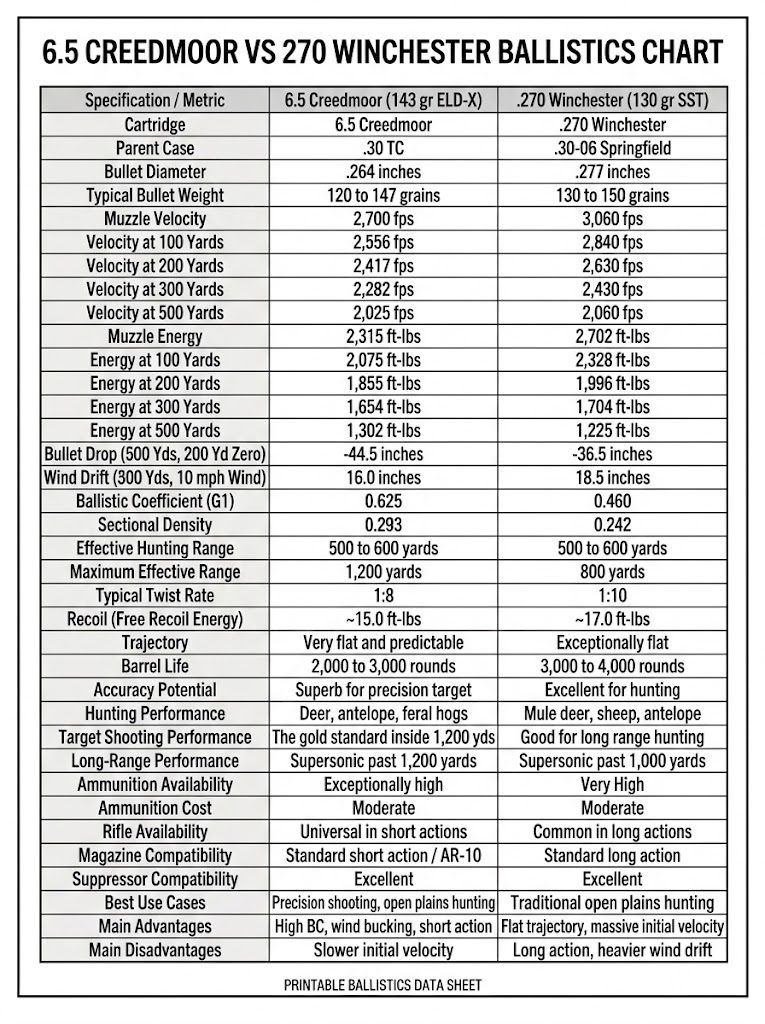
The comparison table reveals how massive powder capacity competes against modern aerodynamic efficiency. The .270 Winchester boasts a significantly larger case, allowing it to pack more gunpowder behind a slightly lighter bullet. This results in a blazing muzzle velocity that exceeds 3,000 feet per second. Because it starts so much faster, the .270 Winchester generates more kinetic energy at the muzzle and maintains a noticeably flatter trajectory out to 500 yards.
However, the 6.5 Creedmoor utilizes heavy for caliber bullets with exceptional aerodynamic designs. While it leaves the barrel roughly 360 feet per second slower than the .270 Winchester, it retains its speed much better. By the time both bullets cross the 500 yard mark, their velocities are nearly identical, and the 6.5 Creedmoor actually retains slightly more kinetic energy.
The sleek bullet design of the 6.5 Creedmoor also provides a major advantage in wind deflection, drifting over two inches less than the .270 Winchester in a crosswind at 500 yards. Furthermore, the 6.5 Creedmoor fits perfectly into lighter, faster cycling short action rifles and produces less felt recoil. The .270 Winchester remains the absolute king of point and shoot hunting trajectories, while the 6.5 Creedmoor provides superior mathematical precision and shooting comfort.
Detailed Comparison Sections
Understanding the Comparison Chart
To truly understand the differences between these two cartridges, you must look at their intended designs. The .270 Winchester is a necked down .30-06 Springfield, created almost a century ago to give hunters a flat shooting option for hitting animals across wide canyons without calculating complex scope adjustments. The 6.5 Creedmoor was developed in 2007 by Hornady specifically for long range target competitors who needed a highly efficient, wind defying cartridge that would not fatigue their shoulders over a multi day match.
How to Read the Ballistics Chart
When analyzing this ballistics chart for your next rifle purchase, pay special attention to bullet drop, wind drift, and retained energy. Bullet drop tells you how flat the cartridge shoots, making range estimation easier. Wind drift tells you how reliable the cartridge will be in poor weather conditions. Retained energy dictates whether the bullet will have enough force to ethically harvest an animal at your maximum shooting distance.
Velocity Comparison
The .270 Winchester is famous for its extreme velocity. Firing a traditional 130 grain bullet, it leaves the muzzle at 3,060 fps. The 6.5 Creedmoor, firing a heavier 143 grain bullet, leaves at roughly 2,700 fps. This initial speed gap gives the .270 Winchester a massive head start. However, because the 6.5 Creedmoor bullet is far more aerodynamically efficient, it sheds velocity at a much slower rate. By the time they reach 500 yards, both bullets are traveling right around 2,050 fps.
Energy Comparison
At the muzzle, the .270 Winchester generates 2,702 foot-pounds of energy, easily surpassing the 2,315 foot-pounds of the 6.5 Creedmoor. This extra initial power makes the .270 Winchester incredibly devastating on medium game at close and intermediate ranges. Because the 6.5 Creedmoor retains its velocity better, the energy gap closes completely downrange. At 500 yards, the 6.5 Creedmoor actually delivers slightly more kinetic energy than the .270 Winchester, ensuring deep penetration at extended distances.
Trajectory Comparison
A flat trajectory is the primary reason hunters have loved the .270 Winchester for decades. It removes the guesswork when aiming at targets across open fields.
Bullet Drop Comparison
If you zero both rifles at 200 yards, the .270 Winchester requires significantly less holdover at extended ranges. At 500 yards, the .270 Winchester drops only 36.5 inches. The 6.5 Creedmoor will drop roughly 44.5 inches. If you misjudge the distance to an animal in the field, the flat path of the .270 Winchester makes it much more likely you will still hit the vital zone.
Wind Drift Comparison
Wind pushes fast, lightweight bullets off course quickly. The high ballistic coefficient of the 6.5 Creedmoor allows it to slice through the wind beautifully. In a 10 mph crosswind at 500 yards, the 6.5 Creedmoor drifts only 16.0 inches. The .270 Winchester drifts roughly 18.5 inches under the exact same conditions. This superior wind resistance makes the 6.5 Creedmoor the clear favorite for precision target shooters.
Ballistic Coefficient Comparison
Ballistic Coefficient measures how efficiently a bullet glides through the air. The long, heavy 143 grain bullets of the 6.5 Creedmoor boast excellent G1 BC ratings often exceeding 0.600. The standard 130 grain .270 Winchester bullet is relatively short by comparison, yielding a BC of roughly 0.460. This massive BC advantage is precisely why the slower 6.5 Creedmoor eventually catches up to the .270 Winchester in downrange energy and velocity.
Accuracy Comparison
Both cartridges are mechanically capable of extreme precision. The 6.5 Creedmoor is inherently accurate due to its modern chamber design, which seats long bullets optimally for consistent barrel engagement. It is currently the gold standard in competitive precision shooting. The .270 Winchester is highly accurate in a quality hunting rifle, but it is rarely used in precision competitions because factory rifles typically lack the fast twist rates needed to stabilize the heaviest target bullets.
Effective Range Comparison
For competitive target shooting on steel plates, the 6.5 Creedmoor comfortably stretches to 1,200 yards before it drops into the transonic zone. The standard .270 Winchester is a reliable 800 to 1,000 yard target round. For practical hunting, both cartridges are highly effective out to 500 or 600 yards on deer sized game, provided the shooter does their part in calculating wind and drop.
Hunting Performance Comparison
If you are hunting mule deer, sheep, or antelope across wide open plains where shots frequently exceed 300 yards, the flat trajectory of the .270 Winchester is incredibly forgiving. If you are hunting in windy conditions or want to ensure maximum penetration at 500 yards, the 6.5 Creedmoor offers exceptional performance. Both cartridges are perfectly suited for all medium game in North America.
Target Shooting Comparison
The 6.5 Creedmoor is the absolute best choice for high volume target shooting. The modern short action design allows for faster bolt cycling, and the incredibly mild recoil prevents shoulder fatigue during long strings of fire. The .270 Winchester heats up rifle barrels very quickly, requires a longer bolt throw, and produces more recoil, making it less ideal for a dedicated day at the shooting range.
Long-Range Performance Comparison
The 6.5 Creedmoor dominates the extreme long-range category. Because the .270 Winchester relies on lighter bullets with lower ballistic coefficients, it gets pushed around by shifting crosswinds much more easily. The 6.5 Creedmoor keeps its high BC bullets supersonic and stable for a significantly longer flight time, resulting in tighter groups and more predictable impacts past 800 yards.
Recoil Comparison
Felt recoil dictates how comfortable a rifle is to shoot over a long afternoon. Both cartridges are very manageable for adult shooters, but the 6.5 Creedmoor is noticeably milder. The 6.5 Creedmoor generates roughly 15.0 foot-pounds of free recoil energy, feeling like a very light push. The .270 Winchester generates roughly 17.0 foot-pounds of recoil, producing a slightly sharper and snappier kick due to its high muzzle velocity and heavier powder charge.
Barrel Life Comparison
Burning massive amounts of gunpowder degrades rifle barrels. The .270 Winchester acts like a cutting torch in the throat of the barrel due to its high case capacity and high velocity, typically limiting peak precision life to roughly 3,000 to 4,000 rounds. The 6.5 Creedmoor is slightly more efficient, but the high pressures pushed through a small bore mean a precision match barrel will still wear out after roughly 2,000 to 3,000 rounds.
Ammunition Cost Comparison
Both cartridges are incredibly popular and widely produced, which keeps prices competitive. The .270 Winchester is strictly a civilian hunting cartridge, meaning most factory options are loaded with premium hunting bullets. The 6.5 Creedmoor is highly popular for both hunting and target shooting, meaning you can easily find affordable full metal jacket target loads alongside premium hunting options. Overall, costs are moderate for both.
Ammunition Availability
You will never have an issue finding ammunition for either of these cartridges. The .270 Winchester has been a staple in hardware stores and sporting goods retailers since 1925. The 6.5 Creedmoor is the most popular modern centerfire cartridge in the world and occupies massive amounts of shelf space in every gun shop across the country.
Rifle Compatibility
The 6.5 Creedmoor holds a distinct advantage in firearm selection. Because it is a short action cartridge, it can be chambered in highly compact, lightweight bolt action rifles and fits perfectly into the semi automatic AR-10 platform. The .270 Winchester requires a standard long action receiver, meaning the rifles are generally heavier and require a longer bolt throw to cycle a new round.
Pros and Cons of 6.5 Creedmoor
Pros:
- Laser focused precision and superior wind resistance.
- Extremely mild recoil prevents shooter fatigue.
- Retains kinetic energy exceptionally well at extreme distances.
- Fits perfectly into compact short action rifles and AR-10s.
Cons:
- Lower initial muzzle velocity.
- Lower muzzle energy compared to traditional hunting magnums.
Pros and Cons of .270 Winchester
Pros:
- Exceptionally flat trajectory out to 500 yards.
- Massive initial velocity and kinetic energy.
- Over a century of proven hunting reliability.
- Very manageable recoil for an open country hunting cartridge.
Cons:
- Requires a heavier long action rifle.
- Slower twist rates limit the use of the heaviest modern bullets.
Which Cartridge Is Better for Beginners?
The 6.5 Creedmoor is the absolute best centerfire rifle cartridge for beginners. The recoil is incredibly forgiving, allowing new shooters to learn solid fundamentals without fear of the rifle kicking them. Additionally, the high ballistic coefficient bullets naturally correct minor wind reading errors, making it easier for a beginner to successfully hit targets at distance.
Which Cartridge Is Better for Hunting?
This depends on your hunting style. If you hunt in open canyons where you might need to take a quick shot at 300 yards without having time to dial your scope, the laser flat trajectory of the .270 Winchester is the ultimate tool. If you hunt in consistently windy conditions or prefer a highly compact, lightweight short action rifle for climbing mountains, the 6.5 Creedmoor is the superior choice.
Which Cartridge Is Better for Long-Range Shooting?
The 6.5 Creedmoor easily wins the long-range category. Traditional .270 Winchester rifles simply cannot stabilize the heavy, high BC bullets required to shoot accurately past 800 yards in the wind. The 6.5 Creedmoor was built from the ground up specifically to conquer the wind and ring steel targets at 1,000 yards.
Which Cartridge Should You Choose?
Choose the .270 Winchester if you want a classic, blazing fast hunting rifle that allows you to aim dead on your target out to 300 yards without worrying about bullet drop. Choose the 6.5 Creedmoor if you want a highly versatile, low recoil rifle for precision target matches and highly efficient medium game hunting.
Verdict
The .270 Winchester and the 6.5 Creedmoor are two of the most successful rifle cartridges ever designed, and they perfectly represent the changing philosophies in ballistics over the last century. The .270 Winchester relies on pure muzzle velocity. It solves the problem of bullet drop by pushing a lighter projectile as fast as safely possible, making it incredibly forgiving at practical hunting distances. The 6.5 Creedmoor represents the modern era of ballistic efficiency. By utilizing heavy, highly aerodynamic bullets, it defies the wind and retains its energy without requiring massive powder charges or heavy long action rifles. If your primary goal is pointing and shooting at medium game across open fields, the .270 Winchester remains a legend. If you demand modern precision, low recoil, and effortless long range target shooting, the 6.5 Creedmoor is the clear path forward.
FAQs
Is the .270 more powerful than the 6.5 Creedmoor?
At the muzzle, the .270 Winchester is more powerful, generating roughly 400 foot pounds more kinetic energy due to its massive powder capacity and high velocity. However, because the 6.5 Creedmoor utilizes highly aerodynamic bullets, it retains its energy much better. At 500 yards, the 6.5 Creedmoor actually delivers slightly more kinetic energy than the .270 Winchester.
Can you use a .270 Winchester for elk hunting?
Yes, the .270 Winchester is a highly capable and historically proven elk cartridge. When loaded with premium, deep penetrating 150 grain bullets, it offers plenty of kinetic energy to ethically harvest an elk with proper shot placement.
Why is the 6.5 Creedmoor so popular?
The 6.5 Creedmoor democratized long range shooting. It provided average shooters with an affordable, short action cartridge that offered incredibly mild recoil and factory ammunition capable of accurately hitting targets at 1,000 yards.
Does a .270 kick harder than a 6.5 Creedmoor?
Yes. The .270 Winchester generates slightly more recoil than the 6.5 Creedmoor. Because the .270 utilizes a much larger powder charge to achieve its extreme velocities, it creates a sharper, snappier rearward force against the shooter’s shoulder.
What parent case is the .270 Winchester based on?
The .270 Winchester was created by taking a standard .30-06 Springfield brass casing and necking it down to accept a smaller .277 caliber bullet. This provides a massive powder capacity for the lighter projectile, resulting in its blistering muzzle velocities.