This 6.5 Creedmoor reloading manual serves as a comprehensive reference guide to the terminology, processes, and equipment necessary for safely assembling ammunition for this popular cartridge. Ammunition handloading requires strict adherence to safety protocols and established mechanical specifications. Reloaders must always rely on current, published load data from reputable powder and bullet manufacturers to determine safe minimum and maximum charge weights. Attempting to develop loads without consulting a published manual can result in catastrophic firearm failure and severe injury.
| Component / Stage | What It Covers |
|---|---|
| Brass Cases | The foundational housing that holds all other components together and expands to seal the rifle chamber. |
| Primers | The ignition source seated in the base of the brass case. |
| Powder | The smokeless propellant that generates the pressure required to push the bullet down the barrel. |
| Bullets | The projectile seated at the mouth of the case. |
| Reloading Press | The mechanical leverage tool used to size brass and seat bullets. |
| Dies | Caliber specific steel cylinders that thread into the press to shape the brass and seat the bullet. |
| Case Preparation | The process of inspecting, cleaning, and modifying fired brass to accept new components safely. |
| Priming | The mechanical seating of a new primer into the case primer pocket. |
| Powder Charging | Measuring and dispensing an exact weight of smokeless powder into the prepared case. |
| Bullet Seating | Pressing the projectile into the case mouth to a specific overall length. |
| Crimping | Applying inward pressure to the case mouth to secure the bullet tightly, if required. |
| Inspection | Final visual and dimensional checks of the completed ammunition before use. |
| Storage | Properly securing completed ammunition in cool, dry environments away from hazards. |
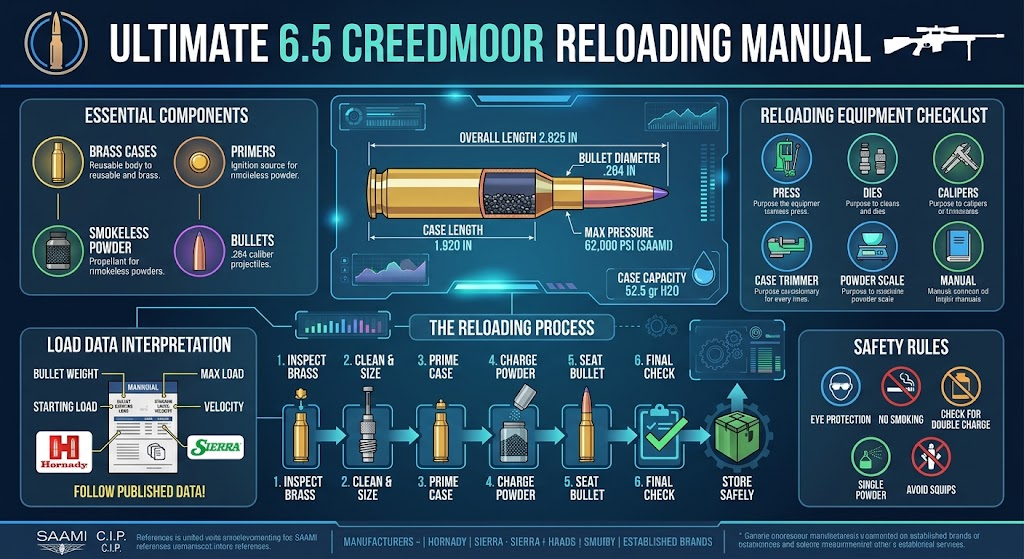
6.5 Creedmoor Cartridge Specifications
The 6.5 Creedmoor is a standardized centerfire rifle cartridge introduced by Hornady. The cartridge dimensions and maximum pressure specifications are regulated by SAAMI (Sporting Arms and Ammunition Manufacturers’ Institute) in the United States and C.I.P. (Commission Internationale Permanente pour l’Epreuve des Armes à Feu Portatives) in Europe. Cartridge specifications dictate the physical dimensions required for ammunition to chamber safely, which must remain distinct from specific handloading powder data.
- Case length: 1.920 inches (48.8 mm)
- Overall cartridge length: 2.825 inches (71.8 mm)
- Bullet diameter: .264 inches (6.7 mm)
- Neck diameter: .2950 inches (7.49 mm)
- Shoulder diameter: .4620 inches (11.73 mm)
- Base diameter: .4703 inches (11.95 mm)
- Rim diameter: .4730 inches (12.01 mm)
- Rim thickness: .054 inches (1.4 mm)
- Maximum pressure (SAAMI): 62,000 psi
- Maximum pressure (C.I.P.): 63,091 psi (435.00 MPa)
- Case capacity: 52.5 grains of H2O (3.40 cubic centimeters)
6.5 Creedmoor Reloading Components
Understanding the physical properties of reloading components ensures consistent ammunition assembly.
Brass: The case is the reusable body of the cartridge. Variations exist in internal capacity between different manufacturers (such as Hornady, Lapua, Alpha Munitions, or Peterson) due to differences in web and wall thickness. These internal volume differences directly affect the pressure generated by a given powder charge.
Primers: 6.5 Creedmoor brass is uniquely manufactured with either Large Rifle or Small Rifle primer pockets, depending on the brass manufacturer. Primers provide the critical spark that ignites the smokeless powder.
Smokeless powder: The propellant used in modern ammunition. Different powders possess different burn rates. Reloaders must select a powder designed specifically for the cartridge case capacity and the bullet weight being used.
Bullets: Projectiles in .264 caliber come in various profiles and construction types intended for specific applications like target shooting or hunting. Bullet weight, bearing surface, and overall length impact the powder space available inside the case.
6.5 Creedmoor Brass
New brass: Unfired cases straight from the factory. While generally ready to load, many handloaders choose to size and chamfer the case mouths before their first use to ensure uniform neck tension.
Once-fired brass: Cases that have been fired in a rifle chamber. They have expanded to match the dimensions of that specific chamber and must be resized before being loaded again.
Case inspection: Visual examination of the brass for cracks, splits, or impending head separation prior to any reloading steps.
Case cleaning: Removing carbon fouling and dirt from the brass to prevent scoring the reloading dies and to allow for accurate visual inspections.
Case sizing: Using a steel die to compress the fired brass back into standard SAAMI specifications so it will chamber freely.
Case trimming: Cutting the case mouth back to the standard trim length. Brass flows forward during firing and sizing, increasing the overall case length.
Case neck condition: Checking the case mouth for dents or splits, and ensuring the inside of the neck is smooth enough to accept a bullet uniformly.
Case primer pockets: The recess at the base of the case where the primer seats. These must be cleaned of carbon residue and occasionally checked for looseness, which indicates excessive pressure.
Case flash holes: The small hole connecting the primer pocket to the main powder chamber. Some reloaders deburr this hole to ensure a uniform flame front.
Case defects: Any structural compromise in the brass, such as a cracked neck or a loose primer pocket. Defective brass must be crushed and discarded safely.
Case separation: A dangerous condition where the brass begins to thin near the web above the case head, eventually leading to a complete rupture upon firing.
Case storage: Processed or unprocessed brass should be stored in labeled bins or bags in a dry environment to prevent corrosion.
6.5 Creedmoor Primers
Primer types: As noted, 6.5 Creedmoor brass is manufactured to accept either Large Rifle primers or Small Rifle primers. The handloader must verify their brass type before purchasing primers. Standard and Magnum variations exist for both sizes.
Primer dimensions: Small Rifle primers measure approximately .175 inches in diameter, while Large Rifle primers measure approximately .210 inches.
Primer construction: A primer consists of a metallic cup, an anvil, and a highly friction sensitive chemical compound.
Primer sensitivity: Different primer brands have different cup hardness levels. A harder cup may resist primer flow at higher pressures but requires a stronger firing pin strike for reliable ignition.
Primer manufacturers: Major manufacturers include Federal, CCI, Winchester, Remington, and Fiocchi.
Primer storage: Primers must be kept in their original factory packaging in a cool, dry place away from any sources of ignition, static electricity, or smokeless powder storage.
Primer inspection: Examining seated primers to ensure they are seated slightly below flush with the case head and that no anvils are exposed or crushed.
6.5 Creedmoor Powder
What smokeless powder does: Smokeless powder is a chemical propellant that, when ignited in a confined space, burns rapidly and generates expanding gases that propel the bullet. It does not detonate like high explosives.
Burn-rate differences: Powders burn at different speeds. The 6.5 Creedmoor generally performs best with medium to slow burning rifle powders.
Temperature sensitivity: Certain powders burn faster when the ambient temperature is hot, which increases chamber pressure. Modern “extreme” or temperature stable powders are formulated to minimize this variance.
Powder manufacturers: Common suppliers include Hodgdon, Alliant, Vihtavuori, IMR, and Winchester.
Published load data: Safe loading parameters established by ballistic laboratories using calibrated pressure testing equipment. This data dictates the safe starting charge and the absolute maximum charge.
Why powder substitutions are unsafe: Powders with similar names or adjacent positions on a burn rate chart are not interchangeable. Substituting powders based on assumptions can cause instant, catastrophic pressure spikes.
Why published data must be followed: Firearm chambers are designed to withstand specific maximum pressures. Exceeding published maximum powder charges risks destroying the firearm and causing severe injury to the shooter.
6.5 Creedmoor Bullets
| Bullet Weight | Common Bullet Type | General Application |
|---|---|---|
| 120 grain | Monolithic Copper / Polymer Tip | Varmint, Light game, Target |
| 123 grain | Hollow Point Boat Tail / Target | Target shooting, Mid range competition |
| 130 grain | Polymer Tip / Hybrid Target | Medium game hunting, Precision rifle |
| 135 grain | Hybrid Target / Monolithic | Target shooting, Precision rifle |
| 140 grain | Hollow Point Boat Tail / Polymer Tip | Long range target, Medium to heavy game |
| 143 grain | Heavy Polymer Tip Hunting (ELD-X) | Long range hunting, Target |
| 147 grain | Heavy Match (ELD-M) | Extreme long range competition |
| 150 grain | Ultra Heavy Match | Extreme long range, Specialized twist rates |
Bullet construction varies greatly. Target bullets often feature thin jackets and hollow points designed strictly for aerodynamic efficiency, while hunting bullets feature thicker jackets or bonded cores designed for controlled expansion and weight retention upon impact. A high ballistic coefficient (BC) indicates the bullet can overcome air resistance well, maintaining velocity and resisting wind deflection over long distances. Sectional density refers to a bullet’s weight relative to its diameter, which typically influences target penetration.
6.5 Creedmoor Reloading Dies
Full-length sizing dies: These dies squeeze the entire body of the fired case and push the shoulder back to standard specifications, ensuring the brass will chamber in any rifle.
Neck sizing dies: These dies only constrict the neck of the case to hold the bullet, leaving the fire formed body untouched.
Seating dies: Used to push the projectile into the charged case to the desired overall length.
Crimp dies: A separate die that pinches the case mouth into the bullet to prevent it from moving during recoil or feeding.
Die sets: Standard packages generally sold with one full length sizing die and one seating die.
Bushing dies: Sizing dies that use interchangeable cylindrical inserts in the neck area, allowing the reloader to set a very precise amount of neck tension.
Micrometer seating dies: Advanced seating dies featuring a dial adjustment on top to control bullet seating depth in increments of .001 inches.
6.5 Creedmoor Reloading Equipment
| Equipment | Purpose |
|---|---|
| Reloading Press | Provides the mechanical leverage to size brass and seat bullets. |
| Dies | Caliber specific tools that shape the brass and seat the projectile. |
| Shell Holder | Secures the base of the cartridge to the press ram. |
| Case Trimmer | Cuts elongated brass back to the correct case length. |
| Calipers | Precision measuring tool used for checking case length and overall cartridge length. |
| Case Cleaning Equipment | Tumblers or ultrasonic cleaners used to remove carbon fouling from brass. |
| Priming Equipment | Hand tools or press mounted tools to seat new primers. |
| Powder Scale | A highly sensitive digital or beam scale to weigh powder charges in grains. |
| Powder Measure | A mechanical hopper that dispenses consistent volumes of powder. |
| Bullet Seating Equipment | The specific seating die used to press the bullet into the case. |
| Case Gauges | Drop-in steel blocks machined to SAAMI specs to verify loaded ammunition will chamber. |
| Loading Manual | The physical book providing safe, tested powder charge data. |
| Safety Equipment | Safety glasses and a clean, organized workspace to prevent distractions. |
6.5 Creedmoor Case Preparation
Inspection: Examining raw or fired brass for defects, splits, and head separation rings.
Cleaning: Tumbling the brass in dry media, wet tumbling with steel pins, or using sonic cleaners to remove debris.
Lubrication: Applying a specific reloading wax or oil to the exterior of the case body (and lightly inside the neck) to prevent the brass from permanently sticking inside the sizing die.
Sizing: Running the lubricated case into the sizing die to reduce its dimensions and bump the shoulder back.
Decapping: Pushing the spent primer out of the case. This usually happens simultaneously during the sizing step.
Trimming: Using a cutting tool to square the case mouth and reduce the brass to the specified trim length.
Deburring: Using a chamfer and deburring tool to remove the sharp metal burrs left on the inside and outside of the case mouth after trimming.
Primer-pocket inspection: Cleaning carbon out of the primer pocket and ensuring the pocket is tight enough to hold a new primer securely.
Neck inspection: Checking the interior of the neck to ensure it is smooth and properly sized.
Final measurement: Using calipers to confirm the prepared case meets dimensional specifications before adding powder.
6.5 Creedmoor Reloading Process
- Inspect components: Verify you have the correct bullets, correct primers, correct powder, and the appropriate published load data manual.
- Prepare brass: Clean, inspect, and lubricate the empty cases.
- Size and deprime: Run the cases through the sizing die to restore dimensions and remove the old primer.
- Inspect cases: Check length, trim if necessary, deburr the mouths, and wipe off the case lubricant.
- Prime cases: Seat the correct new primers firmly into the primer pockets until they are slightly below flush with the case head.
- Measure powder according to published data: Set up your powder scale and verify the starting charge weight indicated in the manual.
- Charge cases: Dispense the exact weighed powder charge into each primed case. Visually inspect the cases with a flashlight to verify powder levels are uniform.
- Seat bullets according to published data: Place a bullet on the charged case mouth and run it into the seating die. Adjust the die until the cartridge matches the overall length listed in the manual.
- Inspect completed ammunition: Wipe the cartridges clean, check them in a case gauge, and verify there are no seated primers protruding.
- Store ammunition safely: Place the loaded ammunition in a plastic cartridge box, label it clearly with the load data, and store it in a cool, dry place.
6.5 Creedmoor Load Data
Load data tables provide the tested parameters for safe ammunition assembly. Reloaders must know how to interpret this data correctly.
Cartridge: Ensure the page explicitly states 6.5 Creedmoor. Do not use data for similar cartridges like .260 Remington or 6.5 Grendel.
Bullet manufacturer: Data is often specific to a brand because bullet bearing surfaces vary.
Bullet weight: Listed in grains. You must use data matched to the exact weight of your projectile.
Bullet type: The specific model of the bullet (e.g., SST, ELD-M, MatchKing).
Powder: The exact brand and model of smokeless powder used in the test.
Primer: The primer brand and type (Standard or Magnum, Large or Small) used during laboratory testing.
Case: The brand of brass used, which can affect internal volume.
Starting load: The minimum safe powder charge. Reloaders must always begin at this weight and slowly work up.
Maximum load: The absolute highest powder charge tested to be safe. Never exceed this number.
Velocity: The expected muzzle velocity (in feet per second) for the listed powder charge.
Pressure: Sometimes listed in PSI or CUP. It indicates the chamber pressure generated by the maximum load.
Test barrel: The length and twist rate of the barrel used in the laboratory to record the velocity data.
Load data from different manuals should not be mixed indiscriminately. Different manuals use different lots of powder, different test barrels, and different brass brands, meaning their maximum loads will often differ. Always stick to the data provided by the manufacturer of the specific powder or bullet you are currently loading.
6.5 Creedmoor Reloading Safety
Published load data: Always use data from a current manual supplied by the powder or bullet manufacturer.
Component identification: Keep components in their original factory packaging. Never guess the identity of an unmarked powder.
Powder identification: Only keep one container of powder on your bench at any given time to prevent accidental mixing.
Primer identification: Ensure you are using the correct primer size and type called for in the manual.
Double-charge prevention: Always visually inspect every charged case in a loading block with a flashlight before seating bullets to ensure no case accidentally received two powder drops.
Case inspection: Discard any brass showing signs of stress, splitting, or loose primer pockets.
Pressure signs: Understand how to read fired brass for indications of excessive pressure.
Squib hazards: A squib load occurs when a case has a primer but no powder. The bullet will lodge in the barrel, creating a catastrophic obstruction if a second shot is fired.
Damaged ammunition: Never attempt to shoot ammunition that is visibly deformed, deeply scratched, or improperly seated. Pull the bullet and safely dispose of the components.
Safe storage: Store powder in original containers away from heat sources. Keep primers separate from powder.
Workspace organization: Keep a clean bench devoid of distractions.
Eye protection: Always wear safety glasses while reloading.
Manufacturer instructions: Follow all safety guidelines provided with your reloading press and dies.
6.5 Creedmoor Pressure and Pressure Signs
Chamber pressure is the physical force generated by the burning powder, which expands the brass to seal the chamber and pushes the bullet down the bore. Pressure can change drastically based on several variables.
Powder: Faster burning powders or higher charge weights increase pressure.
Primer: Switching from a standard to a magnum primer can increase pressure.
Bullet: Heavier bullets or bullets with longer bearing surfaces create more resistance, raising pressure.
Case: Thicker brass has less internal volume, which increases pressure for a given powder charge.
Seating depth: Seating a bullet deeper into the case reduces internal volume and raises pressure. Seating a bullet out so far that it jams into the barrel lands will also cause a severe pressure spike.
Temperature: Hot ambient temperatures can cause powder to burn faster and raise pressure.
Case condition: Overly trimmed cases or neck thickening can alter release tension and affect pressure.
Component lot: Different manufacturing lots of the same powder can vary slightly in burn rate.
Observable warning signs of excessive pressure include heavily flattened primers, cratering around the firing pin indent, heavy ejector mark stamps on the case head, stiff bolt lift after firing, or blown primers falling out of the pocket. These observable signs are not a reliable substitute for laboratory pressure testing. By the time visual signs appear on the brass, the ammunition may already be operating well above the safe maximum limits established by SAAMI.
6.5 Creedmoor Reloading Troubleshooting
| Problem | Possible Cause | General Check |
|---|---|---|
| Difficult chambering | Improper sizing | Verify sizing die is screwed down far enough to bump the case shoulder. |
| Inconsistent velocity | Poor powder drops | Ensure powder measure is throwing consistent weights using a reliable scale. |
| Damaged case | Lack of lubrication | Check that brass is properly lubricated before entering the sizing die. |
| Primer problems | Loose pockets or shallow seating | Ensure primer pockets are clean and primers are seated fully below flush. |
| Bullet seating inconsistency | Varying neck tension | Check that case mouths are uniformly chamfered and brass length is uniform. |
| Poor accuracy | Inconsistent components | Sort brass by weight, check bullet runout, and verify charge weights. |
| Excessive pressure indicators | Over maximum charge | Cross reference charge weights with current published data. |
| Case neck damage | Improper crimping | Back off the crimp die or ensure cases are trimmed to a uniform length. |
6.5 Creedmoor Reloading for Hunting
Handloading for hunting requires different considerations than loading for pure target shooting.
Bullet construction: Hunting bullets must be designed to expand upon impact to ensure ethical harvesting. They feature polymer tips designed to initiate expansion, or bonded lead cores that retain weight as they pass through tissue.
Bullet weight: Depending on the size of the game, reloaders will select weights ranging from 120 grains for light game up to 143 grains for heavier game.
Accuracy: While match level precision is desirable, consistent “minute of angle” accuracy is generally sufficient for most hunting distances.
Reliability: Hunting ammunition must chamber flawlessly in dirty or cold environments. Full length sizing is highly recommended for hunting loads to ensure easy chambering.
Terminal-performance design: Hunting bullets are engineered to operate within specific impact velocity windows. The reloader must ensure the bullet will impact the animal at a velocity fast enough to cause expansion.
Factory vs handloaded ammunition: Factory hunting ammunition is built to general specifications to work in all rifles. Handloaded hunting ammunition can be tailored for maximum accuracy out of the user’s specific hunting rifle.
6.5 Creedmoor Reloading for Long Range
Precision rifle shooting demands the highest levels of consistency from ammunition.
Ballistic coefficient: Long range shooters favor long, heavy for caliber bullets (140 to 147 grains) with high BCs to combat wind drift.
Velocity consistency: The powder charge must be precise to ensure the bullet leaves the muzzle at the exact same speed every time, minimizing vertical stringing on targets at extended ranges.
Extreme spread: The difference between the fastest and slowest shots in a string of fire. Precision reloaders aim for very low extreme spreads.
Standard deviation: A statistical measurement of velocity variation. Lower numbers indicate more consistent ammunition.
Bullet concentricity: Also known as runout. Long range reloaders measure how straight the bullet is seated in the case to ensure it enters the rifling perfectly aligned.
Case consistency: Precision reloaders sort brass by weight, internal volume, and neck thickness to remove variables.
Accuracy testing: Long range load development often involves firing ladders over a chronograph to find powder charges that produce stable velocities and tight groups.
6.5 Creedmoor Reloading Tools and Measurements
Calipers: A precision measuring instrument used to measure overall cartridge length, case trim length, and component diameters in thousandths of an inch.
Case gauges: A steel cylinder machined to the SAAMI minimum chamber dimensions. Reloaders drop loaded cartridges into the gauge to verify they will fit in a rifle.
Headspace gauges: Tools that measure the distance from the cartridge base to the datum line on the case shoulder, allowing the reloader to set their sizing die precisely.
Powder scales: Digital or mechanical balances used to weigh powder charges in grains. A grain is a unit of mass, where 7000 grains equal one pound.
Chronographs: Electronic devices placed in front of the rifle muzzle (or attached to the barrel) to measure the exact velocity of the bullet as it leaves the gun.
Bullet comparators: Attachments for calipers used to measure the cartridge from the base to the bullet’s ogive, rather than the bullet tip, providing a more consistent measurement.
Concentricity gauges: Tools that spin the loaded cartridge on an axis and use a dial indicator to measure if the bullet is seated perfectly straight.
6.5 Creedmoor Reloading Terms
Case capacity: The internal volume of the brass case, usually measured by the weight of water it can hold.
Headspace: The distance from the bolt face to the part of the chamber that stops the cartridge from moving forward.
Neck tension: The amount of friction the brass case neck applies to hold the bullet in place.
Bullet runout: The measurement of how crooked a bullet is seated in the case neck.
Overall length: The total length of the loaded cartridge from the base of the brass to the tip of the bullet.
Cartridge base-to-ogive: A measurement from the base of the case to the curved part of the bullet (ogive) that will first contact the rifling.
Ballistic coefficient: A mathematical value representing a bullet’s ability to overcome air resistance.
Sectional density: The ratio of a bullet’s mass to its cross-sectional area.
Extreme spread: The velocity difference between the fastest and slowest rounds in a fired string.
Standard deviation: The statistical measure of variance in a string of velocities.
Chamber pressure: The pressure generated inside the rifle chamber by the burning powder gas.
Starting load: The published safe minimum powder charge to begin load development.
Maximum load: The published maximum safe powder charge that should never be exceeded.
Burn rate: The relative speed at which a specific smokeless powder combusts.
Case mouth: The open end of the brass case where the bullet is seated.
Primer pocket: The cavity in the base of the brass case where the primer is installed.
Flash hole: The small channel connecting the primer pocket to the interior of the case.
6.5 Creedmoor Reloading Manual FAQs
What is needed to reload 6.5 Creedmoor?
A reloader requires a reloading press, a set of 6.5 Creedmoor dies, a shell holder, calipers, a case trimmer, priming tools, a powder scale, and a published reloading manual.
What components are needed for 6.5 Creedmoor reloading?
You need 6.5 Creedmoor brass, correct primers (Large or Small Rifle depending on the brass), a suitable smokeless rifle powder, and .264 caliber bullets.
What dies are used for 6.5 Creedmoor?
Reloaders typically use a full length sizing die to shape the brass and a seating die to insert the bullet.
What bullet weights are available for 6.5 Creedmoor?
Common weights range from 120 grains for light game and target shooting up to 150 grains for extreme long range precision.
What brass is available for 6.5 Creedmoor?
Major manufacturers produce brass for this cartridge, including Hornady, Lapua, Alpha Munitions, Peterson, and Starline.
What primers are used for 6.5 Creedmoor?
The cartridge is unique because brass is manufactured with either Large Rifle primer pockets or Small Rifle primer pockets depending on the brand.
What powders are commonly listed in published 6.5 Creedmoor data?
Medium to slow burning rifle powders from manufacturers like Hodgdon, Alliant, and Vihtavuori are frequently published in data manuals for this cartridge.
How do you read 6.5 Creedmoor load data?
Load data must be read by matching the exact bullet weight and profile to a specific powder, starting at the listed minimum charge weight and never exceeding the maximum charge weight.
How long does 6.5 Creedmoor brass last?
Brass life depends on chamber pressure and how much the brass is worked during sizing. Moderate loads and minimal shoulder bump sizing can allow brass to last for many firings, while maximum pressure loads can wear out primer pockets in just a few firings.
What causes inconsistent 6.5 Creedmoor ammunition?
Inconsistencies generally stem from varying powder charge weights, mixed brands of brass with different internal capacities, varying neck tension, or inconsistent bullet seating depths.
What is the difference between 6.5 Creedmoor factory ammunition and handloads?
Factory ammunition is loaded to broad specifications to guarantee safety and function across all rifle chambers. Handloads are assembled by the user to tune the ammunition precisely to the dimensions and harmonic preferences of a single specific rifle.