The .50 Browning Machine Gun (.50 BMG or 12.7x99mm NATO) is a massive bottlenecked centerfire rifle cartridge featuring a standard maximum bullet diameter of .510 inches (12.95 mm). The maximum case length is 3.910 inches (99.31 mm), and the maximum overall cartridge length (OAL) is specified at 5.450 inches (138.43 mm) to ensure compatibility with heavy machine guns and extreme long range rifles. The case utilizes a prominent rim and base diameter of .804 inches (20.42 mm), tapering to a .735 inch (18.67 mm) shoulder. Ammunition for this caliber is most commonly found in incredibly heavy bullet weights ranging from 647 grains to over 750 grains. Exact dimensions and operating pressures can vary slightly depending on manufacturing tolerances and whether you reference American SAAMI specifications or European C.I.P. standards.
Table of Contents [Click to open]
.50 BMG Dimensions
| Dimension | Specification | Source | Notes |
| Bullet Diameter | .510 in (12.95 mm) | SAAMI / C.I.P. | Standard for .50 caliber centerfire rifles. |
| Case Length | 3.910 in (99.31 mm) | SAAMI | Maximum case length; trim to length is typically 3.900 in. |
| Overall Cartridge Length | 5.450 in (138.43 mm) | SAAMI | Maximum overall length for standard chambers and magazines. |
| Rim Diameter | .804 in (20.42 mm) | SAAMI | Maximum rim diameter. |
| Case Diameter (Base) | .804 in (20.42 mm) | SAAMI | Measured just above the extractor groove. |
| Shoulder Diameter | .735 in (18.67 mm) | SAAMI | Features a roughly 15 degree shoulder angle. |
| Neck Diameter | .560 in (14.22 mm) | SAAMI | Maximum external diameter at the case mouth. |
| Base Diameter | .804 in (20.42 mm) | SAAMI | Measured just above the extractor groove. |
| Case Capacity | 290.0 to 295.0 gr H2O | Industry Standard | Varies significantly based on military versus commercial brass thickness. |
| Maximum Pressure | 54,000 psi | SAAMI | C.I.P. maximum is 370 MPa (approximately 53,664 psi). |

Understanding The .50 BMG Dimensions
- Bullet Diameter: The measurement across the widest point of the bullet. For the .50 BMG, this is specified as .510 inches. This massive dimension ensures the projectile seals properly within the barrel rifling to trap expanding gases and generate extreme muzzle energy.
- Case Length: The length of the empty brass cylinder from the base to the case mouth, maxing out at 3.910 inches. This massive case length is required to hold the enormous volume of gunpowder necessary to propel heavy bullets.
- Overall Cartridge Length (OAL): The total length of the fully assembled round from the base to the tip of the bullet, strictly capped at 5.450 inches. OAL directly influences whether a cartridge will fit into a box magazine or cycle reliably through belt fed weapon systems.
- Rim Diameter: The diameter of the flange at the very bottom of the case measuring .804 inches. The firearm extractor uses this extremely wide and robust rim to forcefully pull the spent casing out of the chamber after firing.
- Case Diameter: The width of the cartridge body at the base. At .804 inches, the body is exceptionally wide to maximize internal powder capacity while maintaining structural integrity.
- Shoulder Diameter: The width of the case where it begins to angle inward toward the neck (.735 inches). The .50 BMG utilizes this angled shoulder to accurately headspace inside the chamber.
- Case Capacity: Measured in grains of water (gr H2O), this represents the internal volume of the empty case. Averaging roughly 290 to 295 grains of water, this cartridge holds more than five times the powder charge of a standard .308 Winchester.
- Maximum Pressure: The peak internal pressure generated when the cartridge is fired. Standard SAAMI limits set this at 54,000 psi to ensure the massive bolt thrust does not compromise the firearm locking lugs.
.50 BMG Cartridge Dimensions In Inches And Millimeters
For engineers, reloaders, and international shooters, below are the primary .50 BMG measurements converted accurately between imperial and metric systems.
| Dimension | Inches (SAAMI Max) | Millimeters (Equivalent) |
| Bullet Diameter | .510 in | 12.95 mm |
| Case Length | 3.910 in | 99.31 mm |
| Overall Length | 5.450 in | 138.43 mm |
| Rim Diameter | .804 in | 20.42 mm |
| Base Diameter | .804 in | 20.42 mm |
| Shoulder Diameter | .735 in | 18.67 mm |
| Neck Diameter | .560 in | 14.22 mm |
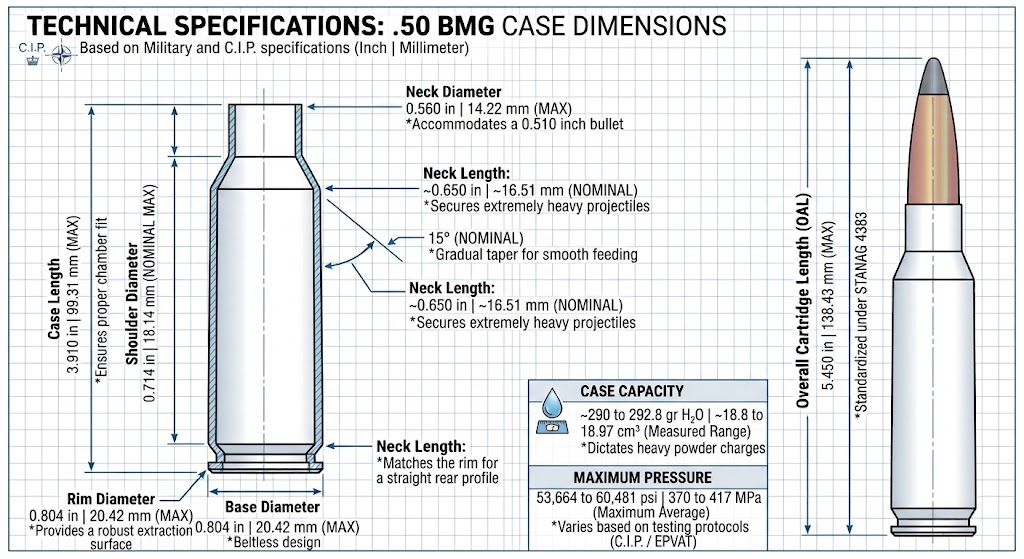
.50 BMG Case Dimensions
| Case Dimension | Inches | Millimeters | Specification Type | Source | Notes |
| Case Length | 3.910 | 99.31 | Maximum | Military / C.I.P. | Ensures proper chamber fit |
| Rim Diameter | 0.804 | 20.42 | Maximum | Military / C.I.P. | Provides a robust extraction surface |
| Base Diameter | 0.804 | 20.42 | Maximum | Military / C.I.P. | Matches the rim for a straight rear profile |
| Shoulder Diameter | 0.714 | 18.14 | Nominal Maximum | Military / C.I.P. | Features a long body taper |
| Neck Diameter | 0.560 | 14.22 | Maximum | Military / C.I.P. | Accommodates a 0.510 inch bullet |
| Neck Length | ~0.650 | ~16.51 | Nominal | Derived | Secures extremely heavy projectiles |
| Shoulder Angle | 15° | N/A | Nominal | C.I.P. | Gradual taper for smooth feeding |
| Overall Cartridge Length | 5.450 | 138.43 | Maximum | Military / C.I.P. | Standardized under STANAG 4383 |
| Case Capacity | ~290 to 292.8 gr H2O | ~18.8 to 18.97 cm³ | Measured Range | Industry / Mfg | Dictates heavy powder charges |
| Maximum Pressure | 53,664 to 60,481 psi | 370 to 417 MPa | Maximum Average | C.I.P. / EPVAT | Varies based on testing protocols |
.50 BMG Bullet Diameter
The standardized maximum bullet diameter for the .50 BMG is .510 inches (12.95 mm). It is vital not to confuse the bullet diameter with the barrel internal bore dimensions.
The standard .50 BMG barrel features a groove diameter of .510 inches and a bore or land diameter of .500 inches. Firing a .510 inch bullet down a .500 inch bore diameter forces the thick copper or steel jacket to engrave tightly into the rifling. This creates the necessary spin to stabilize projectiles that can weigh up to 800 grains over distances exceeding a mile.
.50 BMG Overall Length
The SAAMI maximum overall cartridge length (OAL) for the .50 BMG is 5.450 inches (138.43 mm). This number is a hard limit designed to guarantee that the cartridge will fit inside standard detachable box magazines and cycle through the feed trays of military machine guns like the M2 Browning.
Typical factory cartridge length varies based on the bullet profile. Standard military M33 ball ammunition usually measures close to the 5.450 inch maximum. However, when using extremely long, high ballistic coefficient solid brass target bullets, the total length might technically exceed standard magazine parameters if the reloader seats them closer to the rifling to maximize long range precision. In these specialized scenarios, the rounds are often single fed by hand.
.50 BMG Chamber And Cartridge Dimensions
The relationship between the .50 BMG cartridge and the firearm chamber is critical due to the enormous energy involved. The .50 BMG cartridge headspaces on its angled shoulder.
This means the angled portion of the brass casing physically stops against a matching machined angle inside the barrel chamber. Proper case length and shoulder setback are absolutely mandatory. If a reloader pushes the shoulder back too far during resizing, the cartridge will sit too deeply in the chamber, creating excessive headspace. Upon firing, the massive 54,000 psi pressure will forcefully stretch the brass to fill the gap, which can easily cause a catastrophic case head separation.
.50 BMG Dimensions vs Similar Cartridges
To understand the sheer size of the .50 BMG profile, it is helpful to compare it against other large magnum rifle cartridges.
| Cartridge | Bullet Diameter | Case Length | Overall Length | Base Diameter | Maximum Pressure | Source |
| .50 BMG | .510 in | 3.910 in | 5.450 in | .804 in | 54,000 psi | SAAMI |
| 12.7x108mm | .511 in | 4.250 in | 5.790 in | .860 in | 46,000 psi | C.I.P. |
| .416 Barrett | .416 in | 3.270 in | 4.500 in | .797 in | 65,000 psi | Industry |
| .338 Lapua | .338 in | 2.724 in | 3.681 in | .588 in | 60,916 psi | C.I.P. |
| .300 Win Mag | .308 in | 2.620 in | 3.340 in | .513 in | 64,000 psi | SAAMI |
.50 BMG vs 12.7x108mm Dimensions
The .50 BMG (12.7x99mm NATO) is frequently compared to its Russian equivalent, the 12.7x108mm. While they serve the same military purpose, their dimensions are entirely different.
- Bullet Diameter: Both utilize highly similar projectiles, with the NATO standard at .510 inches and the Russian standard slightly wider at .511 inches.
- Case Length: The 12.7x108mm has a significantly longer case measuring 4.250 inches compared to the 3.910 inch case of the .50 BMG.
- Base Diameter: The Russian cartridge is noticeably fatter at the base, measuring .860 inches compared to the .804 inch base of the .50 BMG.
- Interchangeability: Due to the massive differences in case length, overall length, and base diameter, these two cartridges are completely incompatible. You cannot fire a .50 BMG in a 12.7x108mm weapon system or vice versa.
.50 BMG SAAMI vs C.I.P. Dimensions
Cartridge dimensions and safe pressure limits are governed by SAAMI in the United States and C.I.P. in Europe.
The physical dimensional specifications for the .50 BMG are functionally identical between the two bodies to ensure global compatibility. SAAMI lists the maximum average pressure for standard .50 BMG at 54,000 psi measured via conformal piezoelectric transducers. C.I.P. lists the maximum pressure for the exact same cartridge at 370 MPa, which translates to approximately 53,664 psi. These are not contradictory safety standards but rather the result of different testing methodologies and measurement conversions. Ammunition loaded to either specification is completely safe in appropriately chambered firearms.
.50 BMG Bullet Weight And Dimensions
The .50 BMG is widely loaded in several extreme bullet weights, which alter how the internal dimensions of the cartridge are configured.
- 647 to 660 grain: The traditional standard weight for military ball ammunition (M33). These fit easily within the 5.450 inch maximum overall length.
- 700 to 750 grain: Common weights for modern solid brass or match grade hollow point boat tail bullets. These projectiles are physically incredibly long to maximize their ballistic coefficient.
- 800+ grain: Specialized extreme long range target bullets. To maintain magazine length restrictions, these massive bullets must be seated very deeply into the powder column, requiring specialized reloading data.
Bullet weight does not change the standardized external brass case dimensions. However, because a heavier bullet is physically longer, the manufacturer or reloader must precisely adjust the seating depth to ensure the loaded round still cycles safely through the firearm mechanism.
Why .50 BMG Dimensions Matter
Understanding the specific .50 BMG measurements is essential for several critical safety and performance reasons.
- Press Installation: The 3.910 inch case length and massive overall size mean that standard reloading presses cannot physically accommodate the cartridge. Reloaders must purchase oversized presses specifically built to clear the 5.450 inch overall length.
- Powder Charges: The massive internal case capacity requires careful management. Using incorrect powder types in a case this large can result in catastrophic detonations rather than controlled burning.
- Bolt Thrust: The massive .804 inch base diameter multiplied by 54,000 psi generates tens of thousands of pounds of rearward bolt thrust. If a case is out of dimensional specification and fails to support the chamber walls properly, the resulting failure is incredibly dangerous.
Manufacturer Specifications vs Independent Measurements
If you use heavy duty calipers to measure factory .50 BMG ammunition from companies like Lake City, Hornady, or Barrett, the numbers will rarely match the SAAMI maximum specifications exactly.
SAAMI and C.I.P. publish maximum allowable dimensions to ensure absolute safety and compatibility across all firearm brands. Ammunition manufacturers purposefully produce their cases slightly smaller than these maximums. For example, measuring a factory cartridge and finding a case length of 3.895 inches or an OAL of 5.430 inches does not mean the ammunition is defective. It means the manufacturer built in a reliable negative tolerance margin to guarantee the massive ammunition will load smoothly into tight match grade rifle chambers even when heavily fouled with carbon.
Common Questions
What are the dimensions of the .50 BMG?
The key maximum dimensions are a bullet diameter of .510 inches, a case length of 3.910 inches, and an overall cartridge length of 5.450 inches.
What is the .50 BMG case length?
The maximum SAAMI case length is 3.910 inches (99.31 mm).
What is the .50 BMG overall length?
The maximum overall length (OAL) is 5.450 inches (138.43 mm).
What is the .50 BMG bullet diameter?
The standard bullet diameter is .510 inches (12.95 mm).
What is the .50 BMG rim diameter?
The rim diameter measures .804 inches (20.42 mm).
What is the .50 BMG case diameter?
The case diameter at the base is .804 inches, tapering to a .735 inch shoulder.
What is the difference between .50 BMG and 12.7x99mm NATO?
There is no physical difference. .50 BMG is the civilian and commercial designation, while 12.7x99mm is the military metric designation for the exact same cartridge.
What is the maximum overall length of the .50 BMG?
The absolute maximum allowed by SAAMI is 5.450 inches to ensure the bullet fits inside standard box magazines and feed trays.
What is the .50 BMG maximum pressure?
The SAAMI maximum average pressure is 54,000 psi, while C.I.P. sets the limit around 370 MPa (53,664 psi).