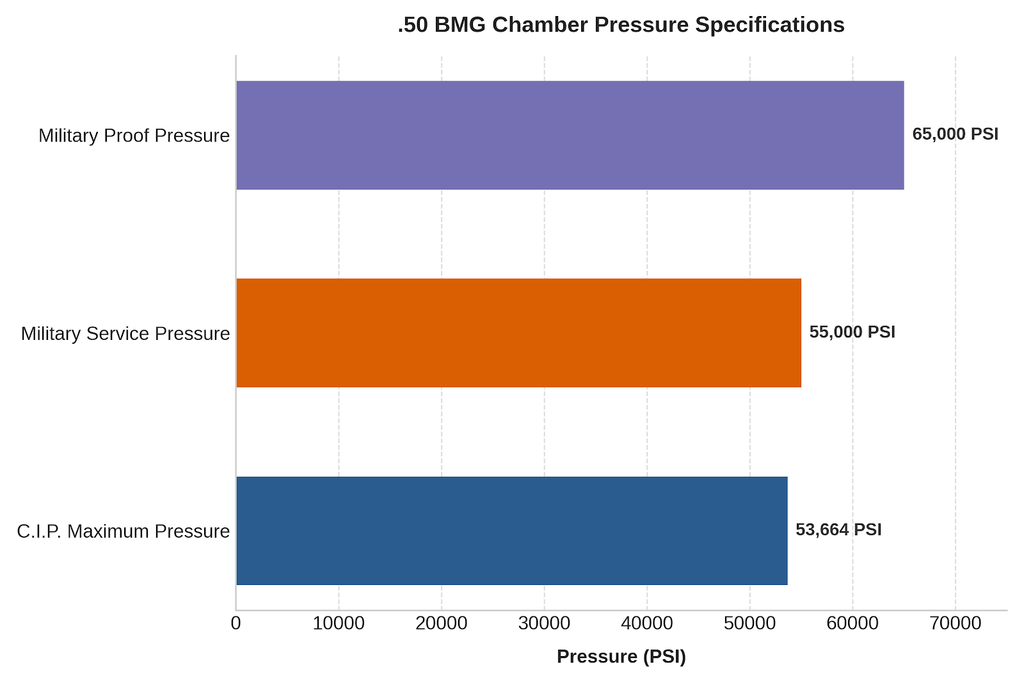
The published maximum chamber pressure for the .50 BMG (12.7x99mm) is 370.00 MPa (53,664 PSI) according to the Commission Internationale Permanente (C.I.P.), while U.S. military technical manuals historically rate standard M33 Ball ammunition at 55,000 PSI using the older copper crusher method. The commercial U.S. ammunition industry widely recognizes 65,000 PSI as the practical maximum pressure limit for the brass case and firearm proofing. Chamber pressure refers to the maximum outward force exerted by expanding propellant gases inside the firearm chamber during the firing sequence. These 50 BMG chamber pressure specifications can differ between C.I.P. and military standards because the organizations use distinct testing methodologies and measurement locations, such as drilled case piezoelectric sensors versus radial copper crushers. It is important not to confuse chamber pressure, which peaks within the first few inches of bullet travel, with muzzle pressure, which is significantly lower as the gas expands down the barrel. Furthermore, actual ammunition pressure can vary within these approved specifications due to slight differences in powder charge, bullet weight, environmental temperature, and individual firearm chamber dimensions.
.50 BMG Chamber Pressure
| Specification | Pressure | Unit | Test / Standard | Source | Notes |
| C.I.P. Maximum Pressure | 370.00 | MPa | Piezoelectric | C.I.P. TDCC | Standard commercial maximum average pressure (equivalent to 3700 bar or 53,664 PSI). |
| Military Service Pressure | 55,000 | PSI | Copper Crusher | U.S. Army TM 43-0001-27 | Historic specification for M33 Ball ammunition. Not directly comparable to modern piezoelectric readings. |
| Military Proof Pressure | 65,000 | PSI | Copper Crusher / Piezo | U.S. Army Specifications | Required pressure for testing firearm structural integrity. Treated as the practical maximum limit for brass. |
Understanding .50 BMG Chamber Pressure
Chamber pressure is the metric used to quantify the physical force generated by burning gunpowder inside the firing chamber of a rifle. When a primer ignites the propellant, the powder rapidly burns and produces high volumes of expanding gas. This gas exerts equal outward force in all directions against the walls of the brass cartridge case, the bolt face, and the bullet itself. The pressure causes the brass case to obturate, sealing the chamber and forcing the bullet down the rifled barrel.
Engineers measure this force using specialized equipment. The two primary methods are the older copper crusher system and the modern piezoelectric transducer system. The copper crusher method determines pressure by measuring how much a calibrated copper cylinder compresses when the cartridge is fired. Modern organizations rely on piezoelectric sensors, which read the electrical charge generated by a quartz crystal subjected to the pressure inside the chamber. These sensors provide exact, real-time pressure curves and peak pressure readings.
Because no two cartridges are completely identical, published specifications represent the maximum average pressure (MAP). A batch of factory ammunition will exhibit slight pressure variations between individual rounds. The 50 BMG maximum pressure limit is a standardized ceiling ensuring that these natural variations remain well within the safe operational limits of the firearm.
.50 BMG Pressure In PSI, MPa And Bar
Converting the official C.I.P. specification for the .50 BMG requires precise mathematical calculation. The following table displays the C.I.P. maximum average pressure across the three most common pressure units.
| Standard Unit | Pressure Value | Converted Value |
| MPa (Megapascals) | 370.00 | Original Source Value |
| bar | 3700 | Equivalent to 370.00 MPa |
| PSI (Pounds per Square Inch) | 53,664 | Calculated from 370.00 MPa |
The conversion factors used are 1 MPa equals 10 bar, and 1 MPa equals 145.038 PSI. These conversions reflect the exact same pressure standard expressed in different regional and scientific units, rather than indicating completely separate pressure limits.
SAAMI .50 BMG Chamber Pressure
Although the U.S. commercial market heavily relies on the Sporting Arms and Ammunition Manufacturers’ Institute (SAAMI) for cartridge standards, SAAMI does not currently maintain an official civilian specification for the .50 BMG in its centerfire rifle guidelines (ANSI/SAAMI Z299.4).Because the cartridge originated as a military machine gun round, its dimensional and pressure limits have historically been governed by military technical documentation and international bodies rather than civilian sporting institutes.
Despite the lack of an official 50 BMG SAAMI pressure specification, the U.S. commercial firearms industry widely accepts 65,000 PSI as the absolute maximum practical pressure for the .50 BMG. This 65,000 PSI figure is derived from military high pressure proof testing and the physical yield strength of the cartridge brass. Operating at or near 65,000 PSI is generally considered the absolute ceiling before shooters experience pierced primers, difficult extraction, or structural failure of the brass casing. Shooters and ammunition manufacturers treat this 65,000 PSI limit with the same respect as a formalized SAAMI maximum average pressure.
C.I.P. .50 BMG Chamber Pressure
The Commission Internationale Permanente (C.I.P.) is the primary international body that officially standardizes the .50 BMG for commercial use, designating it under the name “50 Browning”. The current 50 BMG C.I.P. pressure specification establishes a maximum piezoelectric pressure of 370.00 MPa (53,664 PSI or 3700 bar) for this cartridge.
C.I.P. mandates the use of a drilled case piezoelectric measurement method. In this testing convention, a technician drills a small hole into the brass case before placing it in the test barrel, allowing the combustion gases to press directly against the pressure sensor. This methodology often yields different numerical results than the conformal sensor method used in the United States, which measures pressure through the intact brass wall. The C.I.P. standard ensures that any commercial firearm bearing a C.I.P. proof mark can safely handle factory ammunition produced globally. The difference between the C.I.P. maximum of 53,664 PSI and the U.S. practical limit of 65,000 PSI does not mean one standard is incorrect. It reflects different testing protocols, safety margins, and the distinction between standard operational pressure and proof testing limits.
Military .50 BMG Pressure
The .50 BMG was designed as a military cartridge, and military technical manuals provide the most extensive historical data on its pressure specifications.According to the U.S. Army Ammunition Data Sheets (TM 43-0001-27), the standard M33 Ball cartridge generates a chamber pressure of 55,000 PSI. Older variants, such as early M2 Ball and M2 Armor Piercing rounds, are often listed with pressures around 47,500 to 54,923 PSI depending on the specific manual edition.
It is crucial to understand that military manuals traditionally utilized the copper crusher measurement method, even when they recorded the results as “PSI” rather than “CUP” (Copper Units of Pressure). A military rating of 55,000 PSI derived from a copper crusher cannot be directly compared to a modern piezoelectric reading. The military also specifies a high pressure test (proof) load for the .50 BMG. The proof pressure for military weapons chambered in this caliber is 65,000 PSI, which is designed to deliberately overstress the firearm during manufacturing tests to guarantee the structural integrity of the barrel and locking mechanisms.
.50 BMG Chamber Pressure vs Other Cartridges
Comparing the .50 BMG to other popular rifle cartridges reveals a common misconception. Many people assume that because the .50 BMG is massive, it must operate at a much higher chamber pressure than standard rifle calibers. In reality, the massive case capacity of the .50 BMG allows it to generate tremendous energy at relatively moderate peak pressures compared to modern magnum hunting cartridges.
| Cartridge | Published Pressure | Unit | Standard / Source |
| .50 BMG | 53,664 | PSI | C.I.P. (370.00 MPa) |
| .308 Winchester | 62,000 | PSI | SAAMI |
| 7.62×51 NATO | 60,191 | PSI | Military EPVAT (415.00 MPa) |
| .300 Winchester Magnum | 64,000 | PSI | SAAMI |
| .338 Lapua Magnum | 60,916 | PSI | C.I.P. (420.00 MPa) |
| 12 Gauge (2.75 inch) | 11,500 | PSI | SAAMI |
When analyzing 50 BMG pressure compared to 308 Winchester, the standard commercial .308 Winchester actually operates at a higher peak chamber pressure. Looking at 50 BMG pressure vs 338 Lapua Magnum, the .338 Lapua is officially rated at a higher pressure of 60,916 PSI under C.I.P. testing. Finally, when evaluating 50 BMG pressure vs 300 Win Mag, the .300 Winchester Magnum’s SAAMI specification of 64,000 PSI easily exceeds the C.I.P. limits of the .50 caliber. The destructive power of the .50 BMG comes from its massive powder charge and heavy bullet weight, not from having an unusually high peak chamber pressure.
Chamber Pressure vs Muzzle Pressure
Chamber pressure and muzzle pressure measure the force of the expanding gases at completely different points in the firing sequence. Maximum chamber pressure occurs inside the firearm chamber during the first few milliseconds after ignition, typically when the bullet has only traveled an inch or two into the barrel rifling.
Once the bullet travels further down the barrel, the volume behind it increases rapidly. This expansion causes the pressure of the gases to drop significantly. By the time the bullet exits the barrel, the internal pressure has decreased to a fraction of its peak value. This remaining pressure at the moment the bullet exits is the muzzle pressure. Muzzle pressure is responsible for the loud report and the muzzle blast, but it is entirely separate from the peak chamber pressure that dictates the structural safety of the receiver and bolt.
Factors That Affect .50 BMG Pressure
Published pressure specifications represent controlled laboratory conditions. In the real world, the actual chamber pressure of a .50 BMG cartridge can fluctuate based on multiple variables.
- Propellant type and powder charge dictate how much gas is generated and how quickly it expands. Faster burning powders create sharper, higher pressure spikes.
- Bullet weight and bullet seating depth alter the available case capacity. Seating a bullet deeper reduces internal volume and causes chamber pressure to rise.
- The internal capacity of the brass case varies between manufacturers. Thicker brass walls reduce internal volume, which increases pressure for a given powder charge.
- Environmental temperature heavily influences powder burn rates. Ammunition left in the hot sun will generate significantly higher chamber pressure than ammunition fired in freezing conditions.
- Barrel and chamber characteristics, such as how close the bullet is positioned to the rifling lands, can cause pressure to spike if the bullet engages the rifling prematurely.
.50 BMG Pressure And Barrel Length
A common misconception is that a longer barrel increases the chamber pressure of a firearm. Barrel length does not change the maximum chamber pressure. As previously established, peak chamber pressure occurs when the bullet is still very close to the chamber.
Altering the barrel length changes how long the bullet is exposed to the diminishing pressure curve as it travels toward the muzzle. A longer barrel allows the expanding gases to push the bullet for a greater distance, which increases the final muzzle velocity. Conversely, cutting a barrel down will increase the muzzle pressure (resulting in a louder blast and larger fireball) and decrease the velocity. Neither modification affects the peak chamber pressure that occurred at the very beginning of the firing sequence.
.50 BMG Pressure And Firearm Design
Firearms chambered for the .50 BMG are engineered specifically around the cartridge’s pressure curve and massive bolt thrust. Bolt thrust is the rearward force exerted against the bolt face. While the peak pressure in PSI might be lower than a .300 Winchester Magnum, the internal area of the .50 BMG case head is vastly larger. Pressure multiplied by this larger surface area results in tens of thousands of pounds of rearward force.
To handle this load, .50 BMG firearms utilize heavy steel receivers, massive bolts with thick locking lugs, and heavy contour barrels. The chamber must fully support the brass case to prevent the case head from expanding or rupturing under the intense stress. Reliable extraction requires a highly robust extractor mechanism because the thick brass case grips the chamber walls tightly during peak pressure expansion. Manufacturers build these rifles with significant safety margins to safely contain both standard operating pressures and high pressure proof loads.
.50 BMG Pressure And Ammunition Types
The .50 BMG features a wide variety of specialized ammunition types, but they are all loaded to function within the safe pressure limitations of standard M2 machine guns and sniper rifles. Common military ammunition types include M33 Ball, M2 Armor Piercing, M17 Tracer, and Mk 211 Mod 0 Armor Piercing Incendiary.
While the exact powder charges and projectile weights differ across these variations to accommodate the different payload lengths and tracer compounds, the internal ballistics are carefully engineered to match standard pressure curves. This ensures reliable feeding and extraction across all military platforms. Civilian match grade ammunition is loaded with extremely tight tolerances regarding powder charge and bullet seating, resulting in highly consistent chamber pressures from round to round, which is critical for extreme long range accuracy.
Manufacturer Specifications vs Actual Measurements
When researching ammunition, it is important to distinguish between maximum standard specifications and the actual measurements of individual cartridges. The C.I.P. specification of 53,664 PSI represents the maximum allowable average pressure for commercial production.
However, ammunition manufacturers typically load their products slightly below this maximum limit to ensure a margin of safety against temperature spikes or exceptionally tight chambers. If an engineer tests a box of commercial .50 BMG ammunition in a laboratory, the actual measurements might yield an average of 48,000 or 50,000 PSI. This difference does not mean the ammunition is underpowered. It indicates that the manufacturer designed the load to achieve optimal velocity and accuracy while safely buffering against the strict C.I.P. maximum limit.
Common Questions
What is the chamber pressure of .50 BMG?
The official C.I.P. maximum average pressure for the .50 BMG is 370.00 MPa (53,664 PSI).U.S. military documentation rates standard M33 ball ammunition at 55,000 PSI using older copper crusher testing, while 65,000 PSI is widely treated as the absolute practical limit for the cartridge brass.
What is .50 BMG pressure in PSI?
Under C.I.P. standards, the 50 BMG chamber pressure PSI limit is 53,664 PSI. Military technical manuals often list 55,000 PSI for standard ball ammunition.
What is .50 BMG pressure in MPa?
The C.I.P. maximum average pressure specification for the .50 BMG is 370.00 MPa.
What is .50 BMG pressure in bar?
The C.I.P. maximum average pressure specification for the .50 BMG is 3700 bar.
What is the SAAMI pressure for .50 BMG?
SAAMI does not publish an official pressure specification for the .50 BMG in its standard centerfire rifle guidelines. However, the U.S. commercial industry widely treats 65,000 PSI as the maximum practical pressure limit based on military proof testing.
What is the C.I.P. pressure for .50 BMG?
The C.I.P. maximum average pressure for the .50 Browning (the C.I.P. designation for .50 BMG) is 370.00 MPa, which translates to 3700 bar or 53,664 PSI.
How does .50 BMG chamber pressure compare with .308 Winchester?
The .308 Winchester has a SAAMI maximum average pressure of 62,000 PSI, which is mathematically higher than the .50 BMG C.I.P.specification of 53,664 PSI. The .50 BMG relies on a massive case capacity rather than extremely high pressure to achieve its velocity.
How does .50 BMG pressure compare with .338 Lapua Magnum?
The .338 Lapua Magnum operates at a higher chamber pressure than the .50 BMG. The C.I.P. specification for the .338 Lapua Magnum is 420.00 MPa (60,916 PSI), compared to the .50 BMG at 370.00 MPa (53,664 PSI).
Is .50 BMG chamber pressure higher than .300 Winchester Magnum?
No, the .300 Winchester Magnum has a SAAMI maximum average pressure of 64,000 PSI, which is higher than the standard operating pressure specifications for the .50 BMG.
Is chamber pressure the same as muzzle pressure?
No. Chamber pressure is the maximum force exerted inside the firing chamber immediately after ignition. Muzzle pressure is the drastically reduced force of the expanding gases at the exact moment the bullet exits the barrel.
Does barrel length affect .50 BMG chamber pressure?
No. Altering the barrel length does not affect the peak chamber pressure, because the maximum pressure is reached within the first few inches of bullet travel. Barrel length only affects muzzle velocity and muzzle pressure.
Do different .50 BMG ammunition types have different pressure specifications?
Yes, minor variations exist among military loads like ball, armor piercing, and tracer ammunition to account for different projectile lengths and weights, but they are all loaded to remain safely below the maximum operational pressure limits of the firearm.