The .45 ACP (Automatic Colt Pistol) is a straight-walled, rimless handgun cartridge featuring a standard maximum bullet diameter of .452 inches (11.5 mm). The maximum case length is .898 inches (22.8 mm), and the maximum overall cartridge length (OAL) is specified at 1.275 inches (32.4 mm). The case has a rim diameter of .480 inches (12.2 mm) and tapers slightly from a base diameter of .476 inches (12.1 mm) to a neck diameter of .473 inches (12.0 mm). Ammunition for this caliber is most commonly found in 185-grain, 200-grain, and 230-grain bullet weights. Exact dimensions and pressures can vary slightly depending on whether you reference the American SAAMI specifications or European C.I.P. standards, as well as allowable manufacturing tolerances.
Table of Contents [Click to open]
.45 ACP Dimensions
| Dimension | Specification | Source | Notes |
| Bullet Diameter | .452 in (11.5 mm) | SAAMI / C.I.P. | Maximum for jacketed/lead bullets; .451 in is common for jacketed. |
| Case Length | .898 in (22.8 mm) | SAAMI | Maximum case length; trim-to length is typically .888 in. |
| Overall Cartridge Length | 1.275 in (32.4 mm) | SAAMI | Maximum overall length (OAL). Minimum OAL varies by bullet profile. |
| Rim Diameter | .480 in (12.2 mm) | SAAMI | Maximum rim diameter. |
| Case Diameter | .476 in (12.1 mm) | SAAMI | Maximum diameter measured at the base (web). |
| Shoulder Diameter | N/A | N/A | Straight-walled cartridge; no shoulder. |
| Neck Diameter | .473 in (12.0 mm) | SAAMI | Maximum diameter at the case mouth. |
| Base Diameter | .476 in (12.1 mm) | SAAMI | Measured just above the extractor groove. |
| Case Capacity | 25.0 – 27.4 gr H2O | Industry Standard | Varies slightly based on brass manufacturer and wall thickness. |
| Maximum Pressure | 21,000 psi | SAAMI | +P specification is 23,000 psi. C.I.P. maximum is 19,000 psi (130 MPa). |

Understanding The .45 ACP Dimensions
- Bullet Diameter: The measurement across the widest point of the bullet. For .45 ACP, this is specified as .452 inches. This dimension ensures the projectile seals properly within the barrel’s rifling to trap expanding gases and generate velocity.
- Case Length: The length of the empty brass cylinder from the base to the case mouth, maxing out at .898 inches. This is a critical dimension because the .45 ACP headspaces on the case mouth. If the case is too short, the firing pin may not strike the primer reliably; if it is too long, the gun may not go into battery.
- Overall Cartridge Length (OAL): The total length of the fully assembled round from the base to the tip of the bullet, strictly capped at 1.275 inches. OAL directly influences whether a cartridge will fit into a magazine and feed properly through the firearm’s action.
- Rim Diameter: The diameter of the flange at the very bottom of the case (.480 inches). The firearm’s extractor hooks onto this rim to pull the spent casing out of the chamber after firing.
- Case Diameter: The width of the cartridge body. While the .45 ACP is considered a “straight-walled” case, it has a very slight taper from the base (.476 inches) to the neck (.473 inches).
- Base Diameter: The width of the brass just above the extractor groove. It must withstand the initial expansion of ignition.
- Case Capacity: Measured in grains of water (gr H2O), this represents the internal volume of the empty case (around 25 to 27.4 grains). It dictates how much gunpowder the case can safely hold.
- Maximum Pressure: The peak internal pressure generated when the cartridge is fired. Standard SAAMI limits set this at 21,000 psi to ensure the firearm does not suffer catastrophic failure.
.45 ACP Cartridge Dimensions In Inches And Millimeters
For engineers, reloaders, and international shooters, below are the primary .45 ACP measurements converted accurately between imperial and metric systems.
| Dimension | Inches (SAAMI Max) | Millimeters (Equivalent) |
| Bullet Diameter | .452 in | 11.48 mm |
| Case Length | .898 in | 22.81 mm |
| Overall Length | 1.275 in | 32.39 mm |
| Rim Diameter | .480 in | 12.19 mm |
| Base Diameter | .476 in | 12.09 mm |
| Neck Diameter | .473 in | 12.01 mm |
.45 ACP Case Dimensions
| Dimension | Specification | Source | Notes |
| Bullet Diameter | .452 in (11.5 mm) | SAAMI / C.I.P. | Maximum for jacketed or lead bullets; .451 in is common for jacketed. |
| Case Length | .898 in (22.8 mm) | SAAMI | Maximum case length; trim to length is typically .888 in. |
| Overall Cartridge Length | 1.275 in (32.4 mm) | SAAMI | Maximum overall length for standard magazines. |
| Rim Diameter | .480 in (12.2 mm) | SAAMI | Maximum rim diameter. |
| Case Diameter | .476 in (12.1 mm) | SAAMI | Maximum diameter measured at the base. |
| Shoulder Diameter | N/A | N/A | Straight walled cartridge; no shoulder. |
| Neck Diameter | .473 in (12.0 mm) | SAAMI | Maximum external diameter at the case mouth. |
| Base Diameter | .476 in (12.1 mm) | SAAMI | Measured just above the extractor groove. |
| Case Capacity | 25.0 to 27.4 gr H2O | Industry Standard | Varies slightly based on brass manufacturer and wall thickness. |
| Maximum Pressure | 21,000 psi | SAAMI | +P specification is 23,000 psi. C.I.P. maximum is 19,000 psi (130 MPa). |
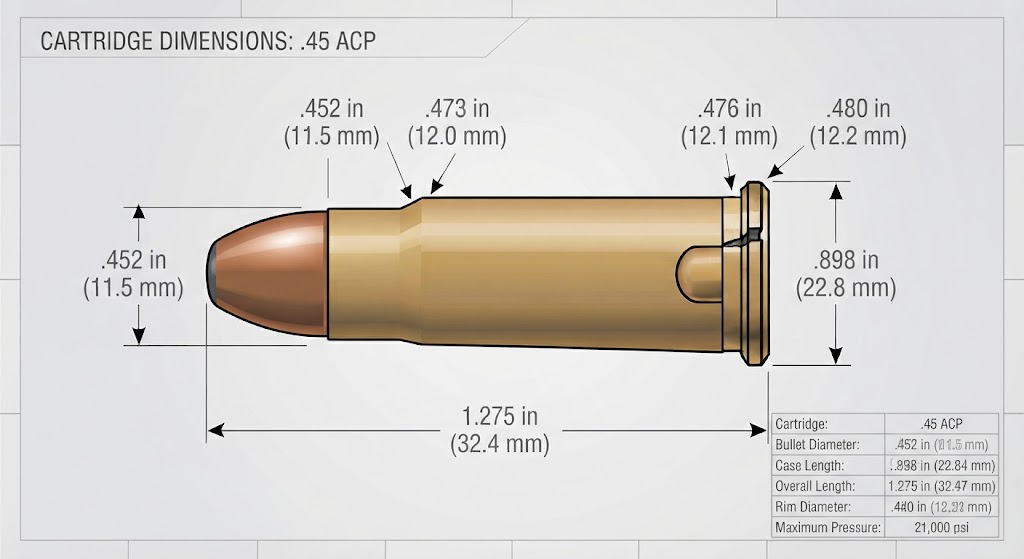
.45 ACP Bullet Diameter
The standardized maximum bullet diameter for the .45 ACP is .452 inches (11.5 mm). In practice, this dimension usually depends on the material of the projectile:
- Jacketed Bullets: Typically measure exactly .451 inches to reduce friction and pressure.
- Lead/Plated Bullets: Typically measure .452 inches to properly grip the rifling and prevent gas blow-by (which causes lead fouling in the barrel).
It is vital not to confuse the bullet diameter with the barrel’s internal dimensions. The standard .45 ACP barrel features a groove diameter of .450 inches and a bore (land) diameter of .442 inches. Firing a .451 or .452-inch bullet down a .450-inch groove diameter forces the bullet to engrave into the rifling, creating spin and stabilizing the projectile.
.45 ACP Overall Length
The SAAMI maximum overall cartridge length (OAL) for .45 ACP is 1.275 inches (32.4 mm). This number is a hard limit designed to guarantee that the cartridge will fit inside standard 1911-style magazines and properly clear the feed ramp.
However, typical factory cartridge length varies based on the bullet profile. A classic 230-grain Full Metal Jacket (FMJ) “ball” round typically measures between 1.250 and 1.270 inches. In contrast, aggressively shaped Jacketed Hollow Points (JHPs) or flat-nose semi-wadcutters are deliberately seated deeper, often resulting in an OAL of 1.200 to 1.230 inches, to ensure reliable feeding and to keep the wider ogive of the bullet from jamming into the barrel’s rifling before the slide locks up.
.45 ACP Chamber And Cartridge Dimensions
The relationship between the .45 ACP cartridge and the firearm’s chamber is critical for functionality. The .45 ACP cartridge headspaces on the case mouth.
This means the forward edge of the brass casing physically stops against a machined ledge inside the barrel’s chamber, preventing the cartridge from sliding too far forward. Because of this, the case mouth cannot be heavily roll-crimped into the bullet like a revolver cartridge; it must be taper-crimped just enough to hold the bullet while leaving a distinct lip to engage the chamber. The feed geometry of the .45 ACP, a relatively fat, blunt cartridge, requires a smooth transition from the magazine, up the feed ramp, and into the chamber. Proper overall length and neck diameter (.473 inches max) are mandatory for this sequence to occur without a malfunction.
.45 ACP Dimensions vs Similar Cartridges
To understand the .45 ACP’s size profile, it is helpful to compare it against other popular handgun cartridges. Note that while some dimensions may appear similar, these cartridges are not interchangeable.
| Cartridge | Bullet Diameter | Case Length | Overall Length | Rim / Base Diameter | Maximum Pressure | Source |
| .45 ACP | .452 in | .898 in | 1.275 in | .480 in / .476 in | 21,000 psi | SAAMI |
| 9mm Luger | .355 in | .754 in | 1.169 in | .394 in / .391 in | 35,000 psi | SAAMI |
| .40 S&W | .400 in | .850 in | 1.135 in | .424 in / .424 in | 35,000 psi | SAAMI |
| .45 Colt | .452 in | 1.285 in | 1.600 in | .512 in / .480 in | 14,000 psi | SAAMI |
| .45 GAP | .452 in | .755 in | 1.070 in | .476 in / .476 in | 23,000 psi | SAAMI |
| .380 ACP | .355 in | .680 in | .984 in | .374 in / .374 in | 21,500 psi | SAAMI |
.45 ACP vs .45 Colt Dimensions
Because of their names, the .45 ACP (Automatic Colt Pistol) and the .45 Colt (sometimes colloquially called the .45 Long Colt) are frequently confused, despite being vastly different cartridges.
- Bullet Diameter: Both historically shoot .452-inch diameter bullets, making them identical in projectile width.
- Case and Overall Length: The .45 Colt is a massive revolver cartridge with a case length of 1.285 inches and an OAL of 1.600 inches, far longer than the .45 ACP’s .898-inch case and 1.275-inch OAL.
- Rim Design: The .45 Colt is a rimmed cartridge with a wide .512-inch rim designed to headspace against a revolver cylinder. The .45 ACP is a rimless cartridge designed to stack cleanly in a semi-automatic magazine.
- Pressure: Standard .45 Colt is limited to a very low 14,000 psi due to the antique revolvers still in circulation, while the .45 ACP operates at 21,000 psi.
Dimensional similarity in bullet diameter does not mean ammunition interchangeability. Attempting to load .45 ACP into a standard .45 Colt revolver (or vice versa) is physically impossible without specialized moon clips and cylinders.
.45 ACP SAAMI vs C.I.P. Dimensions
Cartridge dimensions and safe pressure limits are governed by SAAMI in the United States and C.I.P. in Europe.
While the dimensional specifications for the .45 ACP are functionally identical between the two bodies to ensure global compatibility, the way they measure and report pressure differs significantly.
- SAAMI lists the maximum average pressure for standard .45 ACP as 21,000 psi, measured via conformal piezoelectric transducers.
- C.I.P. lists the maximum pressure for the exact same cartridge at 130 MPa (approximately 19,000 psi), also using piezoelectric sensors but placed at a different location on the case.
These are not contradictory figures; they are the result of different testing methodologies and measurement conventions. Ammunition loaded to SAAMI specs is safe in C.I.P. proofed handguns, and vice versa.
.45 ACP Bullet Weight And Dimensions
The .45 ACP is widely loaded in several common bullet weights, which affect how the cartridge is configured:
- 230-grain: The original military standard. It features a long, round-nose profile that typically pushes the cartridge to its maximum 1.275-inch OAL for smooth feeding.
- 200-grain: Often used in hollow point or target semi-wadcutter designs. These sit slightly shorter in the case, resulting in an OAL of around 1.220 to 1.250 inches.
- 185-grain: A lighter, faster bullet often chosen for self-defense. To maintain adequate bullet seating depth and case tension, these are seated deeper than 230-grain bullets.
Bullet weight does not change the standardized brass case dimensions. However, because a lighter bullet is physically shorter, the manufacturer must adjust the seating depth, and thus the overall length, to ensure the bullet does not jump out of the case under recoil, while still feeding reliably.
Why .45 ACP Dimensions Matter
Understanding the specific 45 ACP measurements is essential for several practical reasons:
- Chamber Fit & Headspacing: Because the round headspaces on the case mouth, cases that stretch beyond .898 inches will prevent the firearm’s slide from closing.
- Feeding & Magazine Compatibility: 1911 magazines are strictly engineered around a 1.275-inch maximum overall length. Ammunition loaded longer than this will bind inside the magazine tube.
- Bullet Selection: Knowing the barrel’s groove diameter (.450 inches) versus the bullet diameter (.451 to .452 inches) allows handloaders to select the correct projectiles for peak accuracy without generating dangerous pressure spikes.
- Firearm Design: The .45 ACP’s relatively fat .476-inch case diameter directly limits how many rounds can fit into a grip-housed magazine. This is why standard 1911s hold 7 or 8 rounds, whereas similarly sized 9mm pistols hold 15 or more.
Manufacturer Specifications vs Independent Measurements
If you use calipers to measure factory .45 ACP ammunition from companies like Federal, Winchester, or Hornady, the numbers will rarely match the SAAMI specifications exactly.
SAAMI and C.I.P. publish maximum allowable dimensions to ensure safety. Ammunition manufacturers produce their cases and load their cartridges slightly smaller than these maximums (using negative tolerances) to guarantee that their ammunition will chamber reliably even in dirty or tightly toleranced match-grade barrels. Therefore, measuring a factory cartridge and finding a case length of .890 inches or an OAL of 1.260 inches does not mean the ammunition is defective; it simply means the manufacturer built in a reliable tolerance margin.
Common Questions
What are the dimensions of .45 ACP?
The key maximum dimensions are: bullet diameter .452 in, case length .898 in, and overall cartridge length 1.275 in.
What is the .45 ACP case length?
The maximum SAAMI case length is .898 inches (22.8 mm).
What is the .45 ACP overall length?
The maximum overall length (OAL) is 1.275 inches (32.4 mm).
What is the .45 ACP bullet diameter?
The standard bullet diameter is .452 inches for lead and .451 inches for jacketed projectiles.
What is the .45 ACP rim diameter?
The rim diameter measures .480 inches (12.2 mm).
What is the .45 ACP case diameter?
The case diameter at the base is .476 inches, tapering slightly to .473 inches at the neck.
What is the difference between .45 ACP bore and bullet diameter?
The bullet diameter is .451 to .452 inches, while the barrel’s bore (land) diameter is .442 inches and the groove diameter is .450 inches, allowing the bullet to engage the rifling tightly.
How does .45 ACP compare with 9mm dimensions?
The .45 ACP is significantly larger. It has a .452-inch bullet and .898-inch case length, while the 9mm uses a .355-inch bullet and a .754-inch case length.
How does .45 ACP compare with .45 Colt dimensions?
While both shoot .452-inch bullets, the .45 Colt is a rimmed revolver cartridge with a much longer 1.285-inch case, whereas the .45 ACP is a rimless semi-auto cartridge with an .898-inch case.
Are .45 ACP and .45 Colt dimensions the same?
No. Aside from bullet diameter, they are completely different in length, case capacity, rim design, and operating pressure.
What is the maximum overall length of .45 ACP?
The absolute maximum allowed by SAAMI is 1.275 inches.
What is the .45 ACP maximum pressure?
The SAAMI maximum average pressure is 21,000 psi for standard loads and 23,000 psi for +P loads.