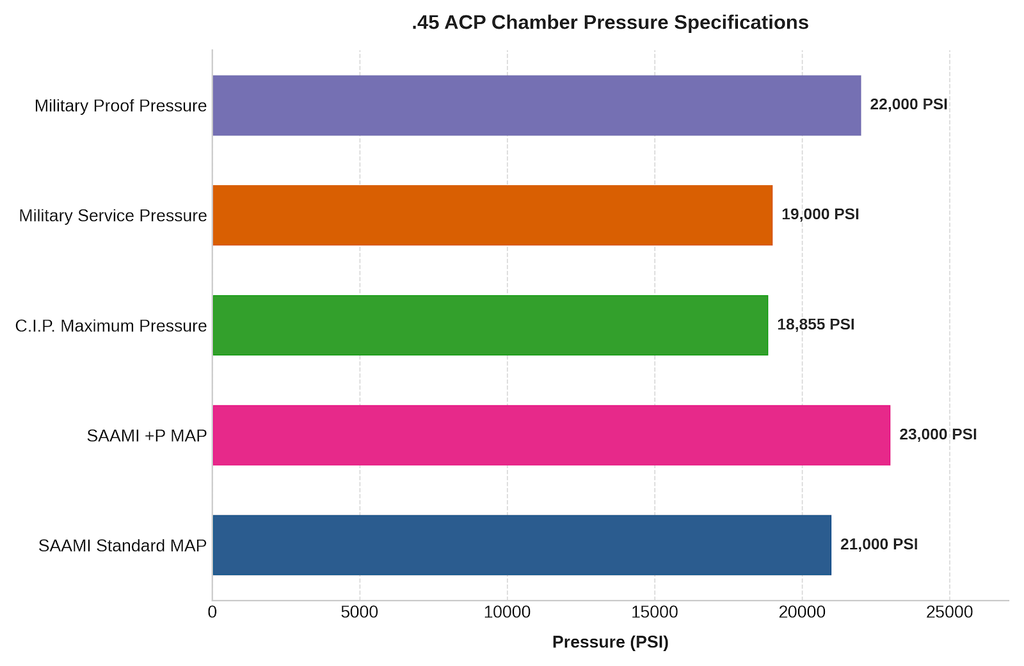
The published maximum chamber pressure for the standard .45 ACP is 21,000 PSI according to the Sporting Arms and Ammunition Manufacturers’ Institute (SAAMI), while the overpressure +P variant is rated at 23,000 PSI. In Europe, the Commission Internationale Permanente (C.I.P.) establishes the maximum piezoelectric pressure for the cartridge at 130.00 MPa (18,855 PSI or 1300 bar). Chamber pressure represents the peak outward physical force exerted by expanding propellant gases inside the firing chamber of a handgun. These .45 ACP pressure standards differ globally because organizations use distinct measuring protocols, such as conformal transducers versus drilled-case radial sensors. It is important not to confuse chamber pressure, which dictates firearm structural safety during ignition, with muzzle pressure, which is the heavily reduced gas pressure remaining as the bullet exits the barrel. Furthermore, actual ammunition pressure will vary naturally from round to round within these approved specifications based on environmental temperature, bullet seating depth, and slight powder charge variations.
45 ACP Chamber Pressure
| Specification | Pressure | Unit | Test / Standard | Source | Notes |
| SAAMI Standard MAP | 21,000 | PSI | Conformal Piezoelectric | SAAMI ANSI Z299.3 | Maximum average pressure for standard commercial .45 ACP ammunition. |
| SAAMI +P MAP | 23,000 | PSI | Conformal Piezoelectric | SAAMI ANSI Z299.3 | Maximum average pressure for authorized +P (overpressure) ammunition. |
| C.I.P. Maximum Pressure | 130.00 | MPa | Drilled Case Piezoelectric | C.I.P. TDCC | Equivalent to 1300 bar or 18,855 PSI. Standard for European proofing. |
| Military Service Pressure | 19,000 | PSI | Copper Crusher | U.S. Army TM 43-0001-27 | Historic specification for M1911 Ball. Not directly comparable to modern piezo readings. |
| Military Proof Pressure | 22,000 | PSI | Copper Crusher | U.S. Army TM 43-0001-27 | High Pressure Test (HPT) M1 cartridge used for proofing military barrels. |
Understanding .45 ACP Chamber Pressure
Chamber pressure is the primary metric used to ensure the safe operation of any firearm. When the firing pin strikes the primer of a .45 ACP cartridge, the gunpowder ignites and rapidly converts into high volumes of expanding gas. This gas pushes radially against the brass cartridge walls, rearward against the breech face, and forward against the base of the bullet. The maximum amount of force generated during this process is known as the peak chamber pressure.
Engineers measure this force using highly specialized laboratory barrels equipped with piezoelectric sensors. As the powder burns, the expanding gas exerts force against a quartz crystal inside the sensor, which generates a measurable electrical charge. This reading provides a precise, real-time pressure curve of the firing sequence. Older historical records often cite the copper crusher method, which measured how much a small copper cylinder deformed when the cartridge fired.
Because mechanical manufacturing and powder dispensing are never perfect, every single cartridge fired will generate a slightly different peak pressure. For this reason, organizations publish a maximum average pressure (MAP). The published .45 ACP chamber pressure is a standardized limit ensuring that standard factory ammunition, despite minor variations, remains well within the safe operational limits of pistols like the M1911.
.45 ACP Pressure In PSI, MPa And Bar
Converting the official SAAMI standard specification for the .45 ACP requires precise calculation. The following table displays the SAAMI maximum average pressure for standard ammunition across three common engineering units.
| Standard Unit | Pressure Value | Converted Value |
| PSI (Pounds per Square Inch) | 21,000 | Original Source Value |
| MPa (Megapascals) | 144.79 | Calculated from 21,000 PSI |
| bar | 1447.9 | Equivalent to 144.79 MPa |
These mathematical conversions use the formulas where 1 PSI equals 0.00689476 MPa, and 1 MPa equals 10 bar. These conversions do not represent separate C.I.P. or military standards. They strictly represent the American SAAMI 21,000 PSI limit converted into European and scientific formats.
SAAMI .45 ACP Chamber Pressure
The Sporting Arms and Ammunition Manufacturers’ Institute (SAAMI) sets the standard guidelines for commercial ammunition manufactured in the United States.The official SAAMI maximum average pressure for standard .45 ACP is 21,000 PSI.This makes the .45 ACP a relatively low pressure cartridge compared to modern service calibers. SAAMI measures this limit using a conformal piezoelectric transducer, which sits flush against the outside of an intact brass case in a specially machined test barrel.
Because modern firearm metallurgy allows for stronger designs, SAAMI also recognizes an official overpressure standard known as .45 ACP +P.The SAAMI specification for .45 ACP +P is 23,000 PSI.Ammunition loaded to this +P standard generates higher velocities but also significantly increases the slide velocity, bolt thrust, and wear on the handgun. Not all .45 caliber firearms are rated for +P ammunition. The 23,000 PSI limit is an absolute ceiling for continuous safe operation in properly rated, modern firearms.
C.I.P. .45 ACP Chamber Pressure
The Commission Internationale Permanente (C.I.P.) oversees ammunition safety standards for European nations and other member countries. The C.I.P. standardizes this cartridge under the designation “45 Auto” and lists the maximum piezoelectric pressure at 1300 bar, which equals 130.00 MPa or 18,855 PSI.
When comparing 50 BMG C.I.P. pressure or standard rifle pressures to pistol readings, it is critical to note that C.I.P. uses a drilled-case piezoelectric testing protocol. The brass cartridge case is physically drilled prior to testing, allowing the combustion gases to press directly against the pressure sensor. This differs fundamentally from the SAAMI conformal method. The fact that the C.I.P. limit of 18,855 PSI is lower than the SAAMI limit of 21,000 PSI does not mean one is wrong. The variation reflects the differing measurement methodologies, differing locations of the pressure taps, and slightly different historical approaches to standardizing John Browning’s original military cartridge.
Military .45 ACP Pressure
Because the .45 ACP was adopted by the U.S. military in 1911, historical military technical documentation provides extensive pressure data. The U.S. Army Ammunition Data Sheets, specifically TM 43-0001-27, govern the specifications for the Cartridge, Caliber .45, Ball, M1911. According to this manual, standard 230-grain ball ammunition has a specified chamber pressure of 19,000 PSI.
Military pressure readings from this era were recorded using the radial copper crusher method. A copper crusher reading of 19,000 PSI cannot be mathematically directly converted to a modern SAAMI piezoelectric reading of 21,000 PSI, as the tools measure force entirely differently. The military also utilized a proofing round, designated the Cartridge, Caliber .45, High Pressure Test, M1.This round generated approximately 22,000 PSI (copper crusher) and was used exclusively at the factory to stress-test M1911 barrels and submachine guns before they were issued to troops.
.45 ACP Chamber Pressure vs Other Cartridges
A defining characteristic of the .45 ACP is its large caliber paired with its very low operational pressure.Comparing the .45 ACP to other common defensive handgun calibers illustrates why the cartridge is known for a smooth, pushing recoil impulse rather than a sharp, snappy one.
| Cartridge | Published Pressure | Unit | Standard / Source |
| .45 ACP (Standard) | 21,000 | PSI | SAAMI |
| .45 ACP +P | 23,000 | PSI | SAAMI |
| 9mm Luger | 35,000 | PSI | SAAMI |
| .40 S&W | 35,000 | PSI | SAAMI |
| 10mm Auto | 37,500 | PSI | SAAMI |
When evaluating .45 ACP pressure compared to 9mm, the 9mm Luger operates at a vastly higher 35,000 PSI limit.Looking at the .45 ACP vs 10mm Auto, the 10mm reaches an intense 37,500 PSI to drive heavy bullets at magnum velocities. The .45 ACP achieves its legendary terminal performance simply by starting with a massive 0.452-inch diameter projectile, negating the need for high chamber pressures to force expansion.
Chamber Pressure vs Muzzle Pressure
Shooters must understand the severe difference between chamber pressure and muzzle pressure. Peak chamber pressure occurs inside the chamber while the bullet is still heavily constrained by the brass case and just beginning to enter the barrel rifling. This peak pressure lasts for only a fraction of a millisecond.
As the bullet travels forward, the internal volume of the barrel behind the bullet rapidly increases. This physical expansion causes the pressure of the hot gases to plummet. By the time the bullet reaches the end of a standard five-inch 1911 barrel, the internal pressure has dropped substantially. This residual pressure exiting the barrel is the muzzle pressure. Muzzle pressure creates the loud gunshot and flash, but it is completely detached from the 21,000 PSI peak force that stresses the locking lugs of the pistol.
Factors That Affect .45 ACP Pressure
While SAAMI mandates a 21,000 PSI maximum average limit, the actual chamber pressure of a specific .45 ACP cartridge will vary significantly based on physical and environmental factors.
- Bullet seating depth is the most critical variable in the .45 ACP. Pushing a bullet just a fraction of an inch deeper into the small pistol case drastically reduces internal volume, causing chamber pressure to spike to dangerous levels.
- Propellant burn rates dictate pressure curves. Fast-burning pistol powders create sharp, sudden pressure spikes, while slower powders generate lower peak pressures that sustain longer down the barrel.
- Bullet weight alters resistance. A heavy 230-grain bullet requires more force to move than a light 185-grain bullet, generally resulting in higher peak chamber pressures for the heavier projectile.
- Temperature extremes alter powder chemistry. Ammunition left in a hot vehicle during summer will burn faster and generate higher peak pressure than the exact same ammunition fired in freezing winter conditions.
- Case capacity fluctuates by manufacturer. Brass cases with thicker internal webs hold less powder and create higher pressures than thinner brass cases.
.45 ACP Pressure And Barrel Length
Changing the barrel length of a handgun does not change the peak chamber pressure of the ammunition. A cartridge loaded to 21,000 PSI will hit that exact same peak chamber pressure whether it is fired in a three-inch concealed carry pistol or a sixteen-inch pistol-caliber carbine.
Peak pressure is achieved extremely early in the firing sequence, usually before the bullet has traveled more than an inch. Barrel length dictates how long the bullet remains trapped in front of the expanding gases. A longer barrel allows those gases to push the bullet longer, yielding higher muzzle velocity and lower muzzle pressure. A shorter barrel yields lower velocity and higher muzzle pressure, resulting in a louder blast. Chamber pressure itself remains completely unaffected by the length of the steel tube in front of the chamber.
.45 ACP Pressure And Firearm Design
The low 21,000 PSI maximum pressure of the .45 ACP significantly influences how firearms are engineered for it. Handguns chambered in this caliber exert relatively low bolt thrust. Bolt thrust is the rearward mechanical force exerted against the breech face of the slide during firing.
Because the .45 ACP has such low operating pressure, many historical submachine guns like the Thompson and the M3 Grease Gun could safely operate using a simple straight blowback mechanism without locked breeches. In modern locked-breech pistols like the M1911 or polymer striker-fired handguns, the low pressure translates directly to extended service life, less stress on steel locking lugs, and a smoother operational cycle. Firearms designed strictly for the 21,000 PSI standard should only be fed 23,000 PSI +P ammunition sparingly, as the extra bolt thrust will accelerate wear on recoil springs and frame buffers.
.45 ACP Pressure And Ammunition Types
Standard commercial .45 ACP ammunition is loaded below the 21,000 PSI limit, regardless of whether it features a full metal jacket (FMJ) for practice or a jacketed hollow point (JHP) for defense.However, ammunition designated as +P is deliberately loaded to generate between 21,000 and 23,000 PSI.
This +P designation is most common with lightweight 185-grain or 200-grain defensive hollow points. By pushing the pressure up to 23,000 PSI, manufacturers can force these lighter bullets to much higher velocities, ensuring reliable expansion upon impact. Target wadcutter ammunition, typically utilizing 185-grain or 200-grain lead bullets, is often loaded extremely light, generating chamber pressures well below 15,000 PSI to ensure minimal recoil during precision competition.
Manufacturer Specifications vs Actual Measurements
There is a clear difference between a published SAAMI specification and the actual pressure of commercial ammunition sitting on a store shelf. The 21,000 PSI SAAMI limit is a regulatory ceiling.
Ammunition manufacturers rarely load their standard ammunition right up to this absolute maximum limit. Doing so leaves no margin for error if the ammunition is fired in extreme heat or in a handgun with an unusually tight chamber. If a laboratory tested standard 230-grain ball ammunition from a major factory, the actual pressure readings would likely average around 18,000 to 19,000 PSI. This intentional safety buffer guarantees that factory ammunition remains strictly within safety margins while still achieving the advertised velocity.
Common Questions
What is the chamber pressure of .45 ACP?
The official SAAMI maximum average pressure for standard .45 ACP is 21,000 PSI. The SAAMI limit for .45 ACP +P ammunition is 23,000 PSI.
What is .45 ACP pressure in PSI?
Under SAAMI specifications, standard .45 ACP is limited to 21,000 PSI, while overpressure +P loads are capped at 23,000 PSI.
What is .45 ACP pressure in MPa?
The C.I.P. maximum pressure specification for the .45 Auto is 130.00 MPa. Converting the American SAAMI 21,000 PSI standard mathematically yields approximately 144.79 MPa.
What is .45 ACP pressure in bar?
The official C.I.P. limit for .45 Auto is 1300 bar.
What is the SAAMI pressure for .45 ACP?
SAAMI dictates a maximum average pressure of 21,000 PSI for standard .45 ACP and 23,000 PSI for .45 ACP +P.
What is the C.I.P. pressure for .45 Auto?
The C.I.P. maximum average pressure for the .45 Auto is 1300 bar (130.00 MPa), which translates mathematically to 18,855 PSI using drilled-case testing protocols.
How does .45 ACP chamber pressure compare with 9mm Luger?
The .45 ACP is a much lower pressure cartridge than the 9mm. Standard .45 ACP is rated at 21,000 PSI, while standard 9mm Luger is rated at 35,000 PSI.
Is .45 ACP chamber pressure higher than .40 S&W?
No, the .40 S&W has a SAAMI maximum average pressure of 35,000 PSI, which is significantly higher than the 21,000 PSI specification for the .45 ACP.
Is chamber pressure the same as muzzle pressure?
No. Chamber pressure is the maximum outward force exerted inside the firing chamber immediately after the powder ignites. Muzzle pressure is the drastically reduced force remaining when the bullet finally exits the barrel.
Does barrel length affect .45 ACP chamber pressure?
No. Changing barrel length has zero effect on peak chamber pressure, which occurs within the first fraction of an inch of bullet travel. Barrel length strictly affects muzzle velocity and muzzle pressure.
Do different .45 ACP ammunition types have different pressure specifications?
Yes. Standard ammunition types operate at or below 21,000 PSI. Ammunition stamped as +P is loaded to higher pressures, operating safely up to a maximum of 23,000 PSI. Lightweight target wadcutter rounds are usually loaded to significantly lower pressures.