The main difference between the .444 Marlin and the .45-70 Government is that the .444 Marlin fires a lighter bullet at a much higher velocity to provide a flatter trajectory for medium game, while the .45-70 Government utilizes massively heavy bullets to deliver bone crushing penetration on the largest and most dangerous game animals. Both are legendary big bore lever action cartridges designed to stop targets immediately in thick cover. The .444 Marlin behaves like an extended magnum handgun cartridge, generating impressive kinetic energy and speed out of a standard rifle barrel. Conversely, the .45-70 Government is a heavy hitting classic from the black powder era that simply plows through resistance with sheer momentum. Choosing the right brush gun requires understanding how velocity and bullet mass dictate their performance in the field.
Table of Contents [Click to open]
444 Marlin vs 45-70 Ballistics Chart
| Specification / Metric | .444 Marlin (240 gr JSP) | .45-70 Government (300 gr JHP) |
| Cartridge | .444 Marlin | .45-70 Government |
| Parent Case | Original Design | Original Design |
| Bullet Diameter | .430 inches | .458 inches |
| Typical Bullet Weight | 240 to 300 grains | 300 to 405 grains |
| Muzzle Velocity | 2,350 fps | 1,880 fps |
| Velocity at 100 Yards | 1,910 fps | 1,530 fps |
| Velocity at 200 Yards | 1,530 fps | 1,240 fps |
| Velocity at 300 Yards | 1,220 fps | 1,040 fps |
| Muzzle Energy | 2,940 ft-lbs | 2,355 ft-lbs |
| Energy at 100 Yards | 1,940 ft-lbs | 1,560 ft-lbs |
| Energy at 200 Yards | 1,250 ft-lbs | 1,025 ft-lbs |
| Energy at 300 Yards | 790 ft-lbs | 720 ft-lbs |
| Bullet Drop (300 Yds, 100 Yd Zero) | -22.5 inches | -34.5 inches |
| Wind Drift (300 Yds, 10 mph Wind) | 20.5 inches | 18.0 inches |
| Ballistic Coefficient (G1) | 0.165 to 0.225 | 0.195 to 0.284 |
| Sectional Density | 0.185 to 0.231 | 0.204 to 0.276 |
| Effective Hunting Range | 200 to 250 yards | 150 to 200 yards |
| Maximum Effective Range | 300 yards | 300 yards |
| Typical Twist Rate | 1:20 or 1:38 | 1:20 |
| Recoil (Free Recoil Energy) | ~18.5 ft-lbs | ~25.0 ft-lbs |
| Trajectory | Arcs moderately past 150 yds | Heavy looping arc past 100 yds |
| Barrel Life | Practically unlimited | Practically unlimited |
| Accuracy Potential | Excellent for brush hunting | Excellent for brush hunting |
| Hunting Performance | Elk, black bear, deer, hogs | Moose, grizzly, large elk |
| Target Shooting Performance | Good inside 200 yards | Heavy steel targets |
| Long-Range Performance | Poor due to rapid energy loss | Poor due to rapid drop |
| Ammunition Availability | Limited to moderate | High |
| Ammunition Cost | High | High |
| Rifle Availability | Limited in new production | Common in lever actions |
| Magazine Compatibility | Tubular magazine | Tubular magazine |
| Suppressor Compatibility | Requires threaded models | Requires threaded models |
| Best Use Cases | Versatile timber hunting | Dangerous game, big bears |
| Main Advantages | Higher velocity, flatter trajectory | Devastating penetration |
| Main Disadvantages | Ammo is harder to find | Punishing recoil, steep drop |
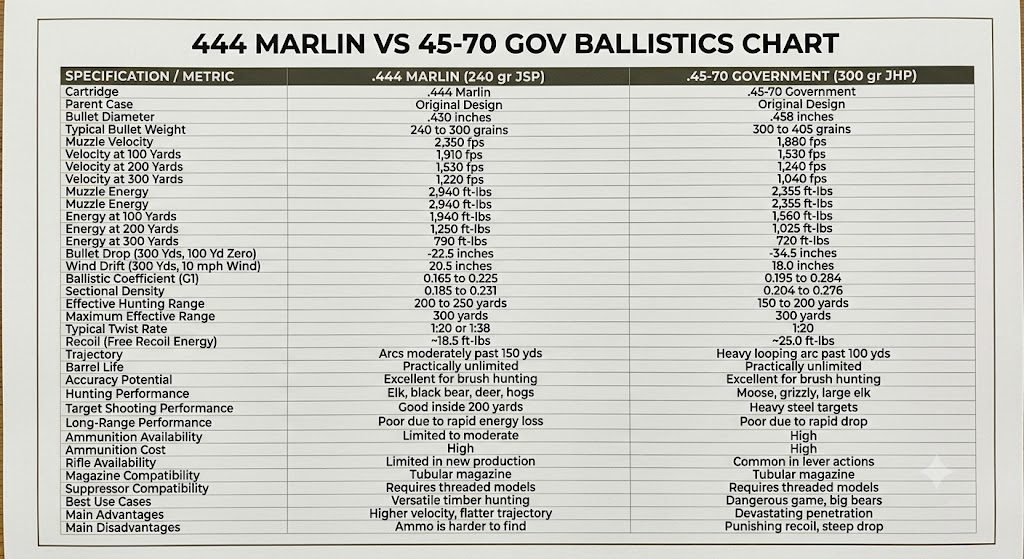
The comparison table above illustrates how these two massive lever action cartridges achieve their stopping power through entirely different methods. The .444 Marlin is built for speed. By utilizing a lighter .430 caliber bullet, it is able to generate blistering muzzle velocities that approach 2,400 feet per second. This speed actually allows standard factory .444 Marlin ammunition to produce more muzzle energy than standard factory .45-70 Government loads.
Because the .444 Marlin is flying nearly 500 feet per second faster than the .45-70 out of the gate, it provides a noticeably flatter trajectory. This makes placing an accurate shot on a deer or black bear at 150 yards much easier. However, light and fast blunt bullets shed their velocity rapidly. By the time both bullets reach 300 yards, their kinetic energy levels are nearly identical.
The .45-70 Government ignores speed and relies purely on momentum and mass. While it drops significantly faster and requires careful range estimation past 100 yards, the massive weight of the .458 caliber bullet ensures reliable, straight line penetration. The .45-70 will crush through thick shoulder bones of dangerous predators where the lighter .444 Marlin bullet might struggle. The tradeoff for this massive penetration is a much heavier recoil impulse on the shoulder.
Detailed Comparison Sections
Understanding the Comparison Chart
To fully grasp the capabilities of these cartridges, you have to understand the firearms that shoot them. Both rounds are primarily chambered in lever action rifles featuring tubular magazines. Because bullets are loaded tip to primer in the magazine tube, both cartridges must be loaded with flat nosed or round nosed bullets to prevent accidental detonations under recoil. This mechanical limitation means both cartridges have poor aerodynamics and are restricted to short and medium ranges.
How to Read the Ballistics Chart
When analyzing the ballistics of big bore brush guns, muzzle velocity and bullet drop are the critical factors. You need to know how fast the bullet drops out of the vital zone to determine your maximum ethical shooting distance. You also need to look at sectional density, which predicts how deeply a bullet will penetrate on massive game animals.
Velocity Comparison
The .444 Marlin holds a substantial speed advantage over standard .45-70 factory loads. Firing a 240 grain soft point, the .444 Marlin leaves the barrel at 2,350 fps. A standard 300 grain .45-70 bullet exits at roughly 1,880 fps. This extra speed helps the .444 Marlin deliver massive hydrostatic shock upon impact. However, both bullets lose speed quickly due to their flat noses. At 200 yards, the .444 Marlin has slowed to 1,530 fps, and the .45-70 has dropped to 1,240 fps.
Energy Comparison
This is where ballistics can be surprising. Standard pressure .444 Marlin factory loads actually generate more muzzle energy than standard pressure .45-70 Government factory loads. The .444 Marlin produces roughly 2,940 foot pounds of energy compared to the 2,355 foot pounds of the .45-70. However, the .45-70 can safely be loaded to much higher pressures in modern rifles. Specialized high pressure .45-70 loads produced by boutique ammunition companies can easily surpass 3,000 foot pounds of energy, completely eclipsing the .444 Marlin.
Trajectory Comparison
The speed advantage of the .444 Marlin makes it the flatter shooting cartridge. The heavy, slow .45-70 Government bullet requires much more holdover at distance.
Bullet Drop Comparison
If you zero both rifles at 100 yards, the difference in trajectory is very apparent. At 300 yards, the .444 Marlin will drop about 22.5 inches. The heavy .45-70 Government bullet will plummet 34.5 inches. This heavy drop makes the .45-70 very difficult to use effectively past 150 yards, whereas the .444 Marlin can be stretched comfortably to 200 or 250 yards by a skilled marksman.
Wind Drift Comparison
Blunt bullets are terrible at fighting the wind. In a 10 mph crosswind at 300 yards, the heavier .45-70 bullet drifts slightly less at 18 inches, while the lighter .444 Marlin bullet drifts roughly 20.5 inches. Neither cartridge is designed for shooting across windy open plains.
Ballistic Coefficient Comparison
Ballistic Coefficient (BC) measures aerodynamic efficiency. Both cartridges suffer from extremely low BC numbers due to their flat nosed designs. The .444 Marlin sits around 0.165, and the .45-70 Government sits around 0.195. Manufacturers have introduced modern polymer tipped bullets like the Hornady LEVERevolution line for both calibers, which slightly improves these numbers and flattens their trajectories.
Accuracy Comparison
Both cartridges are exceptionally accurate for their intended purpose. In a quality lever action rifle, either cartridge will comfortably shoot two inch groups at 100 yards. This is more than enough mechanical accuracy to hit the vital zone of a deer, elk, or bear in dense timber.
Effective Range Comparison
These are classic short range hunting tools. The .444 Marlin is highly effective out to 250 yards due to its flatter trajectory. The .45-70 Government is best utilized inside 150 yards. While the .45-70 carries enough energy to kill an animal at 500 yards, the extreme bullet drop makes placing an ethical shot almost impossible for the average hunter.
Hunting Performance Comparison
The .444 Marlin is arguably the better cartridge for hunting deer, black bear, and wild hogs. Its higher velocity initiates rapid expansion, leading to devastating wound channels on medium to large game. The .45-70 Government is the undeniable king of giant game. If you are pursuing massive animals like moose, giant elk, or grizzly bears, the .45-70 provides the deep, bone breaking penetration required to anchor dangerous animals quickly.
Target Shooting Comparison
Neither of these cartridges is ideal for casual target shooting. The recoil is heavy, the rifles get hot quickly, and the ammunition is far too expensive for high volume plinking. They are meant to be zeroed carefully from the bench and then carried into the woods.
Long-Range Performance Comparison
Do not attempt long range shooting with either of these cartridges. Their flat nosed bullets bleed velocity incredibly fast, turning them into subsonic projectiles that drop out of the sky past 300 yards. If you need to hit targets at 400 yards or beyond, you need a modern bottleneck cartridge like the .300 Winchester Magnum or 7mm Remington Magnum.
Recoil Comparison
Recoil is heavy for both calibers, but the .45-70 Government kicks significantly harder. The .444 Marlin generates about 18.5 foot pounds of free recoil energy, which feels like a heavy shove. The .45-70 Government generates roughly 25.0 foot pounds of free recoil energy with standard loads, and can easily exceed 35 foot pounds with modern heavy hunting loads. The .45-70 requires excellent shooting fundamentals to manage safely without developing a flinch.
Barrel Life Comparison
Both cartridges operate at relatively low internal chamber pressures and utilize heavy bullets moving at modest speeds. Because of this, barrel wear is almost non existent. A rifle barrel chambered in either .444 Marlin or .45-70 Government will easily outlast the shooter and can be passed down to the next generation in pristine condition.
Ammunition Cost Comparison
Both cartridges are very expensive to shoot. The sheer amount of lead, copper, and brass required to manufacture these massive rounds keeps the prices high. Because the .45-70 Government is much more popular, you can occasionally find bulk discounts, but both will require a premium investment for every trigger pull.
Ammunition Availability
The .45-70 Government dominates the big bore lever action market. You can find it in almost any sporting goods store in the country. The .444 Marlin is highly respected but much less popular today. Finding factory ammunition locally can be a frustrating challenge, and most .444 Marlin owners either order their ammunition online or load their own.
Rifle Compatibility
The .45-70 Government is chambered in practically every brand of modern lever action rifle, as well as classic single shot falling block rifles. The .444 Marlin is much harder to find. While Marlin historically produced beautiful rifles for the cartridge, new production .444 Marlin rifles are released in very limited, intermittent batches.
Pros and Cons of .444 Marlin
Pros:
- Much flatter trajectory than traditional big bore cartridges.
- Devastating kinetic energy at short ranges.
- Noticeably less recoil than the .45-70 Government.
- Excellent stopping power for deer, elk, and hogs.
Cons:
- Ammunition is expensive and difficult to find locally.
- Very limited availability of new production rifles.
Pros and Cons of .45-70 Government
Pros:
- Absolute maximum stopping power for the largest animals on earth.
- Unmatched straight line penetration through thick bone and hide.
- Excellent ammunition availability.
- The ultimate cartridge for dangerous bear defense.
Cons:
- Punishing recoil.
- Heavy looping trajectory limits ethical shooting distance.
Which Cartridge Is Better for Beginners?
Neither cartridge is suitable for a beginner. The recoil of both calibers is severe enough to cause a new shooter to develop bad habits, such as flinching in anticipation of the shot. Beginners should start with a .30-30 Winchester if they want to learn how to shoot a lever action rifle.
Which Cartridge Is Better for Hunting?
If your primary targets are deer, hogs, and black bears in thick timber, the .444 Marlin is a fantastic choice that shoots flatter and kicks less. However, if you are specifically hunting moose, hunting in grizzly country, or if you simply want the convenience of buying ammunition at any local store, the .45-70 Government is the undisputed choice.
Which Cartridge Is Better for Long-Range Shooting?
Neither cartridge can be used for long range shooting. Their poor aerodynamics and rapidly dropping trajectories make them completely unsuitable for ethical hunting past 250 yards.
Which Cartridge Should You Choose?
Choose the .444 Marlin if you want a unique, flat shooting big bore rifle for medium to large game and you do not mind hunting down ammunition online. Choose the .45-70 Government if you need absolute maximum stopping power for dangerous animals, or if you prefer having a massive selection of readily available factory ammunition.
Verdict
The .444 Marlin and the .45-70 Government represent two different philosophies for anchoring game in the deep woods. The .444 Marlin is a brilliant compromise between speed and mass. It offers the heavy hitting power of a big bore cartridge while maintaining a trajectory that is actually useful out to 200 yards. Unfortunately, its popularity has waned, making it a specialty item. The .45-70 Government is the undisputed king of the lever action world. It makes no compromises. It kicks hard, it drops fast, and it absolutely obliterates anything standing in front of it. For modern hunters who demand universal ammunition availability and the ability to drop a charging grizzly bear, the .45-70 Government remains the ultimate powerhouse.
FAQs
Can a .444 Marlin kill a grizzly bear?
Yes, the .444 Marlin is highly capable of killing a grizzly bear, especially when loaded with heavy 265 grain or 300 grain hard cast lead bullets. It delivers massive kinetic energy and deep penetration. However, the .45-70 Government is generally preferred by Alaskan guides for absolute maximum stopping power on giant bears.
Can you shoot .44 Magnum in a .444 Marlin?
No. While they share the exact same .430 inch bullet diameter, the brass casings are completely different lengths and dimensions. Attempting to fire a .44 Magnum cartridge in a .444 Marlin rifle can result in a ruptured case and severe damage to the firearm or shooter.
Why is the .45-70 more popular than the .444 Marlin?
The .45-70 Government has over 150 years of history, initially starting as a military cartridge. Its legendary reputation, combined with the massive variety of available ammunition ranging from mild target loads to dinosaur killing magnum loads, ensures its continued dominance in the market.
Which kicks harder, .444 Marlin or .45-70?
The .45-70 Government kicks significantly harder than the .444 Marlin. The .45-70 pushes a much heavier bullet, which creates a more violent opposing force against the shooter’s shoulder.
Is the .444 Marlin obsolete?
The .444 Marlin is not practically obsolete, as it remains a devastatingly effective hunting cartridge. However, it is commercially challenged. Fewer ammunition manufacturers produce it, and fewer gun makers chamber rifles for it compared to the massively popular .45-70 Government.