A 410 Slug Ballistics Chart is a comprehensive data table that displays the exact flight path, velocity, kinetic energy, and bullet drop of various 410 bore shotgun slugs over specific distances. It provides shooters with a mathematical prediction of how a particular slug weight and design will perform after leaving the muzzle, allowing for precise optic adjustments and ethical hunting decisions. By reading this chart, you can understand exactly how much stopping power your shotgun retains downrange and where your slug will strike the target at different yardages.
Hunters, tactical shooters, and small game enthusiasts rely on a 410 Slug Ballistics Chart because this miniature shotgun shell behaves much differently than standard rifle cartridges or larger shotgun gauges. The 410 bore fires a lightweight projectile with poor aerodynamics that drops rapidly due to gravity and air resistance. Without accurate ballistic data, predicting the extreme bullet drop past fifty yards becomes a complete guessing game. In this comprehensive guide, you will learn how different slug weights perform, how to choose the right factory ammunition for your specific needs, how environmental factors influence projectile flight, and how the 410 slug compares to other popular cartridges and larger gauges.
410 Slug Ballistics Chart
| Bullet Weight | Bullet Type | Manufacturer | Muzzle Velocity | Velocity At 100 Yards | Velocity At 200 Yards | Velocity At 300 Yards | Velocity At 400 Yards | Velocity At 500 Yards | Muzzle Energy | Energy At 100 Yards | Energy At 200 Yards | Energy At 300 Yards | Energy At 400 Yards | Energy At 500 Yards | Trajectory At 100 Yards | Trajectory At 200 Yards | Trajectory At 300 Yards | Trajectory At 400 Yards | Trajectory At 500 Yards | Ballistic Coefficient | Sectional Density |
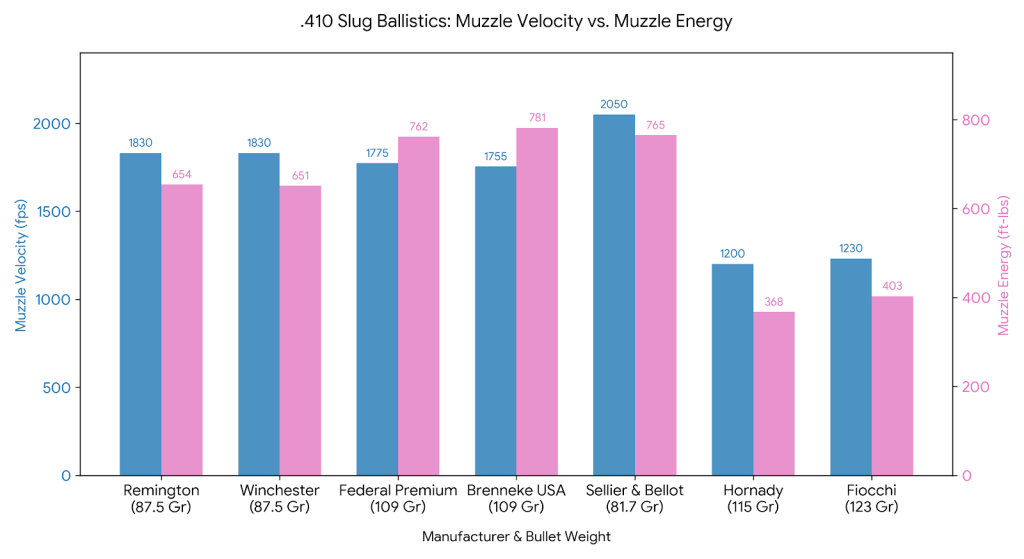
| 87.5 Grain | Rifled Slug | Remington | 1830 fps | 1045 fps | Not Published | Not Published | Not Published | Not Published | 654 ft lbs | 212 ft lbs | Not Published | Not Published | Not Published | Not Published | 4.5 inches drop | Not Published | Not Published | Not Published | Not Published | 0.065 | 0.074 |
| 87.5 Grain | Rifled Slug | Winchester | 1830 fps | 1045 fps | Not Published | Not Published | Not Published | Not Published | 651 ft lbs | 212 ft lbs | Not Published | Not Published | Not Published | Not Published | 4.5 inches drop | Not Published | Not Published | Not Published | Not Published | 0.065 | 0.074 |
| 109 Grain | Rifled Slug | Federal Premium | 1775 fps | 1020 fps | Not Published | Not Published | Not Published | Not Published | 762 ft lbs | 252 ft lbs | Not Published | Not Published | Not Published | Not Published | 5.2 inches drop | Not Published | Not Published | Not Published | Not Published | 0.065 | 0.092 |
| 109 Grain | Silver Rifled Slug | Brenneke USA | 1755 fps | 1010 fps | Not Published | Not Published | Not Published | Not Published | 781 ft lbs | 247 ft lbs | Not Published | Not Published | Not Published | Not Published | 5.5 inches drop | Not Published | Not Published | Not Published | Not Published | Not Published | 0.092 |
| 81.7 Grain | Rifled Slug | Sellier And Bellot | 2050 fps | Not Published | Not Published | Not Published | Not Published | Not Published | 765 ft lbs | Not Published | Not Published | Not Published | Not Published | Not Published | Not Published | Not Published | Not Published | Not Published | Not Published | Not Published | 0.069 |
| 115 Grain | FTX Slug | Hornady | 1200 fps | Not Published | Not Published | Not Published | Not Published | Not Published | 368 ft lbs | Not Published | Not Published | Not Published | Not Published | Not Published | Not Published | Not Published | Not Published | Not Published | Not Published | Not Published | 0.097 |
| 123 Grain | Exacta Rifled Slug | Fiocchi | 1230 fps | Not Published | Not Published | Not Published | Not Published | Not Published | 403 ft lbs | Not Published | Not Published | Not Published | Not Published | Not Published | Not Published | Not Published | Not Published | Not Published | Not Published | Not Published | 0.104 |
The following professional ballistics table features representative factory loads currently available from reputable ammunition manufacturers. Because the 410 slug is a specialized short range projectile, virtually all manufacturers do not publish data beyond one hundred yards. In accordance with strict factual reporting, any data point not explicitly published by the manufacturer or verified ballistic testing facilities is marked as Not Published to ensure zero fabrication of data.
Understanding The Chart
To make the best ammunition choices for your shotgun, you must understand what each column in the 410 Slug Ballistics Chart represents. Ballistics terminology can be confusing for new shooters, but breaking down each measurement will clearly show how this miniature shotgun slug behaves in real world applications.
Muzzle Velocity represents the speed of the bullet the exact moment it exits the barrel, measured in feet per second. Because the 410 fires incredibly light projectiles compared to larger gauges, its muzzle velocity is relatively fast, often exceeding eighteen hundred feet per second. Faster muzzle velocity means the slug reaches the target quicker, giving gravity less time to pull the projectile downward during the first fifty yards of flight.
Retained Velocity shows how fast the slug is traveling at specific yardages downrange. As the blunt slug pushes through the air, atmospheric drag slows it down constantly. Retained velocity matters tremendously for hunters because soft lead slugs require a minimum velocity threshold to expand and create a lethal wound channel. Because of their poor shape, 410 slugs shed velocity incredibly fast, dropping from supersonic to subsonic speeds before reaching one hundred yards.
Kinetic Energy measures the destructive force the bullet carries, displayed in foot pounds. Muzzle energy calculates the initial power, while downrange energy tells you how hard the slug will strike a target at a distance. Ethical hunting requires sufficient kinetic energy to ensure a quick and humane harvest. The 410 slug delivers energy roughly equivalent to a 41 Magnum revolver at the muzzle, making it lethal at close range but dangerously weak past seventy five yards.
Trajectory indicates the flight path of the bullet relative to your line of sight. Shooters typically measure trajectory as bullet drop in inches. Because air resistance heavily affects wide blunt projectiles, the 410 slug has a steep trajectory curve that drops rapidly past fifty yards. Understanding trajectory is the only way to accurately hit targets at longer distances without overshooting or shooting under the animal.
Ballistic Coefficient is a mathematical value that represents how aerodynamic a projectile is during flight. A higher ballistic coefficient means the bullet cuts through the wind more efficiently, retains velocity better, and drops less over long distances. Because shotgun slugs are shaped like short cylinders, they possess notoriously low ballistic coefficients, which completely explains their rapid velocity loss and steep drop.
Sectional Density compares a bullet mass to its diameter. A higher sectional density directly correlates with deeper penetration into soft tissue and bone. Because the 410 slug is extremely light for its caliber diameter, it possesses a very low sectional density. This lack of mass limits penetration, which restricts the cartridge to thin skinned game and prevents it from being effective on heavy boned animals.
Common 410 Slug Bullet Weights
Unlike large caliber rifles that offer dozens of bullet configurations, the 410 shotgun market relies on a few standardized slug weights. Different weights serve entirely different purposes, ranging from high speed hunting loads to specialized defensive applications.
1/5 Ounce Or 87.5 Grain
The one fifth ounce slug is the traditional gold standard for the 410 bore. Translating to roughly eighty seven and a half grains, this lightweight projectile achieves the highest muzzle velocities available, consistently clocking in above eighteen hundred feet per second. These loads offer the flattest trajectory available for the cartridge, making them excellent choices for deer hunting in open woods under fifty yards. Their lightweight construction means they shed energy very quickly, strictly limiting their effective ethical range.
1/4 Ounce Or 109 Grain
Moving slightly heavier, the one quarter ounce slug weighs approximately one hundred and nine grains. Manufacturers like Federal Premium and Brenneke utilize this weight to provide deeper penetration and better energy transfer upon impact. While these slugs fly slightly slower than the lighter variants, their increased mass helps them push through light brush and penetrate deeper into vital organs. Many experienced hunters consider the one quarter ounce slug the absolute minimum for ethical whitetail deer hunting.
115 Grain Specialty Slugs
Modern defensive ammunition sometimes utilizes specialty weights around one hundred and fifteen grains. Hornady produces specialized defense loads that combine a centralized polymer tipped slug with additional round buckshot balls. These unique weights are designed specifically for close quarters personal protection, focusing on rapid energy transfer and multiple wound channels rather than long range accuracy. They are typically fired from specialized revolvers rather than traditional long barrel shotguns.
123 Grain European Slugs
European ammunition manufacturers occasionally produce slightly heavier metric slugs weighing around eight grams, which translates to roughly one hundred and twenty three grains. These heavier projectiles fly much slower, often launching at only twelve hundred feet per second. While they sacrifice the flat trajectory of the lighter American loads, they provide better momentum and stability. Target shooters often prefer these heavier subsonic loads because they produce significantly less felt recoil.
Effective Hunting Range
The 410 slug was explicitly designed for pest control, small game, and very close range hunting. While modern ammunition has improved its capabilities, the extreme velocity loss severely limits the ethical hunting range for most applications. Understanding these strict limits ensures responsible shooting and successful harvests.
For Whitetail Deer, the 410 slug is effective only at very close distances. A well placed one quarter ounce slug will cleanly take a deer out to fifty yards. The blunt lead projectile causes rapid tissue damage, but it lacks the necessary energy and sectional density for ethical shots past seventy five yards. Hunters must treat the 410 slug like archery equipment, requiring immense patience and perfect shot placement in heavy timber environments.
Wild Hogs are tough animals equipped with thick gristle shields over their shoulders. While a 410 slug can kill a small feral hog at thirty yards, it generally lacks the penetration required to punch through the shoulder armor of a massive mature boar. If utilizing a 410 for hog hunting, shooters must aim perfectly behind the ear to guarantee a humane harvest, strictly keeping shots within fifty yards.
When hunting Black Bear, the 410 slug is considered entirely inadequate and potentially dangerous. Black bears possess dense muscle mass and heavy bones that require deep penetrating bullets. The lightweight 410 slug sheds its energy much too fast to guarantee complete penetration into a bear vital cavity. Attempting to hunt black bears with a 410 slug is unethical and highly discouraged by wildlife agencies.
The 410 slug lacks the raw power to take down Elk and Moose. These massive animals require heavy, high energy projectiles to ensure a quick kill. Using a 410 slug on game this large will almost certainly result in a superficial wound and an unrecovered animal. No ethical hunter would ever point a 410 slug at an elk or moose under any circumstances.
For Predator Control, the 410 slug is reasonably effective at close ranges. It will dispatch coyotes or foxes efficiently at fifty yards. However, because predators often hang up at distances around one hundred yards, many hunters prefer flat shooting centerfire rifles over the rapidly dropping shotgun slug.
In Home Defense scenarios, the 410 slug offers excellent stopping power. Fired from a compact shotgun or a specialized revolver, the slug delivers energy equivalent to a magnum handgun. At hallway distances, over penetration can be a concern with solid lead slugs, so defenders must be aware of their backstop and consider specialized defensive loads designed to dump energy quickly inside the structure.
For Target Shooting, the 410 slug is highly enjoyable and very popular for introducing youth shooters to the sport. The cartridge produces extremely mild recoil, allowing new shooters to practice proper fundamentals without developing a flinch. Shooters enjoy ringing steel at fifty yards, though pushing past one hundred yards becomes an exercise in extreme holdover estimation.
Factors That Affect 410 Slug Ballistics
Ballistics are never static; they change based on numerous mechanical and environmental variables. The numbers on a 410 Slug Ballistics Chart provide a baseline, but actual performance in the field will fluctuate based on the following critical factors.
Barrel Length directly influences muzzle velocity. Shotgun shells utilize fast burning powders that reach maximum pressure quickly. Firing a 410 slug from a twenty four inch shotgun barrel allows the gas to fully expand, achieving maximum velocity. Firing that exact same shell from a short barreled revolver drastically reduces the velocity and energy, completely changing the ballistic profile and cutting the effective range in half.
Bullet Weight changes the entire dynamic of the flight path. Lighter slugs fly faster and flatter but lose energy very quickly due to wind resistance. Heavier slugs fly slower and drop faster but retain their momentum for slightly deeper penetration. Selecting the correct slug weight dictates the entire ballistic performance of the firearm.
Bullet Design impacts aerodynamics and terminal performance. A traditional hollow base foster slug relies on a weight forward design to fly straight through a smoothbore barrel like a badminton shuttlecock. Specialized sabot slugs or polymer tipped slugs cut through the air slightly better, resulting in slightly less drop at a distance, though they require a rifled barrel to stabilize properly.
Altitude plays a significant role in projectile drag. At higher elevations, the air is much thinner, which reduces atmospheric friction against the blunt slug. A 410 slug fired in the high mountains will fly slightly flatter and retain slightly more energy at fifty yards than the exact same load fired at sea level.
Temperature affects both the ammunition and the air density. Cold air is dense and creates more drag, pulling the slow slug down faster. Additionally, extreme cold temperatures can slow the chemical burn rate of the gunpowder inside the plastic hull, resulting in noticeably lower muzzle velocities during late winter hunts.
Humidity has a minor but measurable effect on ballistics. Surprisingly, humid air is less dense than dry air, meaning high humidity actually allows the slug to fly through the atmosphere with slightly less resistance. However, for a short range cartridge like the 410 bore, humidity changes are practically negligible in the field.
Wind drift is a major factor for all shotgun slugs. While the 410 slug is heavy compared to a rimfire bullet, its slow flight time and terrible aerodynamics mean the wind has a lot of time to push the projectile off course. A strong crosswind will noticeably blow a 410 slug several inches off target before it reaches fifty yards.
Twist Rate determines the stability of the bullet in rifled barrels. While most 410 shotguns are smoothbore, specialized rifled barrels exist to impart spin on the slug. Firing traditional soft lead foster slugs through a rifled barrel often leads to heavy lead fouling in the grooves, while firing specialized sabot slugs through a smoothbore results in terrible accuracy and tumbling projectiles.
Zero Distance sets the baseline for the entire trajectory arc. Sighting your shotgun in at twenty five yards creates a completely different bullet path than zeroing at fifty yards. Because the slug arcs heavily, choosing the correct zero distance keeps the projectile closer to your line of sight during practical hunting engagements.
Choke Constriction is absolutely critical when firing slugs through a smoothbore shotgun. Firing a solid slug through a full choke can dangerously spike chamber pressure and permanently damage the barrel. Most manufacturers strictly recommend using a cylinder choke or an improved cylinder choke to allow the slug to pass safely and accurately through the muzzle.
Best Zero Distance
Choosing the optimal zero distance determines how much you must hold over or under your target at different ranges. Because the 410 slug acts like a mortar past fifty yards, selecting the right zero is critical for hunting success and ethical shot placement.
A 25 Yard Zero is highly popular for shooters focusing on thick brush hunting and home defense. With a twenty five yard zero, the slug rises slightly to meet the crosshairs and stays incredibly close to the line of sight out to forty yards. This zero provides an incredibly simple point and shoot capability for typical woodland environments where visibility is severely limited.
A 50 Yard Zero is considered the absolute standard for the 410 slug. By zeroing at fifty yards, the bullet impacts slightly high at twenty five yards and dead on at fifty. This zero gives hunters the most predictable trajectory, allowing for confident shots across small clearings without needing to perform complex ballistic calculations in the field.
A 75 Yard Zero pushes the absolute maximum limit of the cartridge point blank range. The slug will strike a couple of inches high at mid range distances before dropping into the vitals at seventy five yards. This zero works well only for highly experienced shooters who understand exactly how fast the projectile sheds energy and velocity at this extended distance.
A 100 Yard Zero is universally discouraged for the 410 slug. Because the projectile drops so rapidly, forcing a one hundred yard zero means the slug will travel extremely high above the line of sight at fifty yards. This extreme mid range trajectory makes hitting targets at standard hunting distances very difficult, and the slug simply lacks the kinetic energy to reliably expand and kill game at one hundred yards.
For nearly all practical hunting and target applications, the fifty yard zero provides the perfect balance of predictability and ethical performance, ensuring the lightweight projectile strikes exactly where intended with maximum retained energy.
410 Slug Ballistics Compared To Other Cartridges
The shotgun slug market features several wildly different calibers. To truly understand 410 slug ballistics, you must see how it stacks up against its larger gauge relatives and its centerfire handgun counterpart.
| Cartridge | Muzzle Velocity | Muzzle Energy | Trajectory At 100 Yards | Recoil | Effective Range | Magazine Capacity | Hunting Performance | Firearm Compatibility |
| 410 Bore | 1830 fps | 650 ft lbs | 5.0 inches drop | Very Light | 50 Yards | Tube Fed | Marginal | Shotgun Or Revolver |
| 20 Gauge | 1600 fps | 1500 ft lbs | 3.5 inches drop | Moderate | 100 Yards | Tube Fed | Excellent | Shotgun |
| 12 Gauge | 1600 fps | 2500 ft lbs | 3.0 inches drop | Heavy | 125 Yards | Tube Fed | Exceptional | Shotgun |
| 45 Colt | 900 fps | 450 ft lbs | 12.0 inches drop | Moderate | 50 Yards | Cylinder | Good | Handgun Or Rifle |
When analyzing Velocity, the 410 bore actually takes the lead. Because it fires a much lighter projectile than the twenty gauge or twelve gauge, it achieves faster speeds off the muzzle. However, this speed advantage vanishes quickly as the lightweight slug bleeds velocity downrange.
In terms of Energy, the larger gauges absolutely dominate. The twenty gauge delivers more than double the kinetic energy of the 410, while the twelve gauge delivers nearly four times the destructive force. This massive energy gap explains why the larger gauges are vastly superior for hunting large game.
Trajectory reveals the limitations of lightweight slugs. Despite its fast muzzle velocity, the 410 slug drops significantly more at one hundred yards than the twenty gauge or twelve gauge because it lacks the momentum to push through air resistance efficiently.
Recoil management is the absolute best feature of the 410 slug. It generates incredibly light felt recoil, making it universally pleasant to shoot. The twenty gauge offers moderate recoil, while a full power twelve gauge slug punishes the shooter with heavy felt recoil that often induces flinching in new shooters.
Magazine Capacity remains similar across all traditional shotguns, typically holding three to five shells in a tubular magazine under the barrel. Revolvers chambered for the 410 bore typically hold five rounds in the cylinder.
For Hunting Performance, the twelve gauge is legendary, capable of taking any game in North America. The twenty gauge is considered the perfect balance for deer hunting. The 410 bore is strictly considered a marginal deer cartridge reserved for experts who can guarantee a perfect heart or lung shot at extremely close range.
Regarding Firearm Compatibility, the 410 bore shares a unique relationship with the 45 Colt cartridge. Many specialized revolvers and derringers are chambered to safely fire both cartridges interchangeably, making the 410 slug a popular choice for snake defense and close quarters protection while hiking.
Ultimately, if you want massive power and long range capability, the twelve gauge wins. If you want a balanced hunting experience, the twenty gauge is superior. But if you need an ultra low recoil option for small game, youth training, or specialized revolver defense, the 410 slug stands completely alone.
Frequently Asked Questions
What Is A 410 Slug Ballistics Chart?
A 410 Slug Ballistics Chart is a specialized data table that tracks the speed, energy, and physical drop of a miniature shotgun slug as it travels over specific distances. It helps shooters understand precisely how their shotgun ammunition will perform in real world conditions, allowing for accurate aiming and ethical range estimation.
How Far Is A 410 Slug Effective?
The practical effective range of the 410 slug is strictly limited to fifty yards for hunting medium game like deer. While the slug will travel much further and remain dangerous, it loses velocity so rapidly that it drops severely and lacks the kinetic energy required for ethical kills past seventy five yards.
How Much Does A 410 Slug Drop At 100 Yards?
When utilizing a standard fifty yard zero, a typical one fifth ounce 410 slug will drop approximately four to six inches at one hundred yards. Heavier European slugs or subsonic loads will drop significantly more due to their slower initial muzzle velocities.
Is The 410 Slug Good For Deer Hunting?
The 410 slug can harvest deer, but it is considered a marginal hunting cartridge. It requires the hunter to be incredibly patient, keeping shots strictly under fifty yards and demanding absolutely perfect shot placement into the vital organs to compensate for the very low kinetic energy and poor penetration.
Can A 410 Slug Take Down A Bear?
No, utilizing a 410 slug for bear hunting is highly unethical and extremely dangerous. Bears possess thick hide, dense muscle, and heavy bones that require deep penetrating high energy bullets. The lightweight 410 slug simply lacks the mass and power required to reliably reach a bear vital cavity.
What Is The Best Slug Weight For A 410?
The one quarter ounce slug, weighing approximately one hundred and nine grains, is generally considered the best overall weight for the 410 bore. It provides a slightly better balance of sectional density and momentum compared to the lighter one fifth ounce loads, ensuring better penetration on small to medium game.
What Is The Best Zero Distance For A 410 Slug?
The optimal zero distance for the 410 slug is fifty yards. This zero creates a practical point blank range that matches the ethical hunting capabilities of the cartridge, ensuring your slug strikes exactly where the crosshairs rest during typical close woodland encounters.
Can You Shoot A 410 Slug Through A Full Choke?
Shooting a solid lead slug through a full choke is highly discouraged and potentially dangerous. The tight constriction can cause massive pressure spikes and severely degrade accuracy. You should only fire slugs through a cylinder or improved cylinder choke for maximum safety and performance.
Is A 410 Slug Better Than A 20 Gauge Slug?
No, the 20 gauge slug is objectively superior to the 410 slug in almost every measurable ballistic category. The 20 gauge hits significantly harder, flies flatter, penetrates deeper, and offers double the effective range, making it a much better dedicated hunting cartridge. The only advantage the 410 holds is drastically lower recoil.
How Does A 410 Slug Compare To A 45 Colt?
The 410 slug and the 45 Colt share similar base dimensions and are often fired from the same specialized revolvers. Ballistically, a traditional 410 slug fired from a long barrel produces slightly more muzzle energy than standard 45 Colt ammunition, operating in a similar power class to a 40 caliber muzzleloader or a light 41 Magnum load.
Conclusion
Understanding a 410 Slug Ballistics Chart is absolutely vital for anyone wielding this miniature shotgun cartridge. Because this unique round fires a very lightweight, blunt projectile, it relies heavily on speed rather than mass to generate its short range kinetic energy. Mastering the steep trajectory curve and the rapid velocity drop off ensures you fully understand the strict limitations of the weapon system, allowing you to place ethical, highly accurate shots in the field.
Whether you are building a dedicated pest control firearm, introducing a young shooter to the hunting woods with an ultra low recoil platform, or loading a specialized revolver for close quarters defense, studying 410 Slug Ballistics gives you a perfectly clear picture of its capabilities. By acknowledging its fifty yard limit and matching the right slug weight to your specific application, you can safely and effectively utilize the historic 410 bore to its absolute maximum potential.