The .38 Special (or .38 Smith & Wesson Special) is a rimmed, straight walled centerfire revolver cartridge with a standard maximum bullet diameter of .357 inches (9.07 mm). The maximum case length is 1.155 inches (29.34 mm), and the maximum overall cartridge length (OAL) is specified at 1.550 inches (39.37 mm) to ensure compatibility with revolver cylinders. The case utilizes a prominent rim diameter of .440 inches (11.18 mm) and maintains a uniform straight body diameter of .379 inches (9.63 mm) from the base to the neck. Ammunition for this caliber is most commonly found in 110 grain, 125 grain, 130 grain, and 158 grain bullet weights. Exact dimensions and safe operating pressures can vary slightly depending on manufacturing tolerances and whether you reference American SAAMI specifications or European C.I.P. standards.
Table of Contents [Click to open]
.38 Special Dimensions
| Dimension | Specification | Source | Notes |
| Bullet Diameter | .357 in (9.07 mm) | SAAMI / C.I.P. | Standard for jacketed bullets; lead bullets often measure .358 in. |
| Case Length | 1.155 in (29.34 mm) | SAAMI | Maximum case length; trim-to length is typically 1.145 in. |
| Overall Cartridge Length | 1.550 in (39.37 mm) | SAAMI | Maximum overall length for standard revolver cylinders. |
| Rim Diameter | .440 in (11.18 mm) | SAAMI | Maximum rim diameter. |
| Case Diameter | .379 in (9.63 mm) | SAAMI | Maximum diameter measured at the base. |
| Shoulder Diameter | N/A | N/A | Straight walled cartridge; no shoulder. |
| Neck Diameter | .379 in (9.63 mm) | SAAMI | Maximum external diameter at the case mouth. |
| Base Diameter | .379 in (9.63 mm) | SAAMI | Uniform with the neck due to the straight walled design. |
| Case Capacity | 23.4 to 24.0 gr H2O | Industry Standard | Varies slightly based on brass manufacturer and wall thickness. |
| Maximum Pressure | 17,000 psi | SAAMI | +P specification is 20,000 psi. C.I.P. maximum is 1,500 bar (21,750 psi). |

Understanding The .38 Special Dimensions
- Bullet Diameter: The measurement across the widest point of the bullet. For the .38 Special, this is specified as .357 inches. This dimension ensures the projectile seals properly within the barrel’s rifling to trap expanding gases and generate velocity.
- Case Length: The length of the empty brass cylinder from the base to the case mouth, maxing out at 1.155 inches.
- Overall Cartridge Length (OAL): The total length of the fully assembled round from the base to the tip of the bullet, strictly capped at 1.550 inches. OAL directly influences whether a cartridge will fit inside the cylinder of a revolver and allow it to rotate freely.
- Rim Diameter: The diameter of the flange at the very bottom of the case (.440 inches). The revolver cylinder extracts the spent casings by pushing against this prominent rim.
- Case Diameter: The width of the cartridge body. The .38 Special is a straight walled case, meaning the base diameter (.379 inches) and the neck diameter (.379 inches) are identical on unfired brass.
- Case Capacity: Measured in grains of water (gr H2O), this represents the internal volume of the empty case. Averaging roughly 23.4 to 24.0 grains of water, this case has a massive internal volume for its relatively low operating pressure, a legacy of its original black powder design.
- Maximum Pressure: The peak internal pressure generated when the cartridge is fired. Standard SAAMI limits set this at a very mild 17,000 psi to ensure older firearms do not suffer catastrophic failures.
.38 Special Cartridge Dimensions In Inches And Millimeters
For engineers, reloaders, and international shooters, below are the primary .38 Special measurements converted accurately between imperial and metric systems.
| Dimension | Inches (SAAMI Max) | Millimeters (Equivalent) |
| Bullet Diameter | .357 in | 9.07 mm |
| Case Length | 1.155 in | 29.34 mm |
| Overall Length | 1.550 in | 39.37 mm |
| Rim Diameter | .440 in | 11.18 mm |
| Base Diameter | .379 in | 9.63 mm |
| Neck Diameter | .379 in | 9.63 mm |
.38 Special Case Dimensions
| Dimension | Specification | Source | Notes |
| Bullet Diameter | .357 in (9.07 mm) | SAAMI / C.I.P. | Standard for jacketed bullets; lead bullets often measure .358 in. |
| Case Length | 1.155 in (29.34 mm) | SAAMI | Maximum case length; trim to length is typically 1.145 in. |
| Overall Cartridge Length | 1.550 in (39.37 mm) | SAAMI | Maximum overall length for standard revolver cylinders. |
| Rim Diameter | .440 in (11.18 mm) | SAAMI | Maximum rim diameter. |
| Case Diameter | .379 in (9.63 mm) | SAAMI | Maximum diameter measured at the base. |
| Shoulder Diameter | N/A | N/A | Straight walled cartridge; no shoulder. |
| Neck Diameter | .379 in (9.63 mm) | SAAMI | Maximum external diameter at the case mouth. |
| Base Diameter | .379 in (9.63 mm) | SAAMI | Uniform with the neck due to the straight walled design. |
| Case Capacity | 23.4 to 24.0 gr H2O | Industry Standard | Varies slightly based on brass manufacturer and wall thickness. |
| Maximum Pressure | 17,000 psi | SAAMI | +P specification is 20,000 psi. C.I.P. maximum is 1,500 bar (21,750 psi). |
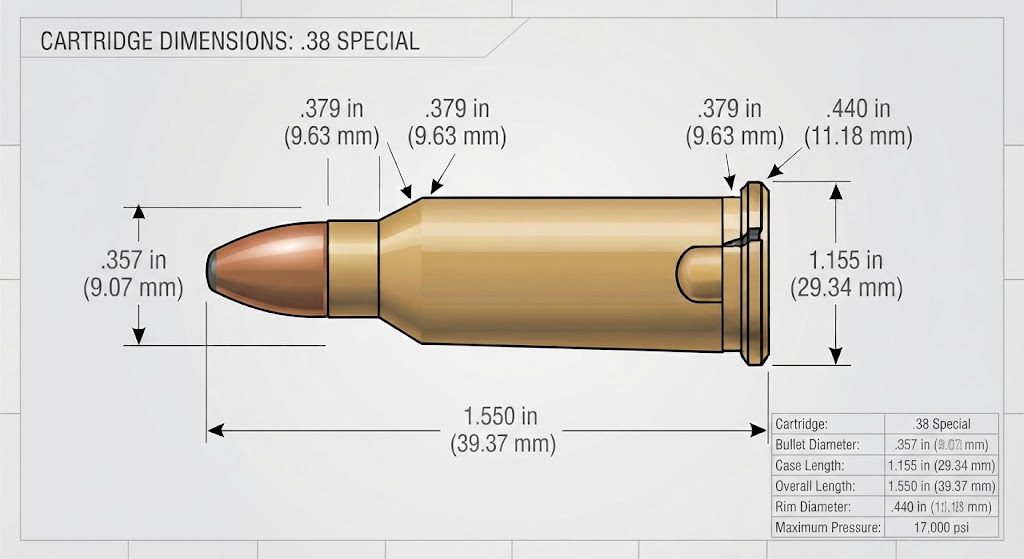
.38 Special Bullet Diameter
The standardized maximum bullet diameter for the .38 Special is .357 inches (9.07 mm) for jacketed bullets. However, reloaders often use .358 inch diameter bullets when loading hard cast lead projectiles. The slightly wider lead bullet seals the bore more effectively, which prevents hot gases from cutting past the bullet and causing severe lead fouling in the barrel.
The name “.38 Special” is a historical misnomer. It dates back to earlier heeled bullets like the .38 Short Colt, which had a true .38 caliber outside diameter. When cartridge design evolved to place the bullet inside the case mouth, the bullet diameter was reduced to .357 inches, but the classic “.38” nomenclature was retained for marketing purposes.
.38 Special Overall Length
The SAAMI maximum overall cartridge length (OAL) for the .38 Special is 1.550 inches (39.37 mm). This number is a hard limit designed to guarantee that the bullet tip will not protrude past the front face of a standard revolver cylinder. If a cartridge exceeds this length, it will bind against the forcing cone of the barrel and physically prevent the cylinder from turning.
Typical factory cartridge length varies based on the bullet profile. A classic 158 grain lead round nose target load often measures close to the maximum 1.550 inches. In contrast, modern 110 grain jacketed hollow points are physically shorter and are typically seated to an overall length closer to 1.450 inches.
.38 Special Chamber And Cartridge Dimensions
The relationship between the .38 Special cartridge and the firearm’s chamber is perfectly adapted for revolvers. Unlike semi-automatic pistol cartridges that headspace on the case mouth, the .38 Special cartridge headspaces on its .440 inch rim.
This means the protruding rim of the brass casing physically stops against the rear cylinder face. Because it headspaces on the rim, the overall case length does not dictate how deep the cartridge drops into the chamber. This design allows revolver cartridges to employ a heavy roll crimp. A roll crimp physically bends the case mouth into a groove on the bullet known as a cannelure. This heavy crimp is mandatory for holding the bullet firmly in place against the recoil of adjacent cylinders firing.
.38 Special Dimensions vs Similar Cartridges
To understand the .38 Special size profile, it is helpful to compare it against other popular handgun cartridges. Note that dimensional similarities do not imply ammunition interchangeability unless strictly specified by the manufacturer.
| Cartridge | Bullet Diameter | Case Length | Overall Length | Rim Diameter | Maximum Pressure | Source |
| .38 Special | .357 in | 1.155 in | 1.550 in | .440 in | 17,000 psi | SAAMI |
| .357 Magnum | .357 in | 1.290 in | 1.590 in | .440 in | 35,000 psi | SAAMI |
| 9mm Luger | .355 in | .754 in | 1.169 in | .394 in | 35,000 psi | SAAMI |
| .380 ACP | .355 in | .680 in | .984 in | .374 in | 21,500 psi | SAAMI |
| .38 Super | .356 in | .900 in | 1.280 in | .406 in | 36,500 psi | SAAMI |
.38 Special vs .357 Magnum Dimensions
The .38 Special and the .357 Magnum are deeply connected, but their dimensional differences are a matter of critical safety.
- Bullet and Rim Dimensions: Both cartridges use the exact same .357 inch bullet diameter, the exact same .379 inch base diameter, and the exact same .440 inch rim diameter.
- Case Length Difference: The .357 Magnum case (1.290 inches) is intentionally manufactured exactly 0.135 inches longer than the .38 Special case (1.155 inches).
- Pressure Differences: Standard .38 Special operates at a very mild 17,000 psi. The .357 Magnum generates a massive 35,000 psi.
Because of this specific dimensional design, a short .38 Special cartridge can be loaded and fired safely in any .357 Magnum revolver. However, the elongated 1.290 inch case of the .357 Magnum physically prevents it from fully chambering in an older, weaker .38 Special revolver. This dimensional offset protects shooters from explosive firearm failures.
.38 Special SAAMI vs C.I.P. Dimensions
Cartridge dimensions and safe pressure limits are governed by SAAMI in the United States and C.I.P. in Europe.
While the physical dimensional specifications for the .38 Special are functionally identical between the two bodies to ensure global compatibility, the way they measure and report pressure differs significantly.
- SAAMI lists the maximum average pressure for standard .38 Special at 17,000 psi, measured via conformal piezoelectric transducers.
- C.I.P. lists the maximum pressure for the exact same cartridge at 1,500 bar, which translates to approximately 21,750 psi.
These are not contradictory safety standards. They are the result of different testing methodologies, transducer placement locations, and historical pressure measurement conversions. Ammunition loaded to SAAMI specs is completely safe in C.I.P. proofed firearms, and vice versa.
.38 Special Bullet Weight And Dimensions
The .38 Special is widely loaded in several common bullet weights, which alter how the internal dimensions of the cartridge are configured.
- 110 to 125 grain: These lightweight bullets are commonly used for modern self defense loadings, particularly in +P variants. They are physically short, leaving maximum case capacity for gunpowder.
- 130 grain: A very common weight for full metal jacket (FMJ) target ammunition.
- 158 grain: The traditional standard weight for the caliber. These longer bullets take up more space inside the brass case, slightly reducing powder capacity but offering excellent momentum and accuracy.
Bullet weight does not change the standardized external brass case dimensions. However, because a heavier bullet is physically longer, the manufacturer must adjust the seating depth to ensure the loaded round still fits inside the cylinder.
Why .38 Special Dimensions Matter
Understanding the specific .38 Special measurements is essential for several practical reasons.
- Cylinder Binding: The strict 1.550 inch overall length defines whether a cartridge will function in a revolver. Handloaders who seat their bullets too shallow will lock up their firearm the moment the cylinder tries to rotate past the barrel forcing cone.
- Crimping Requirements: Because the case measures 1.155 inches, reloaders must accurately trim their brass to the exact same length. If case lengths vary, the reloading die will apply inconsistent roll crimps, leading to bullet jump under recoil.
- Firearm Safety: Knowing the dimensions allows shooters to understand why it is perfectly safe to fire .38 Special ammunition in a .357 Magnum revolver, but physically impossible to do the reverse.
Manufacturer Specifications vs Independent Measurements
If you use calipers to measure factory .38 Special ammunition from companies like Federal, Winchester, or Hornady, the numbers will rarely match the SAAMI maximum specifications exactly.
SAAMI and C.I.P. publish maximum allowable dimensions to ensure absolute safety and compatibility across all firearm brands. Ammunition manufacturers purposefully produce their cases slightly smaller than these maximums. For example, measuring a factory cartridge and finding a case length of 1.142 inches or an OAL of 1.530 inches does not mean the ammunition is defective. It means the manufacturer built in a reliable negative tolerance margin to guarantee the ammunition will load easily into tight match grade revolver cylinders.
Common Questions
What are the dimensions of the .38 Special?
The key maximum dimensions are a bullet diameter of .357 inches, a case length of 1.155 inches, and an overall cartridge length of 1.550 inches.
What is the .38 Special case length?
The maximum SAAMI case length is 1.155 inches (29.34 mm).
What is the .38 Special overall length?
The maximum overall length (OAL) is 1.550 inches (39.37 mm).
What is the .38 Special bullet diameter?
The standard bullet diameter is .357 inches for jacketed bullets and often .358 inches for lead bullets.
What is the .38 Special rim diameter?
The rim diameter measures .440 inches (11.18 mm).
What is the .38 Special case diameter?
The .38 Special is a straight walled cartridge, meaning the case diameter is uniformly .379 inches from the base to the neck.
Why is it called a .38 if the bullet is .357 inches?
The name is a historical leftover from the late 1800s when revolver cartridges used heeled bullets that measured the same width as the outside of the brass case (roughly .38 inches).
How do .38 Special and .357 Magnum dimensions compare?
They share the exact same bullet diameter and case width, but the .38 Special case is intentionally 0.135 inches shorter to prevent powerful .357 Magnum ammunition from chambering in weaker .38 Special firearms.
What is the maximum overall length of the .38 Special?
The absolute maximum allowed by SAAMI is 1.550 inches to ensure the bullet does not bind against the front of a revolver cylinder.
What is the .38 Special maximum pressure?
The SAAMI maximum average pressure is 17,000 psi for standard loads and 20,000 psi for +P loads.