The main difference between the 360 Buckhammer and the 350 Legend is their intended rifle platform and velocity output. The 360 Buckhammer was designed specifically for lever action rifles and delivers higher muzzle velocity and energy, pushing a 180 grain bullet at 2400 feet per second. In contrast, the 350 Legend was engineered for the AR15 platform and bolt action rifles, firing a similar 180 grain bullet at 2100 feet per second. Because of the larger powder capacity and higher velocity, the 360 Buckhammer offers more knockdown power at close range and slightly flatter trajectories. However, the 350 Legend provides significantly less recoil and enjoys broader ammunition availability across a wider range of modern sporting rifles. Both straight wall cartridges are excellent options for hunting deer at ranges up to 200 yards, but your choice will largely depend on whether you prefer a traditional lever action or a modern semi automatic rifle.
360 Buckhammer vs 350 Legend Ballistics Chart
| Specification | 360 Buckhammer (180 Grain Remington) | 350 Legend (180 Grain Winchester) |
| Cartridge Type | Straight Wall Centerfire | Straight Wall Centerfire |
| Parent Case | 30 30 Winchester | 223 Remington |
| Bullet Diameter | 0.358 Inches | 0.357 Inches |
| Case Length | 1.80 Inches | 1.71 Inches |
| Overall Length | 2.25 Inches | 2.26 Inches |
| Bullet Weight | 180 Grain | 180 Grain |
| Common Factory Loads | Remington Core Lokt and Federal Power Shok | Winchester Power Point and Hornady American Whitetail |
| Muzzle Velocity | 2400 Feet Per Second | 2100 Feet Per Second |
| Muzzle Energy | 2302 Foot Pounds | 1762 Foot Pounds |
| Velocity at 100 Yards | 1949 Feet Per Second | 1762 Feet Per Second |
| Velocity at 200 Yards | 1558 Feet Per Second | 1466 Feet Per Second |
| Velocity at 300 Yards | Approximately 1250 Feet Per Second | 1230 Feet Per Second |
| Velocity at 400 Yards | Beyond Effective Range | Beyond Effective Range |
| Velocity at 500 Yards | Beyond Effective Range | Beyond Effective Range |
| Energy at 100 Yards | 1518 Foot Pounds | 1240 Foot Pounds |
| Energy at 200 Yards | 970 Foot Pounds | 859 Foot Pounds |
| Energy at 300 Yards | Approximately 600 Foot Pounds | 604 Foot Pounds |
| Energy at 400 Yards | Beyond Effective Range | Beyond Effective Range |
| Energy at 500 Yards | Beyond Effective Range | Beyond Effective Range |
| Trajectory at 100 Yards | Zero Inches | Zero Inches |
| Trajectory at 200 Yards | Drop of 7.9 Inches | Drop of 8.9 Inches |
| Trajectory at 300 Yards | Drop of 30.4 Inches | Drop of 33.0 Inches |
| Trajectory at 400 Yards | Beyond Effective Range | Beyond Effective Range |
| Trajectory at 500 Yards | Beyond Effective Range | Beyond Effective Range |
| Ballistic Coefficient | 0.240 | 0.245 |
| Sectional Density | 0.201 | 0.202 |
| Maximum Effective Hunting Range | 200 Yards | 200 Yards |
| Maximum Effective Target Range | 300 Yards | 300 Yards |
| Maximum Point Blank Range | Approximately 165 Yards | Approximately 150 Yards |
| Typical Twist Rate | 1 in 14 Inches | 1 in 16 Inches |
| Maximum Average Pressure | 50000 PSI | 55000 PSI |
| Recoil Energy | 14.1 Foot Pounds | 8.5 Foot Pounds |
| Wind Drift | High | High |
| Factory Ammunition Availability | Moderate | High |
| Typical Rifle Platforms | Lever Action and Single Shot | AR15 and Bolt Action |
| Magazine Capacity | Varies by Tube Length | 5 to 20 Rounds |
| Primary Hunting Use | Whitetail Deer and Black Bear | Whitetail Deer and Feral Hogs |
| Whitetail Suitability | Excellent | Excellent |
| Black Bear Suitability | Excellent | Good |
| Hog Hunting Suitability | Excellent | Excellent |
| Elk Suitability | Marginal at Close Range | Marginal at Close Range |
| Accuracy Potential | 1 to 2 MOA | 1 MOA |
| Pros | Higher Velocity and More Energy | Lower Recoil and Broad Platform Options |
| Cons | Higher Recoil and Limited Rifles | Lower Kinetic Energy Output |
| Best Use Cases | Brush Hunting and Lever Actions | Recoil Sensitive Shooters and AR15 Fans |
| Overall Winner | Tie Depending on Rifle Choice | Tie Depending on Rifle Choice |
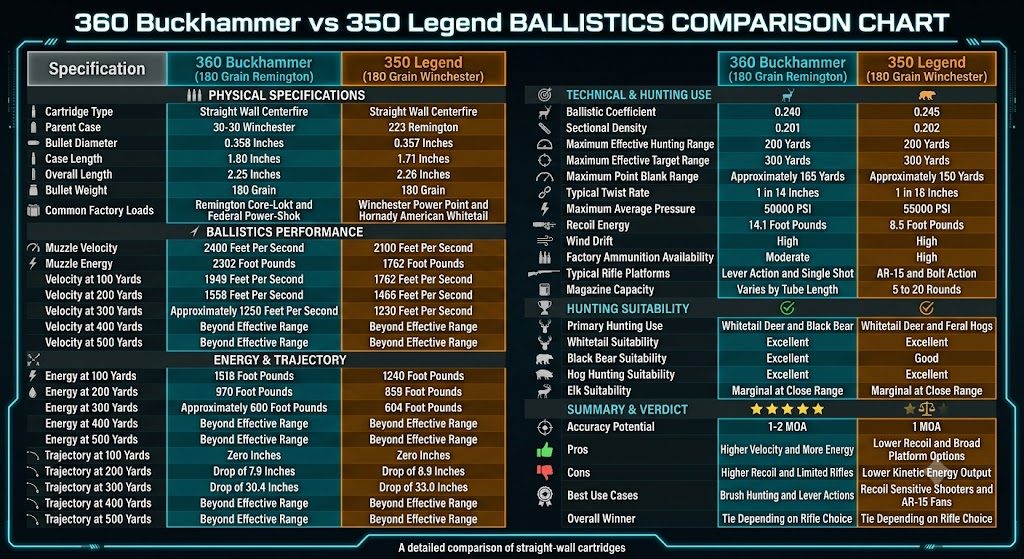
Muzzle Velocity Comparison
The 360 Buckhammer offers a significant advantage in muzzle velocity compared to the 350 Legend. When comparing 180 grain factory loads from major ammunition manufacturers, the 360 Buckhammer pushes its projectile at 2400 feet per second. The 350 Legend fires the same weight bullet at 2100 feet per second. This 300 feet per second difference translates to a flatter trajectory and more kinetic energy transferred to the target at typical hunting distances.
Muzzle Energy Comparison
Kinetic energy is crucial for achieving clean and ethical harvests on medium sized game. The 360 Buckhammer generates 2302 foot pounds of muzzle energy, which is substantially higher than the 1762 foot pounds produced by the 350 Legend. Even at 200 yards, the 360 Buckhammer retains nearly 1000 foot pounds of energy. The 350 Legend drops below the 1000 foot pound threshold at approximately 150 yards. Hunters pursuing tougher game like black bear will appreciate the extra stopping power provided by the Buckhammer.
Trajectory Comparison
Both straight wall cartridges are designed for moderate hunting distances rather than extreme long range precision. When sighted in at 100 yards, the 360 Buckhammer experiences a drop of 7.9 inches at 200 yards. Under the same conditions, the 350 Legend drops approximately 8.9 inches at 200 yards. The higher velocity of the Buckhammer helps it shoot slightly flatter, making holdover calculations easier for hunters when taking shots across open fields or wide clearings. Beyond 200 yards, both bullets experience severe drop and rapid energy loss.
Recoil Comparison
The increased velocity and energy of the 360 Buckhammer come with a tradeoff in felt recoil. The Buckhammer generates approximately 14.1 foot pounds of recoil energy, which is similar to a standard 30 30 Winchester load. The 350 Legend was specifically engineered to be a low recoil cartridge, producing only about 8.5 foot pounds of recoil energy. This makes the 350 Legend an exceptionally pleasant cartridge to shoot, especially for recoil sensitive hunters, youth shooters, or anyone spending long days at the shooting range.
Rifle Availability Comparison
Your choice between these two cartridges will likely be dictated by the type of firearm you prefer to carry into the woods. The 360 Buckhammer features a rimmed case design, making it perfectly optimized for lever action and single shot rifles. It feeds flawlessly through tubular magazines. Conversely, the 350 Legend features a rebated rimless case designed specifically to feed from box magazines in modern semi automatic AR15 platforms and traditional bolt action rifles.
Ammunition Availability Comparison
Because the 350 Legend was introduced several years earlier and gained massive popularity in straight wall hunting states, it currently enjoys a significant advantage in ammunition availability. Hunters can find a wide variety of factory loads ranging from 150 grain to 280 grain subsonic options on almost any sporting goods store shelf. The 360 Buckhammer is a newer cartridge with fewer factory loads available, primarily focused on 180 grain and 200 grain soft point hunting ammunition.
Effective Hunting Range Comparison
Both cartridges share a similar maximum effective hunting range on whitetail deer. The 350 Legend is generally considered a 150 to 200 yard deer cartridge, while the 360 Buckhammer stretches that effective range to a solid 200 yards with slightly more authority. Attempting to harvest game beyond 200 yards with either cartridge is not recommended due to the steep trajectory curve and rapid shedding of kinetic energy.
Which Cartridge Is Better for Deer Hunting
Deciding which cartridge is better for deer hunting comes down to personal preference and state regulations. If you live in a straight wall restricted state and want a modern AR15 or a lightweight bolt action rifle, the 350 Legend is the clear winner. If you prefer the classic feel of a lever action rifle and want performance that exceeds the legendary 30 30 Winchester, the 360 Buckhammer is the superior choice for your deer camp.
Frequently Asked Questions
What is the maximum effective range of a 360 Buckhammer?
The maximum effective range for harvesting deer with the 360 Buckhammer is 200 yards. At this distance, the bullet retains enough velocity and kinetic energy to ensure a clean and ethical harvest. Pushing the cartridge beyond 200 yards results in severe bullet drop and insufficient energy.
Does the 350 Legend kick hard?
No, the 350 Legend is known for having very mild recoil. It produces around 8.5 foot pounds of recoil energy, which is significantly less than most traditional deer hunting cartridges. This makes it an excellent choice for young hunters or anyone sensitive to heavy recoil.
Can I shoot 360 Buckhammer out of a 350 Legend rifle?
You absolutely cannot interchange these two cartridges. The 360 Buckhammer uses a rimmed case and a larger 0.358 inch diameter bullet, while the 350 Legend uses a rimless case and a 0.357 inch diameter bullet. Attempting to chamber the wrong ammunition can cause catastrophic firearm failure and severe injury.
Why are straight wall cartridges becoming so popular?
Many states have updated their hunting regulations to allow straight wall cartridges in areas previously restricted to shotguns and muzzleloaders only. These cartridges offer better accuracy, longer effective ranges, and more pleasant shooting experiences compared to heavy shotgun slugs. This legal change has driven massive popularity for both the 350 Legend and 360 Buckhammer.
Is the 360 Buckhammer better than the 30 30 Winchester?
For hunters in straight wall restricted states, the 360 Buckhammer is a legal alternative that actually outperforms the 30 30 Winchester. The Buckhammer fires a heavier bullet at faster velocities, resulting in more muzzle energy and comparable trajectory. However, the 30 30 Winchester remains legal in more traditional hunting areas and has a wider variety of rifle options.
What type of bullet works best for 350 Legend hunting?
Most hunters find incredible success using 150 grain to 180 grain soft point or polymer tipped bullets. These projectiles are specifically engineered to expand reliably at the moderate velocities produced by the 350 Legend. Subsonic loads should generally be avoided for hunting medium game unless shooting at very close ranges with specialized expanding bullets.
Are AR15 magazines compatible with 350 Legend ammunition?
While the 350 Legend shares the same case head dimensions as the 223 Remington, it requires specifically designed magazines to feed reliably. Standard AR15 magazines have internal ribs that interfere with the wider straight wall case of the 350 Legend. You must purchase dedicated 350 Legend magazines to ensure proper feeding in your semi automatic rifle.
Understanding 350 Legend Bullet Drop Over Distance
This visual guide breaks down straight wall trajectory changes over longer distances to help you make more precise shots in the field.